Positive interactions can cease to be beneficial under some circumstances
Interactions between two species can be categorized by determining for each species whether the outcome of the interaction is positive (benefits > costs), negative (costs > benefits), or neutral (benefits = costs).
However, the costs and benefits experienced by interacting species can vary from one place and time to another (Bronstein 1994). Thus, depending on the circumstances, an interaction between two species may have either positive or negative outcomes.Soil temperature, for example, influences whether a pair of wetland plant species interact as commensals or competitors (Callaway and King 1996). Some wetland plants aerate hypoxic soils by passively transporting oxygen through air channels in their leaves, stems, and roots. Oxygen leaked into the soil from the roots of such plants can become available to other plant species, thereby reducing the negative effects of the hypoxic soil conditions. In a greenhouse experiment, Ragan Callaway and Leah King grew the cattail Typha Iatifolia, a species that has extensive air channels, together with the small-flowered forget-me-not Myosotis laxa, a species that lacks air channels. They grew these plants under two different temperature regimes (11°C-12°C and 18oC-20oC) in pots filled with a mix of natural pond soil and peat, with the soil in the pots submerged under 1-2 cm of water to make it hypoxic. They also grew some pots of Myosotis without Typha under the same conditions.
At the low soil temperatures, the dissolved-oxygen content of the soil increased when Typha was present, but that did not happen at the high soil temperatures. How did these different oxygen levels affect the outcome of the Myosotis-Typha interaction? At the low soil temperatures, the growth of Myosotis roots and shoots increased when Typha was present (FIGURE 15.8A). At the high soil temperatures, however, Myosotis growth decreased when Typha was present (FIGURE 15.8B).
Overall, these results suggest that at the low soil temperatures, Typha provided benefits to Myosotis (perhaps by aerating the soil), while at the high temperatures, Typha had a negative effect on Myosotis—just one example of how a change in environmental conditions can alter the outcome of an ecological interaction (other examples are discussed in Concepts 16.3 and17.3 and in Bronstein 1994).
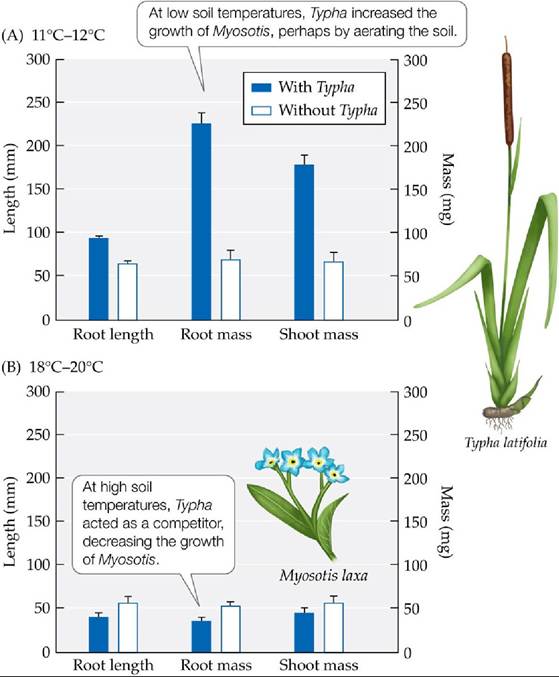
FIGURE 15.8 From Benefactor to Competitor The growth of the small-flower forget-me- not Myosotis laxa under (A) low soil temperatures (11°C-12°C) and (B) high soil temperatures (18°C-20°C) in the presence and absence of the cattail Typha Iatifolia was measured by changes in three parameters: root length (left y-axis), root mass (right y-axis), and shoot mass (right y- axis). Error bars show one standard error of the mean.
Under what conditions does Myosotis laxa best grow? Explain.
(After R. M. Callaway and L. King. 1996. Ecology 77: 1189-1195.) View larger image
More on the topic Positive interactions can cease to be beneficial under some circumstances:
- Positive interactions can cease to be beneficial under some circumstances
- Reviewers
- Answers to Review Questions
- Positive interactions can be obligate or facultative and loosely structured
- Conclusion
- Leveraging Lawyers' Strengths and Training Them to Support Team Problem-Solving Under Crisis Conditions
- CONTROL AND MANAGEMENT
- GREEN UNPLEASANT LAND
- Developments in the New Welfare Economics and the Economic Theories of Justice
- WORKING WITH MORAL CONFLICTS