Positive interactions can be obligate or facultative and loosely structured
Mutualism and commensalism include a broad set of interactions, ranging from those that are obligate (that is, required for species) to those that are facultative (not required).
The leaf-cutter ant-fungus mutualism discussed in the Case Study illustrates one end of this spectrum: the ants and the fungi they cultivate have a highly specific, obligate relationship in which neither partner can survive without the other, and their interaction has led each partner to evolve unique features that benefit the other species.Similarly, many tropical fig trees are pollinated by one or a few species of fig wasps. These relationships are mutually beneficial and obligate for both species in that neither species can reproduce without the other. Fig-fig wasp interactions also show clear signs of coevolution (Bronstein 1992). Fig flowers are contained within structures of fleshy stem tissue known as receptacles (FIGURE 15.6). In monoecious figs (those in which each tree has separate male and female flowers), the male and female flowers are located in different parts of the receptacle, and the male flowers mature after the female flowers. The forms of female flowers range from those with short styles to those with long styles.
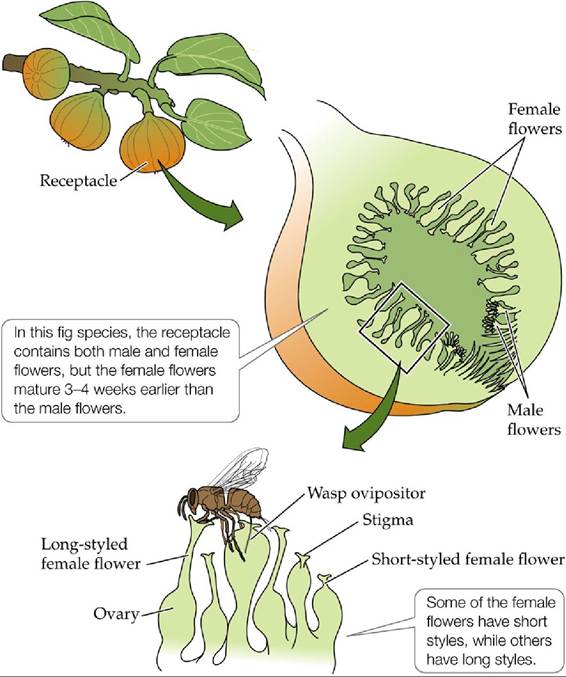
FIGURE 15.6 Fig Flowers and the Wasp That Pollinates Them Thereceptacleand flowers of a typical monoecious fig tree, Ficus sycomorus. (After J. L. Bronstein. 1992. In InsectPlant Interactions, Vol. 4, E. A. Bernays [Ed.], pp. 1-44. CRC Press: Boca Raton, FL.) View larger image
A female fig wasp enters the receptacle, carrying pollen she collected from male flowers in another receptacle. Once inside, the wasp inserts her ovipositor through the styles of the female flowers to lay eggs in the ovaries (see Figure 15.6). She then deposits pollen on the stigmas of those flowers.
The wasp pollinates both long-styled and short-styled flowers, and hence both flower types develop seeds. Perhaps because wasp ovipositors are not long enough to reach the ovaries of long-styled flowers, wasp larvae typically develop within short- styled flowers and feed on some of their seeds.When the young wasps complete their development, they mate, the males burrow through the receptacle, and the females exit through the passageway the males have made. Before the females leave the receptacle, however, they visit male flowers (which are now mature), collect pollen from them, and store it in a specialized sac for use when they lay their eggs in another receptacle. The wasp's reproductive behavior is a remarkable example of a specialization that provides a benefit to another species.
Unlike the ant-fungus and fig-fig wasp mutualisms, many mutualisms and commensalisms are facultative. In desert environments, for example, the soil beneath an adult plant is often cooler and moister than the soil of an adjacent open area. These differences in soil conditions may be so pronounced that the seeds of many plant species can germinate and survive only in the shade provided by an adult plant; such adults are called nurse plants because they “nurse” or protect the seedlings. A single species of nurse plant may protect the seedlings of many different species. Desert ironwood (Olneya tesota), for example, serves as a nurse plant for 165 different species, most of which can also germinate and grow under other plant species. This situation is typical of facultative interactions: a species that requires “nursing” may be found under a variety of nurse plant species (and hence has a facultative relationship with each of them), and the nurse plant and the beneficiary species may evolve little in response to one another.
Facultative positive interactions also occur in forest communities. For example, large herbivores such as deer or moose may inadvertently eat the seeds of small herbaceous plants whose leaves they feed on.
The seeds may pass unharmed through the herbivore's digestive tract and be deposited with its feces, often far from the parent plant (FIGURE 15.7). As we saw in Concept 9.3, dispersal of offspring away from parents may be advantageous, so benefits may accrue to both the plant (whose seeds are dispersed) and the herbivore (which feeds primarily on leaves).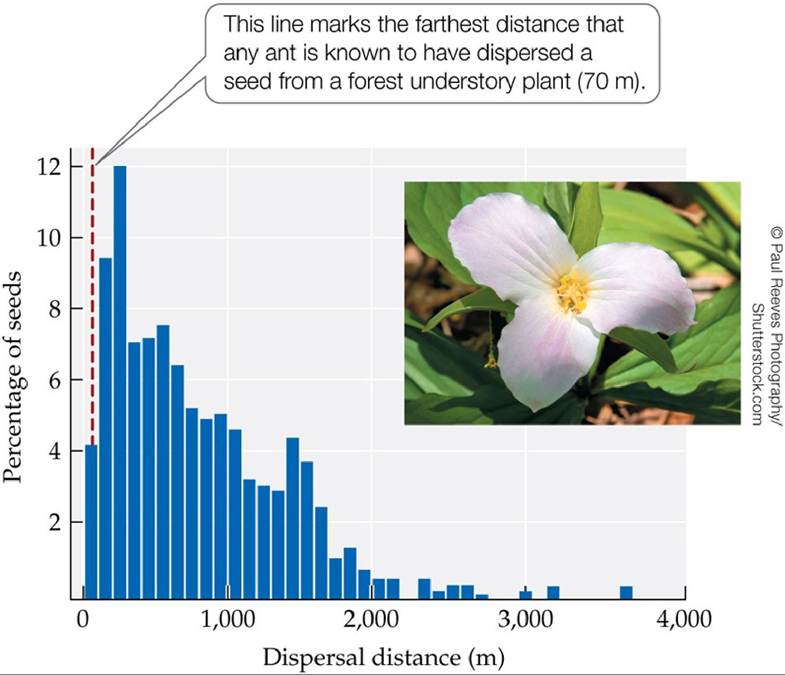
FIGURE 15.7 Deer Can Move Plant Seeds Long Distances Theseestimatesofthe distances that white-tailed deer disperse the seeds of the forest understory plant Trillium grandiflorum are based on observations of deer movements and of the length of time that deer retain plant seeds in their digestive tracts (from the time they eat the seeds until they defecate them). Although T. grandiflorum seeds are also dispersed by ants, deer move the seeds much farther. (After M. Vellend et al. 2003. Ecology 84: 1067-1072.) View larger image