Mutualism and commensalism are ubiquitous
Mutualistic associations literally cover the land surface of Earth. For example, most vascular plant species, including those that dominate terrestrial ecosystems, form mycorrhizae, symbiotic associations between plant roots and various types of fungi that are usually mutualistic (FIGURE 15.3).
About 80% of angiosperms (flowering plants) and all gymnosperms (e.g., conifers, cycads, and the ginkgo) form mycorrhizal associations. Mycorrhizae provide clear benefits to the plants, improving their growth and survival in a wide range of habitats (Smith and Read 2008; Booth and Hoeksema 2010). One way in which mycorrhizal fungi benefit plants is by increasing the surface area over which the plants can extract water and nutrients from the soil; in some cases, over 3 m of fungal filaments, known as hyphae, may extend from 1 cm of plant root. The fungi may also protect the plants from pathogens, while the plants typically benefit the fungi by supplying them with carbohydrates.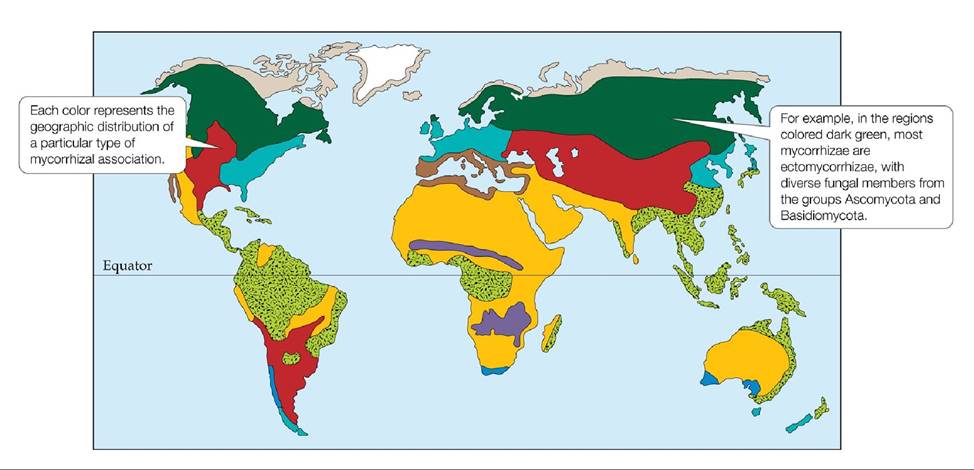
FIGURE 15.3 Mycorrhizal Associations Cover Earth's Land Surface Eachcoloronthe map shows the region in which one of eight major types of mycorrhizal associations is found (see Fitter 2005 to learn which fungi are involved in each of these eight mycorrhizal associations). Notice that the locations of the different types of mycorrhizal associations correspond fairly closely to the locations of major terrestrial biomes (see Figure 3.5A).
What types of plants are likely to be involved in the mycorrhizal association shown in the light green stippled areas? (Hint: Refer to Figure 3.5A.)
(After A. H. Fitter. 2005. J Ecol 93: 231-243; based on D. J. Read. 1991. Experientia 47: 376; D. J. Read et al. 2004. Can JBot 82: 1243-1263.) View larger image
There are two major types of mycorrhizae (FIGURE 15.4).
In ectomycorrhizae, the fungal partner typically grows between root cells and forms a mantle around the exterior of the root; hyphae in the mantle often extend varying distances into the soil. In arbuscular mycorrhizae, the fungal partner also grows into the soil, and it grows between some root cells while penetrating the cell walls of others. Hyphae of arbuscular mycorrhizae that penetrate a root cell form a branched network, called an arbuscule. Because their hyphae can penetrate root cells, arbuscular mycorrhizae once were called “endomycorrhizae” (from the Greek entos, “in”). However, most researchers no longer use the term “endomycorrhizae,” because the hyphae of some ectomycorrhizae can also penetrate root cells.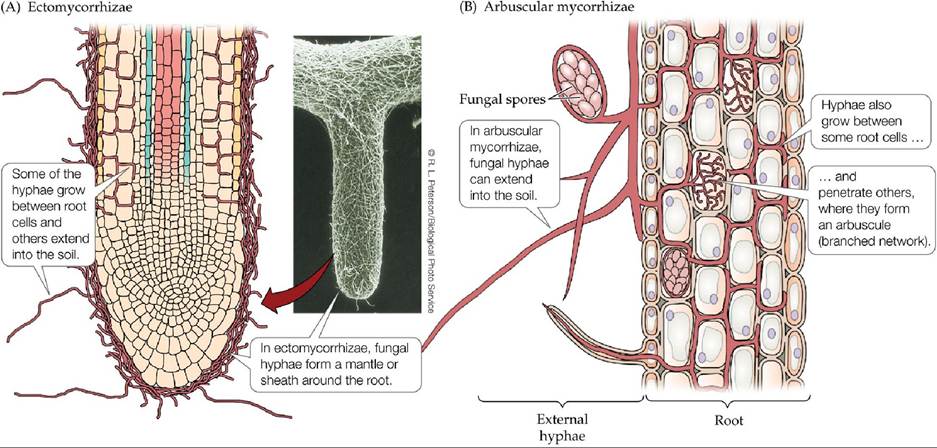
FIGURE 15.4 TwoMajorTypesofMycorrhizae Mycorrhizaecanbeclassifiedas(A) ectomycorrhizae or (B) arbuscular mycorrhizae. In arbuscular mycorrhizae, hyphae can live between the root cells and penetrate the cell wall.
Describe morphological features that distinguish ectomycorrhizae from arbuscular mycorrhizae.
(After A. D. Rovira et al. 1983. In Inorganic Plant Nutrition [Encyclopedia of Plant Physiology, new series, Vol. 15B], A. Lauchli and R. L. Bieleski [Eds.], pp. 61-93. Springer: New York.) View larger image
Mutualistic associations can be found in many other organisms and habitats. In the oceans, corals form mutualisms with symbiotic algae, as mentioned in Concept 3.3. The corals provide the algae with habitats, nutrients (nitrogen and phosphorus), and access to sunlight; the algae provide the corals with carbohydrates produced by photosynthesis. All the numerous invertebrate and vertebrate species that live in and on coral reefs depend directly or indirectly on the coral-alga mutualism. On land, mammalian herbivores such as cattle and sheep depend on bacteria and protists that live in their guts and help them metabolize otherwise indigestible plant material, such as cellulose.
Similarly, insects rely on mutualisms with a number of other species, including plants (e.g., pollination mutualisms, fungi, protists; see FIGURE 15.5), and bacteria.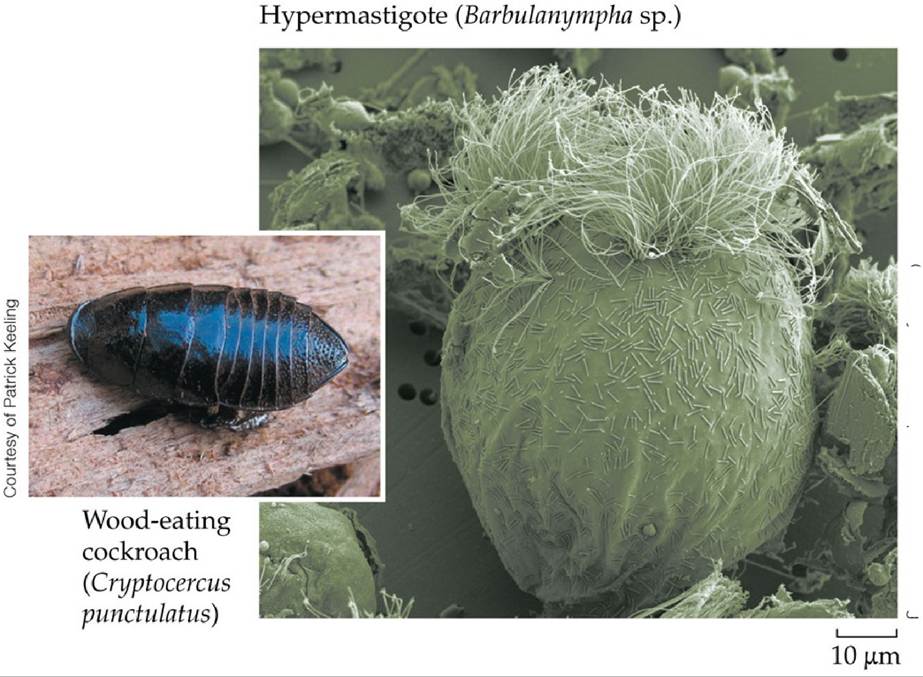
Courtesy of Kevin Carpenter and Patrick Keeling
FIGURE 15.5 A Protist Gut Mutualist This wood-eating cockroach (like other wood-eating
insects, such as termites) would starve if gut mutualists such as the protist shown here (a hypermastigote) did not help it to digest wood. The hypermastigote can break down cellulose, a major structural component of wood that the cockroach cannot digest on its own. View larger image
Commensalism, like mutualism, is everywhere—the ecological world is built on it. As we'll see in Concept 16.3, millions of species form +/0 relationships with so-called foundation species, which provide the habitat in which they live. In these relationships, a species that depends on the habitat provided by another species often has little or no effect on the species that provides that habitat. Examples include species that live on other species, such as lichens found on the bark of a tree or the harmless bacteria that grow on the surface of your skin. Many algae, invertebrates, and fishes found in marine kelp forests go locally extinct if the kelp are removed (see Case Study in Chapter 9); such species depend on the kelp for a home, but most of them do not harm or benefit the kelp. Likewise, although the numbers are quite uncertain, there may be more than a million insect species and thousands of understory plant species that live in tropical forests and nowhere else. These insects and small plants depend on the forest for their habitat, yet many have little or no effect on the trees that tower above them.
More on the topic Mutualism and commensalism are ubiquitous:
- There are two fundamental types of positive interactions: mutualism and commensalism.
- 15 Mutualism and Commensalism
- Characteristics of Mutualism
- The concept of legal obligation is as ubiquitous as it is puzzling.
- One of the most familiar tropes—even cliches—of British colonialism is the persistent and ubiquitous theme of the relationship between sport, muscular Christianity and empire.
- SUMMARY
- Learning Objectives
- Positive interactions influence the abundances and distributions of populations
- Learning Objectives
- Learning Objectives
- Positive interactions can be obligate or facultative and loosely structured
- Some mutualists have mechanisms to prevent overexploitation
- Mutualists are in it for themselves
- Positive interactions can alter communities and ecosystems
- Answers to Review Questions
- Mutualisms can be categorized according to the benefits they provide
- Positive interactions may be more common in stressful environments
- Brief Contents
- Environmental Non-tuberculous Mycobacteria (NTMs)