Mutualists are in it for themselves
Although both partners in a mutualism benefit, that does not mean that a mutualism has no costs for the partners. In the coral-alga mutualism, for example, the coral receives benefits in the form of energy, but it incurs the costs of supplying the alga with nutrients and space.
Likewise, the alga gains limiting nutrients, but it provides the coral with energy that it could have used to support its own growth and metabolism. The costs of mutualism may be especially clear when one species provides the other with a “reward” such as food for a service such as pollination. For example, during flowering, milkweeds use up to 37% of the energy they gain from photosynthesis to produce the nectar that attracts insect pollinators such as honeybees.For an ecological interaction to be a mutualism, the net benefits must exceed the net costs for both partners. However, neither partner in a mutualism is in it for altruistic reasons. Should environmental conditions change so as to reduce the benefits or increase the costs for one of the partners, the outcome of the interaction may change. This is especially true if the interaction is not obligate. Ants, for example, often form facultative relationships in which they protect other insects from competitors, predators, and parasites. In one such case, ants protect treehoppers from predators, and the treehoppers secrete honeydew (a sugar syrup substance), which the ants feed on (FIGURE 15.12). Treehoppers always secrete honeydew, so the ants always have access to this food source. However, in years when predator abundances are low, the treehoppers may receive no benefit from the ants. In such years, the outcome of the interaction may shift from +/+ (a mutualism) to either +/0 (a commensalism) or +/- (parasitism), depending on whether the consumption of honeydew by ants
reduces treehopper growth or reproduction.
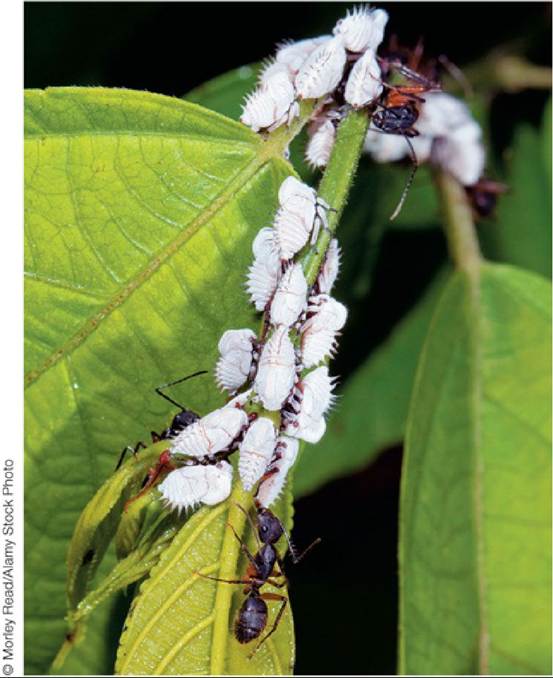
FIGURE 15.12 AFacultativeMutualism Antsoftenformfacultativemutualismswith insects that secrete honeydew, a sugar syrup substance on which the ants feed. The ants shown here will protect these Ecuadorian treehoppers from predators and parasites in exchange for honeydew. View larger image
Finally, under certain conditions, a mutualist may withdraw or modify the reward that it provides to its partner. In high-nutrient environments, for example, some plants reduce the carbohydrate rewards that they usually provide to mycorrhizal fungi. In such environments, the plant can obtain ample nutrients on its own, and hence the fungus is of little benefit. Thus, when nutrients are plentiful, the plant may cease to reward the fungus because the costs of supporting fungal hyphae are greater than the benefits the fungus can provide.
Moreover, a recent study found that the plant Medicago truncatula can discriminate among mycorrhizal fungi, allocating more carbohydrate rewards to those fungal hyphae that are supplying the most nutrients (FIGURE 15.13). You can explore this relationship further in ANALYZING DATA 15.1, where you will examine whether the fungus also modifies its provision of nutrients to the plant depending on the rewards it receives from the plant.
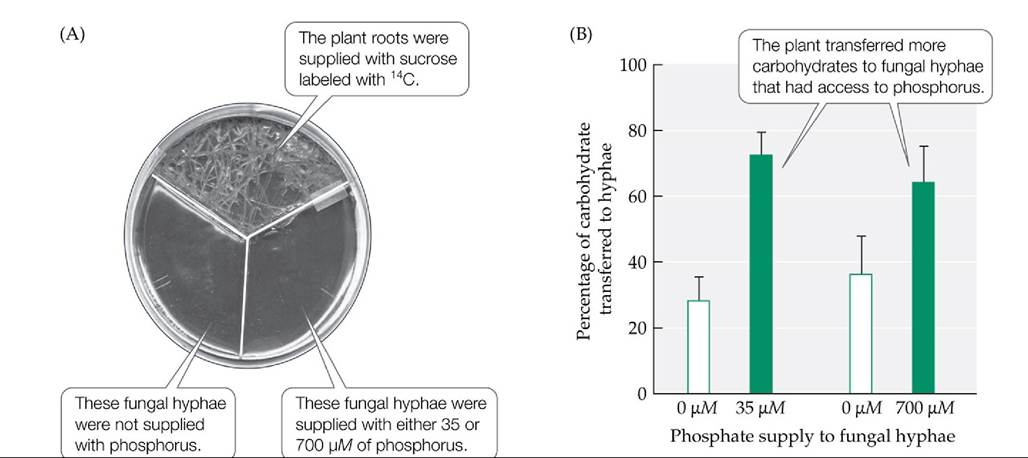
FIGURE 15.13
Rewarding Those Who Reward You
Researchers tested the hypothesis
that Medicago truncatula plants allocate more carbohydrates to those mycorrhizal fungi that provide them with higher concentrations of phosphorus, a key plant nutrient. (A) They used a splitplate design to separate the fungal hyphae into two groups. Some fungal hyphae lacked access to phosphorus, while other fungal hyphae were supplied with either 35 or 700 μM of phosphorus. (B) They then tracked the proportion of sucrose (labeled with 14C) that the plant provided to each group of hyphae.
Error bars show one standard error of the mean. (After E. T. Kiers et al. 2011. Science 333: 880-882.) View larger imageANALYZING DATA 15.1
Does a Mycorrhizal Fungus Transfer More Phosphorus to Plant Roots That Provide More Carbohydrates?
As seen in Figure 15.13, Kiers et al. (2011)* found that the plant Medicago truncatula transfers more carbohydrates to those fungal hyphae that have greater access to phosphorus. The researchers also tested the reciprocal interactions: whether the plant's mycorrhizal partner, the fungus Rhizophagus irregularis (previously known as Glomus intraradices), behaves in a similar manner, transporting more phosphorus to roots that have greater access to carbohydrates.
To do this, Kiers et al. used a split-plate experimental design similar to that in Figure 15.13. They provided fungal hyphae with radioactively labeled phosphorus (33P) and monitored the transfer of phosphorus to plant roots differing in access to carbohydrates (sucrose). Some plant roots had no access to sucrose, while other plant roots were supplied with either 5 or 25 mM of sucrose. In the results shown in the figure, “dpm” refers to disintegrations per minute, a measure of radiation intensity; error bars show one standard error of the mean.
1. Draw and label a sketch of the split-plate experimental design, modeling your diagram on the photograph in Figure 15.13A.
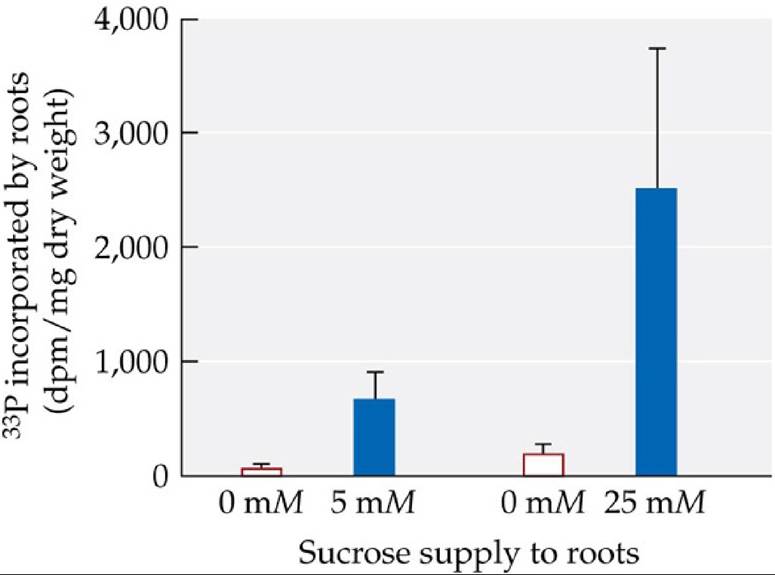
2. Interpret the results shown in the figure.
3. Compare the results in the figure here with those in Figure 15.13B. Does the plant or the fungus control the exchange of materials, or do both partners play a role? Explain.
*Kiers, E. T., and 14 others. 2011. Reciprocal rewards stabilize cooperation in the mycorrhizal symbiosis. Science 333: 880-882.