Mutualisms can be categorized according to the benefits they provide
Mutualisms are often categorized by the types of benefits that the interacting species provide to each other, such as food or a place to live. As we'll see, one partner in a mutualism may receive one type of benefit (such as food) while the other receives a different benefit (such as a place to live).
In such cases, the mutualism could be classified in two different ways.There are many trophic mutualisms, in which a mutualist receives energy or nutrients from its partner. In the leaf-cutter ant-fungus mutualism described in this chapter's Case Study, each partner feeds the other. (Recall that the ant and the fungus also help each other to overcome plant defenses, so each also provides the other with an ecological service.) In other trophic mutualisms, one organism may receive an energy source while the other receives limiting nutrients. In mycorrhizae, for example, the fungus receives energy in the form of carbohydrates and the plant may get help in taking up water or a limiting nutrient such as phosphorus. An exchange of energy for limiting nutrients also occurs in the coral-alga symbiosis, in which the coral receives carbohydrates and the alga receives nitrogen.
In habitat mutualisms, one partner provides the other with shelter, a place to live, or favorable habitat. Alpheid (pistol) shrimps form a habitat mutualism with some gobies (fishes of genera Cryptocentrus and Vanderhorstia) in environments with abundant food but little protective cover. The shrimp digs a burrow in the sediments, which it shares with a goby, thus providing the fish with a safe haven from danger. For its part, the goby serves as a “seeing-eye fish” for the shrimp, which is nearly blind. Outside the burrow, the shrimp keeps an antenna on the fish (FIGURE 15.11); if a predator or some other form of disturbance causes the fish to move suddenly, the shrimp darts back into the burrow.
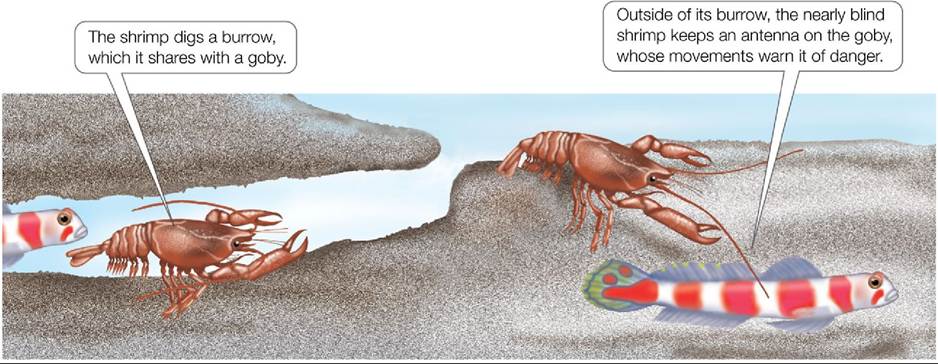
FIGURE 15.11 ASeeing-EyeFish In environments with little protective cover, a habitat mutualism between an alpheid (pistol) shrimp and a goby benefits both partners.
View larger imageIn other habitat mutualisms, a species may provide its partner with favorable habitat by altering local environmental conditions or by improving its partner's tolerance of existing conditions. The grass Dichanthelium Ianuginosum grows next to hot springs in soils whose temperatures can be as high as 60°C (140°F). Regina Redman, Russell Rodriguez, and colleagues performed laboratory and field experiments in which this grass was grown with and without Curvularia protuberata, a symbiotic fungus that grows throughout the plant body (such fungi are called endophytes). In the laboratory, 100% of the grass plants that had the Curvularia endophyte survived intermittent soil temperatures of 60°C, while none of the plants without the endophyte survived (Redman et al. 2002). In field experiments in which soil temperatures reached up to 40°C (104°F), plants with endophytes had greater root and leaf mass than plants without endophytes. In soils above 40°C, the grass plants with endophytes continued to grow well, but all the plants without endophytes died. Thus, Curvularia increased the ability of its grass host to tolerate high soil temperatures. Curvularia is not alone: many other fungal endophytes can increase the tolerance of their host plants for soils that are high in temperature or salinity (Rodriguez et al. 2009), as can some
mycorrhizal fungi (Bunn et al. 2009).
More on the topic Mutualisms can be categorized according to the benefits they provide:
- Shared Responsibility to Provide Aid
- CASE 32: The Duty to Provide a Dowry
- 1 Direction to provide or alter fixed equipment
- Benefits of PFCC2
- Benefits of PFCC2
- E-Banking’s Benefits
- Benefits of Outreach Education
- Benefits of Outreach Education
- Benefits of overconfidence
- Benefits and Costs of Higher Capital Requirements for Banks
- Small size has benefits and drawbacks
- Group size may reflect a balance between the costs and benefits of group living
- The Digital Alternatives Landscape: State of Play and Perceived Benefits
- Benefits of group living include access to mates, protection from predators, and improved foraging success
- The benefits and challenges of digitalization for employee performance management in a medium-sized company in Kecamatan Lembang, West Java, Indonesia
- Economic studies of the costs and benefits of capital requirements for banks may usefully be divided into five categories.
- CONCEPT 8.3 Mating behaviors reflect the costs and benefits of parental investment and mate defense.
- The idea that Earth has unlimited capacity to provide for human desires and absorb human wastes was undermined when the first pictures of the planet from outer space were published.