Small size has benefits and drawbacks
Small, early life cycle stages can be particularly vulnerable to predation because there are many predators that are big enough to consume them (although for some predators, small prey may be more difficult to detect).
These small stages may also be poor competitors for food and thus more susceptible to environmental perturbations that diminish food supply, because they have little storage capacity for energy and nutrients to help them withstand starvation. These vulnerabilities are typically counterbalanced by behavioral, morphological, and physiological adaptations. Furthermore, in some organisms, small, mobile early stages can perform essential functions that are not possible for large adult stages. Here, we examine how organisms protect small-sized life history stages and the important functions those stages can provide.Parental Investment
In many organisms, the parents' main investment in their offspring is the provisioning of the eggs or embryos. Animals add yolk to their eggs, which helps their offspring survive and grow through the small, vulnerable stages of life. Female kiwis, for example, produce one yolk-rich egg at a time. The kiwi egg is so large that it makes up 15%-20% of the bird's body size (FIGURE 7.17A). During the month that it takes her to make the egg, the female kiwi eats about three times as much as when she is not producing an egg. Offspring of many invertebrate species with greater yolk volume develop more rapidly, and require less food during development, than those with less yolky eggs. Another pattern common among invertebrates is investment in energetically expensive egg coverings that protect the offspring during development. Plants provision the fertilized embryos in their seeds with endosperm, nutrient-rich material that sustains the developing embryo and often the young seedling. The starchy white part of corn kernels and the milk and meat of coconuts are examples of endosperm.
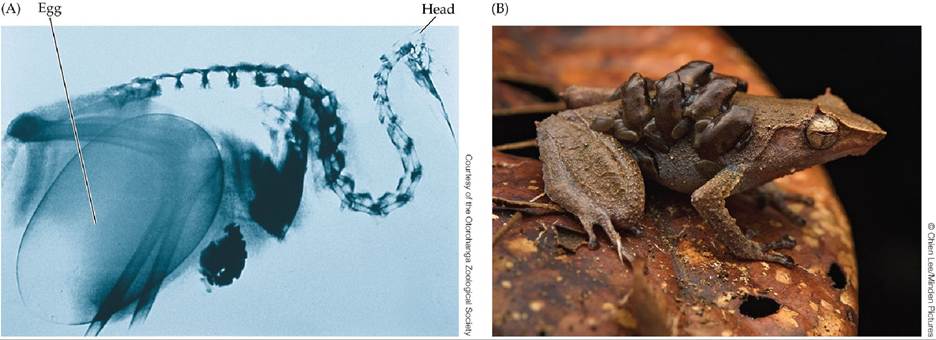
FIGURE 7.17 ParentalInvestment (A) This X-ray photograph shows the size of a kiwi egg in proportion to the female's body size. (B) A male horned land frog (Sphenophryne cornuta) carries its young on its back, from tadpole stage to small offspring, as shown here. View larger image
Another mechanism for protecting small, vulnerable offspring is parental care. Birds and mammals are the most familiar examples of parental care because they invest large amounts of time and energy in protecting and feeding their relatively helpless offspring. Some fishes, reptiles, amphibians (FIGURE 7.17B), and invertebrates also guard or brood their embryos and hatchlings, protecting them until they are big enough to be less vulnerable to starvation and predation.
Dispersal and Dormancy
Although small offspring are vulnerable to many hazards, they are also well suited for several important functions, including dispersal and dormancy. Dispersal—the movement of organisms or propagules from their birthplace—is a key feature in the life history of all organisms. Even in organisms such as plants, fungi, and many marine invertebrates that are sessile or move very little as adults, the life cycle typically includes a stage in which dispersal occurs. The small pollen, seeds, spores, or larvae of these organisms can be carried long distances by water or wind or, in the case of pollen and seeds, by animals. In general, smaller propagules disperse more readily and can travel farther in a given amount of time.
Dispersal provides a number of potential advantages. For example, dispersal reduces competition among close relatives, and allows organisms to reach new areas where they can grow and reproduce. In some circumstances, dispersal can increase the chance of escaping regions of high mortality, as when pathogens and other natural enemies are abundant at the location from which organisms disperse.
The ability of an organism to disperse can also have important evolutionary consequences. For example, Hansen (1978) compared the fossil records of extinct marine snails with typical swimming larvae with those of species that had lost their swimming larval stages and developed directly into crawling juveniles. He found that the species without swimming larvae tended to have smaller geographic distributions and were more prone to extinction (FIGURE 7.18). Hansen attributed these differences to differences in dispersal ability. Species with swimming larvae would have been able to move greater distances and hence would have had more broadly distributed populations that were less vulnerable to random events that could lead to extinction.
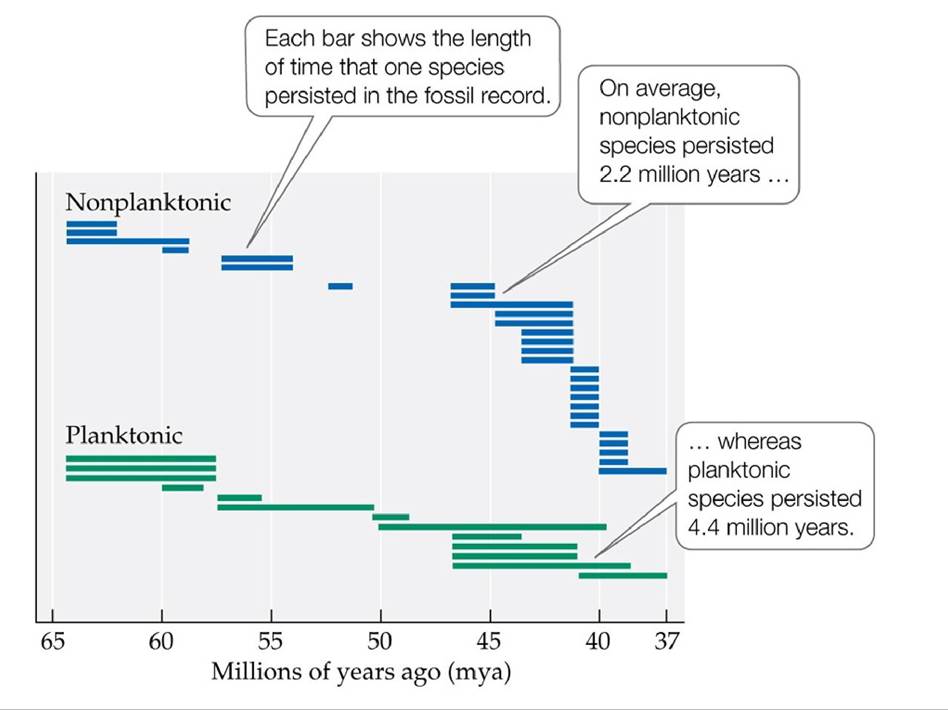
FIGURE 7.18 Developmental Mode and Species Longevity Species of marine snails that undergo direct development without a swimming larval stage (nonplanktonic) have become extinct more rapidly than those with swimming larvae (planktonic). (After T. A. Hansen. 1978. Science 199: 885-887.) View larger image
Small size also makes eggs and embryos well suited to dormancy, a state of suspended growth and development in which an organism can survive unfavorable conditions. Many seeds are capable of long periods of dormancy before germination, which in extreme cases can last up to thousands of years. Most bacteria and some protists and animals can also undergo various forms of dormancy. The brine shrimp eggs that children purchase as “sea monkeys,” for example, are in a dormant state that allows them to survive out of water, often for years. In general, small seeds, eggs, and embryos are better suited to dormancy than large multicellular organisms because they do not have to expend as much metabolic energy to stay alive. However, some animals do enter dormancy in mature stages in response to stressful environmental conditions (as described in Concept 4.2).
More on the topic Small size has benefits and drawbacks:
- Group size may reflect a balance between the costs and benefits of group living
- CONCEPT 10.2 The risk of extinction increases in populations that fluctuate in size and/or are small.
- CONCEPT 11.4 Life tables show how survival and reproduction vary with age or size structure, influencing population growth and size.
- Some populations exhibit logistic growth, a pattern in which abundance increases rapidly at first and then stabilizes at a population size known as the carrying capacity, the maximum population size that canbe supported indefinitely by the environment
- Size, openness and growth: Theory
- Benefits of PFCC2
- Benefits of PFCC2
- E-Banking’s Benefits
- Mutualisms can be categorized according to the benefits they provide
- Benefits of overconfidence
- Benefits and Costs of Higher Capital Requirements for Banks
- There is a trade-off between number and size of offspring
- Benefits of Outreach Education