There is a trade-off between number and size of offspring
Many organisms show a trade-off between their investment in each individual offspring and the number of offspring they produce. Investment in offspring includes energy, resources, and time.
In many cases, organisms that make a large investment in each offspring produce small numbers of large offspring, while organisms that make a small investment in each offspring produce large numbers of small offspring. As we'll see, parental investment can also affect offspring “quality,” as when reduced investment per offspring increases the risk of offspring mortality.Lack Clutch Size
A classic example demonstrating the trade-off between how much investment goes into each offspring versus the number of offspring was first described by David Lack in 1947. Lack asserted that the number of eggs per reproductive bout (known as the clutch size) is limited by the maximum number of young that the parents can raise at one time, which in turn is related to the resource availability (prey and other factors needed to raise the young). If the parents rear fewer than this maximum number, they will reduce their genetic representation in future generations (fitness). If they attempt to rear more than this maximum number, their offspring may be more likely to die from starvation, predation, or other factors, again reducing the parents' fitness.
Lack made careful observations of the breeding biology of bird species, from the poles to the tropics. What struck him was that clutch size varied with latitude, with a greater number of offspring at higher latitudes. He hypothesized that the reason for larger clutches at higher latitudes was the longer periods of daylight during the breeding season. These longer days allowed parents more time for foraging, and they could therefore feed greater numbers of offspring.
The term “Lack clutch size” refers to the maximum number of offspring that a parent can successfully raise to maturity.
Lack hypothesized that as a result of natural selection from the trade-off between numbers versus resource provisioning of young birds, the most productive clutch size would be found in natural populations. This hypothesis has generally been supported using experiments that manipulate the number of eggs in nests, and examining whether there are costs to unusually large clutch sizes. For example, Nager et al. (2000) artificially increased the number of eggs in clutches laid by the lesser black- backed gull (Larus fuscus). They did this by removing eggs from nests, which stimulated the females to lay more eggs. Nager et al. found that the increased clutch size resulted in a drop in the nutritional quality of later-produced eggs (specifically, these eggs had a lower lipid content). They also found that eggs from larger clutches had reduced survivorship to fledging (the point at which wing feathers are developed enough for flight) (FIGURE 7.12). Thus, in lesser black-backed gulls, production of larger clutches reduced both egg quality and survivorship to fledging.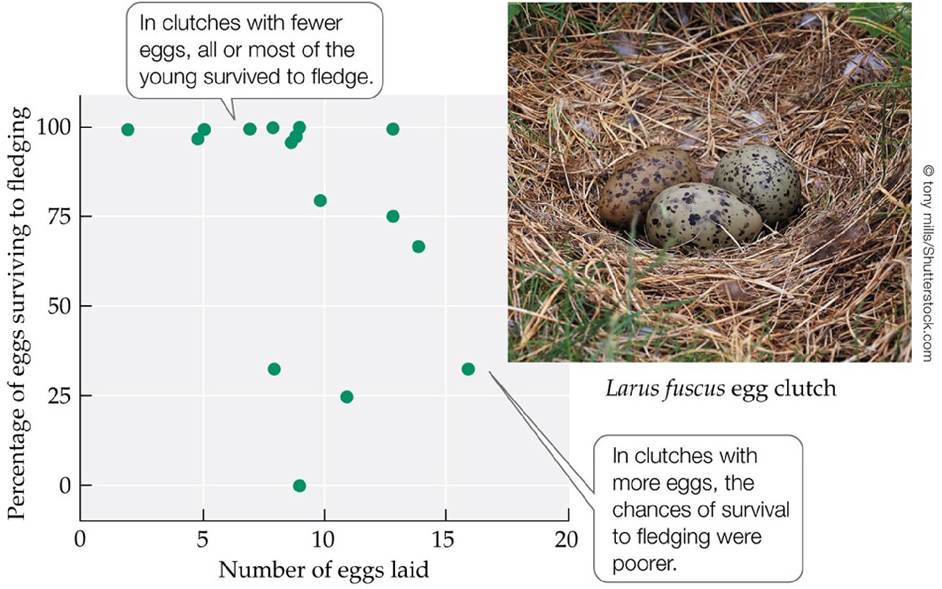
FIGURE 7.12 ClutchsizeandSurvival Lesser black-backed gulls typically lay three eggs in a clutch. However, when they are manipulated experimentally to produce larger clutches of eggs, their offspring have reduced chances of survival to fledging. (After R. G. Nager et al. 2000. Ecology 81: 1339-1350.) View larger image
Trade-Offs in Organisms Without Parental Care
Parental care like that provided by birds and some other vertebrates is relatively rare. In organisms that do not provide parental care, resources invested in propagules (such as eggs, spores, or seeds) are the main measure of reproductive investment. In this case, the size of the propagule is the primary measure of parental investment, and propagule size is traded off against the number of propagules produced in a reproductive bout. In plants, for example, the size of the seeds that a species produces is negatively correlated with the number of seeds it produces (FIGURE 7.13).
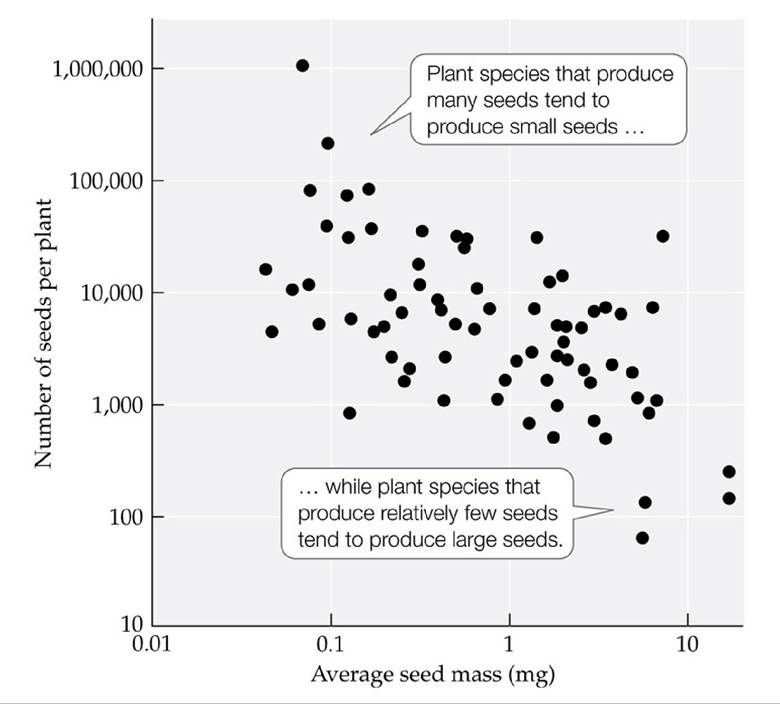
FIGURE 7.13 Seed Size-Seed Number Trade-Offs in Plants (AfterO. A. Stevens. 1932.Am
JBot 19: 784-794.) View larger image
In some cases, the size-number trade-off also applies to variation within species. The western fence lizard (Sceloporus occidentalis), which is common throughout the coastal mountains of the western United States, does not provide parental care. Barry Sinervo (1990) found that lizard populations farther to the north laid more eggs per clutch (Washington: 12 eggs/clutch vs. California: 7 eggs/clutch) but laid smaller eggs (Washington: 0.40 g vs. California: 0.65 g) (FIGURE 7.14).
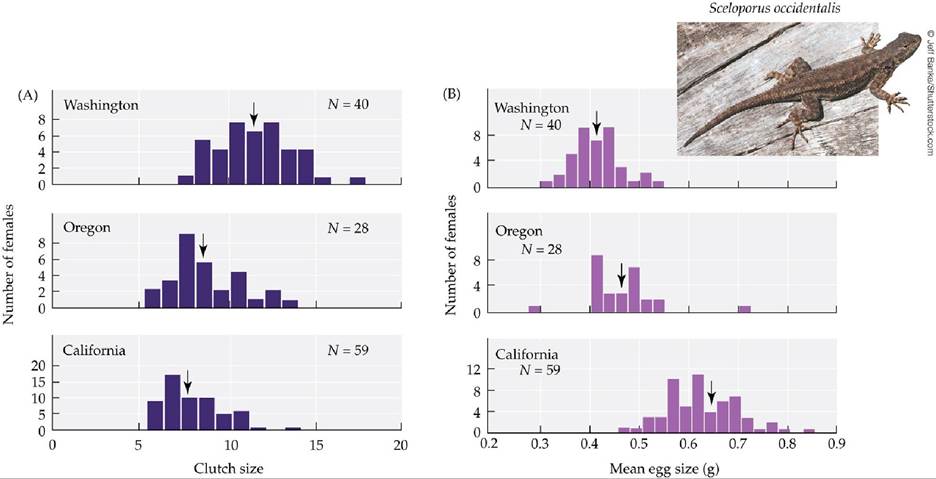
FIGURE 7.14 Egg Size-Egg Number Trade-Off in Fence Lizards Western fence lizards in northern populations produced (A) larger clutches and (B) smaller eggs than those in southern populations. The arrow points to the average for each population. (After B. Sinervo. 1990. Evolution 44: 279-294.) View larger image
In order to determine the consequences of egg size for offspring performance, Sinervo raised fence lizard eggs in the laboratory. He artificially reduced the size of some of the eggs by using a syringe to remove some yolk from them. To control for any possible effects of this method on egg development, he inserted a syringe into some other eggs but did not remove any yolk. These eggs that had been poked, but not reduced, developed at the same rate as unmanipulated eggs, indicating that insertion of the syringe was not the cause of differences between unmanipulated and reduced eggs.
Sinervo found that the reduced eggs developed faster than the unmanipulated eggs but produced smaller hatchlings. These small hatchlings grew faster than their larger siblings, but they were not able to sprint as fast to escape from predators. Many of the differences between the lizards hatched from the reduced eggs and from the unmanipulated eggs echoed observed differences between populations with naturally differing egg sizes. Sinervo hypothesized that the differences between populations in egg and hatchling size may be the result of selection favoring faster sprint speeds in the south, where there may be more predators, or of selection favoring earlier hatching and faster growth in the north, where the growing season is shorter.