There are trade-offs between current reproduction and other life history traits
As we've seen, when parents produce more offspring, their investment per offspring may decline. Such a decline can have various effects on the offspring, including reduced survival (as in lesser black-backed gulls) and reduced size (as in western fence lizards).
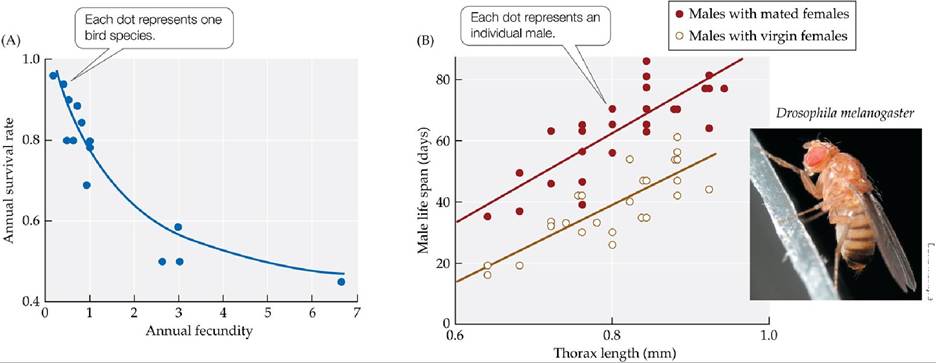
The allocation of resources to reproduction can also affect the parent by decreasing an individual's growth rate, its survival rate, and its potential for future reproduction.For example, a trade-off between current reproduction and survival has been documented in studies that examine how life history traits differ among species. In one such study, Ricklefs (1977) observed a trade-off between annual fecundity (as measured by the number of offspring raised to maturity) and annual survivorship in birds (FIGURE 7.15A). Trade-offs between reproduction and survival have also been observed within a species. For example, in the fruit fly Drosophila melanogaster, males spend more time and energy courting unmated females than they spend courting recently mated females. Partridge and Farquhar (1981) tested whether such differences in courtship activity affected the longevity of male fruit flies. Males were kept with eight virgin females per day or with eight previously inseminated females per day. In the absence of sexual activity, a male's life span is correlated positively with his size, so Partridge and Farquhar also recorded the size of each male. Among males of any particular
size, males kept with virgin females had a shorter life span than did males kept with inseminated females (FIGURE 7.15B), showing a cost (reduced life span) of sexual activity among males of this species.
David McIntyre
FIGURE 7.15 Trade-Offs between Reproduction and Survival (A) In a comparison of 14 different bird species, the annual survival rate declines as annual fecundity increases.
(B) Life span versus size (thorax length in millimeters) for male Drosophila kept with eight virgin females or eight previously mated females. Regression lines represent average male life spans.In (B), what is the average life span of male flies with a 0.8-mm thorax kept with virgin females? How does this compare with that of males of the same size kept with previously mated females?
(A after R. E. Ricklefs. 1977. Am Nat 111: 453-478; B after L. Partridge and M. Farquhar. 1981. Nature 294: 580-582.) View larger image
Similarly, evidence for a trade-off between current reproduction and growth has been found in mollusks, insects, mammals (including humans), fishes, amphibians, and reptiles (see citations in Barringer et al. 2013). A trade-off between reproduction and growth has also been observed in many plants, including Douglas fir trees (Pseudotsuga menziesii) (FIGURE 7.16). Note that by allocating resources to reproduction instead of growth, an individual will reproduce at a smaller size than it would if it had continued to grow and reproduced at a later time (when it was larger). Small individuals often produce fewer offspring than do large individuals, so this observation suggests that allocating resources to current reproduction might decrease an individual's potential for future reproduction. This trade-off has also received empirical support, as you can explore in ANALYZING DATA 7.1.
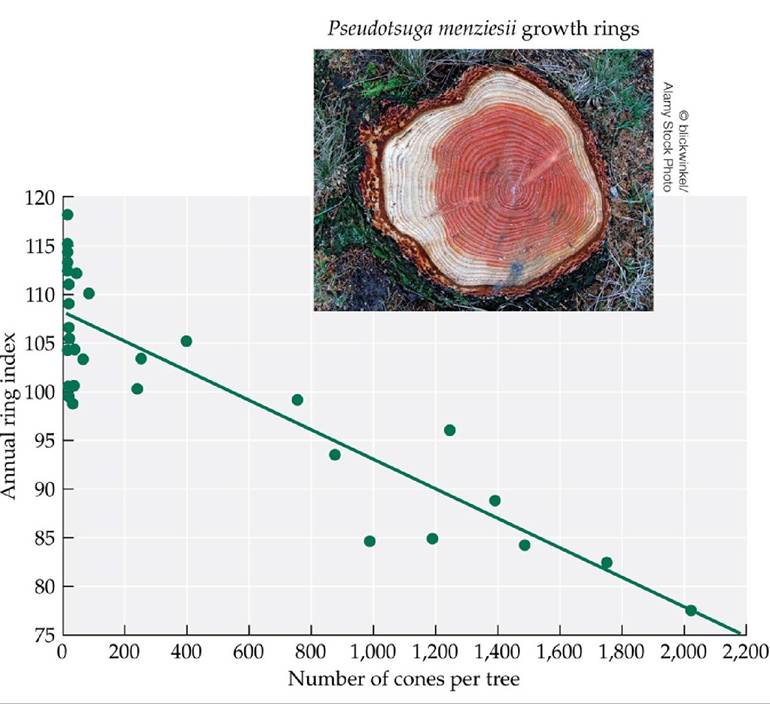
FIGURE 7.16 AReproductionversusGrowthTrade-Off Thethicknessofannualgrowth rings (a measure of growth rate) declines in Douglas fir trees that produce many cones. (After S. Eis et al. 1965. Can JBot 43: 1553-1559.) View larger image
ANALYZING DATA 7.1
Is There a Trade-Off between Current and Delayed Reproduction in the Collared Flycatcher?
Lars Gustafsson and Tomas Part (1990)* studied a population of collared flycatchers (Ficedula albicollis) on the Swedish island of Gotland.
Gustafsson and Part monitored the survival and reproduction of each bird throughout its entire life. They noted that some females reproduced for the first time when they were 1 year old (“early breeders”), while others reproduced for the first time when they were 2 years old (“late breeders”). The average number of eggs laid by early breeders and late breeders are reported in the table.| Average number of eggs | ||
| Age (years) | Early breeders | Late breeders |
| 1 | 5.8 | — |
| 2 | 6.0 | 6.3 |
| 3 | 6.1 | 7.0 |
| 4 | 5.7 | 6.6 |
1. Graph the average number of eggs (on the у-axis) versus age (on the x-axis) for both early breeders and late breeders.
2. Do the results suggest that it would be advantageous for birds to delay reproduction until they were 2 years old? Explain.
3. Do the results indicate that allocating resources to current reproduction can reduce an individual’s potential for future reproduction? Explain.
4. These results were based on field observations. What are the limitations of such data? Propose an experiment to test whether there is a cost of reproduction in females that reduces their potential for future reproduction.
*Gustafsson, L., and T. Part. 1990. Acceleration of senescence in the collared flycatcher Ficedula albicollis by reproductive costs. Nature 347: 279-281.
More on the topic There are trade-offs between current reproduction and other life history traits:
- CONCEPT 7.2 There are trade-offs between life history traits.
- Mode of reproduction is a basic life history trait
- Trade-offs and Possible Worlds
- Trade-Offs
- CONCEPT 11.4 Life tables show how survival and reproduction vary with age or size structure, influencing population growth and size.
- Country size and trade in history
- Aging is a fact of life, and although many may not be well prepared for typical aging changes, current marketing suggests this is not an unexpected event
- LIFE HISTORY TYPES AMONG PROTOZOA
- 7 Life History
- Life History Diversity
- Life History Continua
- The Evolutionary History of Life