Some mutualists have mechanisms to prevent overexploitation
As we've seen, there is an inherent conflict of interest between the partners in a mutualism: the benefit to each species comes at a cost to the other. In such a situation, natural selection may favor cheaters, individuals that increase their production of offspring by overexploiting their mutualistic partner.
When one of the partners in a mutualism overexploits the other, it becomes less likely that the mutualism will persist. But mutualisms do persist, as the 50-million-year association between fungus-growing ants and the fungi they cultivate readily attests. What factors allow a mutualism to persist in spite of the conflict of interest between the partners?One answer is provided by “penalties” imposed on individuals that overexploit a partner. If those penalties are high enough, they can reduce or remove any advantage gained by cheating. Olle Pellmyr and Chad Huth documented such a situation in an obligate, coevolved mutualism between the yucca plant Yucca filamentosa and its exclusive pollinator, the yucca moth Tegeticula yuccasella (Pellmyr and Huth 1994). Female yucca moths collect pollen from yucca plants with their unique mouthparts (FIGURE 15.14A). After collecting pollen, a female moth typically moves to another plant, lays eggs in the ovary of a flower, and then walks up to the top of the style. There, the moth deliberately places some of the pollen she carries on the stigma, thus pollinating the plant (FIGURE 15.14B). The larvae that hatch from the moth's eggs complete their development by eating some of the seeds, which then develop in the ovary of the flower.
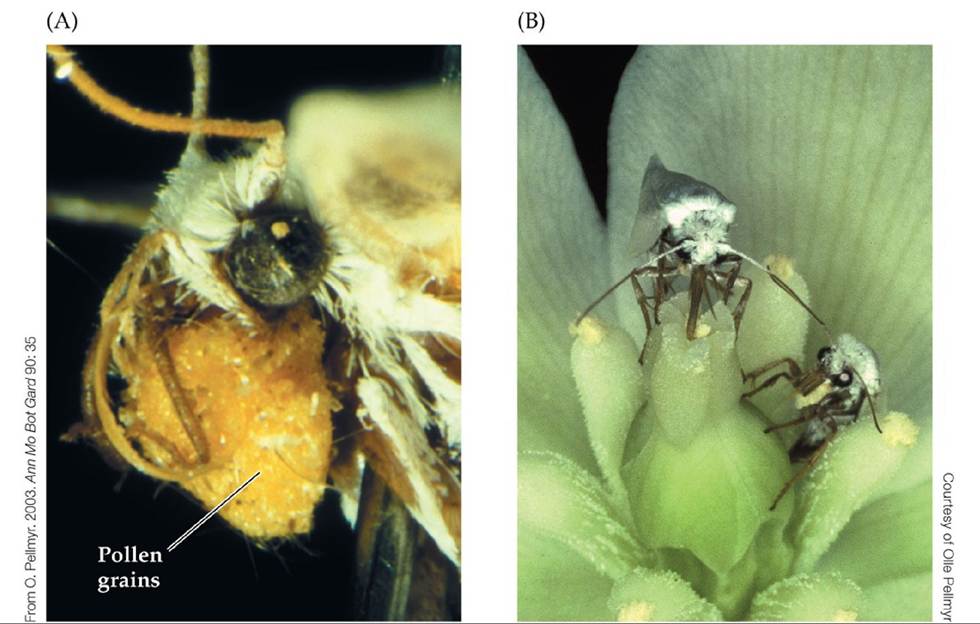
FIGURE 15.14 Yuccas and Yucca Moths Yucca filamentosa has an obligate relationship with its exclusive pollinator, the yucca moth Tegeticula yuccasella. (A) The female moth collects pollen from a yucca flower using specialized mouthparts.
She may carry a load of up to 10,000 pollen grains, nearly 10% of her own weight. (B) The moth at the lower right of this photo is layingeggs in the ovary of a yucca flower; the moth at the top is placing pollen on the stigma. View larger image
The moth and the plant depend absolutely on each other for reproduction. However, the mutualism is vulnerable to overexploitation by moths that lay too many eggs and hence consume too many seeds. Yuccas have a mechanism to prevent such overexploitation: they selectively abort flowers in which female moths have laid too many eggs (FIGURE 15.15). On average, yuccas retain 62% of the flowers that contain up to six moth eggs, but only 11% of the flowers that contain nine or more eggs. When the yucca aborts a flower, it does so before the moth larvae hatch from their eggs. Although the cue that determines flower abortion is not known, it is clear that it is a powerful mechanism for reducing overexploitation: all the moth larvae in an aborted flower die.
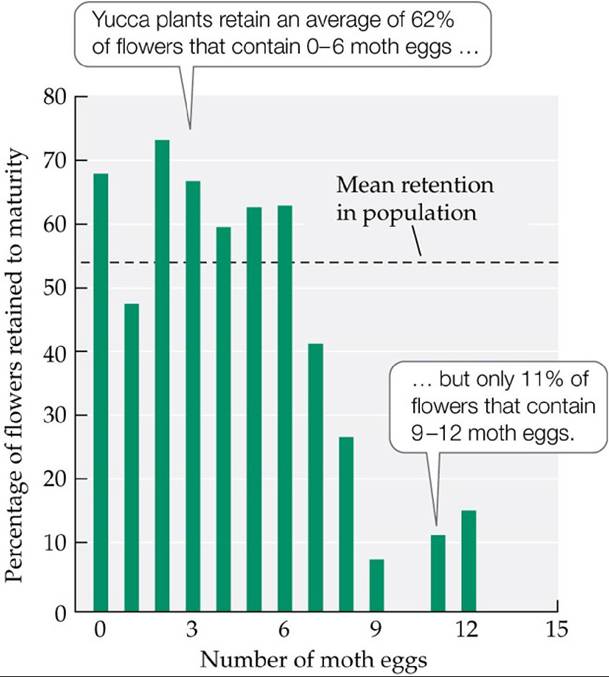
FIGURE 15.15 APenaltyforCheating Yucca plants selectively abort flowers in which yucca moths have laid too many eggs. (After O. Pellmyr and C. J. Huth. 1994. Nature 372: 257-260.) View larger image
Few other clear cases of penalties for cheating have been documented, so we do not yet know whether such penalties are common in nature. Be that as it may, the yucca-yucca moth interaction illustrates the theme that runs throughout this section: the partners in a mutualism are not altruistic. Instead, the yucca takes actions that promote its own interests, and the yucca moth does the same. In general, a mutualism evolves and is maintained because its net effect is advantageous to both parties. If the net effect of a mutualism were to impair the growth, survival, or reproduction of one of the interacting species, the ecological interests of that species would not be served, and the mutualism might break down, at least temporarily. Should such a situation continue, the longer-term or evolutionary interests of that species might also fail to be served, and the mutualism might break down on a more permanent basis.
Although it is possible for a mutualism to break down, we've also seen that mutualism and commensalism are very common and that some of these interactions have been maintained for millions of years. Let's turn now to the ecological effects of these pervasive interactions.