WORKING WITH MORAL CONFLICTS
One of the most critical and challenging steps in addressing moral conflicts is engaging the conflicting parties in a new process. There may seem to be little motivation for these groups to want to suspend their fighting long enough to sit in the same room with others whom they perceive as their enemy.
The question is how do we frame the conversation such that the parties will be motivated to participate in a process that might transcend the conflict?In a study conducted at the International Center for Cooperation and Conflict Resolution (ICCCR) at Teachers College, Columbia University, seventeen experienced practitioners working in the United States and internationally in the area of protracted and seemingly intractable conflicts were interviewed. Two main questions were posed: how do you engage the parties and how do you sustain their engagement? A rich array of responses based on their successful (and not so successful attempts) were collected. Among the responses, there was some consensus on critical factors to consider in determining who should be at the table and how to inspire them to come. Some suggested targeting top and middlerange leaders who are in positions to implement structural changes, while others suggested targeting grassroots leaders and extremists. It was also suggested that providing incentives and support to enable people to attend, such as food, babysitters, and honorariums, enabled the process. Another factor that promoted the process was developing relationships with key opinion leaders among the stakeholders so they can then influence others to participate (Coleman, Hacking, Stover, and Fisher-Yoshida, 2003).
Once people are at the table, using the CMM model is an approach that can help deepen their understanding of themselves, each other, and the situations within which they find themselves. A basic premise of CMM is that meaning emerges in the process of people relating to one another.
It is based in a social constructionist perspective that emphasizes that our thoughts, feelings, behaviors and sense-making processes are made in an ongoing stream of social interactions (Gergen, 1991). Meaning is cocreated by the engaged parties and not simply by the statements each make. CMM shifts the focus from what is said to what we are making in the process of communicating (Pearce and Littlejohn, 1997). While each person may have a message he or she wishes to communicate, meaning is believed to be emerging in the to-and-fro of the process. Each response to what is said, or turn in the conversation, makes new meaning.Moral conflict is characterized and perpetuated by an unwillingness to accept that there may be other seemingly opposing, valid, moral stories. The communication approach to social constructionism postulates that multiple truths are revealed in the narratives or stories we tell. Attending to these many narratives enhances our understanding of the meaning of our own lives (Jost and Kruglanski, 2002).
There are three foundational concepts in CMM that help us to understand moral conflicts and the particular types of dilemmas the conflict presents. These are coherence, coordination, and mystery (Cronen, Pearce, and Changsheng, 1989-90). Coherence refers to how people interpret their environment and their experience. People make sense of their interactions with others based on how they are integrated with their experiences from the past and the narratives, stories or scripts they have made of those experiences. Coordination is what we do in relationship with others to create shared meaning. Groups with apparently opposing moral orders may be likely to interpret the same event very differently based on different versions of the past. In using CMM, one goal would be to explore these different stories. Coordination does not necessitate having the same story, rather we create it when each of us can find coherence in how we and others are making sense of something, regardless of whether we agree.
One way of illustrating this would be to think of a couple dancing to music. A well-coordinated communication would be that the couple is moving in sync with each other to the same music with the same steps.The third concept, mystery, reflects the infinite possibilities of what is and what can be. Given the level of complexity inherent in the world today, the degree of complexity that underlies the moral conflicts within which we may be engaged includes overlapping layers of events, people, history, and other elements. There will always be new aspects to discover in any situation. Exploring mysteries opens up alternative ways for contextualizing relationships and thus moral conflicts. The concept of mystery reminds us that what we do not know or understand presents an opportunity for discovery rather than despair, and invites us to be curious and explore the unknown to better understand each other.
We have selected four of the CMM tools to describe ways that the model helps us to see our narrative as one possible version or way of telling the story as we attempt to make sense of the situation. The tools help us to explore our narratives about each other and ourselves in the interest of being able to better coordinate the meaning we make in our relationships. The four reflective tools can be used individually or in combination. Each tool highlights a different perspective within the broader view of the conflict. We use the tools as lenses to see our role and the patterns of our behavior as participants in these conflicts.
The four tools are: the Serpentine Model, the Daisy Model, the LUUUTT Model, and the Hierarchy Model. We will use the Terri Schiavo case, which drew international attention in early 2005, to describe the unique characteristics of each tool and the situations in which we may use them to deepen mutual understanding. First, we will provide a brief description of the case. Then we will introduce each tool to highlight different dimensions of how they individually and collectively make meaning of this situation.
Four Tools of CMM and Terri Schiavo
Terri Schiavo was a young woman who went into a coma because of a potassium deficit linked to an eating disorder. She remained on life support for close to fifteen years, after which her husband and parents were at odds as to whether to remove her feeding tubes. Her husband was in favor of removing the tubes and allowing Terri to die with dignity. He agreed with medical professionals who determined that she had sustained brain damage, was in a vegetative state, and was not capable of recognizing them or having the quality of life she deserved. Her parents and siblings believed that although she was in a coma, she was still alive, recognized them, and gave them little signs to acknowledge their presence. They felt that removing the feeding tubes would inflict unnecessary pain on her and that she should be allowed to continue living until God decided it was time for her to leave this world.
Terri Schiavo’s situation began as a moral dilemma. Her family members were at odds with each other about what was best for her. Terri clearly could not actively participate in this conversation about her own fate. What started out as an interpersonal conflict over a difference in values soon became a widespread media event with many third-party groups taking a moral stand using Terri as a platform to advance their own agendas. It developed into a moralized conflict where there was less and less of a middle road to take and the extreme positions of live or die became the only alternatives.
How we make sense of this moral issue and how we evaluate the positions of the different family members are influenced by where we begin the story, how the narrative is told, what is emphasized, and what is silenced. How we choose to define the boundaries defines the episode and is consequential to how we define or frame the conflict and the various factors involved. We can begin the episode about Terri Schiavo when she was a little girl growing up and explore her issues of self-esteem related to her weight, or we can begin the episode when she got married, or when she precipitously lost a lot of weight, or when she first went into her coma, or the last ten days of her life when her feeding tubes were removed.
The Serpentine Model describes the flow of a conversation or series of events as a process. Meaning is made in the context of what went before and what follows, rather than being made in isolation. Each event or comment takes on new meaning as subsequent comments and events take place. Responses and reactions define what was said or done and these new actions are also then defined by subsequent comments and actions. Focusing on different places within and between episodes can create multiple meanings.
In the case of Terri Schiavo, the episode of her cardiac arrest and decline takes on different meanings depending on how it is contextualized and when we begin the story. We can only speculate. If the family were involved in this reflection, they might each have different perspectives to offer. Consider for example that Episode A started when Terri suffered a cardiac arrest and was hospitalized. (See Figure 25.1.) This episode includes the questions when did her husband call the ambulance? How could such a young woman suffer a cardiac arrest? Did the medical professionals do all that they could? How did this tragic and unlikely medical occurrence happen to a woman far too young to deserve it?
Episode B might begin when Terri and Michael moved to Florida and Terri began to lose weight. What we do not know is what inspired Terri to lose weight. How did Michael feel about her new appearance? Was Michael concerned about how Terri was losing weight? Did he notice that she was becoming dehydrated, throwing her potassium levels out of balance? Was Michael concerned and, as a consequence, did he try to encourage Terri to eat? His encouragement might have been interpreted as expressions of jealousy as she was now more attractive to other men. Others among her family and friends may
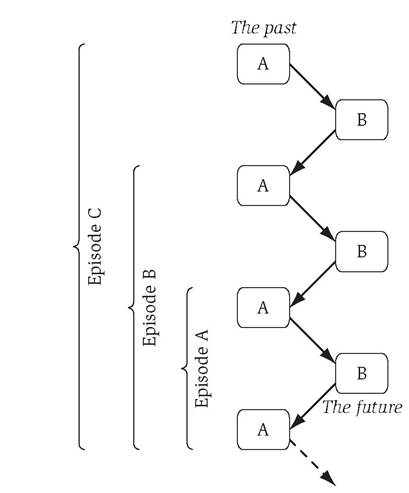
Figure 25.1 The Serpentine Model
Source: Pearce, 2000.
have been pleased to see her finally take off the weight that had troubled her for so long and begin to enjoy her new body.
Episode C may have begun in junior high school when Terri first began to put on weight. What we don’t know is what messages Terri received from her parents, from her friends, and from the culture regarding her weight. What efforts did Terri make to lose weight? What did her size mean to her? What did it mean in her relationship with Michael when they first met? How was Michael’s relationship with Terri’s parents? How did Michael feel about moving to Florida? What story did Terri tell of her relationship with Michael to her parents? Extending the episode expands the questions and the stories that help make sense of a painful situation.
The moral dimensions of the question of whether to remove the feeding tube rested in part on whether people thought Terri was brain dead. The series of events that lead up to her being in a coma, being hospitalized, and having the feeding tube removed could all be depicted as turning points or junctures in the Serpentine Model.
The Daisy Model is a tool used to show the many voices, conversations, or influencing factors that implicitly influence the main issue or event that is taking place in the center of the daisy. (See Figure 25.2.) When we think about a daisy, we see there are several layers of petals. We can think of the top layer of
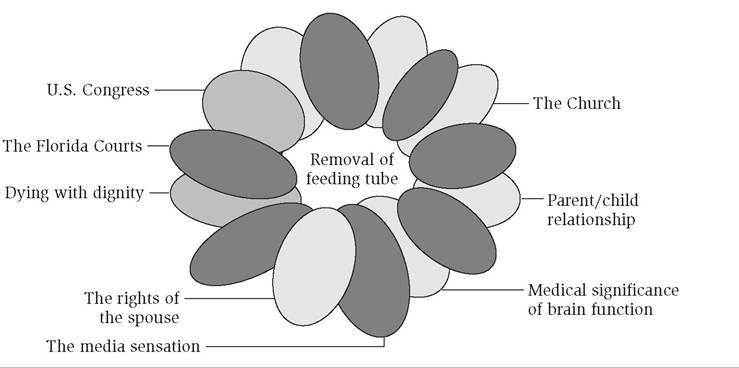
Figure 25.2 The Daisy Model
Source: Adapted from The Daisy Model (Pearce, 2000).
petals as representing those influences that more strongly impact the center of the daisy, while the petals underneath may have secondary levels of influence. At any time, these petals can shift their composition or change places moving into positions of prominence or receding further into the background.
In the case of Terri Schiavo, the petals might represent the different voices, conversations, and assertions of moral authority that were competing to determine the outcome.
The petals identified in the figure represent the voices and conversations that were heard in the public discourse; the location of the moral debate concerning Terri. If this were a more private decision, the prominent petals might consist of more personal conversations reflecting the intimacy of the relationships.
The LUUUTT Model highlights the many aspects of storytelling that are a part of any situation. (See Figure 25.3.) LUUUTT is an acronym that stands for stories Lived, stories Untold, stories Unheard, stories Unknown, stories Told, and storyTelling (Pearce and Pearce, 1998). StoryTelling is performed in accordance with certain patterns or rules. There are the stories that are Lived together and the stories Told by those involved, which might differ from the stories Told by those not directly involved. Conflicts may emerge in the space of discrepancy between Lived stories and Told stories. We may believe the stories we are Telling are true depictions of the stories we are Living or we may Tell a certain version of a story as a way of convincing others and ourselves. There may be a habit of storyTelling that fits into patterns of complaining. A rule might be that stories must be polite regardless of any feelings that may accompany them.
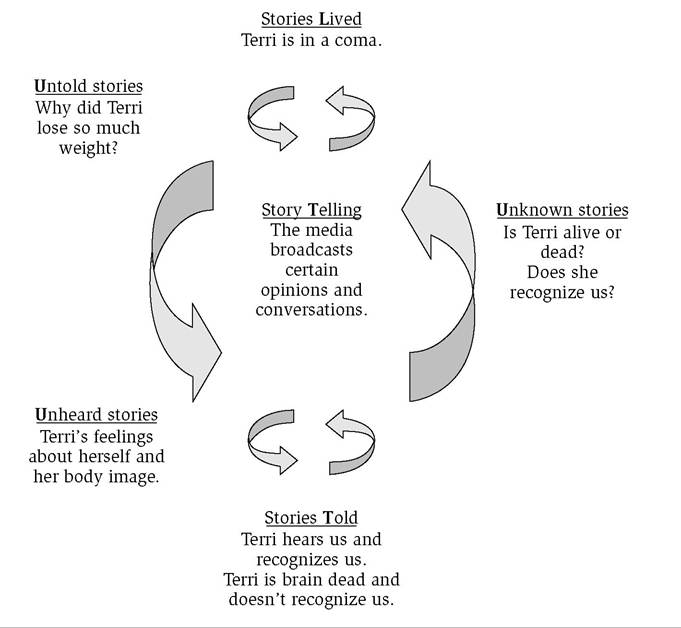
Figure 25.3 The LUUUTT Model
Source: Adapted from The LUUUTT Model (Pearce, 2000).
The process of storyTelling itself influences stories that are Told, as well as stories that are Untold. Some stories go Unheard while others are amplified and privileged. Stories may be privileged because they are part of the dominant discourse. Stories that represent and perpetuate the dominant discourse have explicit and implicit permission to be Told. The Unheard stories may have been cries for help, sources of frustration, or destructive actions. Unknown stories might be related to what Terri wanted for herself. The process of coming together and identifying these Unknown, Untold, and Unheard stories may then transform them into stories that are known, told, and heard.
There are many stories Unknown about and Untold by Terri herself since she was in a coma. Her close family members and friends were trying to represent her voice and in the process contradicted each other. We might also wonder how she suffered silently for so many years being self-conscious about her
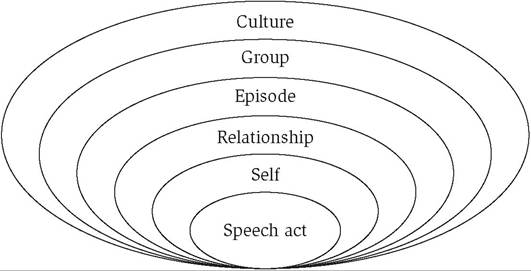
Figure 25.4 The Hierarchy Model
Source: Pearce, 2000.
weight. Her story may have been unheard in her cries for acceptance that led her to want to change her physical body image to such a degree.
The Hierarchy Model depicts how stories contain multiple levels of context. (See Figure 25.4.) Stories can be personal, about relationships, laden with content, about groups, about culture, to name a few. Who is telling the story and the nature of the storytelling amplifies one level and nests other levels within and around it. The labels we use to show these different layers of context may also change depending upon the unique factors of any given situation.
The contexts might include:
The speech act, which is what is said, the content, the event or the interaction
The story we tell about our self in relationship with others
The relationship^) or the scripts for what might be expected and the latitude within which we might act
The episode or the frame in which the interaction occurred
The group in which the self and relationship are embedded
The culture and the larger system
In the case of Terri, those representing the different sides of the case contextualized the situation in different ways. Both sides could put the removal of the feeding tubes as the speech act and then the elevation of Terri, self, as taking precedence over other contexts. However, how each side contextualizes the self would differ. For her husband, Michael, a series of contexts and the accompanying stories could be that the speech act is embedded in the self because Terri needs
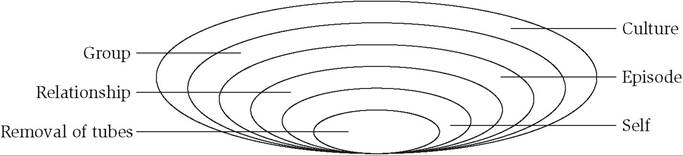
Figure 25.5 Terri's husband, Michael's, version of the LUUUTT Model
to die a dignified death. Then there would be the relationship in that he was her loving husband and, as her closest kin, had the authority to make decisions concerning her condition. The episode may be punctuated at the beginning of her ordeal when she lapsed into a coma 15 years ago. He might appeal to the group of husbands and wives who may also have been or are currently in similar situations of having to make these same tough choices and then the larger culture that enforces individual rights.
Terri's parents and siblings might tell a very different story around the event in the center. They may put culture next to represent the religious beliefs of the larger moral culture they belong to and that condones leaving the tubes. After the event and culture, they might place episode, as for her parents the episode may be her whole life as she is their daughter and is still living. The next level of context may be relationship as they are her closest family, have known her the longest, and should, therefore, be entrusted to make these difficult decisions concerning her life or death. Perhaps they would put religious beliefs next claiming that nothing should stand in the way of preserving life. The connection the Schindlers felt with other families in similar situations provides another context to empathize and sympathize with them in their plight. This is but one set of stories deriving from contexts that we have arranged. The change in placement of any one of these context levels would change the story.
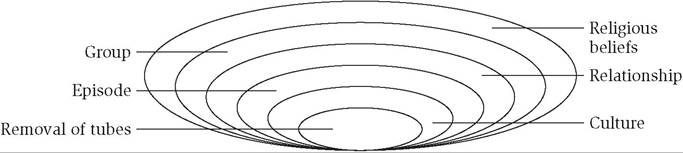
Figure 25.6 Terri Schiavo's family, the Schindler's, version of the LUUUTT Model
CMM emphasizes process over content and emergent meaning over fixed truth. The communication and social construction approaches open us up to the possibility that our view is but one view among many. The possibility of other perspectives and alternative meanings invites us to explore the mystery.
The opportunity to bring people holding different perspectives together to reflect on their respective stands and the influences that hold them there has the potential to foster new perspectives. These sets of tools help foster coherence for ourselves and coordination with others and potentially demystify what may otherwise be a stalemate. Taking a communication perspective using CMM tools may deepen people’s capacity to see each other’s perspectives and as a result create new narratives.
The next section describes how the CMM tools were used to foster shared meaning in a group engaged in dialogue across differences.
Case Story: In Dialogue About Israelis and Arabs
In the fall of 2004, a documentary, Columbia Unbecoming, was shown at Columbia University. The documentary alleges discrimination and harassment of an antiSemitic nature at the University by some of the professors in the Middle Eastern Asian Languages and Culture (MEALAC) department. The documentary is a twenty-five-minute film made by a pro-Israeli Boston-based group, The David Project. The film sparked wide-ranging debate and criticism, including what some viewed as the inadequacy of the university’s response to the allegations. A bigger issue to some was that of academic freedom on the college campus.
For two of the student groups, namely LionPac, Columbia’s pro-Israeli political action group and Turath, Columbia’s Arab Student Organization, this series of incidents sparked them into action faster than they had originally planned. They began holding a series of dialogues with the goal of getting students from at least these two different backgrounds to foster deeper understanding of each other. When the sessions convened, they realized that each of them knew little about the other’s culture and history. They decided to spend the few weeks left in the semester sharing key points in each other’s history.
We had been following the events at Columbia and identified some of their issues as characteristic of a moralized conflict. What started out as issues of academic freedom also drew attention to perceptions of discrimination based on ethnic background. We contacted the leaders of the two groups and others leading the way for these Arab-Israeli dialogues and offered to facilitate their dialogue and development of a shared, mutual understanding using the CMM model as a process. This was agreeable to the leaders of both organizations who felt that in order to really move the members of their groups forward, they would need to approach the process in a different way. Together the authors decided they would send an invitational e-mail to members of their respective organizations and whoever showed up would be the right people.
It was the end of the spring semester and most students were busy preparing for their summer leave. We were able to gather a group of seven individuals, ranging from undergraduate students and graduate students to those having completed their graduate studies, together for a four-hour dialogue session. While all of the participants knew someone in the group, no one knew all the other participants. Some members of the group had previously experienced engaging in dialogue with each other on the topic of the Arab-Israeli conflict. Participants self-selected based upon the topic of the dialogue session.
The CMM process was introduced as a tool to help them surface some of the otherwise implicit stories, influences, and assumptions that shaped their narratives of their situation and their relationship with each other’s group. These stories and the dialogue they provoked would potentially deepen their understanding of themselves, each other, and the conflict (Fisher-Yoshida, 2000; Wasserman, 2004).
The process we used was based on an appreciative collaborative inquiry methodology (Wasserman, 2004). Appreciative Inquiry and CMM are both grounded in social construction and together complement one another. Using these methodologies, the groups were asked to identify constructive processes that enabled them to engage disparate stories. This approach begins with paired interviews guided by appreciative inquiry process, an action research methodology that is grounded in social construction theory (Cooperrider, Barrett, and Srivastva, 1995; Ludema, Cooperrider, and Barrett, 1999). Central to this approach is the belief that what we talk about and how we talk are consequential to the shared meaning we create. Since the focus of our inquiry was conditions that transcend seemingly intractable conflict, we provided the following prompt for their conversations:
Share a story about a time when you engaged with someone who had a different point of view from you about the Israeli-Arab relationship and land issues and, despite your differing points of view, you were able to have a deep, respectful, and authentic conversation. What enabled these kinds of conversations to take place? What was it about you, the other person, and the conditions that enabled this to happen?
Talking about what enabled them to have respectful dialogues on controversial topics made explicit the principles that enabled those conversations. After their paired conversations, we identified as a group what they learned from their stories about what sustains engagement in conversations with another who has a very different perspective. This seeded the next step, which is a process they would use to reflect on their previous dialogues using the CMM model as a guide.
After the interviews, we introduced CMM and its four tools. The participants then formed two small groups and used whichever tools they selected to guide their conversations about the Arab-Israeli situation. For example, the LUUUTT Model was used to identify the stories that are lived by the different groups of people in Israel. The storytelling process highlighted the manner in which the stories were told, revealing how stories alternate from people demonizing the other to having compassion for the other. They explored stories told in the Jewish community, in the United States, in the Arab community, in the Middle East, and in the general public discourse. The model also invited people to talk about the stories that are untold and the stories that are unheard, and opened the possibilities for exploring new avenues of meaning by imagining the stories that are unknown. In the process of using the CMM tools some of the untold, unheard, and unknown stories were told, heard by all, and became shared knowing.
The Serpentine Model helped to map the ebb and flow of relationships over a period of time and how different events marked the shifts and turns in this relationship for each of the groups. Since we each have our own way of determining the beginning, middle, and end of these episodes depending on where we choose to begin our story, the boundaries the participants placed to frame the periods of time significantly influenced the context and meaning derived from the story. In this particular case, turns in history shift relationships from thriving to warring, shift land ownership and geographical boundaries, shift who holds power in governance, and shifts the definition of insiders and outsiders and how they influence each other. They discussed how the story changes when they shift the beginning of the story from 2000, to 1973, to 1967, to 1948, to 1896, to 900, to 10, to 300 BCE!
The Daisy Model surfaced the various influences, conversations, and stories that shaped their views about Arabs and Israelis and their relationship to each other, as well as their own relationship to Israeli-Arab dynamics in the public discourse. This included identifying needs, desires, and entitlements based on how they construed the histories they lived, the patterns of conversations they had in their families growing up, the prescribed stories they inherited, and major news events they both heard about and witnessed. Petals on the daisy elevated how old stories could perpetuate objectifying the other, in the case of “they are people who want to annihilate us,” or create caring relationships, “we used to live as neighbors, we share so many of the same core values.”
The Hierarchy Model helped the participants situate the context they were privileging in how they told their stories. For example, one woman’s story amplified a personal relationship with her boyfriend. No matter what their differences were, they placed sustaining their relationship as the highest priority. In her story, relationship was the primary context; stories of intergroup conflict and the culture were less influential to how she made meaning and interpreted events. Another person in the group had a very different way of contextualizing meaning. For him, history of conquest and dominance was the elevated layer. This context or lens was so salient that it was difficult for him to hear stories of reconciliation and hope. The Hierarchy Model helped the group take a third person perspective to stand at the boundary to how they were making meaning of similar stories. The model visually depicted how multiple layers contextualize meaning, each layer embedded in another. How we construe what is real to us and what is possible varies significantly by how we talk about events. We are all part of a bigger system and anything happening at one level sends ripples of impact to all other levels.
The shared group reflection provided a window through which they could hear what they have not heard and come to know what they did not know. When we reflect with others holding a very different perspective, particularly those whose historical narratives might be in conflict with our own, we have the opportunity to know ourselves differently in relationship with each other (Wasserman, 2004).
Emergent Meaning
In their initial conversations the participants identified five principles for engagement that allowed them to stay involved. We think these characteristics are important. These principles were:
• A strong value for listening to learn—this is different from listening to challenge and defeat, typical patterns of listening we have in conflict situations
• Seeking to understand and not trying to convince—another behavior different from a competitive stance some take in conflict
• A value for seeing both sides—broadening perspectives and what Oliver (1996) characterized as a component of systemic eloquence
• Having an overarching commitment to the formation, development, and preservation of their relationship over ideology—clearly distinguishing levels of importance and reflecting their values
• A desire to learn and grow in relationship with others who were different from them—a genuine interest and curiosity and value of the other side’s perspective
The participants held different principles regarding the role of emotion in their conversation. Some said that emotions need to be kept in check, while others said that expressing emotions is important and authentic. Identifying these principles and developing our readiness to be able to identify them require a level of self-awareness that comes through moments of critical self-reflection where implicit assumptions and values are surfaced and addressed (Fisher- Yoshida, 2003). Dialogue and the use of CMM are tools that create opportunities for these transformative shifts to take place.
The two groups presented the tools they used and presented the stories of their diagrams to each other. They each used the tools in different ways to expand and elicit the stories, rules, commitments, and entitlements that influenced their conversations on this subject and how they made meaning. First, there were the stories of identity. The story of “a good Arab,” “a good Israeli,” “a good Muslim” and “a good Jew” was being written both within and outside the boundaries of each community. The framing of these stories sometimes acted to prohibit engagement with “the other side.” In some cases, such engagement would be considered to be betrayal. They received mixed messages as some members of their groups encouraged the dialogic engagement. However, the power of influence and potential feelings of being ostracized by one’s own group cannot be underestimated. Those who ventured forth in these endeavors experienced themselves as outsiders in both groups simultaneously.
As we listened, we could hear the voice of moral authority. There were members of each group who felt they had more of a right to be the voice for their group. CMM describes this voice as a logical force in that it is the dominant influence, guiding and defining meaning. Logical force is the overwhelming feeling of needing to act on our commitments, or our sense of what we should do, what we ought to do. For these participants, the amount of personal suffering was the criterion to decide who was more worthy of speaking for the group. Their logic was based on the frame that those who suffered more in the past are more entitled than those who did not. For those who felt or were told they were not as entitled to their point of view, they felt a sense of loss, of being ostracized from their communities.
The level of emotional engagement with the story of the other side affected the capacity to hear it, especially when it conflicted deeply with an alternative existing story they held. This supported a recent study of transformative discourse about deeply held historical identity differences where emotional engagement through the frame of storytelling was critical to transformative learning (Wasserman, 2004). In this instance, when the value of the relationship superseded the content of issues in the conflict, participants were better able to engage, hear, and accept a perspective or story that was significantly different from their own, while remaining in the tension of holding their own story (Buber, 1955; Pearce and Pearce, 2003).
More on the topic WORKING WITH MORAL CONFLICTS:
- MACHIAVELLI, CICERO, AND PLUTARCH ON THE LION AND THE FOX
- Accountability, Human Rights, and Human Dignity
- Somalia
- FIVE COMPONENTS OF LEGAL COMPETENCIES
- THE POLITICS OF ISLAMIZATION
- WOMEN IN PRIVATE LAW
- Islam and Constitutionalism in African Contexts
- The Cypriot Advisory Model
- THE THEORY AND PRACTICE OF EMPIRE-BUILDING
- Index