A simple model of resource partitioning envisions each type of resource available in a community as varying along a “resource spectrum.”
This spectrum could represent, for example, different nutrients, prey sizes, or habitat types; note that such a spectrum represents the variability of an available resource, not the amount.
We can assume that the resource use of each species falls somewhere along this spectrum and overlaps with the resource uses of other species to varying degrees (FIGURE 19.8A). The assumption is that the more overlap, the more competition between species, with the extreme being complete overlap and competitive exclusion. The less overlap, the more partitioning of resources has occurred, and the less strongly the species will compete with one another.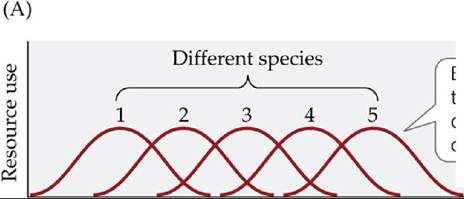
Each curve represents the resource use of a different species in the community.
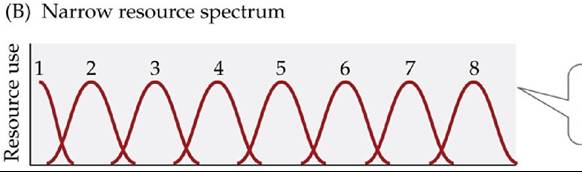
Species in this community show a high degree of specialization (little overlap) in their resource use.
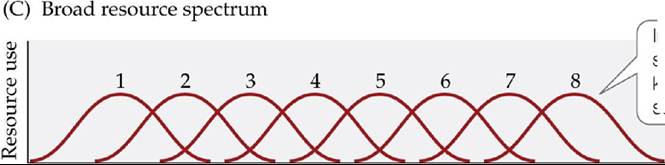
In this community, the resource spectrum is broad, making more kinds of resources available to support more species.
Resource spectrum
FIGURE 19.8 ResourcePartitioning Speciescoexistencewithincommunitiesmaydepend on how the species divide resources. (A) The principle of resource partitioning along a resource spectrum. (B,C) Two characteristics of communities that can result in higher species richness.
Which panel shows the most resource partitioning? Which shows the least? (After J. Hill and R. Hill. 2001. Prog Phys Geogr 25: 326-354.) View larger image
Using this guiding theory, we can consider some of the ways in which resource partitioning might result in higher species richness in some communities than in others. First, species richness could be high in some communities because species show a high degree of partitioning along the resource spectrum (FIGURE 19.8B). More species could be “packed” into a community if the overlap in resource use among the species is low, leading to less competition and ultimately higher species richness. This lower overlap could be due to the evolution of specialization or character displacement (see Figure 14.12), which may reduce competition over time. Second, species richness could be high in some communities because the resource spectrum is broad (FIGURE 19.8C). Presumably, a broader resource spectrum would make a greater diversity of resources available to be used by a wider variety of species, resulting in higher species richness.
At this point, let's turn our attention away from models and take a look at some real communities to see how resource partitioning might work in practice.