SUMMARY
CONCEPT 16.1 Communities are groups of interacting species that occur together at the same place and time.
16.1.1 Describe the ways ecologists delineate communities.
Communities can be delineated by the characteristics of their physical environment or by biological characteristics, such as the presence of abundant species.
16.1.2 Explain why ecologists use subsets of species to define communities and list some of the subsets used.
Ecologists often use subsets of species to define and study communities because it is impractical to count or study all the species within a community, especially if they are small or undescribed.
Subsets of species used to study communities include taxonomic groups, guilds, functional groups, and food and interaction webs.
CONCEPT 16.2 Species diversity and species composition are important descriptors of community structure.
16.2.1 Define and quantify species diversity and compare to biodiversity.
Species diversity, the most commonly used measure of
community structure, is a combination of
the number of species (species richness) and the abundances of those species relative to one another (species evenness).
Biodiversity is a term used to describe the diversity of important ecological entities that span multiple spatial scales, from genes to species to communities.
16.2.2 Define and graph rank abundance and species accumulation relationships.
Communities can differ in the commonness or rarity of their species. Rank abundance curves allow one to plot the proportional abundance of each species relative to the others, from most abundant to least abundant.
Species accumulation curves can be used to determine when most or all of the species in a community have been observed. Species richness increases with increased sampling effort up to a certain point, at which additional samples reveal few or no new species.
16.2.3 Define species composition and explain why it is an important characteristic of communities.
Species composition—the identity of the species present in a community—is an obvious but important characteristic of community structure that is not revealed in measures of species diversity.
Knowing species composition allows an understanding of the roles of those species within the community.
CONCEPT 16.3 Communities can be characterized by complex networks of direct and indirect interactions that vary in strength and direction.
16.3.1 Compare direct versus indirect species interactions and describe the effects they have on communities.
Indirect species interactions, in which the relationship between two species is mediated by a third (or more) species, can have large effects on the outcomes of direct species interactions.
16.3.2 Explain how species interactions can vary in strength and direction, and how these attributes can be measured experimentally.
Some species have a strong negative or positive effect on their communities, but others probably have little or no effect.
Interaction strength, the effect of one species on the abundance of another species, can be measured experimentally by removing individuals of the interactor species and measuring the effect on the number of individuals or biomass of the target species.
16.3.3 Compare foundation species, keystone species, and ecosystem engineers and the effects they have on communities under different environmental contexts.
Species that have large effects on their communities by virtue of their size and abundance are known as foundation species. Those that have large effects due to the roles they play in their communities are known as keystone species.
Ecosystem engineers create, modify, or maintain physical habitat for themselves and other species.
The environmental context, including climate change, can modify species interactions enough to change their outcome.
REVIEW QUESTIONS
1.
What is the formal definition of a community? Why is incorporating species interactions into that definition important?2. Species diversity measurements take into account both species richness and species evenness. Why would these measurements be preferred to species richness alone? What do rank abundance curves add to one's knowledge about community structure?
3. Species vary in the strength of their interactions with other species. Species that interact strongly with other species include foundation species, keystone species, and ecosystem engineers. Describe the differences among these three types of species and give some examples. Can foundation and keystone species also be ecosystem engineers?
HONE YOUR PROBLEM-SOLVING SKILLS
The interaction web shown in the figure is representative of one found in the rocky intertidal zone of Washington and Oregon. The arrows and their signs (+ or -) represent interactions that occur between species in the food web.
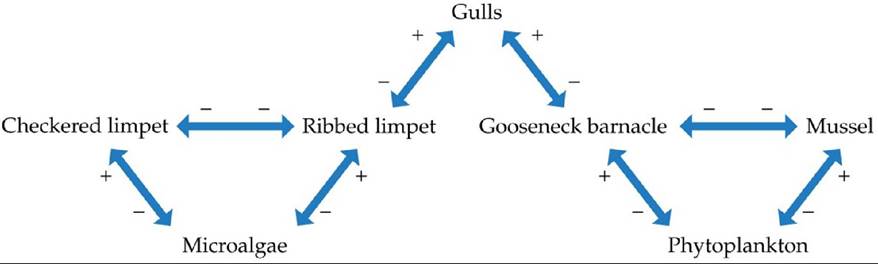
Suppose an ecologist wants to know the influence of gulls on other members of the food web. She conducts a gull removal experiment along a stretch of rocky shoreline to determine the interaction strength between gulls and other members of the food web (with the exception of phytoplankton). The results are shown in the table. Determine the interaction strength values between gulls and each of the five species given in the table, using the relative interaction intensity (RII) equation in Ecological Toolkit 16.1.
| Target species | Control (C) number of individuals with gulls | Experimental (E) number of individuals without gulls |
| Ribbed limpet | 10 | 100 |
| Gooseneck barnacle | 500 | bgcolor=white>3,000|
| Checkered limpet | 100 | 50 |
| Mussel | 3,000 | 2,500 |
| Microalgae | 500 | 100 |
1.
Based on your relative interaction intensity (RII) calculations, which species of prey is most negatively affected by gulls? Which nonprey species is most affected by gulls, and what is that effect?2. Determine the four indirect effects that occur when gulls are removed from the community. How does each species respond (i.e., does it increase, decrease, or not change in abundance) and through what type of interaction (i.e., herbivory or competition)?
3. Would the effect of gulls be stronger or weaker on microalgae and phytoplankton if the mussel and checkered limpet were excluded from the food web? Explain.
LIST OF KEY TERMS
biodiversity communities community structure competitive networks Direct interactions ecosystem engineers food web foundation species functional group guild horizontal interactions Indirect interactions Interaction strength interaction web keystone species rank abundance curves redundant Shannon index
species accumulation curve species composition Species diversity
Species evenness
Species richness
trophic cascade
trophic facilitation
trophic levels