SUMMARY
CONCEPT 24.1 Landscape ecology examines spatial patterns and their relationship to ecological processes.
24.1.1 Describe the elements that make up a landscape and illustrate how they can influence ecological processes such as dispersal and ecosystem function.
A landscape is a heterogeneous area made up of a dynamic mosaic of different components that interact through the exchange of materials, energy, and organisms.
24.1.2 Show how landscape structure can be evaluated using the number and areas of the elements that make up the landscape.
Landscapes are characterized by their composition—the elements that constitute them, including patches, mosaic, and corridors—as well as by their structure—how those elements are arranged on the landscape.
Landscape patterns influence ecological processes by determining how easily organisms can move among elements as well as by influencing ecosystem properties such as rates of biogeochemical cycling.
24.1.3 Compare the benefits and drawbacks associated with using coarse-scale versus fine-scale characterization of a landscape.
The scale that is used to characterize a landscape should match the needs of the research question or management issue.
24.1.4 Describe how disturbances can both affect and be affected by the landscape structure.
Landscape patterns both shape and are shaped by disturbances.
CONCEPT 24.2 Habitat loss and fragmentation decrease habitat area, isolate populations, and alter conditions at habitat edges.
24.2.1 Describe the impacts of habitat fragmentation that lead to loss of diversity in landscapes.
Habitat fragments are biologically impoverished compared with the intact habitat from which they were derived.
24.2.2 Evaluate why fragmentation is more likely to impact higher trophic levels relative to plants and herbivores.
Once a patch of habitat is isolated by fragmentation, organisms reliant on that habitat may be isolated or may be able to cross the intervening matrix to some extent.
The isolation of populations and the shifts in communities that result from habitat fragmentation alter ecological and evolutionary processes.
24.2.3 Explain how edges between habitat patches and the matrix in a fragmented landscape influence the physical environment and how this in turn impacts ecological processes such as dispersal and habitat use.
The edges of habitat fragments have different abiotic conditions, and thus have different population dynamics, than interior habitats.
CONCEPT 24.3 Biodiversity can best be sustained by large reserves connected across the landscape and buffered from areas of intense human use.
24.3.1 List the factors that constitute a suitable core natural area that sustains diversity in a landscape.
The ideal spatial configuration for a core natural area is large, compact, and connected to or close to other protected natural areas.
24.3.2 Describe the importance of buffer zones around a core natural area in designing nature reserves.
Core natural areas should be surrounded by buffer zones where human economic uses that are compatible with biodiversity conservation are allowed.
24.3.3 Evaluate the importance of corridors in the context of environmental change.
Habitat corridors are instrumental in facilitating the movements of organisms between natural areas.
Ecological restoration allows areas that have been degraded to support native species and ecosystem processes once again.
CONCEPT 24.4 Ecosystem management is a collaborative process with the maintenance of long-term ecological integrity as its core value.
24.4.1 Evaluate how collaborative ecosystem management may lead to better solutions to preserving diversity than strictly science-based decisions.
Collaboration among all stakeholders is key to arriving at effective management plans.
24.4.2 Describe why iterative adjustments to land and marine reserve management policies are needed to help improve their effectiveness.
Ecosystem management is a process of setting sustainable goals, developing and implementing land use management policies, monitoring the effectiveness of prior decisions, and adapting plans accordingly.
Humans are an integral part of ecosystems. Conservation plans that include the economic and social well-being of local human populations are more likely to succeed over the long term.
REVIEW QUESTIONS
1. How are islands of terrestrial habitat that result from habitat fragmentation like actual islands surrounded by water? How are they different? How do the principles of island biogeography (see Concept 18.3) apply to habitat islands in a fragmented landscape?
2. Are habitat corridors just long, skinny habitat patches? Describe how a corridor is like the habitat blocks it is meant to join and how it is different from them, and outline the implications for organisms using the corridor. Do you think corridors are beneficial? Do you think they are necessary? Why?
3. The western boundary of Yellowstone National Park, where it borders a national forest, is visible from space (check it out with Google Earth at 44021'45"N, 111o05'50"W). Explain this observation in terms of the contrasting missions of a national park and a national forest. What are the ecological implications of these contrasting institutional functions for biodiversity? For ecosystem management?
HONE YOUR PROBLEM-SOLVING SKILLS
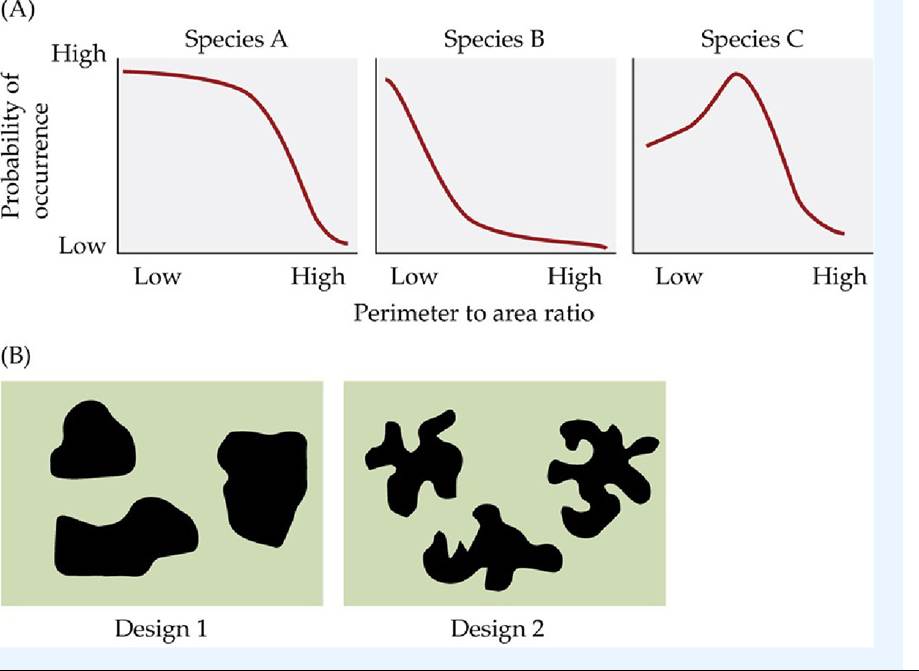
One of the criteria used in determining the design of nature reserves is the shape of the habitat patch, which gives an indication of the amount of edge versus area of core habitat. Some species have greater needs for edge habitat, while others are negatively impacted by edges. Consider FIGURE A, indicating the sensitivity of three bird species to the shape of a habitat patch, estimated as the ratio of perimeter (length) to area.
1. Each of the three bird species is likely to do better in either design 1 or design 2 shown in the maps of habitat patches (FIGURE B). What is your prediction?
2. Describe some of the ecological considerations that might positively or negatively impact the response of a species to a habitat edge. Consider factors such as food preference, predation risk, physical environment, and reproduction.
LIST OF KEY TERMS
adaptive management biological reserves buffer zones core natural areas ecosystem management Edge effects
Extent
Grain
Habitat corridors landscape
Landscape composition Landscape ecology Landscape structure mosaic
Scale