At the most basic level, the term “succession” refers to the process by which the species composition of a community changes over time.
Mechanistically, succession involves colonization and extinction due to abiotic and biotic agents of change. Even though studies of succession often focus on changes in vegetation, the roles of animals, fungi, bacteria, and other microbes are equally important.
Theoretically, succession progresses through various stages that include a climax stage (FIGURE 17.5). The climax is thought to be a stable end point that experiences little change until a particularly intense disturbance sends the community back to an earlier stage. As we will see in Concepts 17.3 and 17.4, there is some argument about whether succession can ever lead to a stable end point.
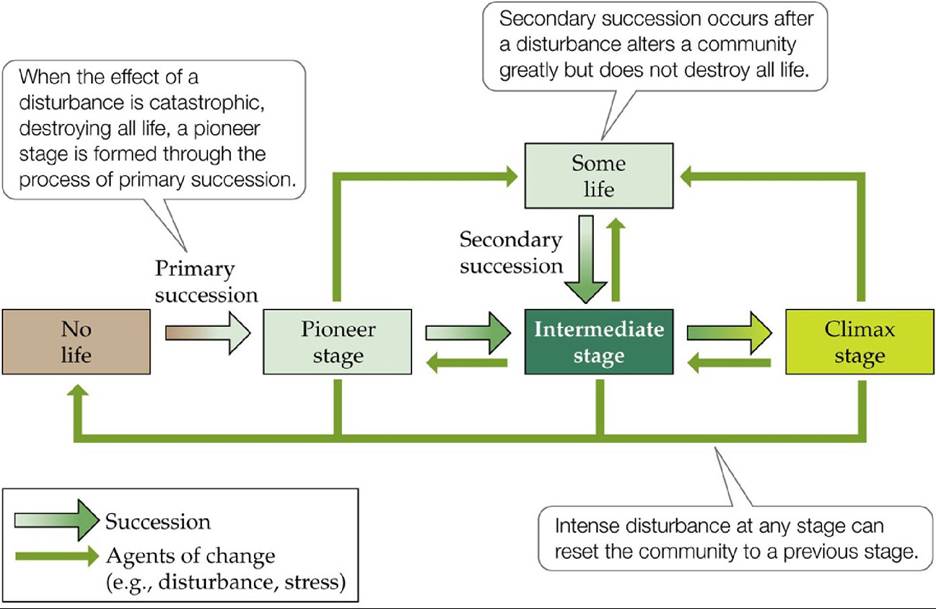
FIGURE 17.5 TheTrajectoryofsuccession Asimplemodelofsuccessioninvolves transitions between stages driven by species replacements over time. Theoretically, these changes ultimately result in a climax stage that experiences little change. There is some argument, however, about whether succession can ever lead to a stable end point. View larger image
More on the topic At the most basic level, the term “succession” refers to the process by which the species composition of a community changes over time.:
- At the most basic level, the term “succession” refers to the process by which the species composition of a community changes over time.
- Reviewers