Trophic efficiencies can influence population dynamics
Changes in food quantity and quality, and the resulting changes in trophic efficiency, can determine the consumer population sizes that can be sustained, as well as the health of the individuals in consumer populations.
Here we'll examine the potential contribution of changes in food quality to the decline in numbers of Steller sea lions (Eumetopias jubatus) in Alaska.From the late 1970s into the 1990s, the total population of Steller sea lions in the Gulf of Alaska and the Aleutian Islands decreased by about 80%, from approximately 250,000 sea lions in 1975 to 50,000 in 2000 (FIGURE 21.8). The population in the eastern part of the range has recovered some since that time, and the species was taken off the endangered list in 2013. However, the population in the western part of its range, along the southern coast of Alaska, has continued to decline. Andrew Trites and C. P. Donnelly reviewed the available information to try to determine possible causes for this decline (Trites and Donnelly 2003). They found that individual sea lions collected during the period of decline were smaller than individuals within the same age classes collected before the start of the decline. There was also a reduction in the number of pups born per female during this period, which resulted in a shift in the age structure toward older individuals. No evidence was found for outbreaks of disease or parasites. The smaller body sizes and declining birth rates suggested that there were fewer prey available, or that the available prey were not providing sufficient nourishment to sustain the sea lions—in other words, that trophic efficiency had declined. Additional data indicated that the sea lions were obtaining prey—primarily fish—as regularly as they had before the decline. Nursing females in the declining population were actually spending less time hunting for the same amount of fish as nursing females in other populations that were not declining.
Therefore, the availability of prey, or the sea lions' ability to capture it, did not appear to be limiting their growth and reproduction.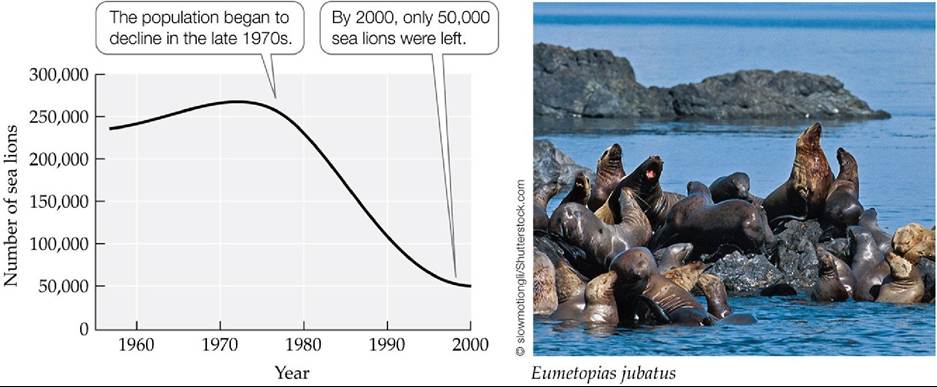
FIGURE 21.8 Steller Sea Lion Population Decline in Alaska Thepopulationofsealions in the Gulf of Alaska and the Aleutian Islands decreased by about 80% over 25 years. (After A. W.
Trites and C. P. Donnelly. 2003. Mamm Rev 33: 3-28; based on A. W. Trites and P. A. Larkin. 1996. Aquat
Mamm 22: 153-166; A. W. Trites, unpublished data.) View larger image
Trites and Donnelly considered the possibility that changes in the species of prey fish available had contributed to the decline of the Steller sea lions. They and others suggested that the decline might be related to declining prey quality, an idea they referred to as the “junk food hypothesis.” Prior to the decline, the diet of the sea lions had been primarily herring, a fish that is relatively rich in fats, along with small amounts of pollock, cod, salmon, and squid. During the period of the population decline, the sea lions' diet shifted away from herring toward a greater proportion of pollock and cod (TABLE 21.2). This change in diet reflected a shift toward cod dominance of the fish community from the 1970s through the 1990s. The causes of the change in fish community composition are uncertain but may be associated with overfishing, oil spills, disease, and longterm climate change. The proportions of fat and energy per mass of pollock and cod are approximately half those of herring. Captive Steller sea lions raised on a diet of herring and then switched to a diet of pollock lose body mass and fat, even with an unlimited supply of pollock.
TABLE 21.2 Proportion of Steller Sea Lion Scats and Stomachs Containing Five Prey Categories
| Years | Gadids (cod, pollock, hake) | Salmon | Small schooling fish (herring, capelin, eulachon, sand lance) | Cephalopods (squid) | Flatfish (flounder, sole) |
| 1990 1993 | 85.2 | 18.5 | 18.5 | 11.1 | 13.0 |
| 1985 1986 | 60.0 | 20.0 | 20.0 | 20.0 | 5.0 |
| 1976 1978 | 32.1 | 17.9 | 60.0 | 0.0 | 0.0 |
Source: R.
L. Merrick et al. 1997. Can JFishAquatSci 54: 1342-1348.
Based on their review of the available information, Trites and Donnelly concluded that nutritional stress was the most likely cause of the decline in the Steller sea lion population. The amount of prey available to the sea lions did not appear to have changed, but changes in the quality of that prey, and associated changes in trophic efficiency, contributed to the decline in the population through their effects on individual growth rates and birth rates. Others have suggested that the decline in Steller sea lion numbers may also be linked to changes in the trophic structure of the North Pacific (Springer et al. 2003). As described in the Case Study Revisited in Chapter 9, massive harvesting of great whales by humans in the mid-twentieth century may have forced their predators, killer whales, to hunt other prey, including Steller sea lions. As we describe in the next section, such “top-down” effects of predators on prey can have important consequences for energy flow in ecosystems.