What we know about ecology is always changing
The information in this book is not a static body of knowledge. Instead, like the natural world itself, our understanding of ecology is constantly changing. Like all scientists, ecologists observe nature and ask questions about how nature works.
For example, when the existence of amphibian deformities became widely known in 1995, some scientists set out to answer a series of questions about those deformities. There were many things they wanted to know: How many species were afflicted by deformities? Did amphibian deformities occur in a few or many geographic regions? What caused the deformities, and did these causes differ among species or geographic regions?The questions stimulated by the discovery of amphibian deformities illustrate the first in a series of four steps by which scientists can learn about the natural world. These four steps constitute the scientific method, which can be summarized as follows:
1. Observe nature and ask a well-framed question about those observations.
2. Use previous knowledge or intuition to develop possible answers to that question. In science, such possible explanations of a well-framed question are called hypotheses.
3. Evaluate competing hypotheses by performing experiments or gathering carefully selected observations.
4. Use the results of those experiments or observations or of models to modify one or more of the hypotheses, to pose new questions, or to draw conclusions about the natural world.
This four-step process is iterative and self-correcting. New observations lead to new questions, which stimulate ecologists to formulate and test new ideas about how nature works. The results from such tests can lead to new knowledge, still more questions, or the abandonment of ideas that fail to explain the results. Although this four-step process is not followed exactly in all scientific studies, the back-and-forth between observations, questions, and results—potentially leading to a reevaluation of existing ideas—captures the essence of how science is done.
We've already seen some examples of how the process of scientific inquiry works: as answers to some questions about amphibian deformities were found, new questions arose, and new discoveries were made. You can explore one such discovery in ANALYZING DATA 1.1, which examines whether introduced species can cause amphibian populations to decline. Indeed, new discoveries occur in all fields of ecology, suggesting that our understanding of ecological processes is, and always will be, a work in progress.
ANALYZING DATA 1.1
Are Introduced Predators a Cause of Amphibian Decline?
Introduced predators are one of many factors thought to have contributed to amphibian population declines, although only a few studies have tested this hypothesis. In one such study, Vance Vredenburg* assessed the effects of two introduced fish species, the rainbow trout (Oncorhynchus mykiss) and the brook trout (Salvelinus fontinalis), on a frog species in decline, the mountain yellow-legged frog (Rana muscosa). Prior to any experimental manipulations, Vredenburg surveyed 39 lakes. For each lake, he noted whether introduced trout were present and then estimated frog abundance; the data from his survey include the following:
| Lake status | Average frog density (per 10 m of shoreline) |
| Trout absent | 184.8 |
| Trout present | 15.3 |
Vredenburg then performed experiments in which he compared frog abundances in three categories of lakes: removal lakes (from which he removed introduced trout), fishless control lakes (that had never contained trout), and fish control lakes (that still contained trout). The data obtained from these experiments appear in the graph. Error bars show one standard error (SE) of the mean.
1. From the survey data in the table, construct a bar graph showing the average density of frogs in lakes with and without trout.
What can you conclude from these data? In your answer, distinguish between causation and correlation.2. Explain why two types of control lakes were used in the experiment.
3. Consider the data for removal lakes 1, 2, and 3. For each of these lakes, calculate (a) the average number of frogs (per 10 m of shoreline) for the 1-year period that ends just before the time frame during which trout were removed and (b) the average number of frogs (per 10 m of shoreline) for the 1year period that starts a year after the removal of trout began. What can you conclude from these calculations?
4. What do the survey and experimental results suggest about (a) the effect of introduced trout on amphibian populations and (b) prospects for population recovery once trout are removed?
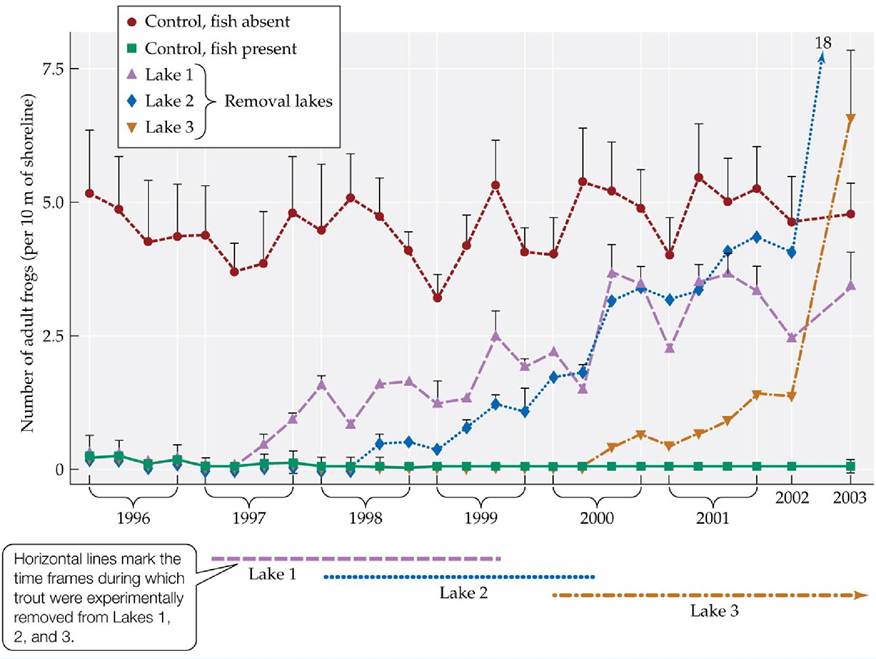
*Vredenburg, V. T. 2004. Reversing introduced species effects: Experimental removal of introduced fish leads to rapid recovery of a declining frog. Proceedings of the National Academy of Sciences U.S.A. 101: 7646-7650. © 2004 National Academy of Sciences, U.S.A.
A Case Study Revisited
Deformity and Decline in Amphibian Populations
As we've seen in this chapter, amphibian deformities are often caused by parasites, but they can also be influenced by other factors, such as exposure to pesticides or fertilizers. Studies have also suggested that a range of factors can cause amphibian abundances to drop. Such factors include habitat loss, parasites and diseases, pollution, climate change, overexploitation, and introduced species.
A consensus has yet to be reached on the relative importance of these and other factors that affect amphibian declines. For example, Stuart et al. (2004) analyzed the results of studies on 435 amphibian species that have experienced rapid declines since 1980. Habitat loss was the primary cause of decline for the largest number of species (183 species), followed by overexploitation (50 species).
The cause of decline for 207 species was listed as “enigmatic”: populations of these species were declining rapidly for reasons that were poorly understood. Skerratt et al. (2007) argued that many such enigmatic declines were caused by pathogens such as the chytrid Batrachochytrium dendrobatidis, a fungus that causes a lethal skin disease. This conclusion has now been supported by many other studies (e.g., Voyles et al. 2009; Berger et al. 2016). Although the fungus continues to spread rapidly and has driven hundreds of amphibian populations to extinction, there are signs of hope. For example, McMahon et al. (2014) have shown that some amphibians can acquire resistance to B. dendrobatidis when exposed to live or dead fungus, while others have found evidence of resistance in wild populations (Eskew et al. 2015; Voyles et al.2018).
Other researchers have emphasized the importance of ongoing climate change. Hof et al. (2011a), for example, project that by 2080, climate change will harm more amphibian species than will B. dendrobatidis. The impacts of factors such as disease and climate change are not mutually exclusive, however. Indeed, Rohr and Raffel (2010) found that while disease often led to amphibian declines, climate change also played a key role. In particular, the impact of increased temperature variability appears to have decreased the resistance of frogs to B. dendrobatidis (Raffel et al. 2012).
Collectively, these and other studies of amphibian population declines suggest that no single factor can explain most of them. Instead, the declines seem to be caused by complex factors that often act together and may vary from place to place. Consider, for example, the effects of pesticides. Although pesticides appear to increase the incidence of frog deformities, many studies have failed to directly link pesticides to decreases in the size of amphibian populations. However, many of these negative findings came from laboratory studies that held other factors constant and examined the effect of pesticides alone on amphibian growth or survival.
Rick Relyea, of Rensselaer Polytechnic Institute, repeated such experiments, but with an added twist: predators. In two of six amphibian species studied, pesticides became up to 46 times more lethal if tadpoles sensed the presence of a predator (Relyea 2003). The predators were kept separate from the tadpoles by netting, but the tadpoles could smell them.In Relyea's experiments, the ability of some tadpoles to cope with pesticides was reduced by stress caused by the presence of a predator. The mechanism by which these two factors act together is unknown. In general, although we know that a broad set of factors can cause frog deformities and declines (FIGURE 1.13), relatively little is known about the extent to which these factors interact or how any such interactions exert their effects. In this and many other areas of ecology, we have learned enough to solve parts of the mystery, yet more remains to be discovered.
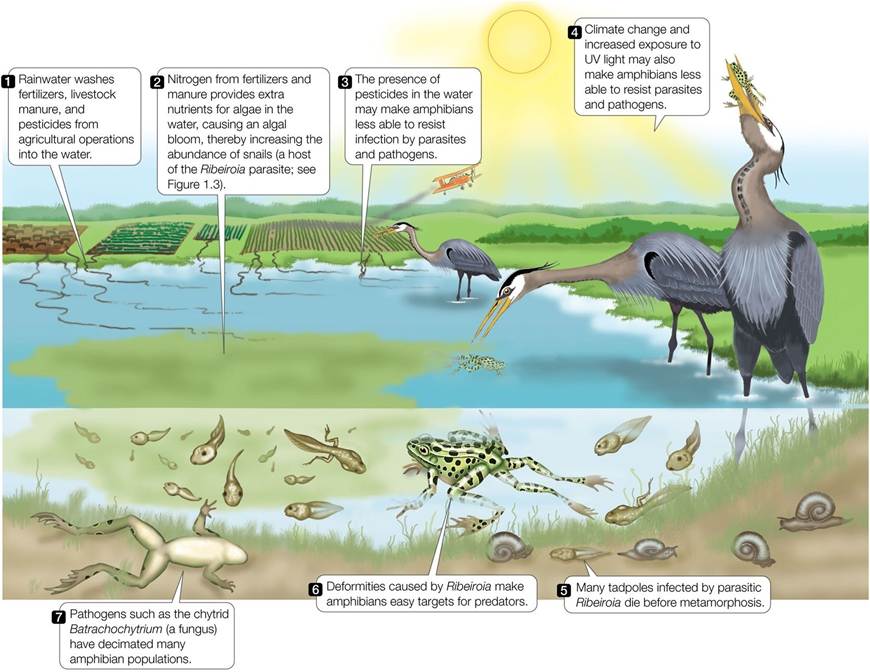
FIGURE 1.13 Complex Causation of Amphibian Deformities and Declines As we have seen, amphibian deformities can be caused by parasites such as Ribeiroia. However, other factors—many of them a result of human actions—may interact to cause amphibian deformities and declines. (After A. R. Blaustein and P. T. J. Johnson. 2003. SciAm 288: 60-65.) View larger image
Connections in Nature
Mission Impossible?
As we emphasized in the opening pages of this chapter, people have begun to realize that it is important for us to understand how nature works, if only to protect ourselves from inadvertently changing our environment in ways that cause us harm. Does the fact that the natural world is vast, complex, and interconnected mean that it is impossible to understand? Most ecologists do not think so. Our understanding of natural systems has improved greatly over the last 100 years. Ongoing efforts to understand how nature works are sure to be challenging, but such efforts are also enormously exciting and important.
What we learn, and how we use that knowledge, will have a great impact on the current and future well-being of human societies. Whatever your career path, we hope this book will help you understand the natural world in which you live, as well as how you affect—and are affected by—that world.SUMMARY
CONCEPT 1.1 Events in the natural world are interconnected.
1.1.1 Explain how interactions between organisms and their environment can affect other organisms and potentially lead to unexpected consequences.
Laboratory and field experiments on the effects of parasites on amphibian deformities illustrate how events in nature can be connected with one another.
Because events in the natural world are interconnected, any action can have unanticipated side effects.
People both depend on and affect the natural environment.
CONCEPT 1.2 Ecology is the scientific study of interactions between organisms and their environment.
1.2.1 Summarize how the inquiries of ecologists and environmental scientists differ.
Ecology is a scientific discipline that is related to, but differs from, disciplines such as environmental science.
Public and professional ideas about ecology often differ.
1.2.2 Outline how ecologists use spatial and temporal scales
when testing their hypotheses.
Ecology is broad in scope and encompasses studies at many levels of biological organization.
All ecological studies address events on some spatial and temporal scales while ignoring events at other scales.
CONCEPT 1.3 Ecologists evaluate competing hypotheses about natural systems with observations, experiments, and models.
1.3.1 Compare the advantages and disadvantages of using field observations, field experiments, and lab experiments to test ecological hypotheses.
In an ecological experiment, an investigator alters one or more features of the environment and observes the effect of that change on natural processes.
Some features of the natural world are best investigated with a combination of field observations, experiments, and quantitative models.
1.3.2 Describe the importance of hypotheses, controls, replication, and data analysis to the scientific process.
Experiments are designed and analyzed in consistent ways: typically, each treatment, including the control, is replicated; treatments are assigned at random; and statistical methods are used to analyze the results.
REVIEW QUESTIONS
1. Describe what the phrase connections in nature means, and explain how such connections can lead to unanticipated side effects. Illustrate your points with an example discussed in the chapter.
2. What is ecology, and what do ecologists study? If an ecologist studied the effects of a particular gene, how might the emphasis of that researcher’s work differ from the emphasis of the work of a geneticist or cell biologist.
3. How does the scientific method work? Include in your answer a description of a controlled experiment.