BETWEEN- AND WiTHiN-COUNTRY INEQUALITY
Table 11.3 also presents estimates of between-country and within-country inequality, and Figure 11.3 plots these estimates. Between-country inequality is defined as global inequality under the hypothetical assumption that every individual is assigned his or her country’s mean per capita household income.
It suppresses inequality within countries and measures inequality in the global distribution among world citizens where the only source of variation is mean per capita income across countries (in other words, between-country inequality is just concept 2 global inequality). Between-country inequality is well-defined for any inequality index, and we report it in Table 11.3 for the Gini, MLD (or Theil L), and Theil T measures. For the decomposable measures MLD and Theil T, the difference between overall global inequality and between-country inequality is a weighted average of inequality in each country, and is denoted as within-country inequality. In the case of MLD (i.e., Theil L), within-country inequality is a population-share weighted average of the MLD in each country, whereas for Theil T it is an income-share weighted average of the Theil T in each country (Anand, 1983, pp. 86-92).In the case of MLD (Theil L) only, the within-country component has an additional interpretation: it is equal to what global inequality would be under the hypothetical assumption that mean per capita incomes are equalized between countries, while relative inequality is kept constant within each country. In this sense it is a natural complement to the definition of between-country inequality, and for this reason we consider MLD to be strictly decomposable, but Theil T to be only weakly decomposable (Anand, 1983, pp. 198-202).
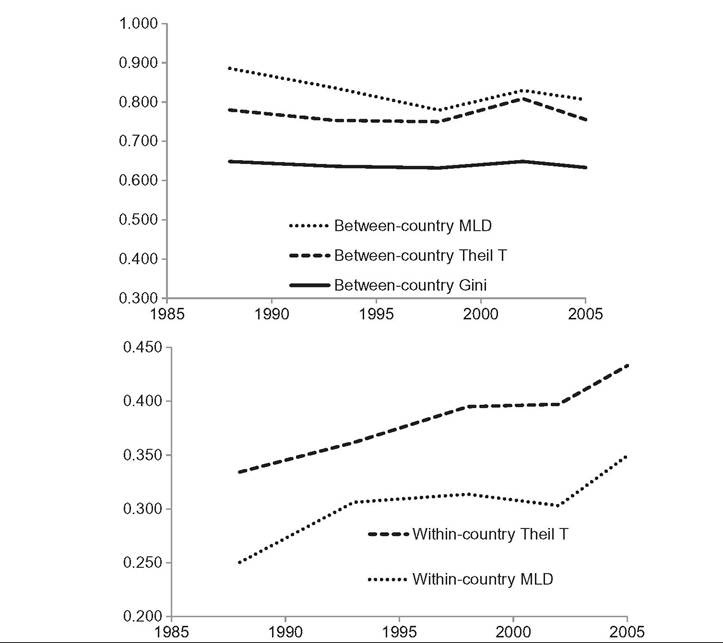
Figure 11.3 Between-country and within-country global inequality with top incomes, 1988-2005.
Source: Table 11.3.Considering estimates of global inequality with top incomes, we make four observations from Table 11.3 (top panel). First, between-country inequality is larger than within-country inequality for both the decomposable indices. Between-country inequality ranges between 70% and 78% of overall global inequality for MLD and between 64% and 70% for Theil T.
Second, the inclusion of top income data increases the within-country component substantially, as would be expected. For MLD the within-country component rises by between 23% and 25%, depending on the year, whereas for Theil T it rises by between 57% and 72%. The between-country component also changes because our imputation of the income share of the top percentile increases country mean incomes by different proportionate amounts.
Third, from 1988 to 2005 between-country inequality declines by all three measures, as shown in Table 11.3. For the estimates with top income data, the between-country Gini falls by 2% from 0.649 to 0.633, the between-country MLD declines 9% from 0.886 to 0.806, whereas the between-country Theil T declines 3% from 0.780 to 0.755.
Fourth, over the period 1988—2005 within-country inequality clearly increases for both decomposable indices as seen in Figure 11.3. For estimates with top income data, the within-country MLD rises by 40% from 0.250 to 0.349, and the within-country Theil T rises by 30% from 0.334 to 0.433.[687]
The Gini coefficient is not a decomposable measure in either the weak or strong sense. Although we can define the between-country Gini straightforwardly, the residual from overall global inequality cannot be interpreted as within-country inequality (see Anand, 1983, pp. 311—326). However, as with any inequality index, we can answer the question of what happens to the global Gini and to Theil T when country mean incomes are equalized but relative inequality is kept constant within each country (Anand, 1983, p. 201). This question is relevant in assessing the following claims.
On the basis of the fact that between-country inequality is greater than within- country inequality, Sala-i-Mart#953;n (2002, p. 39) stated that “the best strategy to reduce world income inequalities is to induce aggregate economic growth in poor countries.” Similarly, Rodrik (2013, p. 12) noted that “the more rapid growth of poor countries since the 1990s is the key behind the recent decline in global inequality,” concluding from this that “aggregate economic growth in the poorest countries is the most powerful vehicle for reducing global inequality.” For economic growth in poor countries to reduce global inequality, it would of course have to be more rapid than growth in richer countries. In this case, the greatest reduction in global inequality that could possibly be achieved without addressing within-country inequality is calculated by eliminating between-country income differences while keeping inequality within each country constant. Conducting this exercise for 2005 with top income data, the Gini would decline from 0.727 to 0.437 and Theil T from 1.188 to 0.433; in the case of the strictly decomposable MLD, the decline is from 1.156 to its within-country component of0.349. This is a large decline, but global inequality would still remain at about the level of a high- inequality country such as China, where in 2005 we find the Gini to be 0.430, MLD to be 0.367, and Theil T to be 0.324.
In Section 11.3 we pointed out that the concept of sigma convergence in the growth literature has little relationship to any other concept of global inequality. Bourguignon et al. (2004) used GNI per capita and found that what we call concept 2 inequality fell between 1980 and 2002, while concept 1 inequality rose. Similarly, in our data, between- country inequality (i.e., concept 2 global inequality) declines by all measures during 1988—2005, whereas we find “sigma divergence” when we calculate concept 1 global
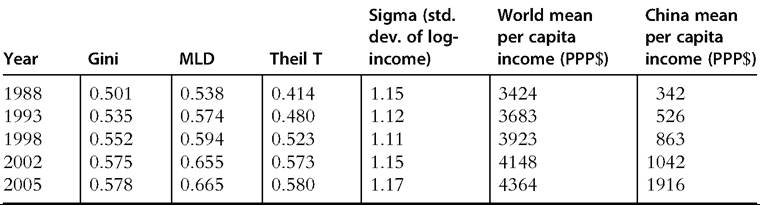
Table 11.5 Concept 1 inequality, calculated using per capita incomes from survey data with top incomes
Source: Authors' calculations.
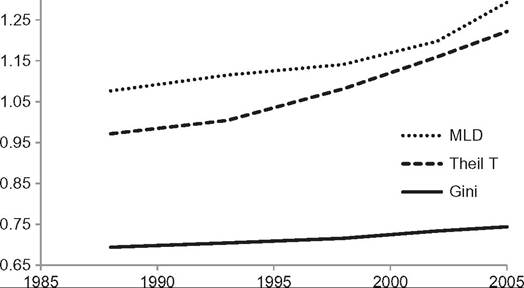
Figure 11.4 Global inequality without China, based on survey data with top incomes. Source: Authors' calculations.
inequality, as shown in Table 11.5. The three inequality measures increase when applied to the concept 1 distribution: the concept 1 Gini increases from 0.501 to 0.578, MLD from 0.538 to 0.665, and Theil T from 0.414 to 0.580. The standard deviation of (unweighted) log mean income also rises from 1.15 to 1.17.[688]
Table 11.5 also presents mean per capita survey incomes for the world, and for China separately. Several papers have estimated global inequality excluding China (e.g., Milanovic, 2012; Sala-i-Mart#953;n, 2006; and Schultz, 1998), and we present our estimates in Figure 11.4, which include the top income data. They indicate that global inequality without China increases by all three measures: the Gini rises by 0.050, MLD by 0.217 and Theil T by 0.250. We would note, however, that although these estimates are instructive from the point of view of accounting for global inequality and its evolution, they have no global welfare implications because they exclude approximately one-fifth of the world population.
11.7.