RELATIVE AND ABSOLUTE GLOBAL INEQUALITY
In an article entitled “What Are We Trying to Measure?” the development economist Dudley Seers (1972, pp. 34-35, endnote 2) made a telling distinction between relative and absolute inequality when he wrote: “Suppose, for example, that a perspective plan specified that [the] per capita income of Brazil doubled in the next thirty years, but assumed no change in distribution or in the proportion unemployed.
Then at the turn of the century, a big landowner in the Matto Grosso could run four cars, instead of two, and a peasant in the North-East could eat two kilogrammes of meat a year instead of one. His son might well be still out of work. Could we really call that ‘development’?”. Although relative inequalities in this example have remained unchanged, the absolute differences have grown in proportion to the expansion of the economy. In addition to considering relative global inequality, there is clearly a case for examining absolute global inequality—as noted, for example, by Ravallion (2004).The first thorough investigation of measures of absolute global inequality is by Atkinson and Brandolini (2010). They posited a “world social welfare function,” which exhibits a changing social marginal valuation of income at different points along the global income distribution (see also Anand and Sen, 2000). The absolute cost of inequality is then expressed in terms of Atkinson’s (1970) concept of “equally distributed equivalent income” for this social welfare function (see also Kolm, 1969). For any income distribution, Atkinson defines the equally distributed equivalent income as that level of income per head, which, if equally distributed, would yield the same level of social welfare as the existing distribution. Then the absolute cost of inequality is the income per head that is “wasted” as a result of inequality (i.e., it is mean income minus the equally distributed equivalent income).
(The relative cost of inequality is the absolute cost divided by the mean, which is the definition of Atkinson’s index of relative income inequality.)For the Gini welfare function, the absolute cost of inequality is mean income #956; multiplied by the Gini coefficient G, and the relative cost is simply G (Anand, 1983; Sen, 1973). In general, mean income #956; times a relative inequality measure produces the corresponding absolute inequality measure. For the relative global inequality measures G, MLD, and Theil T, we also estimate the absolute global inequality measures #956;G, #956;MLD, and #956;T, respectively, where #956; is the world mean income. The world mean income at 2005 PPP$ is shown in Table 11.6 for the years 1988-2005.
Table 11.7 shows the evolution of absolute global inequality with top income data between 1988 and 2005 as measured by the Gini, MLD, and Theil T, expressed as a ratio of 2005 world mean income calculated from surveys with top incomes added (PPP$4364).
Table 11.6 World mean income at 2005 PPP$, alternative estimates
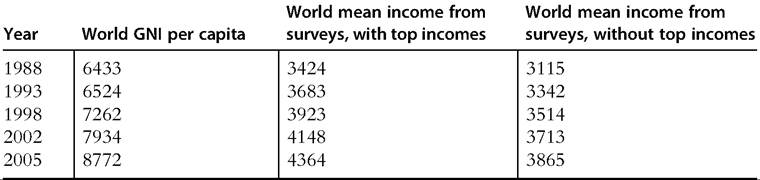
Source: GNI per capita from World Development Indicators, http://data.worldbank.org/data-catalog/world-development- indicators. Estimates of world mean income from surveys, with and without top incomes, are authors' calculations.
Table 11.7 Absolute global inequality using survey data with top incomes added, as a ratio of 2005 world mean income (PPP$4364)
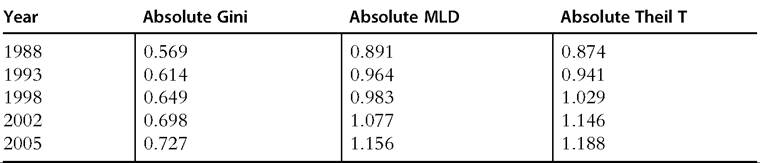
Source: Authors' calculations.
Over the 17-year period 1988-2005, there has been an unambiguous rise in absolute global inequality according to all three measures. This is unsurprising given the rise in world mean incomes over this period. To prevent a rise in absolute inequality, relative inequality has to decrease at a faster rate than the rise in mean incomes—which seems an unlikely prospect for the global economy.
In Section 11.2 of this chapter we noted and discussed the widespread concern about global income inequality—in terms of both its level and change. Given that there appears to be little movement in relative global inequality (see Section 11.5), whereas there is a significant widening of absolute global inequality (Table 11.7), the widespread concern about inequality may be based on people making comparisons of living standards in absolute rather than relative terms.
11.8.