CONCLUSIONS AND OUTLOOK FOR THE FUTURE
24.6.1 What Has Been Achieved So Far?
Tax-benefit modeling is now in widespread use to provide evidence in the policy-making process. Tax-benefit models are used within governments to provide costings of policy reforms and impact assessments of distributional and incentive effects.
They are used to assess progress towards meeting targets within relevant policy domains (and may be used to set feasible targets in the first place). They are used to explore the implications of alternative reform options. Other participants in the policy-making process (opposition political parties, special interest groups, NGOs, international organizations, and civil society generally) may also put forward their own perspectives and alternative proposals on the basis of microsimulation analysis. All of them may draw on the growing body of microsimulation-informed economic analysis from academic research. Within academia, microsimulation is also an accepted and recognized part of the toolbox in applied public economics, other branches of applied economics, and other disciplines, such as quantitative social policy, sociology, and political science. Evidence for this is provided by the increasing frequency of publication of articles making use of microsimulation in mainstream journals, as is clear from the references included in this chapter, and reliance on microsimulation analysis in the economic debate, as illustrated by Mirrlees et al. (2010).Microsimulation modeling provides an opportunity for fruitful links between the policy-making and academic communities. There are many instances in which methodological developments within academic policy-focused research have provided new and more sophisticated tools that can be adopted for use by policy-making institutions. One example is the modeling of labor supply responses, which is increasingly included in microsimulation models used by government agencies.
There are also instances in which innovation has taken place within government agencies in response to particular policy needs, as well as instances of the analytical needs of policymakers providing the impetus for academic developments. One example from the European Union is the adoption of social targets for Europe 2020 and the need to develop methods of forecasting micro-level indicators. Forging such links can bring additional benefit in the form of more open channels of communication with the official producers and providers of micro-data about the data requirements of microsimulation models and the potential benefits for policy-making.In our view there are four major strands of technical/methodological achievement and ongoing progress in the use of tax-benefit microsimulation for the analysis of policy and income inequality. A formal framework for disentangling the effect of policies on income distribution is an important step toward better understanding how various studies have approached measuring these effects and their consistency. A coherent framework can no doubt greatly increase the clarity and transparency of microsimulation studies and facilitate links with other relevant methodological literature. The devil is in the details and microsimulation modeling offers these in abundance.[564]
Behavioral microsimulation is no longer limited to the academic sphere, and it has an increasing impact on policy-motivated analysis. Further developments of behavioral models in terms of policy scope (e.g., extending economic modeling to cover areas such as housing, mobility, and saving) and their robustness based on the comparison with ex-post evaluation studies may strengthen their role in the policy and economic debate. Moreover, the cross-fertilization between the analytical and the computational approach to the optimal taxation problem based on behavioral microsimulation models could reinforce the link between public finance theory and applied research.
The analysis of tax-benefit policies with a clear impact on the labor market participation and the evaluation of the impact of macroeconomic shocks would clearly benefit from the availability of counterfactuals that consider feedback effects between the micro and macro level. A fully integrated micro-macro model, although daunting in terms of the time and resources required to create it, is potentially an incredibly powerful tool for moving beyond the partial equilibrium framework in which microsimulation models operate, for disentangling the effects of macro changes on individual resources, and for extending the policy scope of the analysis through the linkage to environmental models. However, the practical, conceptual, and methodological challenges are formidable. Even so, falling short of full model integration, improving methods of linking microsimulation analysis to macroeconomic data in various ways has been, and remains, an important part of the developing toolbox.
Cross-country comparisons of policy effects, and especially policy swap analysis, inform our understanding of the variation in the effects of policies in different economic and sociodemographic contexts, and, at the same time, these comparisons offer the opportunity for cross-country “policy learning.” The development of EUROMOD, and other multicountry models, has facilitated this type of analysis, while maintaining comparability of concepts and measurement and consistency in the operation of policy rules. There is potential to extend the approach to global regions other than the EU, such as southern Africa, Latin America, or the Balkan region (where, arguably, policy learning is most relevant). There is also potential to extend beyond the EU to include all OECD countries to aid comparisons, for example, between the EU and the US.
There is room for improvement and for development in two key areas. The first relates to the data and methods that are available for input into and adoption by microsimulation models.
Our understanding of how available micro-data may be improved and reconciled with other information, as well as the potential of new forms and sources of data that may improve the quality and scope of simulation or facilitate linkage with other models (macro, environmental, etc.), are areas for attention. In terms of methodological improvements, more attention is clearly needed to assess statistical significance and reliability of results obtained with microsimulation models drawing on various statistical methods.The second area for improvement relates to the organization of microsimulation activities. There is much duplication of effort (with many models doing the same or similar things in some countries), combined with problems oflack of transparency (i.e., lack of documentation, results that are not reproducible by others). Furthermore, most existing models are not made available or accessible to the people who might make use of them. The final two subsections explore the outlook for microsimulation and policy analysis along these two dimensions.
24.6.2 Data and Methodological Developments
Microsimulation models require access to appropriate and good quality micro-datasets that are themselves well-documented and validated against independent information. The trend toward making more use of register (administrative) data to supply information on income receipt (and in some cases many other variables) is welcome in the sense that it reduces measurement problems and underreporting and potentially frees up resources (e.g., survey interview time) for the collection of more or better quality data in other dimensions. At the same time, such linkage may introduce new problems. It may delay the delivery time of the micro-data if there are limits on the speed of obtaining and processing administrative information. Use of administrative information may also raise new concerns about data confidentiality, which may result in additional restrictions on the ways in which the datasets can be accessed and by whom.
There seem to be trade-offs between using high-precision data and widespread access.Technological developments may offer possible ways around these trade-offs, if models and their micro-level data (both input and output) are housed on a suitably secure server and accessed remotely. This is a mode of working that was pioneered for income distribution analysis by LIS32 and, in spite of the additional complexities associated with microsimulation modeling, has also been successfully deployed in a few other cases. These include the WIDER African models, as well as two adaptations of national components of EUROMOD: Mefisto for Flanders (Decancq et al., 2012) and Soresi for Austria.33 In each of these cases, the broad aim of the models is to provide access to modeling capacity by civil society, with the simulation and output options offered to users structured and restricted accordingly. More critically in this context, in each case the providers of the input micro-data have given permission for such access over the web. It remains to be seen whether it will be possible to make use of high-precision administrative data in this way. Even so, there would be other technical and pedagogical challenges to be overcome in offering to the public the full flexibility of a model like EUROMOD using remote access.
More generally there is potential to extend the policy scope and applicability of microsimulation models through the statistical linkage of data from different sources. Given the increasing complexity of tax-benefit systems that operate through direct and indirect taxes, wealth and property taxes, and cash and noncash benefits, microsimulation models can help in understanding the overall effect on individual material wellbeing only if more comprehensive surveys become available, cross-links between various administrative datasets are utilized further, or systematic and rigorous matching procedures are implemented and documented. A prime example is the analysis of the effects of indirect taxes, because any conclusion about the incidence and regressivity of taxes can be easily biased by the data inconsistency observed, in particular, at the tails of the income distribution (see Decoster et al., 2010; Brewer and O’Dea, 2012).
Finally, making progress on many of the technical challenges associated with microsimulation modeling, most notably the modeling of take-up and compliance behavior, is also inhibited by lack of suitable data. For example, nonreceipt of a benefit entitlement may be explained in many ways, ranging from (among other causes) measurement error in the survey responses, lack of information about eligibility on the part of a nonclaimant, or a decision not to claim due to the costs of claiming. It is likely that the relative importance of each factor varies with national context and specific benefit. Accurate modeling of the probability of taking up (i.e., receiving, given positive entitlement) a particular benefit, in principle, needs to take any one or many possible causes into account, which would typically be demanding in terms of the data requirements. Modeling of tax noncompliance at the individual level is even more demanding given the concealed nature of such activities and a potentially wider range of possible factors and interactions at play. Progress in these areas can therefore be expected to be patchy and uneven, depending on the specific problems and the data possibilities.
24.6.3 The Case for a Collaborative Approach
Few models are accessible beyond their producers. This leads to a proliferation of many similar models and the (largely wasteful) duplication of effort that this involves. It also limits access to models because building from scratch is time-consuming and requires specialist skills; there are significant barriers to entry. Furthermore, the need to provide in the public domain documentation or validation of models that are essentially private to their producers is rarely acted upon. This lack of transparency inhibits proper evaluation of microsimulation-based studies, and lack of access inhibits the reproducibility of microsimulation analyses. Together, these factors may reduce the chances of microsimulation-based studies being published in the top scientific journals. As Wolfson (2009, p. 29) says:
.... microsimulation modelling still has not achieved the kind of scientific status it deserves. One reason is that many potential users are concerned about the 'black box' nature of microsimulation models. An important step, therefore, is for microsimulation modelling to become a 'glass box' activity, including for example public availability of the model and open source code.
Models are also expensive to maintain and keep up to date. If there were fewer, better models that were made generally accessible, this would improve efficiency and quality. A collaborative approach would also bring the various types of use and user closer together and, with the appropriate level of (technical) model flexibility, could also facilitate innovations such as model linkages. EUROMOD and TAXSIM provide two rather different examples of models that already take this approach. EUROMOD makes available both tax-benefit codes and input data to anyone with permission to access the original micro-data sources, while TAXSIM provides online access to the tax calculator that may be linked to input data of the user’s own choosing.[565]
Of course, there are also good reasons why microsimulation models are developed as individually or institutionally private investments. In some cases the necessary micro-data cannot be made available more widely (e.g., in the case of government models, especially those using administrative data). In the academic sphere, there are few incentives to share technical developments as public goods in the matter suggested, especially if they embody a large time investment and if they do not themselves attract academic reward.
If the benefits of an open and collaborative approach are to be realized the main challenges are to find ways of organizing and funding arrangements that account for the longterm investment aspect, due to the need to maintain models, as well as engage in initial construction. This would include developing an incentive structure that recognized the academic value of the work done on the “public good” research infrastructure, while
34
eliciting contributions in some form from the users of the models who might otherwise “free ride.” In the end, cooperation within the microsimulation community and particularly between academic researchers and policy makers will contribute to the integration of microsimulation for policy analysis into the mainstream of economic policy-making (Atkinson, 2009).
ACKNOWLEDGMENTS
We wish to thank Tony Atkinson, Franrjois Bourguignon, and Brian Nolan for their comments and suggestions on the early drafts of this chapter. We are also grateful to Paola De Agostini, John Creedy, Mathias Dolls, Carlo Fiorio, Horacio Levy, Marcello Morciano, Andreas Peichl, Iva Tasseva, and Alberto Tumino for comments and useful discussions, as well as information or permission to make use of their analysis. Paulus and Sutherland acknowledge the support for this work from the core funding of the Research Centre on Micro-Social Change and from the UK Economic and Social Research Council (grant RES-518-28-001).
APPENDIX A. INCREASING UK CHILD BENEFIT IN 2001 AND 2013: THE NET EFFECTS
In both 2001 and 2013, the UK Child Benefit was delivered as a universal benefit for all children under the age of 19 in full-time nonadvanced education. In both years there were two rates, one for the oldest child (£15.50 and £20.30 per week, respectively) and one for any other children (£10.35 and £13.40 per week, respectively). As an illustration, we double these values and use EUROMOD to calculate the net budgetary cost after the operation of the rest of the tax and benefit systems, and we also show how the gain per child would vary across the household income distribution.
In 2001, Child Benefit was disregarded by the income tax system but was taken into account for the assessment of Income Support (and income-related Job Seeker’s Allowance), Housing Benefit, and Council Tax Benefit, some of the main UK means-tested benefits for working-age people and their families. (The Working Families Tax Credit disregarded Child Benefit.) As the table shows, although the gross cost of the increase in Child Benefit is estimated at £8.85 billion per year, once the reduced entitlements to these benefits are taken into account, the net cost falls to £7.01 billion or 79% of the gross.
In contrast, in the 2013 system, the Child Benefit is disregarded in the assessment of all means-tested payments, but higher-income parents who pay income tax at the 40% (or higher) marginal rate have the value of their Child Benefit included in their tax calculation. Thus, as shown in the table, the cost of the increase in Child Benefit is offset to a small extent by an increase in income tax liabilities. In addition, in 2013, there was a cap on the overall sum of benefits that could be received by families in some circumstances. This would result in some families not receiving all or any of their Child Benefit increase. In 2013, the gross cost of the increase in Child Benefit is estimated at £11.55 billion per year, and once the reduced entitlements to these benefits are taken into account, the net cost falls to £11.14 billion or 96% of the gross.
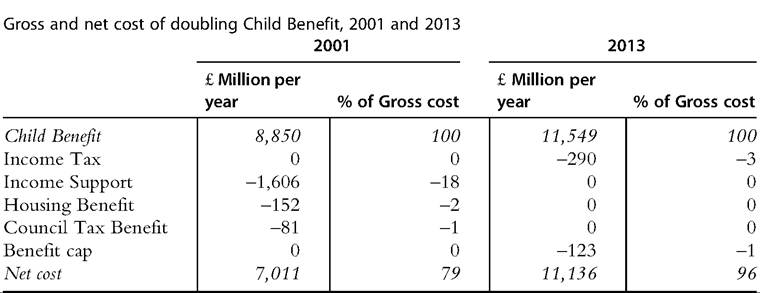
Source: EUROMOD version F6.20, using Family Resources Survey data for 2008—2009, adjusted to2001 and 2013 prices and incomes.
There are different distributional consequences of these differences between gross and net effects, as shown in Figure 24.A1 below. This shows the average net weekly increase in income per child by decile group of equivalized household income under the 2001 and 2013 policy systems. Under the 2001 system, those in the lower income groups receive less, because some of the additional income is withdrawn as reduced entitlement to the means-tested benefit. (This applies to a lesser extent in the bottom decile group in which families simulated to not take-up their entitlements to means-tested benefits are mainly located.) In 2013, however, it is children in higher income households who benefit to a lesser extent, due to the clawback through income tax (the effect of the benefit cap is small and concentrated in the lower-middle of the distribution).
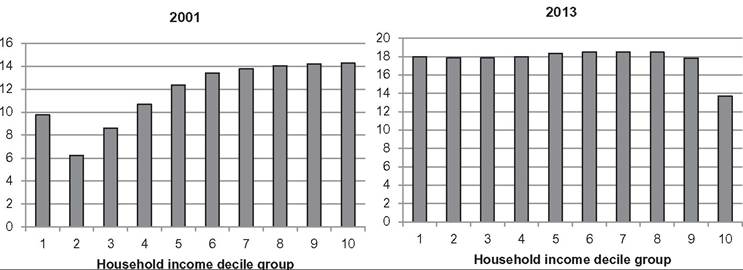
Figure 24.A1 Doubling Child Benefit in the UK: Average net gain per child in £ per week. Notes: Deciles are based on equivalized household disposable income in the respective years and are constructed using the modified OECD equivalence scale to adjust incomes for differences in household size and composition. The lowest income group is labeled “1” and the highest “10.” Source: EUROMOD version F6.20, using Family Resources Survey data for 2008-2009, adjusted to 2001 and 2013 prices and incomes.
The point of this illustration is to demonstrate how the interactions matter and need to be understood when designing policy scenarios. Similarly, the policy analyst needs to account for the interactions in order to understand the effects of policy changes. If policymakers wanted to double the payment made to all children in 2001, they would have needed to increase child amounts within the other benefits as well as in Child Benefit. On the other hand, if the goal had been to reduce the number of families subject to means tests (without anyone losing), then the illustrative reform would have done just that (for example, reducing the number of all households receiving Council Tax Benefit). If the goal in 2013 had been to reduce the reach of means-testing, the means-tested payment rates for children would have needed to be reduced at the same time as Child Benefit increase.
Appendix b. comparison of simulated estimates of income tax with administrative statistics, UK 2010-2011
Here we illustrate the type of validation of simulated income tax that can be carried out using published tables from administrative data of tax revenues. The exercise also suggests ways in which the input micro-data might be adjusted, or not. In this exercise, the input data are the UK Family Resources Survey (FRS) 2009-2010 updated to 2010-2011 incomes and prices.
Simulated income tax liabilities are compared with statistics on income tax paid by band of taxable income, published by the HM Revenue and Customs (HMRC, Table 3.3). The first point to note is that the tax paid in any year may not match the liability for tax on income earned in that year, because of adjustments carried over from previous years.
The first row in the top panel of the table below shows the ratio of microsimulation model (EUROMOD) estimates to those of HMRC in three dimensions: the number of taxpayers (defined as individuals with positive taxable income before deduction of any personal allowances), their total taxable income (before deduction of allowances), and the total tax liability/revenue. The number of taxpayers is underestimated by 7% and taxable income by more: 13%. Also shown are the ratios for the lowest taxable income group (under £10,000 per year) and highest income group (over £150,000).[566]
Ratio of EUROMOD estimates to HMRC statistics
| Taxpayers | Taxable income | Tax revenue | |
| EUROMOD | |||
| All | 0.93 | 0.87 | 0.85 |
| Taxable income bgcolor=white>0.91 | |||
| Taxable income in Britain. The Joseph Rowntree Foundation, The Policy Press, Bristol. Alm, J., 2012. Measuring, explaining, and controlling tax evasion: lessons from theory, experiments, and field studies. Int. Tax Public Financ. 19, 54-77. Alm, J., McClelland, G.H., Schulze, W.D., 1992. Why do people pay taxes? J. Public Econ. 48 (1), 21-38. Alm, J., Deskins, J., McKee, M., 2009. Do individuals comply on income not reported by their employer? Public Financ. Rev. 37 (2), 120-141. Alm, J., Cherry, T.L., Jones, M., McKee, M., 2012. Social programs as positive inducements for tax participation. J. Econ. Behav. Organ. 84 (1), 85-96. Anderson, P.M., Meyer, B.D., 1997. Unemployment insurance takeup rates and the after-tax value of benefits. Q. J. Econ. 112 (3), 913-937. Anderson, B., Agostini, P.D., Lawson, T., 2014. Estimating the small area effects of austerity measures in the UK. In: Dekkers, G., Keegan, M., O’Donoghue, C. (Eds.), New Pathways in Microsimulation. Ashgate, Farnham, pp. 11—28 (Chapter 2). Andreoni, J., Erard, B., Feinstein, J., 1998. Tax compliance. J. Econ. Lit. 36 (2), 818—860. Atkinson, A.B., 2009. An enlarged role for tax-benefit models. In: Lelkes, O., Sutherland, H. (Eds.), Tax and Benefit Policies in the Enlarged Europe: Assessing the Impact with Microsimulation Models. Ashgate, Vienna, pp. 33-46 (Chapter 2). Atkinson, A.B., Marlier, E., 2010. Living conditions in Europe and the Europe 2020 agenda. In: Atkinson, A.B., Marlier, E. (Eds.), Income and Living Conditions in Europe. Eurostat Statistical Books, Publications Office of the European Union, Luxembourg, pp. 21-35 (Chapter 1). Atkinson, A.B., Sutherland, H., 1989. Scaling the “poverty mountain”: methods to extend incentives to all workers. In: Bowen, A., Mayhew, K. (Eds.), Improving Incentives for the Low Paid. NEDO, Macmillan, London. Atkinson, A.B., King, M.A., Sutherland, H., 1983. The analysis of personal taxation and social security. Natl. Inst. Econ. Rev. 103, 63-74. Atkinson, A.B., Bourguignon, F., Chiappori, P.-A., 1988. What do we learn about tax reform from international comparisons? France and Britain. Eur. Econ. Rev. 32 (2-3), 343-352. Atkinson, A.B., Bourguignon, F., O’Donoghue, C., Sutherland, H., Utili, F., 2002. Microsimulation of social policy in the European Union: case study of a European minimum pension. Economica 69, 229-243. Atta-Darkua, V., Barnard, A., 2010. Distributional effects of direct taxes and social transfers (cash benefits). In: Atkinson, A.B., Marlier, E. (Eds.), Income and Living Conditions in Europe. Eurostat Statistical Books, Publications Office of the European Union, Luxembourg, pp. 345-368 (Chapter 16). Auerbach, AJ., Feenberg, D., 2000. The significance of federal taxes as automatic stabilizers. J. Econ. Per- spect. 14 (3), 37-56. Avram, S., Figari, F., Leventi, C., Levy, H., Navicke, J., Matsaganis, M., Militaru, E., Paulus, A., Rastrigina, O., Sutherland, H., 2013. The distributional effects of fiscal consolidation in nine EU countries. EUROMOD Working Paper EM2/13, University of Essex, Colchester. Azzolini, D., Bazzoli, M., De Poli, S., Fiorio, C., Poy, S., 2014. TREMOD: A Microsimulation Model for the Province of Trento (Italy), EUROMOD Working Paper EM15/14. University of Essex, Colchester. Banbura, M., Giannone, D., Reichlin, L., 2011. Nowcasting. In: Clements, M.P., Hendry, D.F. (Eds.), The Oxford Handbook of Economic Forecasting. Oxford University Press, Oxford. Bargain, O. (Ed.), 2007. Micro-Simulation in Action: Policy Analysis in Europe Using EUROMOD. Research in Labor Economics, vol. 25. Elsevier, Oxford. Bargain, O., 2012a. Decomposition analysis of distributive policies using behavioural simulations. Int. Tax Public Financ. 19 (5), 708-731. Bargain, O., 2012b. The distributional effects of tax-benefit policies under New Labour: a decomposition approach. Oxf. Bull. Econ. Stat. 74 (6), 856-874. Bargain, O., Callan, T., 2010. Analysing the effects of tax-benefit reforms on income distribution: a decomposition approach. J. Econ. Inequal. 8 (1), 1-21. Bargain, O., Orsini, K., 2007. Beans for breakfast? How portable is the British workfare model? In: Bargain, O. (Ed.), Micro-Simulation in Action: Policy Analysis in Europe Using EUROMOD. Research in Labor Economics, vol. 25. Elsevier, Oxford, pp. 165-198. Bargain, O., Immervoll, H., Viitamaki, H., 2012. No claim, no pain. Measuring the non-take-up of social assistance using register data. J. Econ. Inequal. 10 (3), 375-395. Bargain, O., Dolls, M., Fuest, C., Neumann, D., Peichl, A., Pestel, N., Siegloch, S., 2013a. Fiscal union in Europe? Redistributive and stabilizing effects of a European tax-benefit system and fiscal equalization mechanism. Econ. Policy 28 (75), 375-422. Bargain, O., Dolls, M., Immervoll, H., Neumann, D., Peichl, A., Pestel, N., Siegloch, S., 2013b. Partisan tax policy and income inequality in the U.S., 1979-2007, IZA Discussion Paper 7190. Bargain, O., Orsini, K., Peichl, A., 2014. Comparing labor supply elasticities in Europe and the US: new results. J. Hum. Resour. 49 (3), 723-838. Benedek, D., Lelkes, O., 2011. The distributional implications of income under-reporting in Hungary. Fisc. Stud. 32 (4), 539-560. Bennett, F., Sutherland, H., 2011. The importance of independent income: understanding the role of nonmeans-tested earnings replacement benefits. ISER Working Paper 2011-09, University of Essex, Colchester. Betson, D., Greenberg, D., Kasten, R., 1982. A simulation analysis of the economic efficiency and distribution effects of alternative program structures: the negative income tax versus the credit income tax. In: Garfinkel, I. (Ed.), Income Tested Transfer Programs: The Case For and Against. Academic Press, New York, pp. 175-203 (Chapter 6). Betti, G., Donatiello, G., Verma, V., 2011. The SienaMicrosimulation Model (SM2) for net-gross conversion of EU-SILC income variables. Int. J. Microsimulation 4 (1), 35-53. Bingley, P., Walker, I., 1997. The labour supply, unemployment and participation of lone mothers in in-work transfer programmes. Econ. J. 107 (444), 1375-1390. Bingley, P., Walker, I., 2001. Housing subsidies and work incentives in Great Britain. Econ. J. 111 (471), C86-C103. Bitler, M.P., Currie, J., Scholz, J.K., 2003. WIC eligibility and participation. J. Hum. Resour. 38, 1139-1179. Blank, R.M., Ruggles, P., 1996. When do women use aid to families with dependent children and food stamps? The dynamics of eligibility versus participation. J. Hum. Resour. 31 (1), 57-89. Blazevski, N.M., Petreski, M., Petreska, D., 2013. Increasinglabour market activity of the poor and females: Let’s make work pay in Macedonia. EUROMOD Working Paper EM16/13, University of Essex, Colchester. Blundell, R., 2006. Earned income tax credit policies: impact and optimality. The Adam Smith Lecture, 2005. Labour Econ. 13 (4), 423-443. Blundell, R., 2012. Tax policy reform: the role of empirical evidence. J. Eur. Econ. Assoc. 10 (1), 43-77. Blundell, R., Shepard, A., 2012. Employment, hours of work and the optimal taxation of low income families. Rev. Econ. Stud. 79, 481-510. Blundell, R., Fry, V., Walker, I., 1988. Modelling the take-up of means-tested benefits: the case of housing benefits in the United Kingdom. Econ. J. 98 (390), 58-74. Blundell, R., Chiappori, P., Magnac, T., Meghir, C., 2007. Collective labour supply: heterogeneity and nonparticipation. Rev. Econ. Stud. 74, 417-445. Boadway, R., Wildasin, D., 1995. Taxation and savings: a survey. Fisc. Stud. 15 (3), 19-63. Borella, M., Coda Moscarola, F., 2010. Microsimulation of pension reforms: behavioural versus non behavioural approach. J. Pension Econ. Financ. 9 (4), 583-607. Bourguignon, F., Bussolo, M., 2013. Income distribution in computable general equilibrium modelling. In: Dixon, P.B., Jorgenson, D.W. (Eds.), Handbook of Computable General Equilibrium Modelling. vol. 1B. Elsevier, Amsterdam, pp. 1383-1437 (Chapter 21). Bourguignon, F., Spadaro, A., 2006. Microsimulation as a tool for evaluating redistribution policies. J. Econ. Inequal. 4 (1), 77-106. Bourguignon, F., Chiappori, P.A., Hugounenq, R., 1993. Exploring the distribution and incentive effects of tax harmonization. In: Heimler, A., Meulders, D. (Eds.), Empirical Approaches to Fiscal Policy Modelling. Chapman and Hall, London, pp. 235-250 (Chapter 11). Bourguignon, F., Robilliard, A.S., Robinson, S., 2005. Representative versus real households in the macroeconomic modelling of inequality. In: Kehoe, T.J., Srinivasan, T.N., Whalley, J. (Eds.), Frontiers in Applied General Equilibrium Modelling. Cambridge University Press, Cambridge, pp. 219-254 (Chapter 10). Bozio, A., Fabre, B., Goupille,J., Laffeter, Q.,2012.Le modele de micro-simulation TAXIPP—version 0.2. Institut des Politiques Publique, Paris. Brandolini, A., D’Amuri, F., Faiella, I., 2013. Country case study—Italy. In: Jenkins, S.P., Brandolini, A., Micklewright, J., Nolan, B. (Eds.), The Great Recession and the Distribution of Household Income. Oxford University Press, Oxford, pp. 130-152 (Chapter 7). Brewer, M., O’Dea, C., 2012. Measuring living standards with income and consumption: evidence from the UK. ISER Working Paper 2012-05, University of Essex, Colchester. Brewer, M., Francesconi, M., Gregg, P., Grogger, J., 2009. In-work benefit reform in a cross-national perspective—introduction. Econ. J. 119 (535), F1-F14. Brewer, M., Saez, E., Shephard, A., 2010. Means-testing and tax rates on earnings. In: Mirrlees,J., Adam, S., Besley, T., Blundell, R., Bond, S., Chote, R., Gammie, M., Johnson, P., Myles, G., Poterba, J. (Eds.), Dimensions of Tax Design: The Mirrlees Review. Oxford University Press, Oxford, pp. 90—173, (Chapter 2). Brewer, M., Browne, J., Joyce, R., 2011. Child and working-age poverty from 2010 to 2020. IFS Commentary C121, The Institute for Fiscal Studies, London. Brewer, M., Browne,J., Hood, A.,Joyce, R., Sibieta, L., 2013. The short- andmedium-termimpacts ofthe recession on the UK income distribution. Fisc. Stud. 34 (2), 179—201. Brown, L.J., Harris, A., Picton, M., Thurecht, L., Yap, M., Harding, A., Dixon, P.B., Richardson, J., 2009. Linking microsimulation and macro-economic models to estimate the economic impact of chronic disease prevention. In: Zaidi, A., Harding, A., Williamson, P. (Eds.), New Frontiers in Microsimulation Modelling. Ashgate, Vienna, pp. 527-555 (Chapter 20). Bruckmeier, K., Wiemers, J., 2012. A new targeting: a new take-up? Non-take-up of social assistance in Germany after social policy reforms. Empir. Econ. 43 (2), 565-580. Caldwell, S.B., 1990. Static, Dynamic and Mixed Microsimulation. Department of Sociology, Cornell University, Ithaca. Callan, T., Sutherland, H., 1997. The impact of comparable policies in European countries: Microsimulation approaches. Eur. Econ. Rev. 41 (3-5), 627-633. Callan, T., Nolan, B., Walsh, J., 1999. Income tax and social welfare policies. In: Budget Perspectives 1999. ESRI, Dublin. Callan, T., Coleman, K., Walsh, J.R., 2007. Assessing the impact of tax-transfer policy changes on poverty: methodological issues and some European evidence. In: Bargain, O. (Ed.), Micro-Simulation in Action: Policy Analysis in Europe Using EUROMOD. Research in Labor Economics, vol. 25. Elsevier, Oxford. Cameron, G., Ezzeddin, R., 2000. Assessing the direct and indirect effects of social policy: integrating inputoutput and tax microsimulation models at Statistics Canada. In: Mitton, L., Sutherland, H., Weeks, M. (Eds.), Microsimulation Modelling for Policy Analysis: Challenges and Innovations. Cambridge University Press, Cambridge, pp. 42-65 (Chapter 3). Canto, O., Adiego, M., Ayala, L., Levy, H., Paniagua, M., 2014. Going regional: The effectiveness of different tax-benefit policies in combating child poverty in Spain. In: Dekkers, G., Keegan, M., O’Donoghue, C. (Eds.), New Pathways in Microsimulation. Ashgate, Farnham, pp. 183-202 (Chapter 12). Capeau, B., Decoster, A., Phillips, D.,2014. Micro-simulation models of consumption and indirect taxation. In: O’Donoghue, C. (Ed.), Handbook of Microsimulation Modelling. Emerald, Bingley (forthcoming). Ceriani, L., Fiorio, C.V., Gigliarano, C., 2013. The importance of choosing the data set for tax-benefit analysis. Int. J. Microsimulation 6 (1), 86-121. Chan, M.K., 2013. A dynamic model of welfare reform. Econometrica 81 (3), 941-1001. Clark, T., Leicester, A., 2004. Inequality and two decades of British tax and benefit reforms. Fisc. Stud. 25 (2), 129-158. Cleveland, R.W., 2005. Alternative income estimates in the United States: 2003, Current Population Reports P60-228, U.S. Census Bureau. Clotfelter, C., 1983. Tax evasion and tax rates: an analysis of individual returns. Rev. Econ. Stat. 65 (3), 363-373. Colombino, U., 2013. A new equilibrium simulation procedure with discrete choice models. Int. J. Microsimulation 6 (3), 25-49. Cowell, F.A., 2000. Measurement of inequality. In: Atkinson, A.B., Bourguignon, F. (Eds.), Handbook of Income Distribution. vol. 1. Elsevier, Amsterdam, pp. 87-166 (Chapter 2). Creedy, J., 1999a. Lifetime versus annual income distribution. In: Silber, J. (Ed.), Handbook on Income Inequality Measurement. Kluwer Academic Publishing, Dordrecht, pp. 513-533 (Chapter 17). Creedy, J., 1999b. Modelling Indirect Taxes and Tax Reform. Edward Elgar, Northampton. Creedy, J., 2004. Survey reweighting for tax microsimulation modelling. Res. Econ. Inequal. 12, 229-249. Creedy, J., Duncan, A., 2002. Behavioural microsimulation with labour supply responses. J. Econ. Surv. 16 (1), 1-39. Creedy, J., Herault, N., 2011. Decomposing inequality and social welfare changes: the use of alternative welfare metrics, Melbourne Institute Working Paper 8/11, University of Melbourne. Creedy, J., Kalb, G., 2005. Discrete hours labour supply modelling: specification, estimation and simulation. J. Econ. Surv. 19 (5), 697-734. Creedy, J., Kalb, G., Kew, H., 2007. Confidence intervals for policy reforms in behavioural tax microsimulation modelling. Bull. Econ. Res. 59 (1), 37-65. Currie, J., 2004. The take up of social benefits, NBER Working Paper 10488. Daponte, B.O., Sanders, S., Taylor, L., 1999. Why do low-income households not use Food Stamps? Evidence from an experiment. J. Hum. Resour. 34 (3), 612-628. De Lathouwer, L., 1996. A case study of unemployment scheme for Belgium and the Netherlands. In: Harding, A. (Ed.), Microsimulation and Public Policy. Contributions to Economic Analysis, vol. 232. North-Holland, Amsterdam, pp. 69-92 (Chapter 4). de Mooij, R., Keen, M., 2013. ‘Fiscal devaluation’ and fiscal consolidation: the VAT in troubled times. In: Alesina, A., Giavazzi, F. (Eds.), Fiscal Policy After the Financial Crisis. University of Chicago Press, Chicago, pp. 443-485 (Chapter 11). de Vos, K., Zaidi, A., 1996. The use of microsimulation to update poverty statistics based on household budget surveys: a pilot study for the UK. In: Harding, A. (Ed.), Microsimulation and Public Policy. Contributions to Economic Analysis, vol. 232. North-Holland, Amsterdam, pp. 111-128 (Chapter 6). Decancq, K., Decoster, A., Spiritus, K., Verbist, G., 2012. MEFISTO: a new micro-simulation model for Flanders, FLEMOSI Discussion Paper 14. Decoster, A., Van Camp, G., 2000. The unit of analysis in microsimulation models for personal income taxes: fiscal unit or household? In: Mitton, L., Sutherland, H., Weeks, M. (Eds.), Microsimulation Modelling for Policy Analysis: Challenges and Innovations. Cambridge University Press, Cambridge, pp. 15-41 (Chapter 2). Decoster, A., Van Camp, G., 2001. Redistributive effects of the shift from personal income taxes to indirect taxes: Belgium 1988-93. Fisc. Stud. 22 (1), 79-106. Decoster, A., Loughrey, J., O’Donoghue, C., Verwerft, D., 2010. How regressive are indirect taxes? A microsimulation analysis for five European countries. J. Policy Anal. Manage. 29 (2), 326-350. Decoster, A., Loughrey, J., O’Donoghue, C., Verwerft, D., 2011. Microsimulation of indirect taxes. Int. J. Microsimulation 4 (2), 41-56. Dekkers, G., Buslei, H., Cozzolino, M., Desmet, R., Geyer, J., Hofmann, D., Raitano, M., Steiner, V., Tanda, P., Tedeschi, S., Verschueren, F., 2010. The flip side of the coin: the consequences of the European budgetary projections on the adequacy of social security pensions. Eur. J. Soc. Secur. 12 (2), 94-121. Dekkers, G., Keegan, M., O’Donoghue, C. (Eds.), 2014. New Pathways in Microsimulation. Ashgate, Farnham. Doerrenberg, P., Duncan, D., 2013. Distributional implications of tax evasion: evidence from the lab. Public Financ. Rev. (forthcoming). Dolls, M., Fuest, C., Peichl, A., 2012. Automatic stabilizers and economic crisis: US vs. Europe. J. Public Econ. 96 (3-4), 279-294. Dorsett, R., Heady, C., 1991. The take-up of means-tested benefits by working families with children. Fisc. Stud. 12 (4), 22-32. Dowling, R., Skabardonis, J., Halkias, J., McHale, G., Zammit, G., 2004. Guidelines for calibration of microsimulation models: framework and applications. Transport. Res. Rec. 1876 (1), 1-9. Duclos, J.-Y., 1995. Modelling the take-up of state support. J. Public Econ. 58 (3), 391-415. Duclos, J.-Y., 1997. Estimating and testing a model of welfare participation: the case of supplementary benefits in Britain. Economica 64 (253), 81-100. DWP, 2013. Households below average income: an analysis of the income distribution 1994/95-2011/12. Department for Work and Pensions, London. Elbers, C., Lanjouw, J., Lanjouw, P., 2003. Micro-level estimation of poverty and inequality. Econometrica 71 (1), 355-364. Elffers, H., Robben, H.S., Hessing, D.J., 1992. On measuring tax evasion. J. Econ. Psychol. 13 (4), 545-567. Erard, B., 1993. Taxation with representation: an analysis of the role of tax practitioners in tax compliance. J. Public Econ. 52 (2), 163-197. Erard, B., 1997. Self-selection with measurement errors. A microeconometric analysis of the decision toseek tax assistance and its implications for tax compliance. J. Econ. 81 (2), 319—356. Erard, B., Ho, C.-C., 2001. Searching for ghosts: who are the nonfilers and how much tax do they owe? J. Public Econ. 81 (1), 25-50. European Commission, 2013. Study on the impacts of fiscal devaluation. Number 36 in Taxation Papers, Publications Office of the European Union, Luxembourg. Feenberg, D.R., Coutts, E., 1993. An introduction to the TAXSIM model.J. Policy Anal. Manage. 12 (1), 189-194. Feinstein, J.S., 1991. An econometric analysis of income tax evasion and its detection. RAND J. Econ. 22 (1), 14-35. Feldstein, M.S., Feenberg, D.R., 1983. Alternative tax rules and personal saving incentives: microeconomic data and behavioral simulations. In: Feldstein, M.S. (Ed.), Behavioral Simulation Methods in Tax Policy Analysis. Chicago, London. Fernandez Salgado, M., Figari, F., Sutherland, H., Tumino, A., 2014. Welfare compensation forunemploy- ment in the Great Recession. Rev. Income Wealth 60, S177-S204. Figari, F., 2010. Can in-work benefits improve social inclusion in the southern European countries? J. Eur. Soc. Policy 20 (4), 301-315. Figari, F., Paulus, A., 2013. The distributional effects of taxes and transfers under alternative income concepts: the importance of three ‘I’s. Public Financ. Rev. (forthcoming). Figari, F., Levy, H., Sutherland, H., 2007. Using the EU-SILC for policy simulation: prospects, some limitations and suggestions. In: Comparative EU Statistics on Income and Living Conditions: Issues and Challenges. Eurostat Methodologies and Working Papers, Office for Official Publications of the European Communities, Luxembourg, pp. 345-373. Figari, F., Immervoll, H., Levy, H., Sutherland, H., 2011a. Inequalities within couples in Europe: market incomes and the role of taxes and benefits. East. Econ. J. 37, 344-366. Figari, F., Paulus, A., Sutherland, H., 2011b. Measuring the size and impact of public cash support for children in cross-national perspective. Soc. Sci. Comput. Rev. 29 (1), 85-102. Figari, F., Salvatori, A., Sutherland, H., 2011c. Economic downturn and stress testing European welfare systems. In: Immervoll, H., Peichl, A., Tatsiramos, K. (Eds.), Who Loses in the Downturn? Economic Crisis, Employment and Income Distribution. Research in Labor Economics, vol. 32. Emerald Group Publishing Limited, Bingley, pp. 257-286. Figari, F., Iacovou, M., Skew, A.J., Sutherland, H., 2012a. Approximations to the truth: comparing survey and microsimulation approaches to measuring income for social indicators. Soc. Indic. Res. 105 (3), 387-407. Figari, F., Paulus, A., Sutherland, H., Tsakloglou, P., Verbist, G., Zantomio, F., 2012b. Taxing home ownership: distributional effects of including net imputed rent in taxable income. EUROMOD Working Paper EM4/12, University of Essex, Colchester. Flood, L., 2007. Can we afford the future? An evaluation of the new Swedish pension system. In: Harding, A., Gupta, A. (Eds.), Modelling Our Future: Population Ageing, Social Security and Taxation. International Symposia in Economic Theory and Econometrics, vol. 15. Elsevier, Amsterdam, pp. 33-54 (Chapter 2). Forest, A., Sheffrin, S.M., 2002. Complexity and compliance: an empirical investigation. Natl. TaxJ. 55 (1), 75-88. Fortin, N., Lemieux, T., Firpo, S., 2011. Decomposition methods in economics. In: Ashenfelter, O., Card, D. (Eds.), Handbook of Labor Economics. vol. 4, Part A. Elsevier, Amsterdam, pp. 1-102 (Chapter 1). Frick, J.R., Grabka, M.M., Smeeding, T.M., Tsakloglou, P., 2010. Distributional effects of imputed rents in five European countries. J. Hous. Econ. 19 (3), 167-179. Fuest, C., Niehues, J., Peichl, A., 2010. The redistributive effects of tax benefit systems in the enlarged EU. Public Financ. Rev. 38 (4), 473-500. Fullerton, D., Metcalf, G.E., 2002. Tax incidence. In: Auerbach, A.J., Feldstein, M. (Eds.), Handbook of Public Economics. vol. 4. Elsevier, Amsterdam, pp. 1787-1872 (Chapter 26). Goedeme, T., Van den Bosch, K., Salanauskaite, L., Verbist, G., 2013. Testing the statistical significance of microsimulation results: a plea. Int. J. Microsimulation 6 (3), 50-77. Gomulka, J., 1992. Grossing up revisited. In: Hancock, R., Sutherland, H. (Eds.), Microsimulation Models for Public Policy Analysis: New Frontiers. London School of Economics, London, pp. 121—132 (Chapter 6). Gupta, A., Harding, A. (Eds.), 2007. Modelling Our Future: Population Ageing, Health and Aged Care. International Symposia in Economic Theory and Econometrics, vol. 16. Elsevier, Amsterdam. Gupta, A., Kapur, V. (Eds.), 2000. Microsimulation in Government Policy and Forecasting. Contributions to Economic Analysis, vol. 247. North-Holland, Amsterdam. Haan, P., 2010. A multi-state model of state dependence in labour supply. Labour Econ. 17 (2), 323-335. Haider, SJ., Jacknowitz, A., Schoeni, R.F., 2003. Food stamps and the elderly: why is participation so low? J. Hum. Resour. 38, 1080-1111. Hancock, R., 2000. Charging for care in later life: an exercise in dynamic microsimulation. In: Mitton, L., Sutherland, H.,Weeks, M. (Eds.), Microsimulation Modelling for Policy Analysis: Challenges and Innovations. Cambridge University Press, Cambridge, pp. 226-237 (Chapter 10). Hancock, R., Barker, G., 2005. The quality of social security benefit data in the British Family Resources Survey: implications for investigating income support take-up by pensioners. J. R. Stat. Soc. Ser. A Stat. Soc. 168 (1), 63-82. Hancock, R., Pudney, S., 2014. Assessing the distributional impact of reforms to disability benefits for older people in the UK: implications of alternative measures of income and disability costs. Ageing Soc. 34 (2), 232-257. Hancock, R., Pudney, S., Barker, G., Hernandez, M., Sutherland, H., 2004. The take-up of multiple means- tested benefits by British pensioners: evidence from the Family Resources Survey. Fisc. Stud. 25 (3), 279-303. Hancock, R., Malley, J., Wittenberg, R., Morciano, M., Pickard, L., King, D., Comas-Herrera, A., 2013. The role of care home fees in the public costs and distributional effects of potential reforms to care home funding for older people in England. Health Econ. Policy Law 8 (1), 47-73. Harding, A., 1993. Lifetime Income Distribution and Redistribution. Application of a Microsimulation Model. Contributions to Economic Analysis, vol. 221. North-Holland, Amsterdam. Harding, A., 1996a. Introduction and overview. In: Harding, A. (Ed.), Microsimulation and Public Policy. Contributions to Economic Analysis, vol. 232. North-Holland, Amsterdam, pp. 1-22 (Chapter 1). Harding, A. (Ed.), 1996b. Microsimulation and Public Policy.Contributions to Economic Analysis, vol. 232. North-Holland, Amsterdam. Harding, A., Gupta, A. (Eds.), 2007. Modelling Our Future: Population Ageing, Social Security and Taxation. In: International Symposia in Economic Theory and Econometrics, vol. 15. Elsevier, Amsterdam. Hernandez, M., Pudney, S., 2007. Measurement error in models of welfare participation. J. Public Econ. 91 (1-2), 327-341. Hernandez, M., Pudney, S., Hancock, R., 2007. The welfare cost of means-testing: pensioner participation in income support. J. Appl. Econ. 22 (3), 581-598. Hernanz, V., Malherbet, F., Pellizzari, M., 2004. Take-up of welfare benefits in OECD countries: a review of the evidence, Social, Employment and Migration Working Papers 17, OECD, Paris. HM Treasury, 2013. Budget 2013: policy costings, London. HMRC, 2012. The Exchequer effect of the 50 per cent additional rate of income tax. HM Revenue & Customs, London. Herault, N., 2010. Sequential linking of computable general equilibrium and microsimulation models: comparison of behavioural and reweighting techniques. Int. J. Microsimulation 3 (1), 35-42. Hungerford, T.L., 2010. The redistributive effect of selected federal transfer and tax provisions. Public Financ. Rev. 38 (4), 450-472. Hurst, E., Li, G., Pugsley, B., 2014. Are household surveys like tax forms: evidence from income underreporting of the self-employed. Rev. Econ. Stat. 96 (1), 19-33. Ilmakunnas, S., Pudney, S., 1990. A model of female labour supply in the presence of hours restrictions. J. Public Econ. 41 (2), 183-210. Immervoll, H., 2004. Average and marginal effective tax rates facing workers in the EU: a micro-level analysis of levels, distributions and driving factors, Social, Employment and Migration Working Papers 19, OECD, Paris. Immervoll, H., 2005. Falling up the stairs: the effects of‘bracket creep’ on household incomes. Rev. Income Wealth 51 (1), 37-62. Immervoll, H., O’Donoghue, C., 2001. Imputation of gross amounts from net incomes in household surveys: an application using EUROMOD. EUROMOD Working Paper EM1/01, University of Cambridge. Immervoll, H., O’Donoghue, C., 2004. What difference does a job make? The income consequences of joblessness in Europe. In: Gallie, D. (Ed.), Resisting Marginalisation: Unemployment Experience and Social Policy in the European Union. Oxford University Press, Oxford, pp. 105-139 (Chapter 5). Immervoll, H., Richardson, L., 2011. Redistribution Policy and Inequality Reduction in OECD Countries: What has Changed in Two Decades?, Social, Employment and Migration Working Papers 122. OECD Publishing, Paris. Immervoll, H., Levy, H., Lietz, C., Mantovani, D., O’Donoghue, C., Sutherland, H., Verbist, G., 2006a. Household incomes and redistribution in the European Union: quantifying the equalizing properties of taxes and benefits. In: Papadimitriou, D. (Ed.), The Distributional Effects of Government Spending and Taxation. Palgrave Macmillan, Basingstoke, pp. 135-165. Immervoll, H., Levy, H., Lietz, C., Mantovani, D., Sutherland, H., 2006b. The sensitivity of poverty rates to macro-level changes in the European Union. Camb. J. Econ. 30 (2), 181-199. Immervoll, H., Kleven, HJ., Kreiner, C.T., Saez, E., 2007. Welfare reform in European countries: a microsimulation analysis. Econ. J. 117 (516), 1-44. Isaacs, J.B., Healy, O., 2012. The recession’s ongoing impact on children, 2012. The Urban Institute. Jara, H.X., Tumino, A., 2013. Tax-benefit systems, income distribution and work incentives in the European Union. Int. J. Microsimulation 6 (1), 27-62. Jenkins, S.P., 2011. Changing Fortunes: Income Mobility and Poverty Dynamics in Britain. Oxford University Press, Oxford. Johns, A., Slemrod, J., 2010. The distribution of income tax noncompliance. Natl. Tax J. 63 (3), 397-418. Keane, M.P., 2010. Structural vs. atheoretic approaches to econometrics. J. Econ. 156 (1), 3-20. Keane, M.P., Moffitt, R., 1998. A structural model of multiple welfare program participation and labor supply. Int. Econ. Rev. 39 (3), 553-589. Keane, C., Callan, T., Savage, M., Walsh, J., Timoney, K., 2013. Identifying policy impacts in the crisis: microsimulation evidence on tax and welfare. J. Stat. Soc. Inquiry Society Ireland 42, 1-14. Kim, K., Lambert, P.J., 2009. Redistributive effect of U.S. taxes and public transfers, 1994-2004. Public Financ. Rev. 37 (1), 3-26. King, M.A., 1983. The distribution of gains and losses from changes in the tax treatment of housing. In: Feldstein, M. (Ed.), Behavioural Simulation Methods in Tax Policy Analysis. University of Chicago Press, Chicago, pp. 109-137 (Chapter 4). Klepper, S., Nagin, D., 1989. The anatomy of tax evasion. J. Law Econ. Organ. 5 (1), 1-24. Kleven, H.J., Knudsen, M.B., Kreiner, C.T., Pedersen, S., Saez, E., 2011. Unwilling or unable to cheat? Evidence from a tax audit experiment in Denmark. Econometrica 79 (3), 651-692. Klevmarken, N.A., 1997. Behavioral modeling in micro simulation models. A survey. Department of Economics, Uppsala University, Working Paper 31. Klevmarken, N.A., 2002. Statistical inference in micro-simulation models: incorporating external information. Math. Comput. Simul. 59 (1-3), 255-265. Klevmarken, N.A., 2008. Dynamic microsimulation for policy analysis: problems and solutions. In: Klevmarken, A., Lindgren, B. (Eds.), Simulating an Ageing Population: A Microsimulation Approach Applied to Sweden. Contributions to Economic Analysis, vol. 285. Emerald Group Publishing Limited, Bingley, pp. 31-53 (Chapter 2). Kotlikoff, L.J., Rapson, D., 2007. Does it pay, at the margin, to work and save? Measuring effective marginal taxes on Americans’ labor supply and saving. Tax Pol. Econ. 21, 83-143. Lanjouw, P., Marra, M., Nguyen, C., 2013. Vietnam’s evolving poverty map: patterns and implications for policy. Policy Research Working Paper 6355, The World Bank, Washington, DC. Laury, S., Wallace, S., 2005. Confidentiality and taxpayer compliance. Natl. TaxJ. 58 (3), 427—438. Lelkes, O., Sutherland, H. (Eds.), 2009. Tax and Benefit Policies in the Enlarged Europe: Assessing the Impact with Microsimulation Models. Public Policy and Social Welfare, vol. 35. Ashgate, Vienna. Leventi, C., Matsaganis, M., Flevotomou, M., 2013. Distributional implications of tax evasion and the crisis in Greece. EUROMOD Working Paper EM17/13, University of Essex, Colchester. Levy, H., Lietz, C., Sutherland, H., 2007a. A guaranteed income for Europe’s children? In: Jenkins, S.P., Micklewright, J. (Eds.), Inequality and Poverty Re-Examined. Oxford University Press, Oxford. Levy, H., Lietz, C., Sutherland, H., 2007b. Swapping policies: alternative tax-benefit strategies to support children in Austria, Spain and the UK. J. Soc. Policy 36, 625—647. Levy, H., Morawski, L., Myck, M., 2009. Alternative tax-benefit strategies to support children in Poland. In: Lelkes, O., Sutherland, H. (Eds.), Tax and Benefit Policies in the Enlarged Europe: Assessing the Impact with Microsimulation Models. Public Policy and Social Welfare, vol. 35. Ashgate, Vienna, pp. 125—151 (Chapter 6). Levy, H., Matsaganis, M., Sutherland, H.,2013. Towards aEuropean Union childbasic income? Within and between country effects. Int. J. Microsimulation 6 (1), 63—85. Li, J., O’Donoghoue, C., 2013. A methodological survey of dynamic microsimulation models. Int. J. Microsimulation 6 (2), 3—55. Liegeois, P., Dekkers, G., 2014. CombiningEUROMOD and LIAM tools forthe development ofdynamic cross-sectional microsimulation models: a snack preview. In: Dekkers, G., Keegan, M., O’Donoghue, C. (Eds.), New Pathways in Microsimulation. Ashgate, Farnham, pp. 203—216 (Chapter 13). Lymer, S., Brown, L., Harding, A.,Yap,M., 2009. Predicting the needfor aged care services at the small area level: the CAREMOD Spatial Microsimulation Model. Int. J. Microsimulation 2 (2), 27—42. Lynn, P., Jackle, A., Jenkins, S.P., Sala, E., 2012. The impact of questioning method on measurement error in panel survey measures of benefit receipt: evidence from a validation study. J. R. Stat. Soc. Ser. A Stat. Soc. 175 (1), 289-308. Lyssiotou, P., Pashardes, P., Stengos, T., 2004. Estimates of the black economy based on consumer demand approaches. Econ. J. 114 (497), 622-640. Mabbett, D., Schelke, W., 2007. Bringing macroeconomics back into the political economy of reform: the Lisbon Agenda and the ‘fiscal philosophy’ of EMU. JCMS 45 (1), 81-103. Mahler, V.A., Jesuit, D.K., 2006. Fiscal redistribution in the developed countries: new insights from the Luxembourg Income Study. Soc. Econ. Rev. 4 (3), 483-511. Mantovani, D., Papadopoulos, F., Sutherland, H., Tsakloglou, P., 2007. Pension incomes in the European Union: policy reform strategies in comparative perspective. In: Bargain, O. (Ed.), Micro-Simulation in Action: Policy Analysis in Europe using EUROMOD. Research in Labor Economics, vol. 25. Elsevier, Oxford, pp. 27-71. Martinez-Vazquez, J., Rider, M., 2005. Multiple modes of tax evasion: theory and evidence. Natl. Tax J. 58 (1), 51-76. Marx, I., Vandenbroucke, P., Verbist, G., 2012. Can higher employment levels bring down relative income poverty in the EU? Regression-based simulations of the Europe 2020 target. J. Eur. Soc. Policy 22 (5), 472-486. Matsaganis, M., Flevotomou, M., 2008. A basic income for housing? Simulating a universal housing transfer in the Netherlands and Sweden. Basic Income Stud. 2 (2), 1-25. Matsaganis, M., Leventi, C., 2013. The distributional impact of the Greek crisis in 2010. Fisc. Stud. 34 (1), 83-108. Matsaganis, M., O’Donoghue, C., Levy, H., Coromaldi, M., Mercader-Prats, M., Rodrigues, C.F., Toso, S., Tsakloglou, P., 2006. Reforming family transfers in Southern Europe: is there a role for universal child benefits? Soc. Policy Soc. 5 (2), 189-197. Matsaganis, M., Levy, H., Flevotomou, M., 2010. Non-take up of social benefits in Greece and Spain. Soc. Policy Adm. 44 (7), 827-844. McFadden, D., 1974. Conditional logit analysis of qualitative choice behaviour. In: Zerembka, P. (Ed.), Frontiers in Econometrics. Academic Press, New York, pp. 105-142 (Chapter 4). Merz, J., 1986. Structural adjustment in static and dynamic microsimulation models. In: Orcutt, G.H., Merz, J., Quinke, H. (Eds.), Microanalytic Simulation Models to Support Social and Financial Policy. North-Holland, Amsterdam, pp. 423-446. Merz, J., 1991. Microsimulation—a survey of principles, developments and applications. Int. J. Forecast. 7 (1), 77-104. Meyer, B.D., Sullivan, J.X., 2011. Further results on measuring the well-being ofthe poor using income and consumption. Can. J. Econ. 44 (1), 52-87. Meyer, B.D., Mok, W.K.C., Sullivan, J.X., 2009. The under-reporting of transfers in household surveys: its nature and consequences, NBER Working Paper 15181. Mirrlees, J., Adam, S., Besley, T., Blundell, R., Bond, S., Chote, R., Gammie, M., Johnson, P., Myles, G., Poterba, J. (Eds.), 2010. Dimensions of Tax Design: The Mirrlees Review. Oxford University Press, Oxford. Mitton, L., Sutherland, H., Weeks, M. (Eds.), 2000. Microsimulation Modelling for Policy Analysis: Challenges and Innovations. Cambridge University Press, Cambridge. Moffitt, R., 1983. An economic model of welfare stigma. Am. Econ. Rev. 73 (5), 1023-1035. Morawski, L., Myck, M., 2010. ‘Klin’-ing up: effects of Polish tax reforms on those in and on those out. Labour Econ. 17 (3), 556-566. Navicke, J., Rastrigina, O., Sutherland, H., 2014. Nowcasting indicators of poverty risk in the European Union: a microsimulation approach. Soc. Indic. Res. 119 (1), 101-119. Nelissen, J.H., 1998. Annual versus lifetime income redistribution by social security. J. Public Econ. 68 (2), 223-249. Nolan, B., Callan, T., Maitre, B., 2013. Country case study—Ireland. In: Jenkins, S.P., Brandolini, A., Micklewright, J., Nolan, B. (Eds.), The Great Recession and the Distribution of Household Income. Oxford University Press, Oxford, pp. 113-129 (Chapter 4). OBR, 2013. Fiscal Sustainability Report. The Stationery Office, London. O’Donoghue, C., 2001. Dynamic microsimulation: a methodological survey. Braz. Electron. Econ. J. 4, 1-77 O’Donoghue, C. (Ed.), 2014. Handbook of Microsimulation Modelling. Emerald, Bingley (forthcoming). O’Donoghue, C., Baldini, M., Mantovani, D., 2004. Modelling the redistributive impact of indirect taxes in Europe: an application of EUROMOD, EUROMOD Working Paper EM7/01, University of Cambridge. O’Donoghue, C., Lennon, J., Hynes, S., 2009. The Life-Cycle Income Analysis Model (LIAM): astudy of a flexible dynamic microsimulation modelling computing framework. Int. J. Microsimulation 2 (1), 16-31. OECD, 2007. Benefits and Wages 2007. OECD, Paris. Orcutt, G.H., 1957. A new type of socio-economic system. Rev. Econ. Stat. 39 (2), 116-123. Orcutt, G.H., Greenberger, M., Korbel, J., Rivlin, A., 1961. Microanalysis of Socio-Economic Systems: A Simulation Study. Harper and Row, New York. Orcutt, G.H., Caldwell, S., Wertheimer, R., 1976. Policy Explorations Through Microanalytic Simulation. The Urban Institute, Washington, DC. Paulus, A., Peichl, A., 2009. Effects of flat tax reforms in Western Europe. J. Policy Model 31 (5), 620-636. Paulus, A., Cok, M., Figari, F., Hegedfis, P., Kralik, S., Kump, N., Lelkes, O., Levy, H., Lietz, C., Mantovani, D., Morawski, L., Sutherland, H., Szivos, P., Vork, A., 2009. The effects of taxes andben- efits on income distribution in the enlarged EU. In: Lelkes, O., Sutherland, H. (Eds.), Tax and Benefit Policies in the Enlarged Europe: Assessing the Impact with Microsimulation Models. Public Policy and Social Welfare, vol. 35. Ashgate, Vienna, pp. 65-90 (Chapter 4). Paulus, A., Sutherland, H., Tsakloglou, P., 2010. The distributional impact of in-kind public benefits in European countries. J. Policy Anal. Manage. 29 (2), 243-266. Pechman, J.A., 1973. Responsiveness of the federal individual income tax to changes in income. Brook. Pap. Econ. Act. 2, 385-427. Peichl, A., 2009. The benefits and problems of linking micro and macro models—evidence from a flat tax analysis. J. Appl. Econ. 12 (2), 301-329. Peichl, A., Siegloch, S., 2012. Accounting for labor demand effects in structural labor supply models. Labour Econ. 19 (1), 129-138. Piketty, T., Saez, E., 2007. How progressive is the U.S. federal tax system? A historical and international perspective. J. Econ. Perspect. 21 (1), 3-24. Pissarides, C.A., Weber, G., 1989. An expenditure-based estimate of Britain’s black economy. J. Public Econ. 39, 17-32. Popova, D., 2014. Distributional impacts of cash allowances for children: a microsimulation analysis for Russia and Europe. EUROMOD Working Paper EM2/14, University of Essex, Colchester. Pudney, S., Sutherland, H., 1994. How reliable are microsimulation results? An analysis of the role of sampling error in a U.K. tax-benefit model. J. Public Econ. 53 (3), 327-365. Pudney, S., Sutherland, H., 1996. Statistical reliability in microsimulation models with econometrically- estimated behavioural responses. In: Harding, A. (Ed.), Microsimulation and Public Policy. Contributions to Economic Analysis, vol. 232. North-Holland, Amsterdam, pp. 473-503 (Chapter 21). Pudney, S., Hancock, R., Sutherland, H., 2006. Simulating the reform of means-tested benefits with endogenous take-up and claim costs. Oxf. Bull. Econ. Stat. 68 (2), 135-166. Randelovic, S., Rakic, J.Z., 2013. Improving work incentives in Serbia: evaluation of a tax policy reform using SRMOD. Int. J. Microsimulation 6 (1), 157-176. Redmond, G., Sutherland, H., Wilson, M., 1998. The Arithmetic of Tax and Social Security Reform. A User’s Guide to Microsimulation Methods and Analysis. Cambridge University Press, Cambridge. Riphahn, R.T., 2001. Rational poverty or poor rationality? The take-up of social assistance benefits. Rev. Income Wealth 47 (3), 379-398. Robilliard, A.-S., Bourguignon, F., Robinson, S., 2008. Examining the social impact of the Indonesian financial crisis using a macro-micro model. In: Bourguignon, F., Bussolo, M., Pereira da Silva, L.A. (Eds.), The Impact of Macroeconomic Policies on Poverty and Income Distribution: Macro-Micro Evaluation Techniques and Tools. The World Bank and Palgrave Macmillan, New York, pp. 93-118 (Chapter 4). Rodrigues, C.F., 2007. Income in EU-SILC—net/gross conversion techniques for building and using EU-SILC databases. In: Comparative EU, Statistics on Income and Living Conditions: Issues and Challenges. Eurostat Methodologies and Working Papers, Office for Official Publications of the European Communities, Luxembourg, pp. 157-172. Salanauskaite, L., Verbist, G., 2013. Is the neighbour’s grass greener? Comparing family support in Lithuania and four other New Member States. J. Eur. Soc. Policy 23 (3), 315-331. Shorrocks, A., 2013. Decomposition procedures for distributional analysis: a unified framework based on the Shapley value. J. Econ. Inequal. 11 (1), 99-126. Slemrod, J., 2007. Cheating ourselves: the economics of tax evasion. J. Econ. Perspect. 21 (1), 25-48. Spielauer, M., 2011. What is social science microsimulation? Soc. Sci. Comput. Rev. 29 (1), 9-20. Stiglitz, J.E., 2012. The Price of Inequality. W. W. Norton & Co., New York. Sutherland, H., 1995. Static microsimulation models in Europe: a survey. Working Papers in Economics 9523, University of Cambridge. Sutherland, H., 2014. Multi-country microsimulation. In: O’Donoghue, C. (Ed.), Handbook of Microsimulation Modelling. Emerald, Bingley (forthcoming). Sutherland, H., Figari, F., 2013. EUROMOD: the European Union tax-benefit microsimulation model. Int. J. Microsimulation 6 (1), 4-26. Sutherland, H., Taylor, R., Gomulka, J., 2002. Combining household income and expenditure data in policy simulations. Rev. Income Wealth 48 (4), 517-536. Sutherland, H., Hancock, R., Hills, J., Zantomio, F., 2008. Keeping up or falling behind? The impact of benefit and tax uprating on incomes and poverty. Fisc. Stud. 29 (4), 467-498. Tanton, R., Edwards, K.L. (Eds.), 2013. Spatial Microsimulation: A Reference Guide for Users. Springer, New York. Tanton, R., McNamara, J., Harding, A., Morrison, T., 2009. Small area poverty estimates for Australia’s Eastern Seaboard in 2006. In: Zaidi, A., Harding, A., Williamson, P. (Eds.), New Frontiers in Microsimulation Modelling. Ashgate, Vienna, pp. 79-95 (Chapter 3). Tanton, R., Vidyattama, Y., Nepal, B., McNamara, J., 2011. Small area estimation using a reweighting algorithm. J. R. Stat. Soc. Ser. A Stat. Soc. 174 (4), 931-951. Thoresen, T.O., 2004. Reduced tax progressivity in Norway in the nineties: the effect from tax changes. Int. Tax Public Financ. 11 (4), 487-506. Urziua, C.M. (Ed.), 2012. Fiscal Inclusive Development: Microsimulation Models for Latin America, Instituto Tecnolcagico y de Estudios Superiores de Monterrey (ITESM). International Development Research Centre, United Nations Development Programme. van Soest, A., 1995. Structural models of family labor supply: a discrete choice approach. J. Hum. Resour. 30 (1), 63-88. Verbist, G., 2007. The distribution effect of taxes on pensions and unemployment benefits in the EU-15. In: Bargain, O. (Ed.), Micro-Simulation in Action: Policy Analysis in Europe using EUROMOD. Research in Labor Economics, vol. 25. Elsevier, Oxford, pp. 73-99. Verbist, G., Figari, F., 2014. The redistributive effect and progressivity of taxes revisited: an international comparison across the European Union. FinanzArchiv (forthcoming). Waddell, P., Borning, A., Noth, M., Freier, N., Becke, M., Ulfarsson, G., 2003. Microsimulation of urban development and location choices: design and implementation of UrbanSim. Netw. Spat. Econ. 3 (1), 43-67. Wagstaff, A., van Doorslaer, E., van der Burg, H., Calonge, S., Christiansen, T., Citoni, G., Gerdtham, U.- G., Gerfin, M., Gross, L., Hakinnen, U., John, J., Johnson, P., Klavus, J., Lachaud, C., Lauridsen, J., Leu, R.E., Nolan, B., Peran, E., Propper, C., Puffer, F., Rochaix, L., Rodriguez, M., Schellhorn, M., Sundberg, G., Winkelhake, O., 1999. Redistributive effect, progressivity and differential tax treatment: personal income taxes in twelve OECD countries. J. Public Econ. 72 (1), 73-98. Wang, C., Caminada, K., Goudswaard, K., 2012. The redistributive effect of social transfer programmes and taxes: a decomposition across countries. Int. Soc. Secur. Rev. 65 (3), 27-48. Wheaton, L., 2007. Underreporting of means-tested transfer programs in the CPS and SIPP. In: 2007 Proceedings of the American Statistical Association, Social Statistics Section. American Statistical Association, Alexandria, VA, pp. 3622-3629. Wheaton, L., Giannarelli, L., Martinez-Schiferl, M., Zedlewski, S.R., 2011. How do States’ safety net policies affect poverty? Working Families Paper 19, The Urban Institute, Washington, DC. Whelan, S., 2010. The take-up of means-tested income support. Empir. Econ. 39 (3), 847-875. Wilkinson, K., 2009. Adapting EUROMOD for use in a developing country—the case of South Africa and SAMOD. EUROMOD Working Paper EM5/09, University of Essex, Colchester. Wolf, D.A., 2004. Book review of Microsimulation in Government Policy and Forecasting (2000). In: Gupta, A., Kapur, V. (Eds.), Journal of Artificial Societies and Social Simulation 7, (1). Wolfson, M., 2009. Preface—Orcutt’s vision 50 years on. In: Zaidi, A., Harding, A., Williamson, P. (Eds.), New Frontiers in Microsimulation Modelling. Ashgate, Vienna, pp. 21-29. World Bank, 2013. Poverty prospects in Europe: assessing progress towards the Europe 2020 poverty and social exclusion targets in New European Union Member States. Report no: ACS4943, Human Development and Poverty Reduction and Economic Management Units. Wright, G., Noble, M., Barnes, H., 2014. NAMOD: a Namibian tax-benefit microsimulation model. EUROMOD Working Paper EM7/14, University of Essex, Colchester. Wu, B., Birkin, M., 2013. Moses: a dynamic spatial microsimulation model for demographic planning. In: Tanton, R., Edwards, K.L. (Eds.), Spatial Microsimulation: A Reference Guide for Users. Understanding Population Trends and Processes, vol. 6. Springer, New York, pp. 171-194. Zaidi, A., Rake, K., 2001. Dynamic microsimulation models: a review and some lessons for SAGE. SAGE Discussion Paper 2, London School of Economics. Zaidi, A., Harding, A., Williamson, P. (Eds.), 2009. New Frontiers in Microsimulation Modelling. Public Policy and Social Welfare, vol. 36. Ashgate, Vienna. Zantomio, F., Pudney, S., Hancock, R., 2010. Estimating the impact of a policy reform on benefit take-up: the 2001 extension to the minimum income guarantee for UK pensioners. Economica 77 (306), 234-254.
More economic literature on Economics.Studio
More on the topic CONCLUSIONS AND OUTLOOK FOR THE FUTURE:
-
Distribution of productive forces -
Economic theory -
General economic issues -
History of economic scientists -
Macroeconomics -
World economy -
-
Conflictology -
Ecology -
Economy -
Finance -
History -
Law -
Medicine -
Philosophy -
Religious studies -
|