EGALITARIAN POLITICAL PHILOSOPHY SINCE RAWLS
Rawls (1958) first published his ideas about equality over 50 years ago, although his magnum opus did not appear until 1971. His goal was to unseat utilitarianism as the ruling theory of distributive justice, and to replace it with a type of egalitarianism.
He argued that justice requires, after guaranteeing a system which maximizes civil liberties, a set of institutions that maximize the level of “primary goods” allocated to those who are among the worse off in society, in the sense of receiving the least amount of these goods. Economists call this principle maximin primary goods; Rawls often called it the difference principle. Moreover, he attempted to provide an argument for the recommendation based on construction of a “veil of ignorance” or “original position,” which shielded decision makers from knowledge of information about their situations that was “morally arbitrary,” so that the decision they came to regarding just allocation would be impartial. Thus, Rawls’s (1971) project was to derive principles of justice from rationality and impartiality.Rawls did not advocate maximining utility (even assuming interpersonal utility comparisons were available), but rather maximining (some index of) primary goods. This was, in part, his attempt to embed personal responsibility into the theory. For Rawls, welfare was best measured as the extent to which a person is fulfilling his or her plan of life: but he viewed the choice of life plan as something up to the individual, upon which social institutions had no business passing judgment. Primary goods were deemed to be those inputs that were required for the success of any life plan, and so equalizing primary goods bundles across persons (or passing to a maximin allocation that would dominate component-wise an equal allocation) was a way of holding persons responsible for their life-plan choice.
The question of how to aggregate the various primary goods into an index that would allow comparison of bundles was never successfully solved by Rawls (and some skeptical economists said that the subjective utility function was the obvious way to aggregate primary goods).Rawls defended the difference principle by arguing that it would be chosen by decision makers who were rational but were deprived of knowledge about their own situations in the world, to the extent that this knowledge included information about their physical, social, and biological endowments, which were a matter of luck, and therefore whose distribution Rawls described as morally arbitrary. He named the venue in which these souls would cogitate about justice the “original position.” In the original position, souls were assumed to know the laws of economics and to be self-interested. They were, moreover, to be concerned with the allocation of primary goods, because they did not know their life plans, or even the distribution of life plans in the actual society. Nor were they to know the distribution of physical and biological endowments in society.
Here, we believe Rawls made a major conceptual error. If the veil of ignorance is intended to shield decision makers from knowledge of aspects of their situations that are morally arbitrary, and only of those aspects, they should know their plans of life, which, by hypothesis, are not morally arbitrary, because Rawls deems that persons are responsible for their life plans. Second, although a person’s particular endowment of resources, natural and physical, might well be morally arbitrary (to the extent that these were determined by the luck ofthe birth lottery), the distribution of these resources is a fact of nature and society, and should be known by the denizens in the original position, just as they are assumed to know the laws of economics. Therefore, Rawls constructed his veil too thickly, on two counts, given his philosophical views.
Given the paucity of information available to the decision makers in the original position, it is not possible to use classical decision theory to solve the problem of the desirable allocation of primary goods.
Indeed, the only precise arguments that Rawls gives for the conclusion that the difference principle would be chosen in the original position occur at Rawls, 1999[1971], p. 134), and they essentially state that decision makers are extremely risk averse. For example:The second feature that suggests the maximin rule is the following: the person choosing has a conception of the good such that he cares very little, if anything, for what he might gain about the minimum stipend that he can, in fact, be sure of by following the maximin rule. It is not worthwhile for him to take a chance for the sake of further advantage, especially when it may turn out that he loses much that is important to him. The last provision brings in the third feature, namely, that the rejected alternatives have outcomes one can hardly accept. The situation involves grave risks.
But extreme risk aversion, which Rawls here depends on for his justification of maximin, is certainly not an aspect of rationality.
Thus, despite its enormous influence in political philosophy, Rawls’s argument for maximin is marred in two ways: first, its reliance on deducing the principle ofjustice from the original position was crucially flawed in depriving the denizens of that position of knowledge of features of themselves (life plans) and ofthe world (the distributions of various kinds of resources, including genetic ones, and ones possessed by families into which a person is born) which were not morally arbitrary,[130] and second, for its assumption (despite claims to the contrary by Rawls and others) that decision makers were extremely risk averse. The value of Rawls’s contribution is in stating a radical egalitarian position about the injustice of receiving resources through luck—and, in particular, the luck ofthe birth lottery—and that it shifted the equalisandum from utility to a kind of resource, primary goods. In our view, however, the project of deducing equality or maximin from rationality and impartiality alone was a failure.
Indeed, Moreno-Ternero and Roemer (2008) argue that some solidaristic postulate is necessary to deduce maximin or, more generally, to deduce some kind of egalitarianism as the ordering principle for social choice. Although egalitarians might wish to deduce their view from postulates that can garner universal approval (like rationality and impartiality), this is not possible. Therefore, an egalitarian theory ofjustice cannot have universal appeal, if the solidaristic postulate, which we believe necessary, is contentious.Although Rawls is usually viewed as the most important egalitarian political philosopher ofthe twentieth century, one may challenge the claim that his view is egalitarian: to wit, the just income distribution, for Rawls, allows incentive payments to the highly skilled in order to elicit their productive activity, even though this produces inequality. The main philosopher who challenges Rawls’s acceptance of incentive-based income inequality is Cohen, whom we discuss below.
In 1981, Ronald Dworkin published two articles that essentially addressed the problems in the Rawlsian argument that we have summarized, although he did not use the Rawlsian language (original position, primary goods). His project was to define a conception of equality that was ethically sound. In the first of these articles, he argued that “equality of welfare” was not a sound view, primarily because equality of welfare does not hold persons responsible for their preferences. In particular, Dworkin argued that if a person has expensive tastes, and he identifies with those tastes, society does not owe him an additional complement of resources to satisfy them. (The only case of expensive tastes, says Dworkin, that justifies additional resources are those tastes that are addictions or compulsions, tastes with which the person does not “identify,” and would prefer he
did not have.) In the second article, Dworkin argues for “equality of resources,” where resources include (as for Rawls) aspects of a person’s physical and biological environment for which he should not be held responsible (such as those acquired through birth).
But how can one “equalize resources,” when these comprise both transferable goods, such as money, and inalienable resources, including talent, families into which persons are born, and even genes? Dworkin proposed an ingenious device, an insurance market carried out behind a veil of ignorance, where the “souls” participating represent actual persons and know the preferences of those whom they represent, but do not know the resources with which their persons are actually endowed in the world. In this insurance market, each participant would hold an equal amount of some currency and would be able to purchase insurance with that currency against bad luck in the birth lottery, that is, the lottery in which nature assigns souls to persons in the world (or resource endowments to souls). Dworkin argues that the allocation of goods that would be implemented after the birth lottery occurred, the state of the world was revealed, and insurance policies taken behind the Dworkinian veil were settled, was an allocation that “equalized resources.” It held persons responsible for their preferences—in particular, their risk preferences—and was egalitarian because all souls were endowed, behind the veil, with the same allotment of currency with which to purchase insurance. Impartiality with respect to the morally arbitrary distribution of resources was accomplished by shielding the souls from knowledge of their endowments in the actual world associated with the birth lottery (genetic and physical). Thus, Dworkin retained Rawls’s radical egalitarian view about the moral arbitrariness of the distribution of talents, handicaps, and inherited wealth, but implemented a mechanism that held persons responsible for their tastes that was much cleaner than discarding preferences and relying on primary goods, as Rawls had done.
Despite the cleverness ofDworkin’s construction, it can lead to results that many egalitarians would consider perverse. To illustrate the problem, consider the following example.
Suppose there are two individuals in the world, Andrea and Bob. Andrea is lucky: she has a fine constitution and can transform resources (wealth) into welfare at a high rate. Bob is handicapped; his constitution transforms wealth into welfare at exactly one-half of Andrea’s rate. We assume, in particular, that Andrea and Bob have interpersonally comparable welfare. The internal resource that Andrea possesses and Bob lacks is a fine biological constitution (say, a healthy supply of endorphins).We assume that Bob and Andrea have the same risk preferences over wealth: They are each risk averse and have the von Neumann-Morgenstern utility function over wealth и (W) = y∕~W. Suppose that the distribution of (material) wealth in the world to (Andrea, Bob) would be ( Wa, Wb), with no further intervention. Thus each individual is endowed with an internal constitution and some external resource.
We construct Dworkin’s hypothetical insurance market as follows.[131] Behind the veil of ignorance, there is a soul, Alpha, who represents Andrea, and a soul, Beta, who represents Bob. These souls know the risk preferences of their principals and the constitutions of Andrea and Bob, but they do not know which person they will become in the birth lottery. Thus, from their viewpoints, there are two possible states of the world, summarized in the table:

Each state occurs with probability one-half. We know that state 1 will indeed occur, but the souls face a birth lottery with even chances, in which they can take out insurance against bad luck (that is, of becoming Bob).
There are two commodities in the insurance market: a commodity x1, a unit of which pays the owner $1 if state 1 occurs, and a commodity x2, a unit of which pays $1 if state 2 occurs. Each soul can either purchase or sell these commodities: selling one unit of the first commodity entails a promise to deliver $1 if state 1 occurs. Each soul possesses, initially, zero income (behind the veil) with which to purchase these commodities. In particular, they have equal wealth endowments behind the veil in the currency that is recognized in that venue. Thus, the insurance market acts to redistribute tangible wealth in the actual world to compensate persons for their natural endowments, which cannot be altered, in that way which the souls, who represent persons, would desire, had they been able to insure against the luck of the birth lottery. It is an institution that transforms what Dworkin calls “brute luck” into “option luck.” The former is luck that is not insurable; the latter is luck whose outcome is protected by insurance, or the outcome of a gamble one has chosen to take.
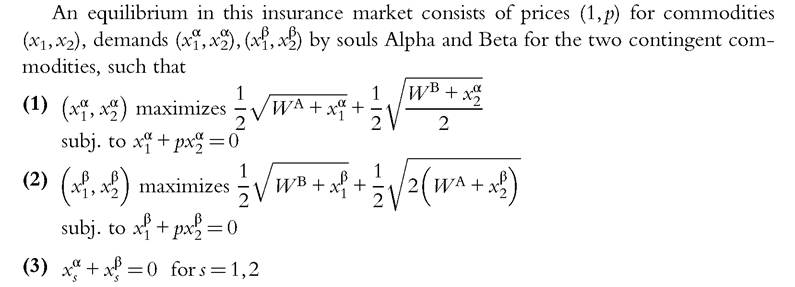
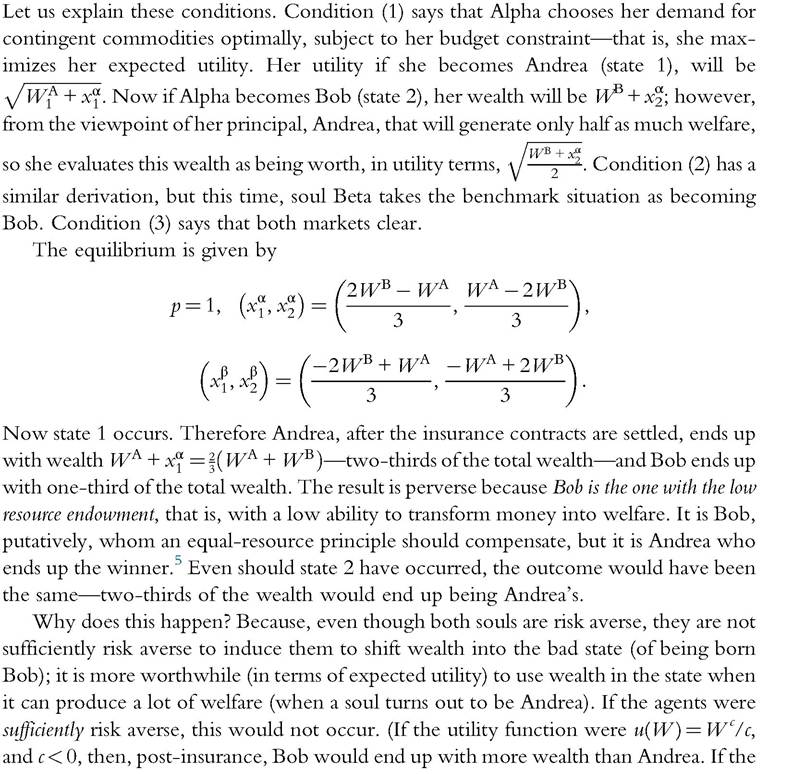
utility function is u( W) = log W, then the agents split the wealth equally.) But the example shows that in general the hypothetical insurance market does not implement the kind of compensation that Dworkin desires: for Bob is the one who suffers from a deficit in an internal resource—from morally arbitrary bad luck. For Dworkin's insurance market to avoid this kind ofperversity, individuals would have to be sufficiently risk averse, and this
5 This perversity of the Dworkin insurance mechanism was first pointed out by Roemer (1985). Dworkin never proposed a model ofthe insurance market but conjectured that it would reallocate wealth in a way to compensate those with a paucity of nontransferable resources. He continued to use the insurance-market thought experiment to justify social policies (e.g., in the case of national health insurance for the United States), even though his thought experiment did not necessarily produce the compensatory redistributions that he thought it would implement.
it is inappropriate to assume, for the theory should surely produce the desired result (of compensating those with a paucity of internal resources) in the special case that all agents have the same risk preferences.[132]
In the model just presented of the hypothetical insurance market, note that it was necessary to make interpersonal welfare comparisons. Alpha, Andrea’s soul, has to contemplate how she would feel if she were to be born as Bob, and with a given amount of wealth. She does this by transforming Bob’s wealth into a welfare-equivalent wealth for Andrea. And soul Beta has to make a similar interpersonal comparison. We maintain that it is impossible to construct a veil-of-ignorance thought experiment without making such comparisons. The point is simple: if a soul has to compare how it would feel when being incarnated as different persons, it must be able to make interpersonal welfare comparisons. Without the ability to compare the lives of different persons in different circumstances, an investment in insurance would have no basis.[133]
Despite the problem we have exhibited with Dworkin’s proposal, it was revolutionary, in the words of Cohen, in transporting into egalitarian theory the most powerful tool of the anti-egalitarian Right, the importance of personal responsibility. One might argue, after seeing the above demonstration, that Dworkin’s insurance market is an appealing thought experiment, and therefore one should give up on the egalitarian impulse of compensating persons for features of their situations for which they are not responsible; that is, instead of rejecting Dworkin’s model as inadequate, one should reject his egalitarian desideratum. Moreno-Ternero and Roemer (2008) consider this and argue instead that the veil of ignorance is an inappropriate thought experiment for ascertaining what justice requires. Although their arguments for this are new, the position is not: It was also advocated earlier by Barry (1991).
In the example we have given, there is, for egalitarians, a moral requirement to transfer tangible wealth from Andrea to Bob, because Bob lacks an inalienable resource that Andrea possesses, the ability effectively to transform goods into welfare, a lack that is beyond his control, and due entirely to luck. Dworkin also focused upon a different possible cause of unequal welfares, that some persons have expensive tastes, while others have cheap ones. His view was that persons with expensive tastes do not merit additional wealth in order to satisfy them, as long as those persons were satisfied with their tastes, or, as he said, identified with them. There is no injustice in a world where wealth is equal, but those with champagne tastes suffer compared to those with beer tastes, due to the relative consumptions of champagne and beer that that equal wealth permits. So the “pathology” that we have illustrated with the Andrea and Bob example depends on the source of Bob’s relative inefficiency in converting wealth into welfare being a handicap, rather than an expensive taste.
Slightly before Dworkin’s articles were published, Sen (1980) gave a lecture in which he argued that Rawls’s focus on primary goods was misplaced. Sen argued that Rawls was “fetishist” in focusing on goods, and should instead have focused on what the goods provide for people, which he called “functionings”—being able to move about, to become employed, to be healthy, and so on. Sen defined a person’s capability as the set of vectors of functionings that were available to him, and he called for equality of capabilities.[134] Thus, although a rich man on a hunger strike might have the same (low) functioning as a poor man starving, their capabilities are very different. While not going so far as to say utilities should be equalized, Sen defined a new concept between goods and welfare—functionings—which Cohan (1993) later described as providing a state of being that he called “midfare.” For Sen, the opportunity component of the theory was expressed in an evaluation not of a person’s actual functioning level, but of what functionings were available to him, his “capability.”
Sen’s contribution led to both theoretical and practical developments. On the theoretical level, it inspired a literature on comparing opportunity (or feasible) sets: If one desires to “equalize” capabilities, it helps to have an ordering on sets of sets. See Foster’s (2011) summary of this literature. On the practical side, it led to the human development index, published annually by the UNDP. For development of Sen’s capability approach, see Chapter 2.
Later in the decade, further reactions to Dworkin came from philosophers, notably Arneson (1989) and Cohen (1989). Arneson argued that Dworkin’s expensive-taste argument against equality-of-welfare was correct, but his alternative of seeking equality of resources was not the only option: Instead, one should seek to equalize Opportunitiesfor welfare. This, he argued, would take care of the expensive-tastes problem. Rather than relying on the insurance mechanism to define what resource egalitarianism means, Arneson proposed to distribute resources so that all persons had equal opportunity for welfare achievement, although actual welfares achieved would differ because people would make different choices. There are problems with formalizing Arneson’s proposal (see Roemer, 1996), but it is notable for not relying on any kind of veil of ignorance, in contrast to the proposals of Rawls and Dworkin.
Cohen (1989) CriticizedDworkin for making the wrong “cut” between resources and preferences. The issue, he said, was what people should or should not be held responsible for. Clearly, a person should not be held responsible for his innate talents and inherited resources, but it is not true that a person should be fully responsible for his preferences either, because preferences are to some (perhaps large) degree formed in circumstances (in particular, those of one’s childhood), which are massively influenced by resource availability. Indeed, if a person has an expensive taste for champagne due to a genetic abnormality, he would merit compensation under an egalitarian ethic.[135] Cohen’s view was that inequality is justified if and only if it is attributable to choices that are ones for which persons can sensibly he held responsible—so if a person who grows up poor, develops a “taste” against education, induced by the difficulty of succeeding in school due to lack of adequate resources—a taste with which he even comes to “identify”—then Cohen would not hold him responsible for the low income due to his consequently low wage, while Dworkin presumably would hold him responsible. Cohen does not propose a mechanism or algorithm for finding the just distribution of resources, but provides a number of revealing examples (see, for example, Cohen, 1989, 2004). He calls his approach “equal access to advantage.”
Besides criticizing Dworkin for his partition of the space of attributes and actions into ones for which compensation is, oris not, due, Cohen (1997), importantly, critiqued Rawls’s difference principle, as insufficiently egalitarian. The argument is based on Rawls’s restriction of the ambit of justice to the design of social institutions—in particular, that ambit does not include personal behavior. Thus, the Rawlsian tax system should attempt to maximize the welfare of the least-well-off group in society, under the assumption that individuals choose their labor supplies to maximize their personal utility. Suppose the highly skilled claim that if their taxes are raised from 30% to 50%, they will reduce their labor supply so much that the worst-off group would be less well off than it is at the 30% tax rate. If 30% is the tax rate that maximizes the welfare (or income) of the least well off, given this self-interested behavior of the highly skilled, then it is the Rawlsian-just rate. But Cohen responds that, as long as the highly skilled are at least as well off as the worst off at the 50% tax rate, then justice requires the 50% tax rate. This difference of viewpoint between Rawls and Cohen occurs because Cohen requires individuals to act, in their personal choices, according to the commands of the difference principle (that is, to take those actions that render those who are worst off to be as well off as possible), and Rawls does not. Indeed, Rawls stipulates that one requirement of a just society is that its members endorse the conception of justice. It is peculiar, Cohen remarks, that that conception should apply only to the design of social institutions, and not to personal behavior.
A question that arises from the discussion of responsibility is its relationship to freedom of the will. If responsibility has become central in the conceptualization of just equality, does one have to solve the problem of free will before enunciating a theory of distributive justice? Different answers are on offer. We believe the most practical answer, which should suffice for practicing economists, is to view the degree of responsibility of persons as a parameter in a theory of equality. Once we assign a value to this parameter, then we have a particular theory of EOp, because we then know for what to hold persons responsible. The missing parameter is supplied by each society, which has a concept of what its citizens should be held responsible for; hence, there is a specific theory of EOp for each society, that is, a theory that will deliver policy recommendations consonant with the theory of responsibility that that society endorses. This is a political approach, rather than a metaphysical one.
Another answer to the free will challenge is to make a distinction prevalent among philosophers. “Compatibilists” are those philosophers who believe that it is consistent both to endorse determinism (in the sense of a belief in the physical causation of all behavior) and the possibility of responsibility; incompatibilists are those who believe that determinism precludes responsibility. Most philosophers (who think about the problem) are probably, at present, compatibilists. For instance, Scanlon (1986) believes that the determinist causal view is true, but also that persons can be held responsible for their behavior, as long as they have contemplated their actions, weighed alternatives, and so on. (The issue of sufficient contemplation is independent of the issue of the cause of expensive tastes, raised above.) From a practical viewpoint, the problem of free will therefore does not pose a problem for designing policies motivated by the idea that persons should not be held accountable for aspects of their condition that are due to circumstances beyond their control.
The philosophical literature on “responsibility-sensitive egalitarianism” continues beyond the point of this quick review, but enough summary has been provided to proceed to a discussion of economic models.
4.3.