INTRODUCTION AND OVERVIEW
Peer production is the most significant organizational innovation that has emerged from Internet-mediated social practice. Organizationally, it combines three core characteristics: (1) decentralization of conception and execution of problems and solutions, (2) harnessing diverse motivations, and (3) separation of governance and management from property and contract.
Functionally, these components make peer-production practices highly adept at learning and experimentation, innovation, and adaptation in rapidly changing, persistently uncertain and complex environments. Under high rates of technological innovation, and the high diversity of sources of uncertainty typical of early twenty-first-century global markets, the functional advantages of peer production have made it an effective organizational model in diverse domains. From free software, through Wikipedia to video journalism, peer production plays a more significant role in the information production environment than predicted by standard models at the turn of the millennium.1Free and open-source software (FOSS) and Wikipedia are the most recognized instances of peer production. FOSS is responsible for the development of most of the basic utilities on which the Internet runs. Firms have recognized this, and have been adopting FOSS as a strategic option for 15 years. The beginning of this period was marked by the 1999 initial public offering (IPO) of Red Hat, the first successful commercial Linux distribution, IBM’s announcement in 2000 that it would invest $1 billion in its FOSS strategy, and the decision by Netscape, the company that had created the web browser market but lost its early dominance to Microsoft (as a result of strategies that formed the basis of the antitrust adjudication against the firm), to make its browser FOSS and create the Mozilla Foundation to shepherd what would become Firefox.
Most recently, Google’s strategic choice to develop Android as FOSS allowed Android to catch up and overtake Apple’s iOS as the dominant smartphone operating system. Wikipedia was laughable - a curiosity at best, a theoretical impossibility at worst, for mainstream economic theory of 1999. And yet it has developed into one of the most important knowledge utilities of our time.Much of the early economic analysis of peer production focused on software (Ghosh, 1998; Lerner and Tirole, 2002; Bessen, 2005), but FOSS was understood by some from the start as an aspect of online cooperation (Ghosh, 1998; Kollock, 1999; Moglen, 1999) with a strong emphasis on the comparative advantages of peer production as an organizational and institutional model of collaborative innovation and information production (Benkler, 2001, 2002; Von Hippel and Von Krogh, 2003; Weber, 2004; Bauwens 2005). Since then there has been a gradually expanding literature on FOSS and peer production.
Peer production refers to open collaborative innovation and creation, performed by diverse, decentralized groups organized principally by neither price signals nor
91
organizational hierarchy, harnessing heterogeneous motivations, and governed and managed based on principles other than the residual authority of ownership implemented through contract. Work has largely fallen in the categories of motivation, organization, and effectiveness or value to innovation. Here I will particularly emphasize the lessons for the importance of (1) diversity of human motivation, (2) innovation, experimentation, and tacit knowledge under conditions of uncertainty and change, and (3) transaction and organization costs, in making these decentralized models stable and self-sustaining, effective, and in some cases superior to the traditional models of production - markets, firms (both for-profit and non-profit), and governments.
The implications of peer production are broader than the direct economic impact of the practice.
Beyond the magnitude of its effects on innovation and knowledge production in the networked economy and participation in the networked society, the success of peer production and online cooperation has several implications for economics more generally. It requires that we refine our ideas about motivation or incentives; it recalibrates the roles of property and contract, as opposed to commons and social organization, in the growth-critical domains of knowledge-dependent production and innovation; and it requires adaptations to the theory of the firm.5.1.1 Definitions: Peer Production Distinguished from Crowdsourcing, Online Labor Markets, Prizes or Competitions, and Open, Collaborative Innovation
Peer production is an organizational innovation along three dimensions:
• Decentralized conception and execution.
• Diverse motivations, including a range of non-monetary motivations, are central.
• Organization (governance and management) is separated from property and contract:
- Inputs and outputs mostly governed as open commons or common property regimes.
- Organizational governance and managerial resource and task definition and allocation utilize combinations of participatory, meritocratic (do-ocracy) and charismatic, rather than proprietary or contractual, models. In firm-hosted peer production, however, property and contract are often retained, but contract structure is designed to simulated freedom to operate features of the absence of property and contract. The retention of control over platforms does influence the dynamics, capabilities, and potential tensions faced by firm-based peer production.
Section 5.2 will explain the centrality of these three to the particular advantages of peer production as an information, innovation, and knowledge production system. For now, take Wikipedia or FOSS as the core examples, where conception and execution (of a feature needing development, or an article that needs writing) are decentralized; where contributors rely on diverse motivations, many (about half in FOSS, all in Wikipedia) non-monetary; where the copyright licenses used make ownership or contract irrelevant to the core organizational question of who does what, when, with what resources and which collaborators; and where task construction generally is collaborative, though in some cases may be merely coordinated/collated.
Property and contract play a somewhat larger role in copyleft2 licenses than non-copyleft licenses. However, even in copyleft licenses the property/contract aspects supply a minimal baseline set of constraints rather than providing the basis for either signaling or authority to direct and coordinate action.The phenomenon most often confounded with peer production (see Table 5.1 for all the phenomena discussed here) is ‘crowdsourcing’ (Howe, 2006), whose clearest instance is Amazon Mechanical Turk (MTurk). MTurk is an online labor market that allows anyone to offer distributed workers monetary rewards in exchange for completing discrete, usually highly granular, tasks for low per-task payment. One common use is image tagging. Visual comprehension is extremely difficult for machines to perform well but highly intuitive for people. ‘Human computing’ is a developing field in computer science that tries to solve machine-hard, human-easy tasks. This includes, for instance, interpreting visual images by building platforms that harness human beings to perform these tasks in ways that can then be recombined as a solution. To provide a concrete example, let us look at ReCAPTCHA, a project developed by Luis van Ahn that uses optically scanned book fragments as gateways to secure services. Because vision is computer-hard, human- easy, requiring human beings to identify and type in the letters in a visually blurry string of letters is a good mechanism for telling humans apart from bots on the Net. These ‘CAPTCHAs’ are therefore a good gateway device for services, such as online subscription services, or security questions, to filter out bots - automated scripts programmed to look human to the service they access. By using scanned books or newspapers as the captcha, ReCAPTCHA harnesses the human beings who need to access the service to clean up digitized archives (Van Ahn et al., 2008).
Crowdsourcing is distinct from peer production because the tasks it involves are highly regimented and pre-specified by the task designer.
It comes in two flavors - monetary and non-monetary. MTurk is the most widely used monetary crowdsourcing platform (Horton, 2010). Non-monetary crowdsourcing platforms, whose lead innovator has been Van Ahn, use fun, as in games with a purpose (GWAP),3 or necessity, as with ReCAPTCHA, to harness distributed human action to achieve the predefined goal. The critical distinction between crowdsourcing and peer production is in the location of conception of tasks and solutions. ‘Crowdsourcing’ would most usefully be applied to instances where cost reduction, rather than distributed exploration of a resource and opportunity space, is the core function of the system. This would properly apply to situations where the task is conceived and defined by a given entity, and then put out to distributed individuals whose actions are limited to performing the preconceived task. In this regard, it harnesses undifferentiated human labor, rather than judgment, creativity, experience, tacit knowledge, or talent. From an organizational perspective, crowdsourcing represents a relatively small innovation. It harnesses thousands of independent contractors to perform tightly specified tasks. However, it does not affect governance or ownership, does not restructure innovation, learning, and adaptation for the organization or the task, and does not generally harness any new motivational vectors beyond standard hedonic gains, through payments (MTurk), fun (GWAP), or as a precondition to access desired services (ReCAPTCHA). The task construction itself generally relies on the coordinated output of many contributors. Unlike online labor markets or prize systems, no single contribution by itself is a potentially complete, however imperfect, solution to the task or problem addressed. Some citizen science projects have this characteristic, like the Mars Clickworkers that originated the practice, distributed computing, like SETI@ Home or Folding@Home, which harnessed thousands of volunteers to contribute excess computation cycles of their home computers to compute highly complex problems at speeds that rival the largest supercomputers, or open government projects that harness citizens to monitor their governments by performing very low-level regimented data input from diverse forms to convert them into computable form.‘Online labor markets’ are yet a different model of decentralization. Upwork (combining Elance and ODesk), for example, is a platform that allows computer programmers from around the world to bid on contracts to execute on orders proposed by customers. The innovation is in creating a much more efficient, global market for high-quality services, which allows firms to harness distributed talent from around the world. Organizationally, these represent a significant incremental improvement in the efficiency of markets for skilled labor, harnessing dramatic declines in market transactions cost to reduce the need for firm-based labor organization. Online labor markets adopt some degree of decentralized conception and execution, more the latter than the former, and in this regard are very different from crowdsourcing. They usually result in individual, rather than collaborative or even coordinated, production: the person who gets the contract generally performs it as an individual contractor. They rely on monetary motivations as the sole motivator and generally maintain the nexus between ownership and governance and management, using contract and property to govern inputs, outputs, processes, and role allocation associated with the task.
‘Prize systems’ include TopCoder, a platform that enables about one million registered coders to enter competitions for designing the best solutions to problems posed by clients. InnoCentive, Kaggle, and other firms provide similar platforms for either general purpose or field-specific competition and prize systems to be deployed to harness creative problem-solving effort toward problems posed by firms or governments. Prize systems are similar to online labor markets, but they emphasize decentralization of conception and execution even more forcefully, leaving even the design of the task to a highly distributed pool of innovative, skilled workers. Because prize systems need not pay for effort or outcome of every participant, unlike online labor markets, they can afford much wider and more diverse experimentation with alternative solution approaches than can online labor markets. This, in turn, allows them to capture extreme value solutions in areas where the problem definition and path of execution are highly uncertain (Boudreau et al., 2011). Even more than online labor markets, prize systems engage parallel efforts of competitors, and the ultimate output is generally the output of a single competing person or entity, as opposed to offering even complementarity between solutions offered. I call this task construction ‘parallel-competitive’, as distinguished from ‘parallel-complementary’ task organization models that allow each discrete contribution to offer a complete solution to the problem, but depend on complementarity between the alternative solutions to attain the best outcome.
‘Open collaborative innovation’ is a set of productive practices that have developed among firms in various complex product- and innovation-rich markets for some time, and received a boost from networked communications (Powell, 1990, 1996; Chesbrough, 2003; Gilson et al., 2008, 2010). These practices share with peer production the recognition that the smartest and best people to solve any given problem are unlikely to work in a single firm, such as the firm facing the challenge. Further, they recognize that the
Table 5.1 Peer production distinguished from other models of decentralized production and innovation
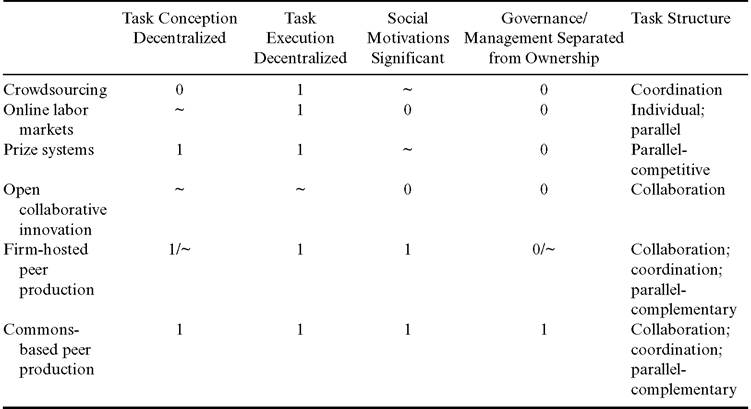
Note: 1 = characteristic present; 0 = characteristic absent; ~ = present in some instances or only to a degree.
models of innovation and problem-solving that allow diverse people, from diverse settings, to work collaboratively on the problem will lead to better outcomes. By contrast, production models that enforce strict boundaries at the edge of the firm and do not allow collaboration based on fit of person to task rather than based on employment contract and ownership of the problem will be less innovative and productive. There are strong overlaps between open collaborative innovation and peer production from policy perspectives, primarily in implications for intellectual property, but this category does not include the separation of ownership from governance and management, or the inclusion of participants who are not part of any of the set of mutually cooperating firms, or those motivated by non-monetary motivations. A firm facing a complex software development problem could enter into contracts with several of its suppliers and even competitors, adopt open standards at the core of its strategy, and place some of its workers in other firms, and receive those of others in its own, as part of an open collaborative strategy. Or, that same firm could partly develop the software it requires and license it as FOSS and use SourceForge or GitHub to manage the repository. In the former case, the firm would be engaged in open collaborative innovation. The latter would be the firm engaging peer production.
Peer production itself has, over the past decade, developed into two quite distinct flavors. Commons-based peer production (CBPP), the original model of FOSS and Wikipedia, includes all attributes I ascribed to peer production. Firm-hosted peer production, such as Yelp or TripAdvisor, deviates in a critical way from CBPP, or full peer production, in that the governance and management are based in proprietary claims to exclusion from the site to enforce terms of use with regard to user contributions. These are anchored in firm control over the infrastructure or platform that is used to host and coordinate the peer-production effort (Fuster Morell, 2010). Yelp is a clear example of this approach. The firm depends on its users to select restaurants, businesses, and so on to be reviewed, and depends on them to provide reviews. At the same time, the contributions are governed by terms of use that retain proprietary claims over the database, and outline certain acceptable use constraints as contractual obligations of the users. Task conception (who should be reviewed) is more distributed than in crowdsourcing, and social motivations are salient, as users are not paid for their reviews. These firm-hosted peerproduction models need to rely on contract terms that simulate the absence of property and contract. Firms do so by retaining and providing to users non-exclusive licenses to all user content, rather than asserting full ownership over it. Further, they make contributions flow into the system without permission, and they limit their own assertion of contractual and property rights to rare occasions. On those rare occasions, firms will justify their actions by reference to shared norms, not merely to firm interest or legal right.
Not all firms that engage with peer production necessarily deviate from commonsbased peer production. When IBM participates in Apache (which is not an IBM-hosted or -initiated project) development, or even when Google distributes Chromium (a Google project) under a FOSS license, the organization of development, despite the formal ownership of the code, is severed from the firm’s ownership. Where the property and contract remain separated from ownership and operation of the site, the fact that a firm owns the site does not make a commons-based peer-production enterprise into a firm-hosted peer-production enterprise. For example, when peer editors of Wikitravel came to dislike the policies of the site/trademark owner, Internet Brands, they were able to leave, take all the content they had developed, which was under a Creative Commons License, and start afresh as Wikivoyage. Despite its corporate ownership and the presence of for-profit advertising on the site from 2006 to 2012, the property and contract structure of management and governance maintained the nature of the site as CBPP or full peer production. It is whether contract and property are separated from governance and management, not ownership of the site or the trademark associated with it, that marks a site as firm- hosted peer production or commons-based peer production. In terms of the information quality attributes, a firm-hosted peer-production process will only share the exploration and discovery characteristics of commons-based peer production if it avoids using contract or property to steer and constrain avenues of exploration and experimentation by the peers. In terms of motivational harnessing attributes, firm-based peer production will only replicate the attributes of commons-based peer production if the host firm can authentically and credibly bind itself, or by practice instill trust in the peers whose work it facilitates, that it will not undermine community norms. The host firm must assure users that it will not assert its contractual or proprietary authority in ways visibly at odds with management and coordination practices commonly observed in commons-based peer-production enterprises or with normative understanding among the peers about the proper role of the firm with regard to the peer community.
5.1.2 How Significant is Peer Production in the Actual Economy?
Measuring the direct economic significance or impact of peer production is difficult. One approach is to observe adoption of information goods, in various verticals, that are the outputs of peer production. The most obvious cluster of utilities is the web itself. Netcraft web survey has been collecting data on web server software adoption since the middle of 1995. At that point, academically developed and a range of ‘other’ servers were competing for adoption. By March of 1996, Sun Microsystems and the FOSS project Apache were the main competitors, as Microsoft joined the field. Within a year, Microsoft caught up with and eclipsed Sun, and since then has been the primary competitor to Apache. Nonetheless, Apache never lost its dominance in terms of share of adopted web server platforms connected to the Net. As of January of 2013, Apache held a 55 percent market share, Microsoft 17 percent; NGINX, an alternative FOSS platform, 13 percent; Google’s servers for its own machines, 4 percent; and the remainder was held by platforms bunched as ‘other’ (Netcraft, 2013).
Server side scripting languages are the primary languages used for programming functions on the web. PHP, an open source language, is used by 78 percent of websites, while Microsoft’s ASP.NET holds the remaining 20 percent. Most of the remaining languages, like Ruby or Python, are also open source (W3Techs, 2013). Web browser statistics are less clearly in favor of open source. Historically, Microsoft’s Internet Explorer (IE) held over 95 percent of the market after it squeezed Netscape Navigator out of the market (illegally, according to antitrust adjudications in both the USA and EU). Netscape then spun out Navigator to a non-profit, the Mozilla foundation, as FOSS. Over time, Firefox gradually captured market share over the 2000s, and in 2008 Google also released Chrome, and at the same time a parallel, FOSS project, Chromium. As of January 2013, competing methods identify IE as either having 55 percent of the desktop browser market or 31 percent; and Chrome and Firefox having either 18 percent and 20 percent, respectively, or 36 percent and 22 percent, respectively (Vaughan-Nichols, 2013). By a different measure, almost 40 percent of firms engaged in software development reported spending development time on developing and contributing to FOSS software (Lerner and Schankerman, 2010). Others have suggested that FOSS has higher quality or innovativeness by various measures. Considering the adoption patterns and the literature it appears clear that, at least in software, FOSS is an economically significant organizational and institutional strategy (Bonnacorsi and Rossi, 2003; Von Krogh, 2003; Lorenzi and Rossi Lamastra, 2007). Additionally, software, as an industry, accounts for somewhere between $350 billion and $400 billion per year in the United States (on one model, one could combine computer services: NAICS4 5415 [$245 billion] software publishing NAICS 5112 [$135 billion]∕Internet publishing NAICS 51913 [$31 billion]; Forrester Research suggests $208 billion in software sales and $188 billion in IT integration and consulting services) (Datta, 2012).
Software adoption is more widely and consistently measured than other information production sectors. Wikipedia is by far the most successful, largest, and most diverse peer-production project. The subject of several books and over 5000 articles, Wikipedia is among the top six to eight sites in the world,5 and has become the basic knowledge utility of networked life, alongside Google search. Frischmann et al. (2014) collect a series of chapters describing a wider range of peer-production practices. Maurer (2010) describes case studies of instances where distributed, non-state, non-market action was able to deliver discrete but meaningful public goods, ranging from nanotech safety standards to a synthetic DNA anti-terrorism code. Online, in a range of specific product areas, business models that depend on peer production have outcompeted businesses that depend on more traditional, price-cleared or firm-centric models of production. Flickr, Photobucket, and Google Images, all of which are peer-production platforms capable of delivering stock photography, have overshadowed Corbis, the primary firm using the traditional model in this field. YouTube, Google video, and Vimeo are all more highly ranked as online video sites than the proprietary models of HULU, Vevo, or even Netflix (though Netflix, the most widely used among these, is roughly equal to Vimeo). TripAdvisor is more popular than Lonely Planet, Fodor’s, or Frommers in travel guides, and Yelp in restaurant reviews. In all, organizations, both for-profit and non-profit, who have found ways of organizing their core production function on a peer-production model have thrived in the networked environment, often overcoming competition from more traditional, market- and firm-based models. However, there have been no formal measurements of the relative contribution of peer production to the Internet economy, or efforts to measure performance of firms that have adopted these strategies. The closest efforts we have are De Jong and Von Hippel (2009), who seek to assess the level of innovation by user firms, as opposed to producer firms, and Von Hippel et al. (2010), who use survey methods to elicit innovation among individuals in the UK population generally. This is related, but not direct evidence. For our purposes here, it is perhaps sufficient to accept that peer production has played a significant role over the course of the first 20 years of the commercial Internet, and continues to do so today. The dearth of work suggests that formal measurement of the productivity and contributions of peer production in well-defined studies is an important avenue for future research.
5.1.3 Core Economic Questions
Three major questions occupy the literature on the economics of peer production, mostly discussed in the domain of free and open source software. The broad overarching question is that of effectiveness and innovation: what are the conditions for the emergence of sustained peer production, and what are the relative advantages of this networked organizational model over more traditional models: firms, government, and pure market clearance? Two more discrete questions inform that broader question: motivations and governance. For motivations, much of the initial question in economics has been why individuals would volunteer their efforts toward producing a product in which they then claim no exclusion rights, and later this work also focused on why firms would invest in such efforts and adopt their outputs. The forward-looking question, however, should be whether or not we can use our knowledge of the microfoundations of diverse motivations to design organizational forms that better harness and direct these diverse motivations. In other words, can we move from mechanism design to cooperative human systems design? The second question is one of governance and management: how do networks of collaborators organize their affairs once exclusive ownership and formal contract are excluded as the foundation of organizational governance (questions of who gets to make what kinds of decision in the organization) and management (questions of who does what with which resource sets)?
5.2