INNOVATION AND LEARNING: WHY WOULD PEER PRODUCTION EMERGE NOW, AND WHAT ARE ITS ADVANTAGES AS A MODE OF PRODUCTION?
Peer production (including FOSS) is an organizational innovation. It marks a new organizational form that expands on the more traditional market/hierarchy dichotomy in the study of organizations (Benkler, 2002, 2006; Osterloh et al., 2003; Elsner et al., 2010; Baldwin and Von Hippel, 2010).
It is the clearest instance of the rise of networks as an alternative organizational model to markets and hierarchies (Powell, 1990). To understand this organizational innovation, in turn, requires an explanation of the advantages that loosely coupled networks of diversely experienced and motivated individuals have over firms or markets as innovation and knowledge production models.The basic model is a straight transactions cost model. Production requires the coordination of people (agents), resources, and projects. In a classic perfect market, prices on each of these three components lead to matching. A firm expecting a given price for project P will be able to determine how much it can afford to pay for agents and resources for the project, which converts resources and agents bought in that market into the output that will be sold at some price p in the market. The values of the competing projects, the value of the various people and resources to competing projects, will determine the market-clearing price for any given resource or person, and in turn will decide whether, when, and at what quality the project can be pursued given the market valuation of its output. Coase’s new institutional theory of the firm (Coase, 1937) posited that for some resources, people, and projects, the cost of managerial allocation plus potential misallocation was lower than the cost of market clearance, leading to the creation of firms but also limiting their size when managerial costs outweigh price-system costs. Once one understands that social exchange is also a transactional framework widely used for a broad range of goods and services (Benkler, 2004 provides a series of NAICS categories that denote market provision of services alongside their commonly used social exchange) (childcare, home healthcare, entertainment, carpooling, being the most intuitively visible services for which social exchange is widely used in modern economies), it is trivial to expand the same analysis to social exchange transactional networks.
Where information inputs, whose marginal cost is zero, can be combined with highly distributed low-cost physical capital (computers and communications networks) and human capital that is widely underemployed (TV watching hours, at least), a substantial amount of distributed information production using these widely distributed inputs can effectively compete with market, firm, or state-based transactional models (Benkler, 2002).A simple, elegant model in this vein is Baldwin and Von Hippel (2010). Baldwin and Von Hippel posit a two-dimensional space made of communications costs and design costs for innovation. Where communications costs are extremely high (e.g., unique needs of a single farmer) but design costs are very low, the communication necessary for producers to work on the problem will fail, and only single-user developers will innovate. Where design costs are high, and communications costs are high, only producer innovators will develop, because the capital cost of innovating will be too high for the user innovator to undertake alone, and the high communication costs will prevent peer production from spreading the design cost among many contributors. Where design costs are extremely high and communications costs extremely low, open collaborative innovation, or peer production, will be dominant, because peer producers can spread the design costs over many developers, at a low communications cost. There are various levels of design cost/communications cost where two or three of the approaches will be sustainable.
The simple transactions cost model can be supplemented with a more specific view of information and learning that explains why distributed innovation, creativity, or problem-solving would have a transactions costs advantage over proprietary and managed systems. A less crisp but more complete explanation requires a clearer model of how organizations learn. Both managerial control and price clearance require formalization of descriptions of resources, people (i.e., their diverse capabilities and availabilities for a given project at a given juncture/time), and projects into units capable of transmission through the communications system these organizational models represent.
To economize on transactions and organization costs, both managerial control and pricing require abstraction, generalization, and standardization of what are in reality heterogeneous and changing characteristics of the people, resources, and projects that could be combined in a project or transaction. In that abstraction process, both administrative descriptions and prices are ‘lossy’: the formalization strips information out of the real world characteristics of the relevant resources and projects. The lost information, in turn, leads systems whose functioning depends on discarding the information to underperform relative to systems able to bring a more refined fit of potential resources and agents to better-defined projects. Complexity and uncertainty make the information problem of matching people, resources, and projects less amenable to managerial or price-based solutions. Complexity and uncertainty (Knightian uncertainty of unknown probabilities of outcomes or unknown potential outcomes, as opposed to risk, with known probabilities of a known range of outcomes) put pressure on both neoclassical and new institutional models, because the actual properties of resources, people, and projects are highly diverse and interconnected; and the interactions among them are complex, in the sense that small differences in initial conditions or perturbations over time can significantly change the qualities of the interactions and outcomes at the system level. This leads to the known phenomenon of path dependence, both technological and institutional (David, 1985; North, 1990; Arthur, 1994), suggesting that these divergences can persist in the face of systematic observed inefficiency. The fine-grained, diverse qualities of people, projects, and resources, and the relatively significant divergences that can occur because of relatively fine-grained differences in input combinations or local interactions, mean that it is impossible to abstract and generalize the process into communications units available for a managerial decision or price clearance without significant loss of information, control, and, ultimately, effectiveness.Note that ‘knowledge’ and ‘learning’ in the presence of complexity and uncertainty refer to more than a classic notion of innovation, such as creating a new way of doing something that was impossible to do before. Importantly, they also include problemsolving, or iterative improvement in how something is done given persistent absence of complete knowledge about the problem and the solution that comes with complexity and uncertainty. If creating the WWW or writable web software like Wiki was ‘innovation’ on a commons-based model, Wikipedia’s organizational innovation is in problem-solving more than innovation: how to maintain quality contributions together with potentially limitless expansion, a problem that scarcity absolved Britannica from solving. Usergenerated content similarly serves more diverse tastes than a more centralized system can; user-created restaurant or hotel accommodation reviews solve a complexity in implementation problem, with highly diverse sites to review and tastes of people who may want to use the places reviewed. In each case, the peer approach allowed the organizations to explore a space of highly diverse interests and tastes that was too costly for more traditional organizations to explore.
In this model, a critical part of the advantage of peer production incorporates the importance of incontractible knowledge, either because it is tacit knowledge or because the number and diversity of people with knowledge that needs to be brought to bear on an implementation problem is too great to contract for. Tacit knowledge is knowledge people possess, but in a form that they cannot communicate. Once you learn how to ride a bicycle, you know how to do so. Yet, if you were to sit down and write a detailed memorandum, your reader would not know how to ride a bicycle. It is increasingly clear that tacit knowledge is critical in actual human systems. Peer production allows people to deploy their tacit knowledge directly, without losing much of it in the effort to translate it into the communicable form (an effort as futile as teaching someone how to ride a bike by writing a memo) necessary for decision-making through prices or managerial hierarchies.
Where knowledge is explicit, but highly distributed in forms that need to be collated to be effective, the barrier is a simple transactions costs problem. A system that allows agents to explore their environment for problems and solutions, experiment, learn, and iterate on solutions and their refinement without requiring intermediate formalizations to permit and fund the process will have an advantage over a system that does require those formalizations; and that advantage will grow as the uncertainty of what path to follow, who is best situated to follow it, and what class of solution approaches are most promising become less clearly defined.Consider the original, single-person version of user innovation as originally developed by Von Hippel (e.g., Von Hippel, 1988). There, Von Hippel showed how in diverse settings lead users were able to identify new uses that required an innovation, the limitations of existing devices or systems to address these uses, and were able to experiment with diverse solutions until they hit on an innovation that solved a problem that producers did not even know existed. Examples of this distributed search for problems and solutions range as wide as the first heart-lung machines, developed by physicians who had reached the boundary of innovation in surgical techniques that required that improvement, or selfmoving irrigation systems developed by leading farmers. In both cases, the diversity of practices in medicine, and the divergence of practices and needs of local farming, created a knowledge gap between emerging needs and the companies that would ultimately stabilize the solution. Innovative users, who applied themselves to the problem, solved the basic innovation outlines, and freely shared their innovations, filled that vacuum. Only once the practice had reached a level of crystallization that could be transmitted to a firm did firms enter and ultimately improve on the original design. But the diversity and complexity of problems, resources, and experiments on potential solutions was driven by decentralized actors that were not operating within either price or managerial structures for the production of the innovations they developed.
Von Hippel documented this phenomenon repeatedly regarding users exploring problem and solution spaces while firms generalize and standardize, you might say ‘productize’, a solution developed by one of these many and diverse individuals.Peer production more generally, in particular when it relies on commons - that is, on symmetrical access privileges (with or without use rules) to the resource without transaction - allows (1) diverse people, irrespective of organizational affiliation or property/ contract nexus to a given resource or project, (2) dynamically to assess and reassess the available resources, projects, and potential collaborators, and (3) to self-assign to projects and collaborations. By leaving all these elements of the organization of a project to self-organization dynamics, peer production overcomes the ‘lossiness’ of markets and bureaucracies, whether firm or governmental. It does so, of course, at the expense of incurring new kinds of coordination and self-organization costs. Where the physical capital requirements of a project are either very low, or capable of fulfillment by utilizing pre-existing distributed capital endowments, where the project is susceptible to modularization for incremental production pursued by diverse participants, and where the diversity gain from harnessing a wide range of experience, talent, insight, and creativity in innovation, quality, speed, or precision of connecting outputs to demand is high, peer production can emerge and outperform markets and hierarchies (Benkler, 2002, 2004).
The effectiveness of the distributed search and experimentation model was increased dramatically when the cost of communication and ‘material’ dropped, so that diverse individuals could share problem definitions, potential solutions, and experimental models (Baldwin and Von Hippel, 2010). The first person to identify a need or problem worth solving may not be the best to offer a tentative solution, or the best to identify the incremental improvement on that tentative solution to move the solution to a usable stage. This collaboration then substantially increased the scale and scope of problems and solutions that communities of users could approach (Raymond, 1999; Benkler, 2002; Von Hippel, 2005; Baldwin and Von Hippel, 2010). An early version that connected the benefits of this approach specifically to the complexity of software projects was Bessen (2005).
To model the importance of learning under uncertainty to organizational models, we can map the organizational approaches described here along three dimensions. These are: (1) the degree of uncertainty in the project space, (2) the degree to which the human knowledge input is important, as well as the degree to which it is formalizable, explicit, and routine as opposed to tacit, intuitive, or creative, and (3) the degree of capital concentration required to execute the project (Figure 5.1). The more uncertain, as opposed to routine, the problem and solution space is, and the more tacit, creative, intuitive, or knowledge-intensive the human dimensions, the harder it is to define the required human, material, and knowledge resources necessary, as well as to define the best project to pursue. As uncertainty and creativity, tacit knowledge, intuition increase, the benefits of managerial control and explicit pricing decrease relative to their costs. As uncertainty increases along these two dimensions, so too do the advantages of peer production specifically, and more generally of open innovation strategies, over proprietary, closed models that limit the range of actors and resources in order to improve appropriability. The third dimension, the degree to which the capital costs of execution are high and concentrated (the steam engine, the assembly plant), as opposed to low (writing a song) or susceptible to fulfillment by aggregating diffuse capital (personal computers already distributed in the population), creates an efficient limit on the more open, diverse strategies. Aggregating, managing, and renewing an expensive and concentrated capital base will tend to favor managerial hierarchies, either state or market-based as necessary, and will place a limit on the degree to which a project can embrace freedom to operate by diverse
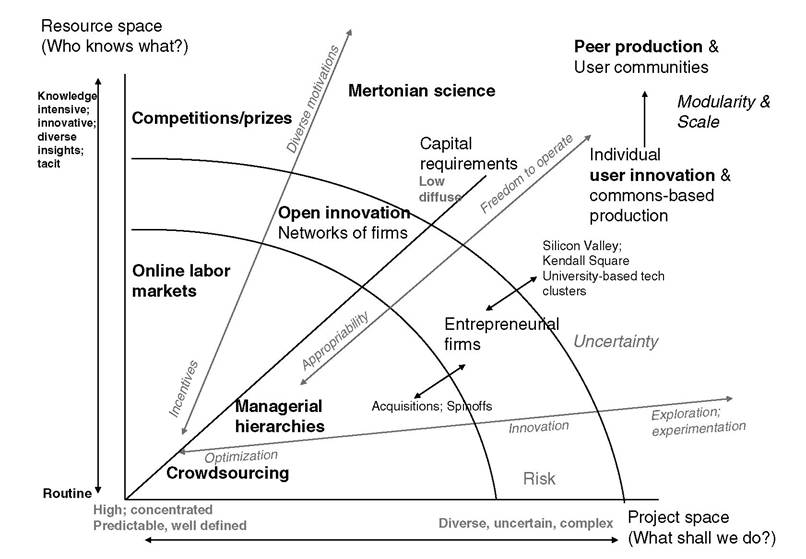
Figure 5.1 Organizational models as a function of uncertainty, knowledge, and capital
actors over appropriability of the project outputs. To the extent that capital formation does not present a barrier, we see strategies migrate toward the more exploratory and less price mediated. The part of the map where projects and resources and human knowledge necessary are relatively routine and well understood, and capital concentrated, hierarchical managerial firms are at their best is also the space where crowdsourcing can lower the cost associated with production (although it depends on distributed capital necessary for participation - that is, computers in the hands of the crowd harnessed), but only where problem spaces and human inputs can be defined in advance with some precision. Online labor markets still require sufficient certainty on the problem definition to assure payment for labor, but greater uncertainty of who can do the job and a higher degree of diversity in capabilities. It also allows for applying labor to less modular problems.
As we move out from the origin, the organizational models trade off clear, well- understood monetary incentives for a need to harness more diverse motivations. In particular, because the required skills and combinations are increasingly uncertain, the required effort becomes increasingly incontractible in that you do not know who to contract with, what to contract them to do, or how to measure what they have done. Here, intrinsic and non-monetary motivations that do not require crisp contracting and monitoring become critical. Moreover, as the project and human space becomes more uncertain, appropriability becomes less certain, and its expected value is overshadowed by the expected learning and exploration benefits of freedom to operate in the resource and problem space; similarly, well-managed optimization of such an uncertain project and human scope becomes futile and wide open exploration and experimentation become more important. As we move out to a band with less certain but still well- understood risk-reward tradeoffs, we see two types of solutions. Where the question of ‘what is worth doing’ is very risky, we see entrepreneurial firms using the market to raise risk capital and deploy, failing or succeeding with little global systemic cost. Where the project space is better understood, but the talent pool is uncertain, we see networks of firms embracing open innovation and collaboration as a mechanism to reach across firm boundaries to apply diverse talent to a range of problems, but retaining manageability and appropriability by keeping the set of actors well-defined, in well-managed, usually long-term contractual relationships, applied to what are more clearly defined problems than those where we see peer production at its more effective. The particular advantage of user innovation, competitions/prizes, and peer production lies outside these relatively well-understood boundaries of routine or even well-understood risky development. Similarly, the classic literature on the tradeoff between basic academic science and applied commercial science (Nelson, 1959), and the role of universities alongside pharmaceuticals and entrepreneurial firms in biotechnology (Powell, 1996) is easy to locate on the map to orient it toward already well-known phenomena.
The broad openness of the model to contributions from anyone, with freedom to operate without having to translate one’s ideas or initiatives into someone else’s decision over purse strings or authority structures, enables rapid and diverse exploration and experimentation in a highly uncertain scape - where neither the relevant insights and knowledge that human beings possess is well understood, nor the range of plausible projects well defined. Because competitions and prizes still require a ‘client’, a payor who defines the goal, and because the competitors in a prize system usually seek the prize, and hence seek to maintain some level of control or appropriability, these systems will tend to be single person or managed group entrants, and are therefore closer to the origin than peer production. Fully distributed search and experimentation that characterizes user innovation and peer production varies based on the scale of the problem and the modularity of the project. As the scale, complexity, or novelty of the problem grows, identifying solutions individually becomes less likely. As long as the solution or project aimed at solution retains its decomposability into modules, these larger-scale projects will draw user communities and peer production rather than depending solely on individual distributed innovation or commons-based production. The ability to harness a more diverse set of eyes to look at the problem gives these collaborative projects their advantage over distributed, purely parallel search.
Before turning to the question of motivation, it is worthwhile noting the development of evolutionary models to explain the organizational distinctness of FOSS specifically, and peer production more generally (e.g., Elsner et al., 2010). Landini (2012) offers an evolutionary game-theoretic model that complements the new institutionalist model of Benkler and Baldwin and Von Hippel. In addition to the technological effects driving decentralization of capital, reduction of communications cost, and modularization making peer production more efficient and feasible, Landini develops a model of two alternative stable equilibria based on bidirectional causality - where the form of rights can determine the type of technological development path chosen as well as vice versa. Thus, closed proprietary and non-modular, relatively high labor cost production is stable given proprietary control, because of its superior rent-extraction properties (whether efficient in context of not), and open, modular, low incremental labor cost contributions are similarly stable because of their cost, learning, and efficiency advantages. Landini’s model explains well the observed relative stability of software projects - those that start open, remain open, and those that start closed, remain closed - rather than convergence on one model or another. It integrates the cost of peer production, in terms of its rentextraction properties, to those who choose it as a development path into a stable equilibrium model that makes no claim to superior welfare or innovation properties.
In conclusion to this section, the primary organizational innovation of peer production is that it represents the confluence of technological, organizational and institutional innovations that permit diverse individuals who would not have been able to communicate and coordinate in advance to explore collaboratively an opportunity space made of resources, problems, people, and potential solutions. Peer production further allows them to self-assign and harness their tacit, creative, or otherwise hard-to-communicate knowledge or facility to identify or contribute to defining a problem or solution. Last, they can do so by relying on diverse, often non-monetary motivations that do not incur the limitations imposed by the need to formalize and standardize their insights, efforts, or experimental successes for transmission into formalized channels of markets or hierarchies.
5.3
More on the topic INNOVATION AND LEARNING: WHY WOULD PEER PRODUCTION EMERGE NOW, AND WHAT ARE ITS ADVANTAGES AS A MODE OF PRODUCTION?:
- INNOVATION AND LEARNING: WHY WOULD PEER PRODUCTION EMERGE NOW, AND WHAT ARE ITS ADVANTAGES AS A MODE OF PRODUCTION?
- Bauer J., Latzer M. (Eds.). Handbook on the Economics of the Internet. Edward Elgar,2016. — 603 p., 2016
- THREE TYPES OF LARGE-GROUP METHODS