MULTIDIMENSIONAL INEQUALITY MEASUREMENT
40
3.4.1 Multidimensional Extensions of the Pigou-Dalton Transfers Principle
Some of the requirements typically specified in the univariate case can be directly transferred to the multivariate context.
For instance, the requirement that the social evaluation pays no attention to any other individual characteristics than those included in the vector of attributes—the “anonymity principle”—does not pose any problem, and it may in fact be even less restrictive with multiple dimensions. On the other hand, the multidimensional extension of the Pigou-Dalton transfers principle is less straightforward. In its original formulation, it states that inequality should fall as income is transferred from a richer to a poorer person, without modifying their relative ranks. (The last condition is unnecessary if the anonymity principle is assumed.) There is no unique way to reformulate the principle when there are two or more dimensions (Kolm, 1977).41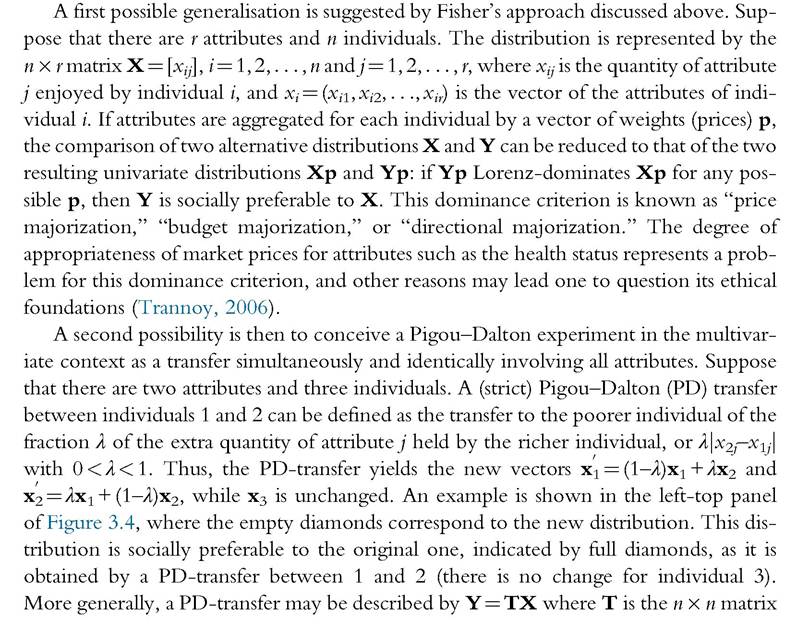
41 See also Das Gupta and Bhandari (1989), Dardanoni (1995), Fleurbaey and Trannoy (2003), Mosler (2004), Fleurbaey (2006), Savaglio (2006a,b), Diez et al. (2007), Nakamura (2012), and Banerjee (2014a,b).
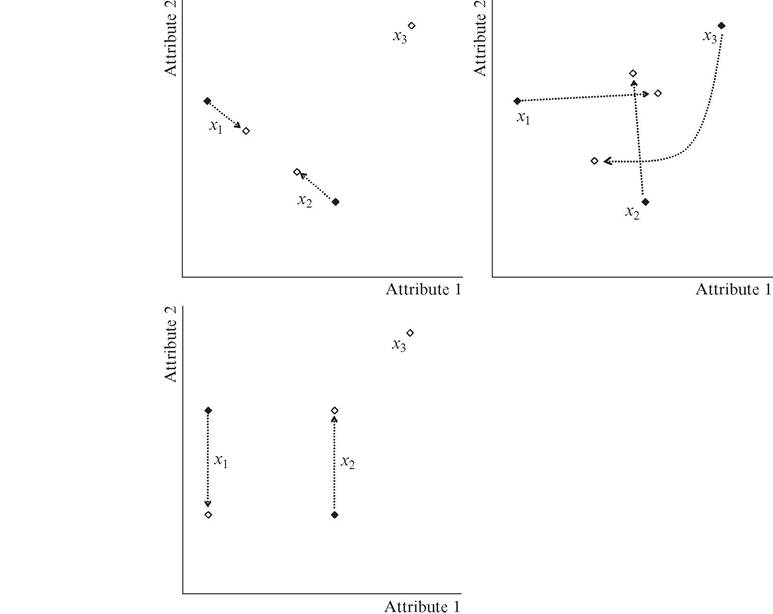
Figure 3.4 Examples of majorization criteria.
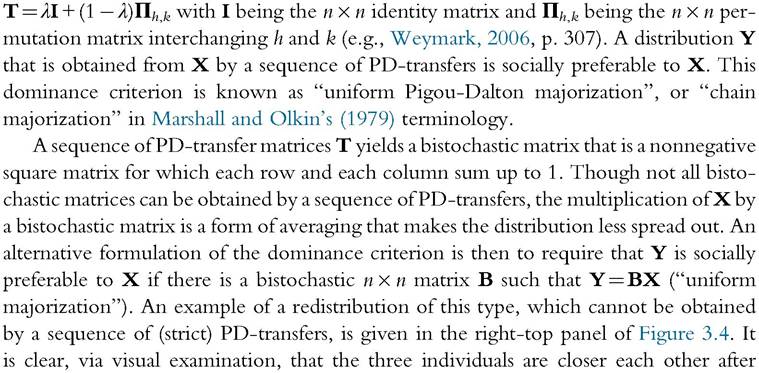
the averaging out performed by the B matrix; the deterioration suffered by individual 3 is socially acceptable by virtue of the anonymity principle.
There are two possible objections to these criteria. The first is that a change in one attribute does not affect the contribution to well-being of other attributes. We could however suppose that the correlation of attributes matter.
Tsui (1999) introduces the concept of correlation-increasing transfer, which is an exchange of all attributes between two individuals after which one individual is left with the lowest endowment and the other with the maximum endowment of each attribute. By concentrating attributes, this type of transfer leads to a distribution that is less socially preferable than the original one. An example of “correlation-increasing majorization” is shown in the bottom-left panel of Figure 3.4. Figure 3.5 summarizes the majorization criteria.The second objection is that, unlike income, many constituents of human welfare are not transferable. In general, it does not make much sense to talk of “transferring health” from a healthier individual to a sick one, with the possible exception of organ transplants (e.g. kidney and bone marrow). This has led Bosmans et al. (2009) to study the implications of formulating a version of the Pigou-Dalton principle that applies only to transferable attributes, and it has led Muller and Trannoy (2012) to examine dominance conditions under which attributes are asymmetric in the sense that one attribute (typically income) can be used to compensate for lower levels of other attributes (e.g., needs, health, etc.).
3.4.2 Partial Orderings and Sequential Dominance Criteria
As in the univariate case, conclusions based on summary measures of multidimensional inequality might be questioned. Thus, it is helpful to investigate their robustness by using partial orderings such as stochastic dominance criteria. The first-degree dominance criterion considered by Atkinson and Bourguignon (1982) was briefly discussed in Section 3.3.3.2. For a discussion of second-order multidimensional stochastic dominance and the conditions that this criterion imposes on the expected utility type of social welfare functions and associated measures of inequality, we refer to Atkinson and Bourguignon
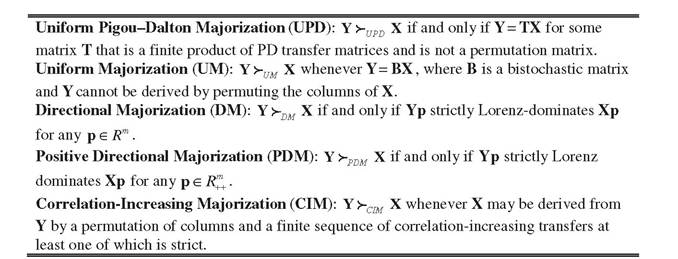
Figure 3.5 Majorization criteria.
Source: adapted from Tsui (1999, pp. 149-152).(1982). Trannoy (2006) and Duclos et al. (2011) propose extensions of the results provided by Atkinson and Bourguignon (1982). Koshevoy (1995, 1998) and Koshevoy and Mosler (1996, 1997, 2007) introduce an alternative approach based on a multidimensional generalization of the Lorenz curve. Note that the equivalence between second- degree stochastic dominance and first-degree Lorenz dominance for fixed means does not hold in the multidimensional case.
The elaboration of sequential dominance criteria for the bivariate asymmetric space of income and household composition has been an early topic of the research on partial orderings in a multidimensional framework. Following Atkinson and Bourguignon (1987), many authors have seen the advantage of this approach over the standard income equiv- alization procedure in the fact that it only requires ranking family types in terms of needs, without specifying how much needier one family type is than another. Bourguignon (1989), Atkinson (1992), Jenkins and Lambert (1993), Moyes (2012), Chambaz and Maurin (1998), Ok and Lambert (1999), Ebert (2000), Lambert and Ramos (2002), Duclos and Makdissi (2005), Decoster and Ooghe (2006), and Zoli and Lambert (2012) belong to this branch of research, with a focus either on poverty or on inequality. Sequential dominance analysis can be applied to other bivariate distributions. Brandolini and D’Alessio (1998) present an early application to the joint distribution of equivalent income and health in Italy, whereas Duclos and Echevin (2011) and Madden (2014) carry out a similar exercise to compare Canada and the United States. Duclos et al. (2006b) study the joint distributions of household expenditure and children’s heights in Ghana, Madagascar, and Uganda. Berenger and Bresson (2012) use sequential dominance to test whether growth is “pro-poor” when poverty is measured by income and another discrete well-being attribute. Sequential dominance criteria for more than two attributes are pre- sentedby Graveletal.
(2009), GravelandMukhopadhyay (2010), and Muller and Trannoy (2011). McCaig and Yatchew (2007) and Batana and Duclos (2011) have developed statistical inference techniques to test dominance.3.4.3 Measures of Multidimensional Inequality
As for the measurement of multidimensional deprivation and poverty, the informational basis defined by the order of aggregation plays a crucial role in measurement of multidimensional inequality as well. Thus, it is helpful to make a distinction between measures of multidimensional measures ofinequality for which the order of aggregation either begins with aggregating across individuals for each single attribute or across attributes for each individual. In the former case, we obtain measures of overall inequality that aggregate inequality over each of the attributes. If we invert the order of aggregation, we derive an overall measure of inequality that aggregates synthetic functions of the attributes across individuals. The latter approach embeds the association between the achievements in the various dimensions into an overall indicator of individual achievements.
3.4.3.1 Two-Stage Approaches: First Aggregating Across Individuals
Two-stage approaches either aggregate individuals’ achievements on each dimension and then the resulting attribute-specific indicators over the r dimensions, or they aggregate the single attributes into individual-specific well-being indicators, before aggregating these individual indicators into a summary measure of multidimensional inequality. The former approach forms the basis of the Inequality-adjusted Human Development Index (IHDI; e.g., UNDP, 2013), which belongs to the class of distribution-sensitive composite indices proposed by Foster et al. (2005), as well as of the following family of multidimensional generalized-Gini coefficients proposed by Gajdos and Weymark (2005):
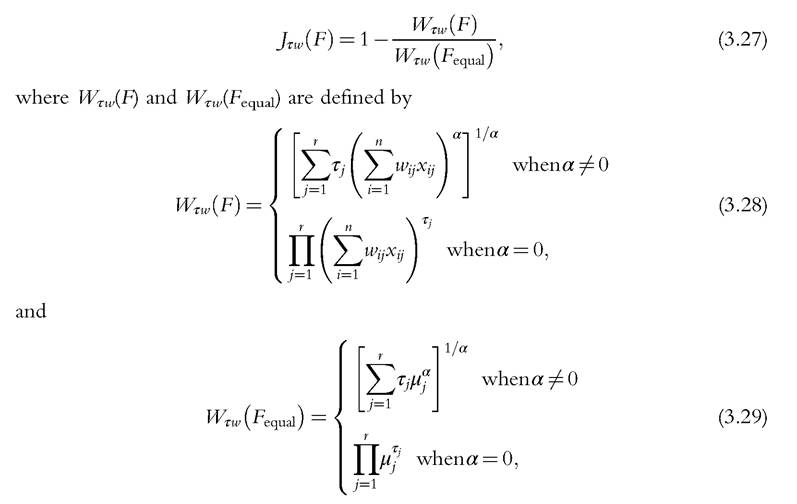
where μj is the mean of attribute j.
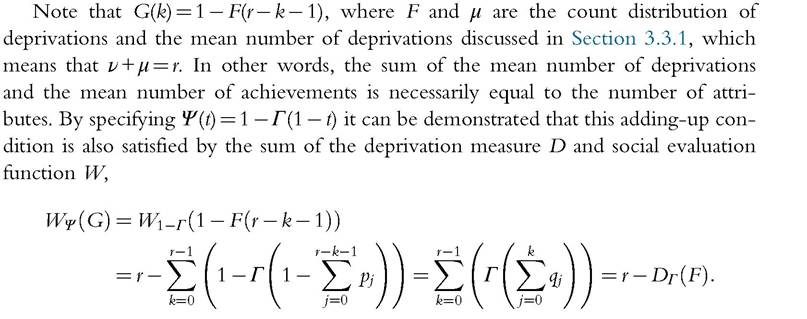
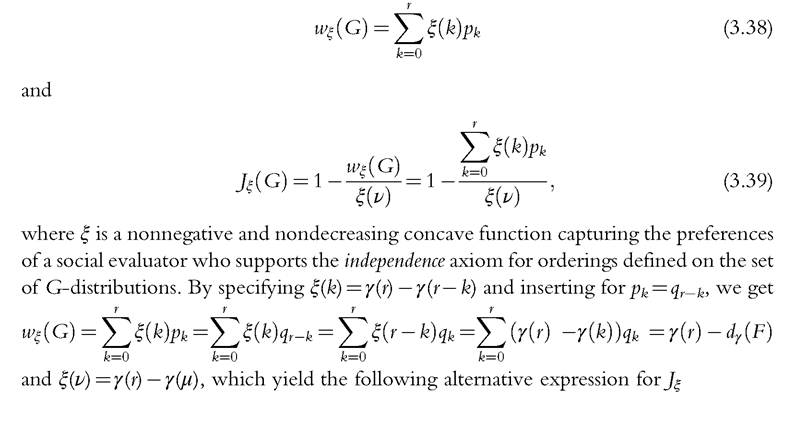
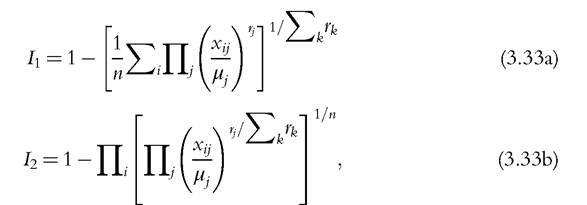
Gajdos and Weymark (2005) demonstrate that the family of social evaluation functions Wτw(F) is characterized by the following set of distributional associated axioms: uniform Pigou-Dalton majorization principle (UPD), strong attribute separability (SAS), weak comonotonic additivity (WCA), and homotheticity (HOM), as well as the conventional non- distributional axioms ordering, continuity, and monotonicity. UPD is a multidimensional Pigou-Dalton transfer principle. SAS requires that any subset of the attributes is independent of the other attributes. WCA is a multidimensional extension of the weak independence of income source axiom imposed by Weymark (1981) on the ordering of univariate income distributions, which is equivalent to the dual independence axiom discussed in Section 3.3. HOM is an extension of the scale invariance axiom for unidimensional inequality measures and requires that a common proportional change in the measurement units of the attributes should not affect the social evaluation ordering.[122] By specifying α = 1 and τj = 1/r in (3.28) and (3.29), Jτw(F) becomes a weighted average of the attribute-specific generalized-Gini coefficients introduced by Donaldson and Weymark (1980). Alternatively, by choosing Tj = 1/pj, Jτw(F) becomes equal to the arithmetic mean of the attribute-specific generalized-Gini coefficients, previously proposed by Koshevoy and Mosler (1997).[123] [124] Replacing WCA with a multidimensional extension of the independence axiom gives a normative justification of a multidimensional Atkinson family similar to the generalized-Gini family (3.27). These types of multidimensional inequality measures ignore the impact of the association between attributes on overall inequality, and therefore, they do not exploit all information when individual-level data on multiple attributes are available. 3.4.3.2Two-Stage Approaches: First Aggregating Across Attributes Measures that capture the association between attributes can be derived either from a two-stage aggregation approach or from a direct one-stage approach. where xi = (xi1, xi2,..., xir) is the attribute bundle of individual i, i = 1,2,..., n; F is the multidimensional distribution of the r attributes; and u is the common utility-like function. Bosmans et al. (2013a) demonstrate that W(F) is characterized by the following axioms:4 monotonicity, continuity, normalization (provides a cardinalization of the social evaluation function), anonymity (makes the utility function common to all individuals), homotheticity (W(F) is invariant to a common proportional change in each attribute), weak uniform majorization (progressive transfers uniformly applied to each attribute do not decrease W(F)), and individualism (social evaluation is made in two steps: the first step aggregates across attributes for each individual and the second step aggregates the aggregated attributes across individuals). Thus, several of the proposed families of multidimensional inequality measures can be ethically justified by drawing on the characterization results of Bosmans et al. (2013a). For example, the common utility-like function can be specified as where Wj is the weight associated with attribute j, equal across individuals, and weights are normalized to sum to unity. The hypothesis of additive separability used in (3.31) rules out attributes that are not perfect substitutes. As suggested by Maasoumi (1986), a straightforward generalization of (3.31) is offered by the class of utility functions showing constant elasticity of substitution (CES) where β is a parameter governing the degree of substitution between the attributes. As β goes to infinity, the attributes are perfect complements, whereas they are perfect substitutes for β = — 1. To aggregate the distribution of u(xi)'s, Maasoumi (1986) proposes using either the entropy family or the Atkinson family of inequality measures.[125] Alternatively, in the second aggregation stage, we can rely on the family of rank-dependent measures, which includes the generalized-Gini family. List (1999), Banerjee (2010), and Decancq and Lugo (2012) characterize multidimensional Gini indices that aggregate first across attributes and then across individuals. Tsui (1995,1999) follows the direct one-stage approach. Tsui (1995) generalizes to the multivariate context Kolm’s (1969) and Atkinson’s (1970) analysis in which inequality is identified with the social welfare loss (see Sen, 1978,1992, for a critique of ethical inequality indices). After restricting the class of social evaluation functions to be continuous, strictly increasing, anonymous, strictly quasi-concave, separable, and scale-invariant, Tsui (1995) derives the two following multidimensional (relative) inequality indices:[126] where μj is the mean of attribute j over all persons and parameters rjs must satisfy certain restrictions. The separability condition implies that the attributes can be aggregated for every person i into an indicator of well-being и (x1j = Π,x,,wj, where Wj = r,∕∑⅛r⅛ can be seen as a normalized weight on attribute j. By replacing ε for Σkrk, (3.33a) and (3.33b) can be rewritten as This reformulation has four advantages. Firs, it demonstrates that the family defined by (3.33a) and (3.33b) could also be justified by the two-stage approach. Second, it shows the close link of the Tsui multidimensional inequality measure with the Atkinson univariate index applied to the u(x)i,s, from which it differs only for the replacement of mean well-being with representative well-being. This is indeed the appropriate normalization because “maximizing social welfare under the constraint of fixed total resources of attributes... requires to give each individual the average available quantity of attributes” (Bourguignon, 1999, p. 478). This observation exposes a conceptual diversity between the direct one-stage approach and the two-stage approach: the first normalizes by the 3.4.3.3 Indices for Binary Variables Ifinformation is restricted to marginal distributions ofzero/one variables, an overall measure of inequality is a function of the proportions of people with attribute values above each of the attribute-specific thresholds, which means that they do not suffer from deprivation in these dimensions. By contrast, when multiple attributes are observed for the same individuals, let pj be the proportion of people with j attributes that take values above the attribute-specific threshold levels, and k or fewer attributes that take values above the attribute-specific threshold levels. Then, similar to the discussion for the distribution of deprivation counts in Section 3.3.1, the social evaluation function yields the following measures of dual multidimensional inequality: where ν is the average number ofindividual achievements above the attribute thresholds, Thus, inequality in the count distribution of achievements, rather than deprivations, can be given the following alternative expression: where Γ is a nondecreasing convex function. Inequality in the distribution of achievements is equivalent to the relative spread of deprivations (divided by the difference between the mean number of deprivations and achievements). Note that the notion of inequality is closely associated with the intersection approach discussed in Section 3.3, whereas the union approach is in conflict with the notion of inequality. (3.10), are given by 3.5.


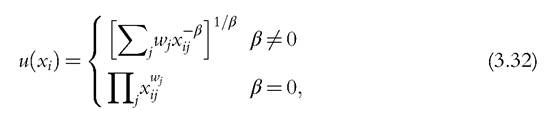
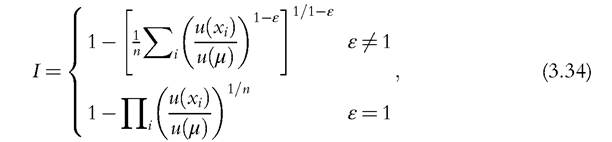

 governs the degree of concavity, and hence inequality aversion, of the social evaluation function. In the univariate income space, the range of economically sensible values for ε can be restricted on the basis of considerations on the preference for redistribution. A similar analysis has not been conducted in the multivariate space of well-being, but “there is not necessarily any reason to change our views about the value of [ε] simply because we have moved to a higher dimensionality” (Atkinson, 2003, p. 59).[127] Fourth, (3.34) shows that the Tsui index allows for different weightings of the attributes (through the Wj’s), but it makes no allowance for a variation in the degree of substitution between the attributes: the Cobb-Douglas functional form of the underlying well-being indicator implies that the elasticity of substitution between two attributes is uniformly equal to unity. In the bivariate case, a straightforward generalization is represented by the index derived by Bourguignon (1999) by assuming a CES functional form for the indicator of well-being, which has the Tsui index as a special case (see Lugo, 2007). Tsui (1999) examines alternative axioms that lead to characterizing a class of multidimensional generalized entropy measures.
 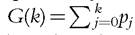 can be the cumulative proportion of people with

 is a nonnegative and nondecreasing concave function capturing the preferences of a social evaluator who supports axioms similar to those underlining the rank-dependent utility theory of Yaari (1987).