MULTIDIMENSIONAL POLARIZATION
Gigliarano and Mosler (2009) constructed multivariate socioeconomic polarization indices on the presumption that polarization should capture internal homogeneity, external heterogeneity, and similarity of group sizes.
Compared to Zhang and Kanbur (2001), the measurement of group homogeneity and heterogeneity is refined by using multivariate distances. Multivariate decomposability into intragroup and intergroup components of inequality is then used to construct multidimensional polarization indices.To see how, consider a distribution of N individuals along C types of endowments, represented by a matrix X
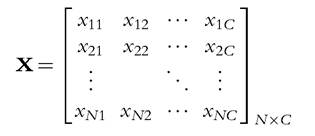
where xiq denotes the endowment q of individual i. Using inequality decomposition, the multidimensional polarization index is given by: 
where GB and GW are multivariate indices that measure inequality between and within groups, respectively, and where ζ is a function that is increasing in GB and S and is decreasing in GW. S(X) is a measure of deviation from equally sized groups; it is maximal if all groups are of the same size. Particular forms of this index are given by
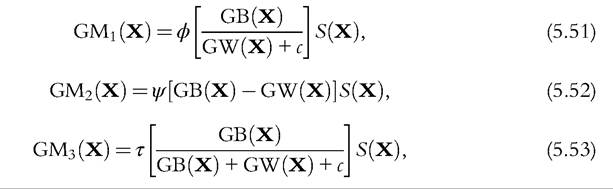
with constant c being positive and possibly dependent on the choice of indices GB and GW The functions φ, ψ, and τ are assumed to be continuous and strictly increasing, with φ(0) = τ(0) = 0. These forms were subsequently developed by Gigliarano and Mosler (2009) using additively decomposable multivariate inequality measures. Similar procedures are proposed for multiplicatively decomposable inequality measures. Equation (5.51) is similar to Zhang and Kanbur (2001) except for the explicit role of group sizes S(X) and for the fact that X is a matrix.
Equation (5.52) is similar to the Foster and Wolfson (2010/1992) bipolarization measure with below and above median groups—although the definition of a “median frontier” in a multidimensional setting is not immediate.Two alternative multivariate polarization indices with special relevance to the case of a population split into two groups are proposed in Anderson (2010). When these two groups are made of poor and nonpoor individuals, these indices can be used as multivariate relative poverty measures based on distances between them. Consider then a population composed of two groups: the poor and the nonpoor. They are assumed to be distributed according to two continuous multivariate unimodal distributions: fp(x) for the poor andf(x) for the nonpoor, where x is a 1 ? C vector of characteristics. An “overlap” measure is defined as:

This is a multidimensional extension of the overlap measure of Equation (5.45). Assessing the degree of polarization between two groups when individuals have many characteristics amounts in this formulation to capturing the degree of commonality between the two distributions.
Anderson (2010) proposed an alternative index that can be used when attributes are mutually exclusive and do not overlap. Let xmp and xmr be the value of the characteristic vector at the modal point of the poor and the nonpoor distributions, respectively. The index is the area of the trapezoid formed by the modal peaks of the densities and the mean normalized Euclidean distance between these two points. Let μq be the mean of the q th characteristic in the pooled population. When the poor and nonpoor distributions are separately identified in C dimensions, multidimensional polarization is written as:

This can be interpreted as a multivariate relative poverty index without formal poverty frontiers, the index being based on distances between two identified groups, poor and nonpoor.
Note, however, that two distributions of the poor and nonpoor may not be separately identified, in which case it may be difficult to apply an index like Equation (5.55). Unique modal distances may also not exist between the poor and the nonpoor. Even if they exist, it is not clear that they would necessarily be appropriate measures of deprivation over the entire distributions: Many different multivariate distributions can exhibit similar distances between such modes but may yet represent quite different allocations of welfare across the poor and the nonpoor.A multidimensional extension of DER’s identification/alienation framework can also be designed. A natural procedure for that is found in Anderson (2011). The extension is multidimensional in the sense that both identification and alienation depend on the joint distribution of multiple socioeconomic attributes. The multivariate distribution can also be defined over a collection of both discrete and continuous variables.
To see how, let ui and vj∙ be stacked vectors of continuous and discrete variables, with dimension k (for the continuous variables) and h (for the discrete variables) and for individuals i and j, respectively. A multivariate polarization index taking into account both continuous and discrete variables is then given by
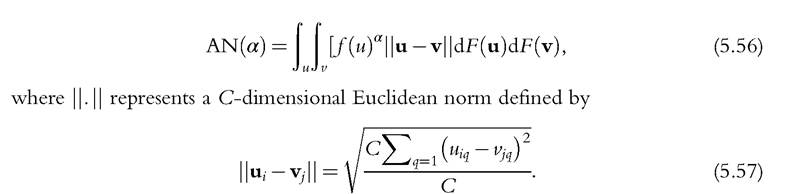
This is the normalized Euclidean distance between individuals i and j, where uiq is the q th variable of individual i and C = k + h.
5.9.