DO PEOPLE ADVOCATE EOp? LESSONS FROM QUESTIONNAIRES AND EXPERIMENTS
The information reviewed here is derived both from the answers of respondents on questionnaires and from the actions chosen by players in laboratory or field experiments.
25
Questionnaires are sometimes regarded with skepticism by economists, whereas they are used extensively by psychologists and political scientists (see Chapter 13 for more methodological issues).
Gaertner and Schokkaert (2012) made a plea for the use of questionnaires in the field of social choice and justice and here we build upon their reasoning. What we desire is a procedure or protocol that helps subjects to reveal their norms of distributive justice. We recognize that respondents can lie; Gaertner and Schokkaert (2012) ask why respondents would do so. In the absence of self-interest, they assert, respondents will choose to reveal their true norms. (We often assume that when an agent is indifferent between cheating and telling the truth, he will tell the truth.) The main risk with questionnaires is that respondents answer at random when the question is too complex, a difficulty of which social psychologists are well aware.4.9.1 Questionnaire on the Empirical Validity of EOp
A first source of information is provided by value surveys conducted by polling companies or scientific associations like the World Values Survey. In our opinion, these are not fully satisfactory, because the questions remain quite vague and are not related to specific normative theories. Rather, they address the beliefs of respondents concerning the determinants of success in a given country.
Since Schokkaert and Lagrou’s (1983) early work, many surveys have been conducted, most of which propose vignettes about different aspects of life in order to inquire whether individuals’ opinions about justice coincide with the theoretical propositions put forward by social scientists (for references and overviews, see Gaertner and Schokkaert, 2012; Konow, 2003; Schokkaert, 1999).
The literature related to our topic can be divided in two subsets. The first tests the raw idea of responsibility. The second is rooted in the theories of EOp proposed by Roemer and Fleurbaey. Konow’s (1996, 2001) studies, although not anchored in a theory, introduced the distinction between discretionary and exogenous variables, which is very close to the responsibility cut as viewed by Cohen (1989), although Konow was apparently unaware of Cohen’s work. A discretionary variable affects output and can be controlled or influenced by the person, while an exogenous variable can have an influence on the amount or quality of output but cannot, under normal circumstances, be influenced by personal choice. His findings (telephone interviews with a general adult population of Los Angeles and written questionnaires completed by college students) support the view that for income acquisition, variables that are deemed to be controlled by the individual are viewed as legitimate influences upon income, whereas exogenous variables are not.Perhaps the most thorough empirical study related to the philosophical project of EOp is that of Schokkaert and Devooght (2003) (see also Schokkaert and Capeau, 1991; Schokkaert and Overlaet, 1989). First, the authors test the two principles of “full compensation” and “natural reward,” which are at the heart of Fleurbaey’s approach (Bossert and Fleurbaey, 1996; Fleurbaey, 1995). The principle of full compensation states that two individuals who exert the same effort should enjoy the same outcome; thus, the effect of differential circumstances is fully compensated. The principle of natural reward states that, if individuals have the same circumstances, there is no reason to transfer income between them (thus, full responsibility for effort). Second, there is an intercultural dimension in their study, as they distributed the questionnaire to first-year university students in three very different countries: Belgium (April 1996), Burkina Faso (May 1996), and Indonesia (August 1997).
(See also Gaertner and Schwettmann, 2007). Finally, this study highlights whether views of responsibility are sensitive to what we have defined as the objective (or the opportunity equalidandum), as the questionnaire addresses views of responsibility with respect to income acquisition and health.Four situations are contrasted in a two-person society. The two persons differ in only one characteristic. Possibilities of redistribution between the persons are then offered, and students are asked to choose what they think is the fair ex post tax income distribution.
The first vignette describes a difference in preferences in income-leisure space. No explanation is offered to explain this difference in tastes, whereas the second vignette stipulates that this difference comes from different backgrounds. That vignette tests the disagreement between Roemer and Barry about sterilizing the distribution of effort of the influence of circumstances. It is important here to notice that the issue raised is not the transmission of wealth, or social networks, but the transmission of values and preferences across different generations. People convinced by Roemer’s reasoning should be more inclined to redistribute from hard-working Elizabeth to easy-going Catherine in the second situation than in the first. The third and fourth vignettes concern differences in productivity. In the third vignette, the difference originates in a difference of effort in the past. The fourth vignette describes a difference in innate talent.
The results are instructive and we will present them in terms of how the majority voted. The Belgian sample made the most clear-cut choice: A majority vote for no compensation at all (no redistribution) in case of Vignettes 1, 2, and 3, and for full compensation for the situation described in Vignette 4. Thus, the Belgians endorse the view that preference for leisure is a responsibility variable—they agree with Brian Barry not to take the causal relationship with parents’ preferences into account.
Innate talent, however, is considered as a circumstance. Were that vote representative of Belgian choices as a citizenry, this society would possess the basic ingredients to implement an equalopportunity policy.The authors find that the intercultural differences are much less pronounced than one might have thought. Still, they cannot be completely ignored, since, according to the majority vote criterion, the Burkina Faso sample is indecisive for all four vignettes. The Indonesian vote is closer to the Belgian one. Indonesians share the same views on the three first vignettes, but no majority is found on the last issue, although full compensation for talent has a plurality of votes.
At this stage, it is useful to ask whether the objective matters. Schokkaert and Devooght (2003) attempted to adapt their questionnaire to health care situations. From the start, two differences with income scenarios must be noticed that render the comparison less than clear-cut. In the income case, the stakes belong to the domain of gains, whereas they belong to the domain of losses in the health care case: the health vignettes describe illness and how to cope with health care expenditures. Since the work of Tversky and Kahneman (1991), we know a person’s tendency strongly to prefer avoiding losses to acquiring gains. This may explain a stronger inequality aversion in the health vignettes. In addition, if questions are asked about how to allocate a budget between two sick persons, an efficiency issue is raised, which makes it difficult to deduce views about fairness. All studies about fairness in health care (Dolan and Tsuchiya, 2009; Ubel et al., 1999, and the above-cited paper) have chosen to formulate the vignettes in a scarcity context. Of course, scarcity of resources is an important issue in the health domain (as in others), but a sequential approach with two steps might better elicit preferences about the responsibility cut.
As an example consider two of the four vignettes proposed by Schokkaert and Devooght (2003), concerning Luke and Mark who are both suffering from lung cancer.
They have the same wealth at their disposal and earn the same income. Luke and Mark have to be admitted to a hospital for treatment. It is supposed that all treatments are effective. The two vignettes raise the relevance of factors that are under the control (smoking) or beyond the control (genetic) of the individual for covering lung cancer expenditure. The respondents have the choice between different divisions of the amount of public resources: equal split between the two patients, all resources for the extra cost of treating Mark, and intermediate solutions between these two.It is noteworthy that in all three societies, equal-split garners a majority of votes in Vignette 1. A majority favor an intermediate solution when genetics calls for extra cost. The social policy that this study suggests is clear-cut: smokers should purchase private insurance for coverage of smoking-related illness. This conclusion holds as long as the society is able to attribute the cause of the extra cost to lifestyle. These results suggest that the reason that the welfare state in many countries does not appear to be inspired by responsibility-sensitive egalitarianism is not due to popular ethics, but to the difficulty of identifying an indisputable causal link in health matters. Off-piste skiing is “the exception which proves the rule,” where the cost of an accident is generally borne by the individual. One salient issue remains unsettled: we know of no questionnaire focusing on the link between lifestyle and family background. The difference of opinion between Roemer and Barry has not been reflected in the empirical literature on fairness in health.
Education is another domain where we can conjecture a different attitude with respect to responsibility. Primary and secondary education take place when the person is still, arguably, below the age of consent. Richard Arneson (1990, p. 179) has appealed to this fact in egalitarian debates. Lu et al. (2013) have investigated whether primary education elicits different responses from income acquisition in the degree to which persons are held responsible for outcomes.
They contrast the results obtained with two vignettes.In the sales vignette, there are salespersons whose sales compensation is composed of two parts: a salary and a bonus. The issue concerns the fairness of the bonus. Sales depend on characteristics which are described as follows. The salesperson’s circumstances are identified with his parents’ network of acquaintances. Effort is described as the salesperson’s hard work, and talent is described as the salesperson’s skill. A salesperson’s brute luck is defined by the territory to which she is randomly assigned. Finally, option luck is described as the risks the salesperson takes: he has to choose between selling an old product that has been on the market for a long time and is familiar to customers, or a more recent product with unknown customer reaction. If a bonus is to be paid to the successful salesperson, respondents are asked how fair it is to judge the salesperson by her circumstances, effort, talent, brute luck, or option luck. The respondent has to choose exactly one answer among very unfair, rather unfair, quite fair, or absolutely fair for each of these choices.
In the school vignette, pupils face difficulties at school. Remedial tuition is supposed to help schoolwork. Five factors are related to school difficulties. Circumstances are determined by parents’ ability to help children with their homework. Effort is identified as the zeal with which the child does his or her homework. Talent is defined as cognitive ability, which is precisely described as an ability to concentrate. Brute luck occurs when the child missed part of the previous school year because of illness. Finally, option luck is risk taking. The child wants to be in the advanced class, with friends, but cannot keep up with the class. Respondents were asked to judge the fairness of remedial tuition, ifit were necessary because of circumstances, effort, talent, brute luck, or option luck.
Figure 4.5 presents the differences in the answers to both vignettes (432 respondents in Marseilles). In the sales vignette, we interpret the answers “quite fair” or “absolutely fair” as indicating that the respondent holds the salesperson responsible for the factor. In the school vignette, we interpret the answers “very unfair” or “rather unfair” as revealing that the pupil was deemed responsible for the factor by the respondent. A chi-square test for goodness of fit is used to test whether subjects treated each factor similarly in the two vignettes. Respondents evaluated moral responsibility with respect to all causal factors except circumstances differently in the two vignettes. More specifically, salespersons were held responsible for talent, while almost no subjects held pupils responsible for talent. Only a small minority deem students responsible for risk taking, while almost everyone deem the opposite for salespersons. The difference for effort is less impressive, since a small majority of respondents still agree to hold schoolchildren responsible for their effort in doing homework. Our results are preliminary as they are perhaps influenced by framing. Nevertheless, they cast doubt on holding children responsible for educational outcomes, at least at the primary level. Ifthat decision is implemented, then primary-school
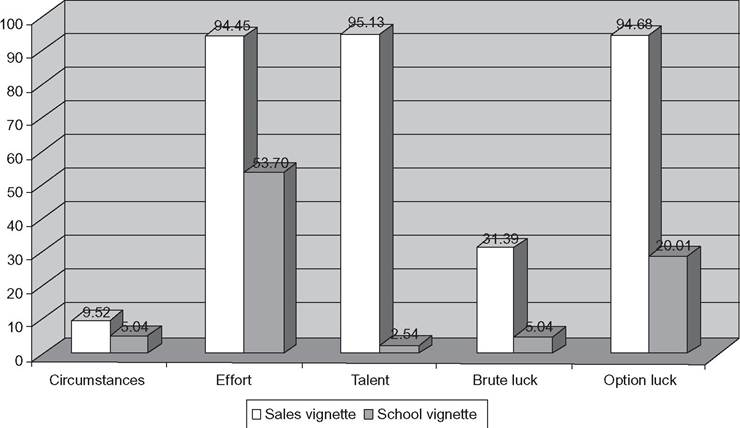
Figure 4.5 The fraction of subjects holding the agent responsible for each factor. Source: Lu et al. (2013).
achievements should be treated as a circumstance in studying opportunity equalization of outcomes in later life.
4.9.2 Experiments
Fairness attitudes in sharing a cake have been studied in laboratory experiments with the ultimatum game and the dictator game (Camerer, 2003), which provide a neat elicitation of preferences. These experiments reproduce exchange or distribution economies where resources are manna from heaven. Various authors (Almas et al., 2010; Cappelen et al., 2007, 2010, 2013; Frohlich et al., 1987, 2004; Konow, 2000; Rutstrom and Williams, 2000) have conducted experiments to study explicitly what happens to people’s distributive preferences by introducing an earned-money or production stage prior to a distribution phase consisting of a dictator game. The most recent articles test the prevalence of responsibility egalitarianism among distributive justice theories. More explicitly, they investigate the control view of responsibility advocated by Cohen, summarized by the principle that “only inequalities that arise from factors under individual control should be accepted.”[148]
Cappelen et al. (2007) study a situation in which individuals differ with respect both to their investments and to the rates of return that they enjoy. The agent chooses the amount to be invested, while the rate of return is assigned randomly. The former factor is clearly an effort variable, while the rate of return is brute luck, like talent. They assume that an individual endorses either strict equality of earnings, laissez-faire, libertarianism (each keeps his income), or responsibility egalitarianism, in which case total income is shared in proportion to investments. The distribution phase is a two-person setting in a one-shot dictator game. A parametric utility function is a weighted sum of a purely selfish element, and an altruistic quadratic loss term, which is larger, the more the distribution differs from the ideal distribution according to the individual’s ethical view. The econometric analysis attempts to retrieve the parameters of the utility function, the marginal utility of money, and the preferred distributive ethic view of the subject. The authors deduce that 43.5% of subjects are strict egalitarians, 38.1% are responsibility egalitarians, and 18.4% are libertarians. The subject pool consisted of approximately one hundred students at the Norwegian School of Economics and Business Administration (NHH), a sample that cannot be viewed as representative of the Norwegian society. In addition, the results may depend on the specific form of the utility function, which balances self-interest and fairness. Nevertheless, their results confirm that responsibility-sensitive egalitarianism is endorsed by a fraction of the population and competes with libertarianism and outcome egalitarianism. But we do not learn much about the responsibility cut.
26
In a companion paper, Cappelen et al. (2010) use the same methodology and pool of students to enlarge the set of proposed fairness views. Individuals now differ with respect to three characteristics: working time, productivity, and the market price of their product. Subjects choose their working time (effort), market price is set randomly (brute luck), and productivity (talent) is determined through a test in the experiment (the number of correctly typed words in a short period). The authors consider four competing distributional views expressed by the list of responsibility factors. An empty list corresponds to outcome egalitarianism. If effort is the only factor belonging to this list, the view is control-responsibility egalitarianism. When this list comprises effort and talent, the view is named meritocratic[149] by the authors. (In other words, people may rightfully benefit from their inborn talent.) Finally when this list comprises effort, talent, and brute luck, it is said that the participant endorses the libertarian view. The subject pool includes students from all undergraduate years and some alumni. The differences in preferred distributive views, as estimated by the econometric model, are not pronounced among students, but alumni have quite different ethical preferences. Whatever the age group, the meritocratic view is the most popular view among students whereas the libertarian view is slightly more popular among alumni. The striking fact is that the control view of EOp is only supported by a tiny fraction of the pool: 6% among students and 2% among alumni. At this stage, it is premature to declare that these results are biased by a selection effect: however, let us remark that business-school students and alumni are very likely among the least egalitarian people in society.
27
In a less sophisticated way but using the same framework, Almas et al. (2010) investigate how the views about distributive justice evolve as pupils mature between the 5th and 13th grades. At the beginning of this span, schoolboys favor outcome egalitarianism (two-thirds) and libertarianism (one-third). As the children get older, they become increasingly sensitive to equality-of-opportunity arguments and by the end of the grade span, meritocracy 8 becomes the plurality view, even if it does not garner a majority of votes. Indeed it is striking that the distribution of views in this study for the 13th grade is almost the same as that obtained for the first year of college obtained by Cappelen et al. (2010).
If we assemble the lessons of these two instructive studies, they lead to the following conjecture for the development of distributive ideals over the life cycle. Starting with the stark and simple views of outcome egalitarianism and libertarianism in childhood, the development of cognitive skills induces understanding of more complex and less clear-cut views, like EOp. Views appear not to change significantly between the end of the high school and the end of the university.
Those successful in the labor market tend more toward laissez-faire opinions. Were that true in the real world, we should observe a self-serving bias (Messick and Sentis, 1983) on a large scale, in the sense that individuals, given their degree of success, would (tend to) endorse the fairness ideal that most benefits themselves. In that sense, experiments are superior to surveys and vignettes in that they enable one to measure the extent of this self-serving bias. This phenomenon should be at its minimum when subjects are students. At this stage of development, subjects are able to understand all theories ofjus- tice but they are still shielded by a veil of ignorance regarding their degree of success (in the United States, where 50% of a generation enrolls in tertiary education). The prediction would be that the difference between surveys and experiments would be minimal for this adult group.
We turn now to testing popular views about option luck. Buchanan (1986) identifies four factors that determine the distribution of income and wealth: luck, choice, effort, and birth. He considers the acceptability of rewarding effort the least controversial, and believes that the only inequalities that conflict with common views of justice are ones caused by birth (pp. 129-30). The difficulty with option luck comes from the fact that it is a mix of two more fundamental factors, one for which we want to hold people responsible, choice, and the other that is exogenous, luck. A similar difficulty prevails for talent which is a mix of birth, an exogenous factor, and past effort, which is a responsibility variable. (Buchanan does not observe the semantic convention that talent is an inborn factor, and skill results from the application of effort to talent.) [150]
28
Two papers, Cappelen et al. (2013) and Chanel et al. (2013), investigate the views of people about option luck and risk taking vis-a-vis the responsibility cut. The first article endeavors to shed light on the relative popularity of three views about option luck. The first view is Dworkin’s, according to which no redistribution of gains or losses from risk taking is ethically required. Dworkin argues in favor of a laissez-faire stance, because risky lifestyles or risk taking are expressions of preferences. The second view considers it fair to eliminate all inequalities resulting from risk taking. The third view is intermediate between the first two: It would approve ex post redistribution between lucky and unlucky gamblers but not between gamblers and nongamblers. This view is reminiscent of a position first defended by Le Grand (1991) and refined by Fleurbaey (2008), who considers that people should be fully insured and only bear the consequences of their decisions over the expected value of the lottery. Gamblers will then receive the expected gain corresponding to their class of risk. The experiment consists of a risk-taking phase followed by a distribution phase. In the risk-taking phase, subjects face a sequence of choices between a risky and a safe alternative, where the value of the safe alternative varies. Estimates of the choice model reveal that subjects (students at the Norwegian School of Business in Bergen) have diverse opinions and split quite evenly into three groups. Roughly speaking, two-thirds of the subject pool think that people should be deemed responsible for their choice of risk taking. The same proportion but not the same individuals think that people should not bear the consequences of luck. If we interpret the econometric results as a vote, Le Grand—Fleurbaey’s view is the Condorcet winner among the three alternatives offered to participants. This interesting result needs to be confirmed by other studies.
Chanel et al. (2013) are less precise in studying option luck but their aim is to deduce the relative importance of option luck in the set of factors for which individuals should be held responsible. They conduct an experiment on a large scale whose purpose is to reveal the preferences of agents when four factors matter for earnings: circumstances, effort, brute luck, and option luck. Three experimental sessions were organized involving a treatment of about 100 subjects each, who are told that they form a small society. Each treatment involves an earned-money phase followed up by a redistribution phase, where the allocation rule is determined by majority vote. In the first phase, participants can earn money through four different channels, each of which reflects a specific factor: the place of one’s birth represents a circumstance and success at a visual-spatial attention task requires effort. Brute luck and option luck are easily contrasted by a random draw and taking a bet, respectively. Votes are then organized on whether or not to redistribute the gains from each step, which corresponds to a given factor. A self-serving vote is found to be prevalent (about one-third of the sample who succeeded in earning money vote not to redistribute) and nonparametric econometrics are mobilized to retrieve the true ethical preferences beneath the votes. The distribution of ethical preferences among the subject pool is described in Figure 4.6.
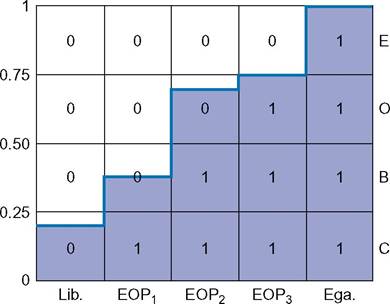
Figure 4.6 Distribution of ethical preferences about the responsibility cut. On the left vertical axis, the figures are proportions. On the right vertical axis, E stands for effort, O for option luck, B for Brute luck, C for circumstances. In each square, 0 (respectively 1) means no compensation (resp. compensation). For example, egalitarians think redistribution is mandated regardless of the cause of earnings. Source: Chanel et al. (2013).
Five ethical positions are represented here.[151] At the two extremes, we find the libertarian and outcome-egalitarian stances. Three intermediate positions are allowed: in EOP1, only differential circumstances merit compensation; in EOP2 brute luck in addition merits compensation. Option luck joins the compensation set with EOP3. The two extreme positions attract almost a quarter ofthe views. This means that 60% ofthe sample endorse some version ofEOp. There remains a large diversity of opinion regarding the locus of the responsibility cut. In the aggregate, the result of this experiment supports Dworkin’s view according to which we should draw a distinction between option luck and brute luck, option luck being on the responsibility side along with effort, and brute luck being on the compensation side with circumstances. Nevertheless, we need to be more careful before a more definitive conclusion is reached, for many areas of uncertainty must addressed. More specifically, the design of the experiment tests Le Grand- Fleurbay’s position against that of Dworkin. Redistributing gains from bettors to nonbettors has not been proposed to voters.
4.9.2 A Progress Report
In agreement with Roemer’s suggestion (1993), we have developed the view that theory and empirical work are more complements than substitutes. As stated by Gaertner and Schokkaert (2012), “The theory ofEOp offers a general and consistent framework which can be applied for any cut between effort and circumstances, while empirical work supplies the necessary information about where the boundary is drawn in different societies.”
29
If we take again the four “primary factors” identified by Buchanan—birth, luck, choice, and effort[152]—it seems indisputable that subjects make a clear distinction between the first two and the last two. In questionnaire-experiments, the assumption that choice and effort are under the control of the individuals and that participants are well-informed about the consequences of the acts cannot be disputed, since the protocols of the experiments are clear. Even if more research is welcome, the conclusion reached by Konow (2001) 10 years ago appears to stand: “To summarize, the evidence from experiments and surveys generally indicates that someone whose contribution is more highly valued is more deserving if that person bears responsibility for the contribution but not if it is due to factors outside his or her control.” Does this mean that from an empirical perspective, the control view of Arneson and Cohen prevails over the preference view of Dworkin and Fleurbaey-Maniquet? Not exactly, for the proper test has not been conducted. Except for Schokkaert and Devooght (2003), we know of no study testing both theories in a competitive way through questionnaire-experiments. The control theory has been repeatedly tested by psychologists and economists but not against the preference theory. We observe choices, not preferences. Economists are keen on promoting the concept of preference among social scientists; the main weakness of the concept is that preferences are not easily revealed to experts, let alone laypersons. It is asking a lot to make preferences pivotal in a theory of distributive justice that will garner mass agreement, when, at best, only some experts can argue that they have been able to deduce what preferences people hold.
EOp involves an equalizing aspect and a disequalizing one.[153] Equalization, or compensation, takes place with respect to those factors deemed circumstances; inequality is noncompensable, however, ifit is due, tautologically, to factors for which individuals are held responsible. The difficulties arise when some causes of success or failure, with respect to a desirable objective, involve mixtures of these two kinds of element. Skill is a mixture of talent, due to birth, and past effort; option luck is a mixture of choice and luck. Selfprotection as defined by Ehrlich and Becker (1972) is an expenditure that reduces the probability of a loss, which can be generalized to any effort that transforms the probability distribution of states in a good way for the agent. We do not know whether the
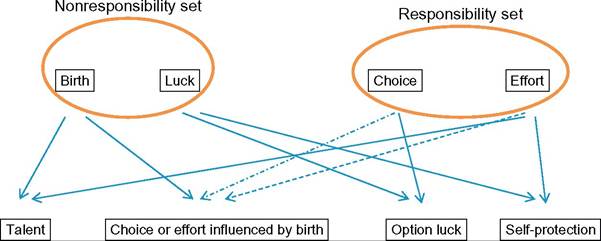
Figure 4.7 Binary combination of primary factors.
differences in views that people hold about distributive justice are due to the ambiguities introduced by the mixtures of these two kinds of factor in real life, or to fundamentally different ethical principles. See Figure 4.7.
4.10.