THE COMPARATIVE VIEW
When the reference group is viewed comparatively, individuals are not indifferent to others and compare to them to evaluate their own status in society.[855] If the individual is a member of this reference group, then higher incomes for others will reduce her well-being, whereas lower incomes have the opposite effect.
Alternatively, if she is not in the reference group, but would like to be, then others’ higher incomes will have a positive effect on her well-being. In both cases income disparities among others will be correlated with individual well-being.We first consider evidence for the importance of such comparisons to others based on the measures of subjective well-being that are by now commonly available in many sources of survey data, before turning to the complementary work in experimental economics.
13.2.1 Subjective Well-Being and Others' Income
Arguably inspired by the salience of the Easterlin paradox[856] (Easterlin, 1974), and the increasing availability of information on various measures of subjective well-being in large-scale (including panel) data sets, there is by now quite a considerable stock of work on the relationship between income and well-being. One of the key questions in this literature has been “Does money buy happiness?” In standard economic theory, individual utility is not supposed to be affected by the behavior or income of others, unless these latter impose an externality on the individual.
In the context of the comparative reference group evoked earlier, however, the incomes of others in the reference group do indeed impose just such an externality. An increase in the income of others reduces the individual’s well-being, through either greater relative deprivation or lower relative satisfaction (depending on whether the others whose income rises earn more or less than the individual in question), whereas analogously a reduction in others’ income increases the individual’s well-being.
There are any number of ways of attempting to show that individual well-being depends negatively on others’ income. These were surveyed in Clark et al. (2008), and as such this chapter will only provide a shorter run-through of some of the relevant findings. Of course, comparisons need not be restricted to income and may well refer to comparisons of consumption, as initially suggested by Veblen (1949) and demonstrated empirically by, among others, Bloch et al. (2004), Brown et al. (2011), and Heffetz (2011). Comparisons could also cover leisure (Frijters and Leigh, 2008) or arguably almost any other observable economic attribute.
Some of the empirical work on the comparison of income has used a revealed- preference approach, in which observed measures of labor supply or consumption are argued to be more consistent with a relative utility function, in which either income or some consumption goods are compared to those of others in the reference group. A number of pieces of evidence along these lines can be found, for example, in Frank (1999), Layard (2005), and Schor (1992).
It is always difficult to convince skeptics that any such correlations do indeed reflect spillover effects within the utility function, rather than learning, a hidden common factor within the reference group, or endogenous selection into the reference group. The tightest evidence in this respect may well come from natural experiments, in which either reference group income or consumption randomly changes. A small number of these experiments are described here.
Card et al. (2012) appeal not to expected outcomes but rather the revelation of information on others’ earnings. The natural experiment here is a court decision that made the salary of any California state employee public knowledge. A local newspaper set up a website making it easy to find this information. Following this website launch, Card et al. informed a random subset of employees at three University of California campuses about the site.
Some days later, all employees on the three campuses were surveyed. Comparing those in the treatment group (informed about the website) to others reveals the impact of information regarding others’ salaries. The reference group in this work was defined as coworkers in the same occupational group (faculty vs. staff) and administrative unit in the university. Finding out about others’ earnings should reduce the well-being of those who find themselves to be relatively less well-paid than others in the reference group and increase it if they find themselves to be better paid. The survey did indeed find lower job satisfaction for those with pay below the reference group median and a greater intention to look for a new job. The effect on both of these variables for those who were relatively well paid was insignificant. There is in addition some evidence of an actual quitting effect on those who were found to be in the bottom earnings quartile in the reference group.Kuhn et al. (2011) consider observed large changes in close neighbors’ incomes, which result from the design of the Dutch postcode lottery. Each week, this lottery randomly selects a postal code and allocates a prize of E 12,500 per lottery ticket purchased within the postcode. In addition, one participating household in the winning postcode receives a new BMW. These postcodes are small, comprising on average about 20 households. Individuals who do not live in the winning postcode area, and those who do but did not buy a ticket, receive nothing. Households in winning postcodes were surveyed 6 months after the prize was won. One of the paper’s key findings is that lottery nonparticipants in winning postcodes (who live next door to winners) are significantly more likely to have purchased a new car since the date of the lottery draw than are other nonparticipants, as if individuals do indeed compare their own car to that of their near neighbors.
A last example of a natural experiment is one in which comparisons to a reference position or an expectation (rather than comparison to other individuals) affect observable behavior (rather than subjective well-being).
In NewJersey, police unions bargain over wages with their municipal employer, and in cases of dispute, an outside arbitrator has the final say. Mas (2006) found that the per capita number of crimes solved (cleared) is 12% higher when the unions win their case compared to when they lose. He concluded that “the change in performance of police officers following an arbitration loss depends not only on the amount ofthe pay raise, but on the counteroffer that was demanded but never implemented as well” (p. 785).Natural experiments of this kind are relatively rare. A great deal of work has instead appealed to survey data and modeled subjective well-being as a function of both the individual’s own income and the income of a plausible reference group. This latter reference group is almost always imposed by the researcher as some measure ofthe income earned by those who are of the same age, sex, and education, for example, or who live in the same region, or (in the case oflinked employer-employee data, as in Brown et al., 2008; Clark et al., 2009b) who work in the same firm. Direct information on who is in the individual’s reference group in survey data is very rare (an exception is Clark and Senik, 2010).
Some of the by now large body of empirical literature is surveyed in Section 3.1 of Clark et al. (2008). For the income of “people like you,” Clark and Oswald (1996) used the first wave of British Household Panel Study (BHPS) data to show that the estimated coefficients on income and others’ income in a job-satisfaction equation are statistically equal and opposite, which is compatible with the Easterlin paradox. An early contribution by Cappelli and Sherer (1988) considered workers in the airline industry. The authors appealed to an occupational definition of others’ earnings and showed that individual pay satisfaction is negatively correlated with an outside “market wage,” which is average pay by occupation in other airlines. Ferrer-i-Carbonell (2005) related life satisfaction in the German Socio-Economic Panel (SOEP) to average income defined by sex, age, and education; Luttmer (2005) also considered life satisfaction, which is shown to be negatively correlated with average income by local area identified in a number of waves of the U.S.
National Survey of Families and Households.Instead of modeling reported subjective well-being as a function of own and others’ income, an alternative is to ask how much income individuals need to attain a certain level of well-being. This is the method used in the Welfare Function of Income, associated with the Leyden school in the Netherlands. In this project, individuals are asked to assign income levels (per period) to a number of different verbal labels (such as “excellent,” “good,” “sufficient,” and “bad”). It is then possible to estimate an individual lognormal Welfare Function of Income using the responses for each individual; this function shows how much income each individual needs to hit a certain level of well-being. The estimated means (#956;i) of these lognormal functions can then be used as the dependent variable in regressions seeking to explain which types of individuals require a higher level of income to be satisfied. The mean #956; was found to be positively correlated with reference-group income (average income by age, education, and certain other individual or job characteristics); see Hagenaars (1986) and Van de Stadt et al. (1985). In other words, when the income of the reference group is higher, individuals need more money to attain a certain stated level of utility.
To date we have discussed empirical results that are consistent with a comparative reference group of which the individual is a member. The discussion in Section 13.1 revealed a possible counteracting effect when incomes rise in a comparative reference group to which the individual aspires, but of which she is not yet a member. Some work has indeed found that individual well-being is positively correlated with reference group income and has attempted to interpret this correlation in the light of aspirations and future outcomes. A positive correlation between my own well-being and others’ income is consistent with Hirschman’s tunnel effect, where others’ earnings provide information about my own future prospects.
In the terminology of Manski (2000), these are expectations interactions, where the individual updates their information set based on others’ outcomes. The tunnel effect relates to the literature on the “prospect of upward mobility” (POUM), where both current and future income matter. This will be discussed further in Section 13.4.3.Clark et al. (2009b) make the point that the estimated coefficient on others’ earnings in a typical subjective well-being equation will likely mix together the comparison element (comprising relative deprivation and relative satisfaction, as discussed earlier) and the relative aspiration effect of the group to which the individual aspires. In the associated literature, this latter is often called an information or signal effect (whereas the former is called a jealousy or status effect). Positive subjective well-being effects from others’ income are found, for example, in Senik (2004), Kingdon and Knight (2007), and Clark et al. (2009b). In each of these, the case can be made that the retained measure of others’ income contains some element of my own likely future outcomes: An information or aspiration role for others’ income is more likely the greater my probability of accession to the reference group in question. As will be discussed in Section 13.3.1, the inversion in the correlation between satisfaction and overall income inequality in Grosfeld and Senik (2010) in Poland can be interpreted in the light of such a tunnel effect. Individuals were initially happy with others’ higher incomes (toward the top end of the income distribution), as this was thought to reflect their own future opportunities. Once it became clear that only relatively few people were actually going to be able to accede to these incomes, the correlation with satisfaction became more comparative, with a net negative effect in the later years of their sample.
Before describing the results of this literature any further, it is useful to set out the models of income comparisons formally. There is a set N = {1,..., n} of n #8805;2 individuals whose incomes are recorded in an income distribution x = (x1,..., xn) 2 R+, where R+ is the set of n-dimensional vectors with nonnegative components. The mean of x is #955;(x). For x 2 Щ, Bi(x) = {j 2 N#8739;xj#8729; gt; xi} is the set of individuals with income greater than that of i, known as the better-off set; analogously, W)#8729;(x) = {j 2 N#8739;xj#8729; lt; xi} is the set of individuals who have an income that is lower than that of i, the worse-off set.
In the income-distribution literature, the most significant role of relative standing is in the determination of deprivation and satisfaction, which is related to inequality measurement as we will see later. As opposed to measures of income inequality, deprivation and satisfaction are defined at the individual level and aim to capture individuals’ reactions when they compare their situation to that of others who have different levels of income (or of some other variable). Deprivation “involve(s) a comparison with the imagined situation of some other person or group. This other person or group is the ‘reference group,’ or more accurately the ‘comparative reference group’” (Runciman, 1966, p. 11). In this literature, it is generally assumed that the reference group is the entire society.
The definition of relative deprivation adopted is the following: “We can roughly say that [a person] is relatively deprived of X when (i) he does not have X, (ii) he sees some other person or persons, which may include himself at some previous or expected time, as having X (whether or not this is or will be in fact the case), (iii) he wants X, and (iv) he sees it as feasible that he should have X” (Runciman, 1966, p. 10). When we consider income as the object of relative deprivation, which is the X in the preceding citation, then individual deprivation is simply the sum of the gaps between an individual’s income and the incomes of all individuals richer than her.
Formally, Hey and Lambert (1980) specified the deprivation felt by someone with income xi with respect to a person with income Xj as:

In this case, as also suggested by Yitzhaki (1979), the deprivation function of an individual with income xi is the sum of all the gaps to those in the better-off set divided by the number of individuals in the society:
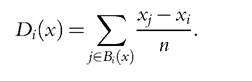
Aggregate deprivation, that is deprivation at a societal level, is then given by the average value of all of the individual deprivations. This aggregate deprivation turns out to the absolute Gini coefficient, which is given by the most popular index of income inequality (the Gini coefficient) multiplied by mean income.
Following on from these early contributions, Chakravarty (1997) proposed the inclusion of mean income in the measurement of individual deprivation. The latter now becomes the gap as a fraction of mean income, di(x)#8725;#955;(x). This normalization is argued to be more appropriate for the comparison of the same society at different points in time, or different societies. When we use this formulation, aggregate deprivation is equal to the Gini coefficient, which is the absolute Gini index divided by mean income.
Analogously, income can be compared to those who are poorer than the individual in question (i.e., those who are in the worse-off set). This comparison yields the relative satisfaction function of an individual with income xi, Si(x), given by:
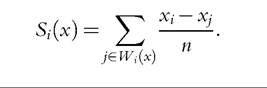
These measures of deprivation and satisfaction are called disadvantageous and advantageous inequality in Fehr and Schmidt’s (1999) utility function. On this point Runciman (1966, p. 9) wrote: “If people have no reason to expect or hope for more than they can achieve, they will be less discontent with what they have, or even grateful simply to be able to hold on to it. But if, on the other hand, they have been led to see as a possible goal the relative prosperity of some more fortunate community with which they can directly compare themselves, then they will remain discontent with their lot until they have succeeded in catching up”.
Although Fehr and Schmidt imagine that individuals are averse to both kinds of inequality, in the income-distribution literature it is most often implicitly assumed that individual well-being depends negatively on relative deprivation but positively on relative satisfaction. One of the main reasons for individuals not being inequality-averse, as will be set out in the following section, is that real income is not manna from heaven, and how that income comes about matters for individual attitudes.
This same concept of deprivation, which is at the core of the Gini coefficient, is also found in the literature of polarization (see Chapter 5). Deprivation is there called alienation. In general, alienation is assumed to be symmetric, whereas only the comparison to better-off individuals matters for deprivation. The interaction between alienation and identification is at the basis of the measure of polarization proposed by Esteban and Ray (1994). Bossert et al. (2007) reinterpret alienation and (the lack of) identification in terms of deprivation in a multivariate setting where functioning failures are analyzed. In this setting, individual deprivation is a multiple of the product of the share of agents with fewer functioning failures than the agent under consideration (the lack of identification) and the average of the functioning-failure differences between the individual and those who are better off (the alienation component).
The empirical subjective well-being literature described in this subsection has arguably made a key contribution in reminding social scientists (and maybe especially economists) that there are spillovers in individual income. The more you earn, the less happy I am, if you are in my reference group. Unless you are in a reference group to which I aspire, in which case my subjective well-being may well be higher (your position today provides me with an idea of what I can aspire to tomorrow).
The news is not only good, however. It can be argued that there are a number of drawbacks in this literature. In particular, the pertinent reference group is only a guess at who really matters in terms of the individual’s own specific group that counts for income comparisons. In almost all cases, the best that we can do is use a series of likely reference groups and show that the effect of others’ incomes seems to be consistent across them. An arguably useful piece of additional information comes from the identification of
reference groups to which the individual aspires (for which there is an information or signal effect): We expect the correlation between individual subjective well-being and others’ income in these groups to be less negative, or even positive. Even so, in both cases we can only guess at the correct reference group, with obvious implications for the accurate measurement of the relevant income gaps. As noted earlier in this subsection, we practically never ask individuals about their comparative reference group and have to our knowledge never asked about the reference group to which the individual aspires.
In the context of contributing to the analysis of relative deprivation and relative satisfaction described earlier, this literature has also not been an overwhelming success. Almost every paper here appeals to one single measure of the centrality of others’ incomes, independent of whether the individual in question finds herself above or below that level. As such, there has been little attempt to distinguish relative deprivation from satisfaction.[857] Equally, knowing both my own income and the mean (or median) of my reference group income actually tells me fairly little about the gaps between me and others. Someone who has an income of 1000 euros above the mean or median reference-group income, say, can have widely varying values of relative deprivation and relative satisfaction.
The set of empirical subjective well-being work explicitly appealing to deprivation and satisfaction is not entirely empty. D’Ambrosio and Frick (2007) provided an empirical counterpart to the theoretical measures given earlier by exploring the relationship between self-reported income satisfaction and relative deprivation. Using panel data from the SOEP, they showed that subjective well-being depends more on a measure of relative deprivation than it does on absolute income because the correlation between income satisfaction and absolute income is 0.357, whereas that between satisfaction and relative deprivation is larger in absolute value at -0.439. As predicted by the income-distribution literature, the effect of relative deprivation on well-being is negative. This finding holds even after controlling for other influential determinants of well-being in a multivariate setting. Cojocaru (2014a) also estimated an individual well-being regression as a function of advantageous and disadvantageous inequality in the reference group, using 2006 data from the Life in Transition Survey (LiTS). Disadvantageous inequality is associated with lower life satisfaction, but advantageous inequality is not significantly so.
Bossert and D’Ambrosio (2007) introduced time as an additional dimension in the determination of the level of deprivation felt by an individual. They suggested that, as is usual, an individual’s feeling of relative deprivation today depends on a comparison with those who are better off today. They then proposed an additional consideration: The feeling of deprivation relative to someone who has a higher income today is more pronounced if this someone was not better off than the individual in question yesterday. In other words, relative deprivation is more keenly felt relative to those who, between yesterday and today, have passed the individual in question in the income distribution. Individual relative deprivation in this framework is then determined by the interaction of two components: the average gap between the individual’s income and the incomes of all those who are richer than her (this is the traditional way of measuring deprivation), and a function of the number of people who were ranked below or equal in the previous period’s distribution but who are now above the individual in question in the current distribution. A similar modification can be effected for the measurement of relative satisfaction, with the latter rising with the number of people that the individual has passed in the distribution between yesterday and today.
In a similar spirit to Bossert and D’Ambrosio (2007), D’Ambrosio and Frick (2012) proposed a utility function including dynamic-status considerations, which is tested on SOEP data. Individual well-being, measured in the SOEP by individual income or life satisfaction, depends at time t on four different elements: (1) the absolute component (i.e., the standard of living of the individual at time t); (2) the absolute dynamic component (i.e., how the individual’s own income changed between t — 1 and t); (3) the relative component, which is the individual’s income at time t compared to others’ incomes at time t; and (4) the relative dynamic component, which reveals how the result of the individual’s income comparison in (3) changed between t — 1 and t. This utility function is a generalization of that proposed by Fehr and Schmidt (1999), with the addition of individuals’ income histories.[858]
This separation of income comparisons into those with respect to richer and poorer individuals, and explicitly distinguishing the others who have passed (or have been passed by) the individual in question, can be argued to shed some light on the debate regarding the potential status and signal effects of comparison income.
Individual well-being being negatively affected by comparisons to those who are permanently richer (and positively affected by comparisons to the permanently poorer) is completely in line with the standard empirical findings in the literature on relative income. At the same time, the presence of newly richer and poorer individuals can be argued to play the informational role described in Hirschman’s (1973) tunnel effect. Someone who is today richer than me, but was yesterday poorer than me provides me with a positive signal about my own future prospects. And indeed in the empirical application, D’Ambrosio and Frick (2012) showed that individual satisfaction is positively correlated with the income today of such people. Analogously, the income gap with respect to those who are now behind the individual but who were ahead of her reduces the individual’s satisfaction, which is consistent with a negative signal that the individual could well be one of this group tomorrow. Finding such an effect in an advanced stable economy such as Germany is new and perhaps unexpected, in that previous work in the literature had rather underlined the relevance of the tunnel effect in societies that were either volatile or in earlier stages of economic development.
The broad conclusion from this work, which is by now far too voluminous to be listed in detail, is that others’ incomes often do play a role in determining an individual’s well-being. As the income of others to whom I compare rises, my well-being falls, but this status effect may be diminished or even entirely neutralized by a signal effect if what happens to others today informs me about what may happen to me in the future.
In general, however, the link between the formal models of income gaps (which are behind the measurement of inequality) and empirical work in the subjective well-being literature has been weak. The subjective well-being spillovers in society consist of a many-to-many mapping. As incomes in a society change, we need to know both who is affected by a movement in the income of individual i and who is in individual i’s reference group. We then have to identify the nature of the relationship between each pair: relative deprivation, relative satisfaction, or rather aspirations? Put in this light, it is obvious that we are asking a great deal of the information that is contained in standard surveys, all of which contain significant lacunae in this respect. To complement our understanding of how my well-being depends on my comparison to your income, we turn to experimental economics, where all the relevant parameters of the comparison process can arguably be controlled.
13.2.2 Experimental Economics
Experimentalists appeal to the notion of interdependence in preferences to explain the behavior of subjects who repeatedly violate game-theoretic predictions. Extensive surveys of work in this area can be found in Fehr and Schmidt (2003), Sobel (2005), and Camerer and Fehr (2006).
Interdependent preferences, that is, preferences that depend directly on the situation of others, were modeled formally for the first time in the theory of consumer demand. The phenomenon whereby individual utility functions depend on other people’s income or consumption is known generically as the relative income hypothesis (Duesenberry, 1949). This can be further differentiated into “Keeping up with the Joneses,” where the preference interaction with others depends on current consumption, and “Catching up with the Joneses,” where it depends on lagged consumption. Leibenstein (1950) was the first to introduce demand functions that explicitly took into account the desire to be “in style,” bandwagon and snob effects, and conspicuous consumption. Since then the literature has advanced to a considerable degree of sophistication, exploring the implications of such preferences on the theory of asset pricing (Abel, 1990; Campbell and Cochrane, 1999; Gali, 1994), Pareto optimality (Collard, 1975; Shall, 1972), the theory of optimal taxation (Abel, 2005; Aronsson and Johansson-Stenman, 2008; Boskin and Sheshinki, 1978; Dupor and Liu, 2003; Ljungqvist and Uhlig, 2000), the determination of work hours (Bell and Freeman, 2001; Bowles and Park, 2005), public spending (Ng, 1987), and the allocation of resources in general (Fershtman and Weiss, 1993), among others. A theory of social interactions has been proposed using varying formulations, where preferences are either defined over general consumption goods or an individual’s identity. See Becker (1974) and Stigler and Becker (1974) for the first group and Akerlof and Kranton (2000) for the second. Sobel (2005) provides a thought-provoking discussion of the similarities and differences between these two strands of the literature.
Experimental work has made significant contributions to this area, in particular in considering the distribution of income across players, and distinguishing between doing better than others and doing worse than them.
13.2.2.1 Models of the Distribution of Income
The experimental economics literature fully incorporated distributional concerns into the utility function for the first time in Bolton (1991), with the modeling of inequity or inequality aversion. The two terms are very often used as synonyms in the literature to refer to the single phenomenon: that “people resist inequitable outcomes; i.e. the fact that they are willing to give up some material payoff to move in the direction of more equitable outcomes” as Fehr and Schmidt (1999, p. 819), to whom the definition ofineq- uity aversion is due, put it.
The effect of inequality clearly results from some comparison being made to the reference group. On this point Fehr and Schmidt (1999, p. 819) continued by explaining that “Inequity aversion is self-centered if people do not care per se about inequality that exists among other people but are only interested in the fairness of their own material payoff relative to the payoff of others”.
Fehr and Schmidt (1999) incorporated inequality into the individual utility function via the inclusion of all the pairs of the differences between the individual’s own income and others’ incomes. Bolton and Ockenfels (2000), who refined the earlier work of Bolton (1991), proposed an inequality-averse utility function that depends on the individual’s own income and their share of the total income. The survey in Engelmann and Strobel (2007) compares these two approaches, together with that of Charness and Rabin (2002). Charness and Rabin’s model is more related to social welfare than to inequality aversion and will not be analyzed in what follows: preferences in Charness and Rabin are a combination of the individual’s own payoff and the payoff of the worst-off individual only.
Fehr and Schmidt (1999), who we henceforth call FS, proposed a utility function for individual i, i = 1,..., n, which depends on the individual’s own outcome, and the gaps to those in the better-off set and the worse-off set, as defined in Section 13.2.1

where #945; #8804; #946; #8804; 0 In this formulation, the utility of an individual depends positively on their own income, but negatively on both their levels of disadvantageous inequality (the gaps to those who earn more than them: the second term in Equation 13.1) and advantageous inequality (the gaps to those who earn less than them: the third term in Equation 13.1). According to Fehr and Schmidt, individuals dislike inequitable distributions. “They experience inequity if they are worse off in material terms than the other players in the experiment, and they also feel inequity if they are better off. (...) (H)owever, we assume that, in general, subjects suffer more from inequity that is to their material disadvantage than from inequity that is to their material advantage” (Fehr and Schmidt, 1999, p. 822). As such, #945; is larger in absolute terms than is #946;.
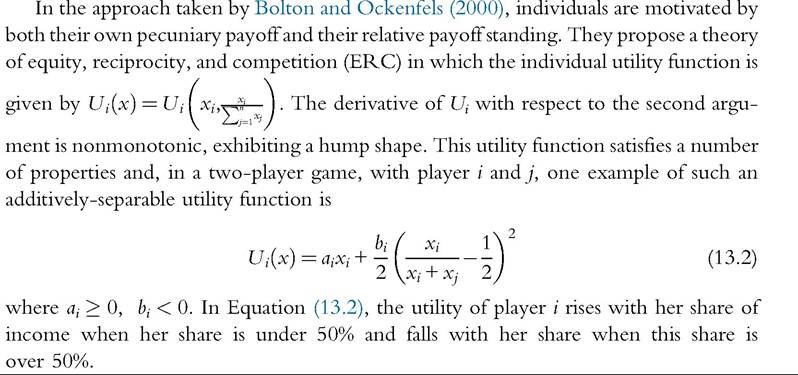
In most experiments, these two models (FS and ERC) yield similar predictions. However, the predicted outcomes can differ for games where there are three or more players because ERC is not sensitive to all the inequalities in payoffs. In the ERC formulation, individuals want the average payoff of others to be as close as possible to their own but do not dislike the presence of richer and poorer individuals per se; in Fehr and Schmidt, individuals dislike inequality in all the outcomes. The experiment conducted in Engelmann and Strobel (2000) is designed to compare the performance of these two models: their results suggest that the formulation proposed by Fehr and Schmidt performs better than the ERC. A similar conclusion was reached by Dawes et al. (2007): Humans appear to be strongly motivated by egalitarian preferences.
The various contributions to the experimental literature measure inequality aversion via a number of alternative methods, which we will describe later. We believe that the appropriate term that should be used here is indeed inequality aversion, and not the original one proposed of inequity aversion. All the empirical contributions here are based on the assumption that the equality of payoffs is the fair, and hence equitable, outcome. But this need not necessarily be the case. If the distribution of income is not random, but depends (or is thought to depend) on individual effort or some other kind of meritworthy individual characteristic, the individual’s view of what is equitable will depend on her own moral standards and the normative reference group. Opinions regarding what distribution of income is equitable will then very likely differ among subjects (see the discussion in Giith et al., 2009; Tyran and Sausgruber, 2006).
Experimental work has tested for the presence of inequality aversion and its consequences for economic outcomes in a number of different settings, such as ultimatum games, dictator games, dynamic bargaining games, public-good games with punishment, and redistribution games.[859]
13.2.2.2 Experimental Evidence from Ultimatum, Dictator and Dynamic-Bargaining Games
In the ultimatum game, some subjects, the proposers, are asked to suggest a division of a certain sum of money, say 100, between themselves and the other subjects, the responders. The proposer suggests a division, which the responder can either accept or reject. If the latter accepts the proposal, both the proposer and the receiver receive the money in accordance with the proposed division; if the responder refuses, neither player receives anything. Both the proposer and the respondent are fully aware of the rules of the game. The standard economic prediction based on subgame perfection is that the resulting outcomes will be very unequal: the proposer should make an offer of just over zero, and the responder should accept any positive offer that is made to them (as something is always better than nothing).
This prediction is not borne out by the behavior that is actually observed in the lab. The experimental results reveal a far more equal division of the pie, with responders frequently rejecting offers that are under 25% of the total sum (see Camerer, 2003; Levitt and List, 2007; see also Thaler, 1988, for a more comprehensive discussion of the general anomalies of these results). Bellemare et al. (2008) provide representative estimates of inequality aversion for the Dutch population. They found considerable differences between socioeconomic groups. Inequality aversion, in particular advantageous inequality, rises with age and falls with education level. Young and highly educated participants are one of the most selfish subgroups of the population under consideration. Fehr and Schmidt (1999), in their survey of experimental results from the ultimatum game, noted that the vast majority of offers are consequently between 40% and 50% ofthe total sum, and no offers are below 20%. These results seem to hold regardless of the size of the sum that is to be divided, and in particular are also found in high-stakes games.
The second type of experiment used to reveal preferences over inequality is the dictator game. This is a simple variation ofthe ultimatum game, with the advantage of being nonstrategic. Here, as the name suggests, the proposer behaves like a dictator in proposing a split of the sum to be divided, with the responder having to accept the offer and thus having no decision to make. Experiments using the dictator game yield, as perhaps might be expected, distributions of income between the two players that are less egalitarian than those from the ultimatum game described earlier, with the proposer offering lower amounts. Even so, and despite the proposer running no risk of rejection, positive amounts of money are still offered. The survey of 616 such experiments in Engel (2011) concludes that dictators give on average 28.35% ofthe sum of money to be split to the responder, which is far from the self-interested economic prediction of no money being offered at all.
Abbink et al. (2009) also considered dictator games, but in the novel context of the destruction of others’ income. This destruction is both negatively and positively framed. In the latter, individuals can decide to award their partner 50 points, and by doing so gain 10 points themselves. The decision not to make this award is analogous to the destruction of 50 of their partner’s points at a cost of 10 points to themselves (and this is how the decision appears in the negative framing). Abbink et al. found destruction rates of about 25% with both framings. One surprising finding is that initially equal income distributions are actually more likely to be burnt, and the authors conclude as to the presence of a certain amount of equity aversion. One potential reading of this result is that, in their setup, the initially equal distribution is the only one from which the individual can gain rank by burning money (see their Table 1). We will return to the question of the rank comparisons of income in Section 13.4.2.
Last, in dynamic bargaining games, the evolution of bargaining proposals over time and the reasons that individuals provide for their behavior during the bargaining process can be examined jointly. In this framework, the experiments in Herreiner and Puppe (2010) show that Pareto-inferior solutions pertain due to the players’ inequality aversion. For example, it is found that a majority (51%) of bargaining partners will reject the unequal payoff distribution of (46, 75) in favor of the Pareto-inferior equal split of (45, 45).
13.2.2.3 Public-Good Contributions and Punishment
In the public-good game, players are given an endowment and then secretly choose how much of this endowment they wish to put into the public pot (in order to finance the supposed public good, which will benefit everyone) and how much they would like to keep for themselves. Once the donation decisions have been taken by all players, the total sum of money in the public pot is multiplied by a factor of greater than one, and the resulting amount is evenly divided among all players. The Nash equilibrium in this game is for each player to contribute nothing to the public good. However, in experiments subjects are found to contribute an average of 40-60% of their endowment (Camerer and Fehr, 2004).
The public-good game can be refined by introducing a second stage in which information on others’ contributions is provided, and players can punish each other. Introducing potential punishment in this second stage causes a sharp jump in cooperation in the first stage public-good game, as shown in Fehr and Gachter (2000). Masclet and Villeval (2008) assessed the role of inequality aversion in determining individuals’ decisions to punish. They showed that individuals will punish others even when this punishment does not immediately affect the distribution of payoffs (in some situations the cost of one punishment point to the punisher is the same as the cost of this point to the target). Consistent with previous work, punishers are not primarily motivated by a desire to increase equality. Interindividual comparisons of outcomes do play a decisive role in the punishment decision in all treatments; the intensity of punishment is strongly correlated with the size of the difference in contributions and earnings between the punisher and the target. This result indicates that, irrespective of the willingness to directly reduce payoff differences, individuals may be willing to punish those whose decisions give rise to payoff differences, and that this inequality arouses emotions that trigger punishment. Punishment is shown to reduce inequality over time, as potential free-riders are incited to increase their contributions.
An open question in this literature is why individuals decide to spend their own resources to punish others. This decision could be self-centered, as today’s punishment enhances my own future interests, or carried out altruistically in order to confer an advan- tageonmykin or group (see Van Veelen, 2012). Ofcourse, any prosocial behavior can be self-interested if we include nonpecuniary moral preferences in the utility function (Levitt and List, 2007).
The sequential public-good game can be used to estimate separately the advantageous and disadvantageous inequality aversion suggested by Fehr and Schmidt (1999). In this game with two players, the first mover chooses his contribution to the public good under strategic uncertainty, as he does not know what the second mover will decide. The second mover does know what the first mover has decided and can choose to contribute either the same amount as the first mover or zero. Teyssier (2012) confirmed the theoretical predictions: First movers with greater risk aversion or disadvantageous inequality aversion contribute less to the public good than do others, and second movers with a sufficiently high degree of advantageous inequality aversion contribute more than do others. (For an analysis of risk aversion in the experimental literature see Section 13.3.2.).
Inequality aversion as in Fehr and Schmidt has been also applied to the analysis of the results of voting over redistribution. Although traditional economic models predict no redistribution, Tyran and Sausgruber (2006) showed that inequality aversion can predict the opposite result in their experiments, in which subjects have different endowments and decide how to redistribute from the rich to the poor by majority vote. On this point see also Farina and Grimalda (2011). In taxation games, Bolton and Ockenfels’s ERC can predict the opposite allocations to those in Fehr and Schmidt, as shown by Engelmann and Strobel (2004), because the middle class would no longer be in favor of redistribution.
13.2.2.4 Deservingness: The Source of Income
One of the critiques of inequality aversion models and the experiments used to test them is that they often neglect the procedure that is behind the money to be allocated. Money appears here out of nowhere as “manna from heaven”; see, on this point, Bergh (2008) and Giith et al. (2009), among many others. In the majority of experiments, income is an allocation, so that having more than others is not seen as being deserved. However, in many real-world applications individuals likely believe that they earn more than others because they deserve to do so. As might be imagined, when income is considered to reflect effort rather than luck, the results do change. For example, Hoffman et al. (1994) reported that when the role of proposer in the ultimatum game is earned, rather than being randomly assigned, proposers offer less and respondents are more likely to accept unequal offers. Similar results are found in Cherry et al. (2002) when the asset of the dictators in the bargaining game is legitimate. We will return to this point in Section 13.4.3 when describing some evidence from the income-distribution literature on the fairness of outcomes. Another critique refers to the size of the stakes, with the suggestion that inequality aversion may be lower when the stakes are high. See on this point the discussion in Eckel and Gintis (2010), who concluded that this fact does not refute the theory but is rather a proof of the rationality of subjects who take the costs of their behavior into account.
A more general criticism of FS, which calls the scientific basis of their method into question, is contained in the various contributions of Shaked, and Binmore and Shaked. The details can be found in the January 2010 special issue “On the Methodology of Experimental Economics” of the Journal of Economic Behavior amp; Organization. This special issue includes the critique by Binmore and Shaked (2010a), the replies by Fehr and Schmidt (2010) and Eckel and Gintis (2010), and the rejoinder by Binmore and Shaked (2010b).
A novel test of the desire to change the income distribution and the provenance of the income in question appears in Zizzo and Oswald (2001). Rather than taking money from one person and giving it to another, participants in this experiment are allowed (at a cost to themselves) to destroy each other’s earnings. This is the “negative framing” of the destruction described in Abbink et al. (2009) above. Participants played in groups of four. Each participant has the same amount of money to start with and can attempt to increase it by 10 rounds of betting on a number (1, 2, or 3) that is randomly chosen by a computer. A maximum amount per round can be wagered. This betting stage creates an unequal distribution of income. In the second stage, players can pay to burn each other’s earnings, at a price to themselves of 0.01, 0.02, 0.05, and 0.25 of a money unit per money unit burnt.
Although the initial distribution of income is equal, two of the four players in each group are favored. These players can bet more than the others in each round of the betting stage, and they in addition receive a cash bonus between the betting and burning stages. This is public knowledge.
The results in Zizzo and Oswald show a remarkable amount of destruction. Just under two-thirds of players burned some money, and the average player had just shy of half of their earnings burned. The destruction rates here are higher than those in Abbink et al. (2009), which may well reflect that the average burning price here is lower. There is little evidence of a price elasticity ofburning, except at the top burning-cost rate of 0.25. In the context of the current paper, richer players were burned more, but especially the two players who had received an unfair advantage were burned more.
13.2.2.5 Hypothetical Preferences and Neuro Evidence
Inequality aversion runs counter to the hypothesis that individuals are status seeking, as noted by Bolton and Ockenfels (2000, p. 172). The concern for relative standing is the focus of another set of contributions in experimental economics (see Alpizar et al., 2005; Johansson-Stenman et al., 2002; SolnickandHemenway, 1998; YamadaandSato, 2013). The approach here is to allow individuals to make choices over hypothetical states of the world to understand how important absolute and relative outcomes are to them. In income terms, these are couched in terms of own income and average societal income. The greater the importance of relative income, the more the individual will be willing to give up own income to achieve a better relative standing.
For example, in Solnick and Hemenway (1998), individuals are asked to choose between states A and B, as follows:
A. Your current yearly income is $50,000; others earn $25,000.
B. Your current yearly income is $100,000; others earn $200,000.
It is specified that “others” refers to the average of other people in the society and emphasized that “prices are what they are currently and prices (the purchasing power of money) are the same in States A and B.”
The key in this hypothetical-choice literature is that respondents choose between one state in which they are better off in absolute terms and another in which they are better off compared with others. All of the cited papers find evidence of strong positional concerns over income, in that individuals report that they are willing to give up absolute income to gain status (choosing A over B). The percentage who exhibit “relative” preferences can be large: Half of the respondents said that they preferred to have 50% less real income but higher relative income (i.e., they preferred A to B; see Solnick and Hemenway, 1998, 2005).
Such choice experiments are easy to couch in terms of consumption or other life domains, rather than income, as well. The taste for relative standing in Solnick and Hemenway (1998) is found to be strongest for attractiveness and supervisor’s praise and weakest for vacation time; in Alpizar et al. (2005) it is stronger for cars and housing and weaker for vacations and insurance. A useful extension in Corazzini et al. (2012) is to take the approach outside of only rich countries; in their work, respondents in high-income countries are more concerned by relative standing than are those in lower-income countries.
Most of these experiments have been conducted with students, which is the standard practice in experimental economics. Carlsson et al. (2007) is the first study that is based on a random sample of the population as a whole. Their results are comparable to those in Alpizar et al. (2005), who found that on average about half of the utility obtained from an additional dollar comes from relative concerns. Carlsson et al. (2007) reported that, on average, 45% of the utility increase from a small income increase arises from enjoying a higher relative income, a result that is halfway between 100% (corresponding to the hypothesis that only relative income matters) and 0% (where only absolute income matters).
A final set of experimental results comes from the recent NeuroEconomics literature. FlieBbach et al. (2007) appealed to MRI techniques to measure the brain activity of pairs of individuals who carry out identical evaluation tasks in different scanners. If the individual succeeds in the task (remembering the number of blue dots on a previous screen, which they see for one and a half seconds), they obtain a monetary reward of a certain size, as indicated on their computer screen. The outcome of the other player (their success, and the amount won if the answer was correct) is shown at the same time. FlieBbach and colleagues manipulated both the amount the individual won if correct and the amount the other player won to create a number of contrasting conditions. For example, in their conditions C6, C8, and C11, the individual always won 60 euros if his answer was correct (all participants were men), but the other player won, if correct, 120, 60, and 30 euros, respectively. One of each individual subject’s many trials was randomly picked for payment after the end of the experiment.
The results show that relative incomes matter. Holding the subject’s own earnings constant, the amount earned by the other player is significantly correlated with blood oxygenation level-dependent (BOLD) responses in the ventral striatum, one of the regions of the brain known to be involved in the processing of rewards. Wu et al. (2012) also found evidence of social comparisons in brain activity and suggested that it mostly appears in later cognitive appraisals and reappraisals, rather than in the initial evaluation stage. Recent follow-up work by FlieBbach et al. (2012) repeated their 2007 experiment, but this time with both men and women, and distinguished between advantageous and disadvantageous inequality. Disadvantageous inequality is shown to have a much larger impact on brain activity in the ventral striatum than does advantageous inequality. Dohmen et al. (2011) also used the same experiment and showed in a regression analysis that the effects of own and others’ income on activation in the ventral striatum are equal and opposite (which was also true in the 2007 experiment). This holds for both men and women, although the estimated effect of both income variables is larger in size for men.
Somewhat similar in intent, although the experiment here consisted of individuals reading written reports on (fictitious) others who were superior or inferior to the respondent and the good or bad events that happened to them, is Takahashi et al. (2009).
Dawes et al. (2012) explicitly considered redistribution and brain activity. They considered individual decisions to pay a cost to change the distribution of income within a group, where this latter distribution was determined randomly. Redistribution was correlated with brain activation in an area known to reflect social preferences. In addition, this brain activation was shown to be correlated with survey measures of egalitarian preferences that were elicited outside of the scanner. Zaki and Mitchell (2011) showed that inequitable decision making (choosing to favor a smaller reward for oneself rather than a larger reward for the other player in a modified dictator game) is associated with brain activity in a region associated with subjective disutility. Last, Tricomi et al. (2010) explicitly addressed advantageous and disadvantageous inequality by randomly assigning individuals in pairs to be rich (with $50) or poor (no dollars) after both received an initial allocation of $30. Brain activity in areas known to be related to the valuation of stimuli was then measured via MRI as further transfers to both pairs were carried out. The results showed that the “poor” responded more strongly to transfers to themselves than to the other person, whereas the “rich” evaluated transfers to others more strongly than transfers to self. This is argued to show that individuals have social preferences over both advantageous and disadvantageous inequality.[860] [861] The discussion in the current section has shown that there is by now a considerable body of evidence consistent with individuals comparing their incomes with each other. Income is, in this sense, a social good. A certain amount of work has suggested something of a loss aversion with respect to these comparisons, in that doing worse than others is more important in a well-being sense than doing better than others. Any movement in the distribution of income will therefore affect societal well-being both directly, via changes in individuals’ own incomes, and in a comparative manner, via the various gaps between individual incomes. Imagine a rise in inequality caused by an increase in some top incomes. Those who benefit from higher incomes will have higher well-being, both because they are richer and because their gaps to others have risen (although this effect may only be secondary). On the contrary, those whose incomes have not risen and who compare to the fortunate few who are richer are now relatively worse off, which reduces their well-being. The overall effect is a priori ambiguous. Alternatively, inequality may fall due to a rise in the incomes of those at the bottom of the distribution (via an uptick in the minimum wage, say). Again, the well-being of those who benefit rises, both via greater own income and smaller gaps to the richer others. But the well-being of those who do not benefit falls as their advantageous gaps to the poorer are now smaller in size. Ifwe continue to believe that this latter effect is of second order, then we may expect societal well-being to improve here. Unfortunately, most of the changes in the distribution of income that we see are not this stylized. To make any kind of welfare statement, we need to know who compares to whom, how much the different kinds of income gaps matter, and how much relative income matters compared to absolute income. We have little reasonable hope of measuring these magnitudes with any degree of accuracy in existing data. Even so, we do believe that the comparative reference group exists and represents one central constituent of attitudes toward inequality in an economy. The other main part of such attitudes comes from the normative view of inequality in the income distribution (as defined in the Introduction). Although there is a substantial amount of work devoted to the comparative reference group, it arguably turns out to be rather more difficult to evaluate normative attitudes toward inequality. It is to this question that we turn in Section 13.3. In this section we will also review some of the work that has tried to disentangle the various motivations behind individuals’ actions. 13.3.
More on the topic THE COMPARATIVE VIEW:
- Ahmed Hilal, Mishra R.K.. Rethinking Muslim Personal Law: Issues, Debates and Reforms. Routledge India,2022. — 187 p., 2022
- REVIEW OF FORENSIC ASSESSMENT INSTRUMENTS
- THEORETICAL CONSIDERATIONS