THE FLEURBAEY-MANiQUET APPROACH
Marc Fleurbaey and Francois Maniquet have, in a series of writings, made a number of proposals for ordering policies with respect to the degree to which they equalize opportunities, which are similar in spirit to those discussed above, but different in detail.
Their work is summarized in Fleurbaey (2008); the general inspiration of the theory is the idea of envy-freeness, pioneered in the works of Foley (1967), Kolm (1972), and Varian (1975). Here, we present one of their main proposals, which falls in the family of egalitarian-equivalent proposals, and as such, descends from the work of Pazner and Schmeidler (1978). The approach is substantially different from the one outlined in Section 4.3, because it does not take the viewpoint that equalizing opportunities involves maximizing the lower-envelope function θ defined in Equation (4.4).Suppose that a population is characterized by an outcome function u(c, r, φ), where c is a vector of circumstances (characteristics of the individual or his environment for which he is deemed not responsible), r is a vector of characteristics for which he is deemed responsible, and φ is a policy. We will specialize to the case where φ is the distribution of some resource to the population: say, an allocation of money. Let us suppose, further, that there is some type (i.e., vector of circumstances c*) that characterizes the most disadvantaged type. We desire to place an ordering on policies φ that reflects the view that persons should not be held responsible for their circumstances, but should be held responsible for the choice of r.
Fleurbaey (2008) represents the idea that persons should not be held responsible for their circumstances by various “principles of compensation.” An example would be “equal well-being for equal responsibility,” meaning that if two individuals have the same values of r, their outcomes should be the same (i.e., independent of their circumstances).
Thus, the ordering of policies should reflect this desideratum. He, Bossert (1995) and Maniquet also advocate various “principles of reward.” For instance, if all individuals have identical circumstances, then the resource should be divided equally among them, called the “liberal reward principle.” That is, if everyone is of the same type, there is no justification for any compensatory policy. It is clear from simple examples that it is, in general, impossible to respect the liberal reward principle and the “equal well-being for equal responsibility” principle simultaneously as long as the environment is sufficiently rich, and so Fleurbaey (2008) is a study of social-policy orderings that satisfy weaker versions of postulates inspired by these principles.We summarize a prominent example of such an ordering. Let φ be given, and construct another allocation of the resource, φ—which need not be feasible, given the budget—defined by:

where i indicates the individual and c* is a reference set of circumstances—say, those of the most disadvantaged type. Thus, under φi each individual receives an amount of resource that makes her as well off as she is in the φ allocation, but assuming, counter- factually, that she had been a member of the reference type, and had maintained the same values of the responsible factors. In the counterfactual world in which φ lives, everybody is of the same type (c*) and so, no special compensation should be made to individuals from the opportunity-equalizing viewpoint, according to the liberal reward principle. Hence, the ideal policy φ is one in which the associated φ is an equal distribution of the resource. This tells us how to order actual policies φ: we say that φ >z φ0 if the counterfactual dis-

This particular version of the egalitarian-equivalent approach to responsibility is what the authors call zero egalitarian equivalence (ZEE), because the standardization takes place by counterfactually making everyone a member of the worst-off type.
Of course, standardizing with some other set of circumstances would do as well, although each choice of how to standardize will (generally) produce a different ordering over policies. One virtue of this approach is that an ordinal outcome function u is all that is required, as we only need to compare the outcome for individuals to variants of themselves (where they have different circumstances), which contrasts with the approaches discussed in Section 4.3, that require cardinality and even ratio-scale comparability.Of course, the ZEE approach will in general give a different ordering of policies than the GEOp approach; Roemer (2012) calculates some examples. Both approaches are incomplete: GEOp, as has been discussed, does not dictate a choice of the operator Γ and ZEE does not dictate a choice of the way to standardize circumstances.
An essential feature of the egalitarian-equivalent approach is the liberal reward principle, that if everyone were of the same type, then no redistribution is called for. To be specific, in the EOp approach, Roemer closes the model by saying that if everyone is of the same type, then policies are preferred if they produce higher average outcomes, whereas Fleurbaey and Maniquet say that policies are better in this case the closer they are to equal-resources. But, as we have argued in Section 4.4, we remain agnostic on the right way of closing the model, because we do not think the concept of EOp contains a theory of just rewards to effort. In particular, the liberal reward principle, described above, will sometimes or often use market institutions to close the model. Consider a
problem where all persons have the same circumstances, but preferences differ, due to voluntary choices. The principle of liberal reward might be interpreted as saying that the allocation of goods should be that associated with the competitive equilibrium following from an equal division of wealth. But this means that the welfare of individuals is determined by a particular set of institutions (markets with private property).
Our objection, then, to the liberal reward principle is that in some cases there is no obvious benchmark that can be considered “natural” to define distribution in the case where there is a unique set of circumstances. This point harkens back to the legal realists, who argued that there is no conception of laissez-faire that is free of ethical bias (see Fried, 1998)—or, to put it more starkly, the usual conception of laissez-faire is a misnomer, as it presupposes property rights enforced by state power.One disadvantage of the egalitarian-equivalent approach is that the notation does not force the practitioner to come to grips with the fact that choices people make are themselves influenced by circumstances. Recall that in the EOp approach, it was the degree of effort rather than the level of effort that was taken as reflecting responsibility, and this distinction was made because the distribution of levels of effort is infected with circumstances. Now one can model the same idea in the ZEE approach, but the notation does not invite doing so: There may be a tendency of practitioners to take r as observed levels of effort and choices of various kinds, and this would fail to take account of the fact that the distribution of choices r in a type is itself a characteristic of the type, and something that calls for compensation. So a literal application of the ZEE model, which is insensitive to this fact, will ascribe to persons responsibility for choices that are perhaps heavily influence by circumstances, and should therefore call for compensation.
One of the innovative applications of the egalitarian-equivalent approach by the authors is to tax policy. From among feasible tax policies, the policy that should be chosen is most preferred according to the ZEE preference order. As noted, this approach provides a theory of optimal taxation that does not rely on any cardinalization of the utility function. Therefore, Fleurbaey and Maniquet have produced a theory of optimal taxation liberated from cardinal measurement of utility (that is, from maximizing the integral ofsome social-welfare function).
See Fleurbaey and Maniquet (2006) and Fleurbaey and Maniquet (2011, Chapter 11).Fleurbaey and Maniquet also propose a kind of dual to ZEE: namely, imagine a coun- terfactual where all individuals expend the same reference level of effort but maintain their actual circumstances. In this case, that allocation is most preferred which most closely equalizes outcomes (that is, each person should be indifferent to how she would feel if she had the circumstances of any other person). The basis of this view is that if persons all expend the same value of the responsible factors r, then there is no ethical basis for their having different outcomes. Again, this gives a preference order on policies that can be defined without using cardinal utility functions, but using egalitarian equivalence. The authors name this approach “conditional equality.”
One way to compare the approaches of Roemer and Fleurbaey-Maniquet is to ask, Can the Fleurbaey-Maniquet preference orders be rationalized as instances of program (GEOp), for some choice of Γ? It turns out that the ZEE approach can be, but the conditional-equality approach cannot be. See Roemer (2012) and Fleurbaey (2012).
Fleurbaey and Maniquet, in their work reported in Fleurbaey (2008), take an axiomatic approach, proposing a number of axioms modeling the ideas that persons should be held responsible for their autonomous actions but not for their circumstances. Strong versions of these axioms produce impossibility results, as we noted. (This is immediately clear if one thinks of the EOp model discussed in Section 4.3. There will almost never exist a policy that uses all the budget available and equalizes for all π, the outcomes across all types. This would be the summum bonum, from the viewpoint ofEOp, but it cannot be achieved in a problem of any complexity. So some compromise is called for.) Their approach is to sequentially weaken axioms until they find possible preference orders over policies. A significant part of their analysis therefore consists in providing axiomatizations of different preference orders over policies, each of which has some purchase as reflecting the equal-opportunity view.
The egalitarian-equivalent and conditional-equality families turn out to be the important ones.Before concluding this section, we mention another preference ordering of policies similar in spirit to the EOp ordering, first proposed by Van de gaer (1993): order policies according to the value of

In other words, maximize the average outcome value of the most disadvantaged type. Formally, this proposal simply commutes the integral and “min” operators compared to Roemer’s approach in (4.1). Its virtue is that it is sometimes easier to compute than 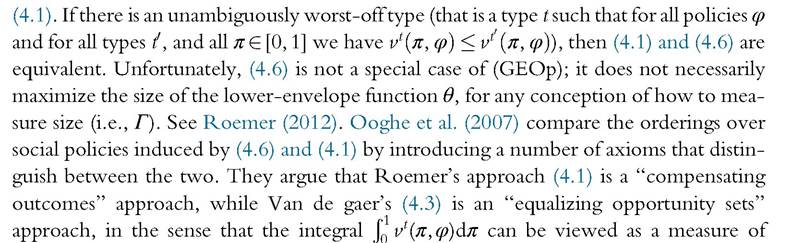 the degree of opportunity available to type t. Therefore, these authors link their approach to the large literature on equalizing opportunity sets (e.g., Bossert, 1997; Foster, 2011) which derived its inspiration from Sen’s capability approach.
Our final topic of this section is the attempt to incorporate luck into the theory of equal opportunity. Of course, luck has already to some extent been incorporated, as
circumstances are aspects of luck—for example, the luck of birth lottery assigns genes, families, and social environments. Besides the luck inherent in circumstances, however, there are two other kinds of luck that are important: first, what might be called episodic luck, which is randomly distributed across individuals, and is often unobservable to third parties (being in the right place at the right time), and the luck due to the outcome of gambles. Dworkin’s view was that no compensation is due to anyone who suffers a bad outcome owing to a voluntarily taken gamble—such “option luck” is due to an exercise of preferences for which the person is held responsible. Fleurbaey (2008), however, contests this view. He splits gambles into two parts: the decision to take the gamble, which is the person’s responsibility, and the outcome of the gamble, which is an aspect of luck. Let us view the risk-taking preference of the individual as a responsibility characteristic, and the outcome of the gamble as a circumstance—something over which the individual has no control. Fleurbaey proposes giving all persons with a given risk-taking propensity (i.e., responsibility characteristic) the average value of all gambles that such persons take. Thus, everyone with the same responsibility characteristic receives the same outcome. Of course, the informational requirements for implementing such a plan are severe. Moreover, this proposal seems to countervene the purpose of gambling. If gamblers wanted to protect themselves from bad outcomes, they would insure to receive the expected value of the gamble. If, however, gamblers are risk-loving, then they would only insure to receive something more than the gamble’s expected value, and such insurance is not fiscally feasible. So in offering gamblers the expected value of all gambles taken by their risk type, their welfare is being reduced from actual gambling, assuming that they are true risk lovers.[142] This solution, first advocated by Le Grand (1991), has other weaknesses. The different lotteries offered to the individual decision makers can be ranked unambiguously from the most profitable to the least if Fleurbaey’s solution is implemented. Indeed, the lotteries would only differ in terms of the average outcome since all risk is eliminated. All rational decision makers (who prefer more than less) will choose the same lottery. Full equality will be then observed ex post.
Lefranc et al. (2009) believe that the project of separating influences into circumstances and effort is too binary. They call “residual luck” a third influence, and recommend something weaker than compensation for residual luck, namely, that the correlation between such luck and circumstances be eliminated. Consider the following examples: Some people gain by the chance meeting of another person; popular views do maintain that persons with rare productive talent be specially compensated; the winnings of national lotteries (Belgium, France, United Kingdom) are often not taxed. The luck inherent in these examples (especially the first two) is often considered to be part of life, something that policy should not eliminate. The first example could be brute luck or due to special effort; the second example is brute luck; the third is option luck. These authors maintain that these kinds of luck should be equally distributed across types, at any given level of effort.
Suppose the income-generating process is given by:

where c, e, and l are circumstances, effort, and residual luck, respectively. The distribution of income, conditional upon c and e is defined as:

where Fc e is the distribution of luck in the element of the population characterized by (c, e). The above-described principle says that

This allows the distribution of virtual luck to depend on effort but not on circumstances. If all luck factors are named as circumstances, then the distribution K is simply a point mass. More generally, the support of this distribution can be as small as the decision maker wishes. It depends on her inequality aversion. The authors propose further refinements using stochastic-dominance arguments.
4.6.