A MORE GENERAL APPROACH
Formula (4.1) gives an ordering on policies, with regard to the degree to which they equalize opportunities, after the set of circumstances has been delineated. It implements the view that inequalities due to differential circumstances for those who expend the same degree of effort are unacceptable.
There is, however, a conceptual asymmetry: while the instruction to eliminate inequalities due to differential circumstances is clear, the permission to allow differential outcomes due to differential effort is imprecise. How much reward does effort merit? There is no obvious answer. To provide a social-welfare function (or a preference order over policies) that question must be answered, at least implicitly. In formula (4.1), the preference order is delineated by stating that, if there is a society with just one type, then policies will be ordered according to how large the average outcome is for that society. Fleurbaey (2008) therefore calls formula (4.1) a “utilitarian approach” to EOp.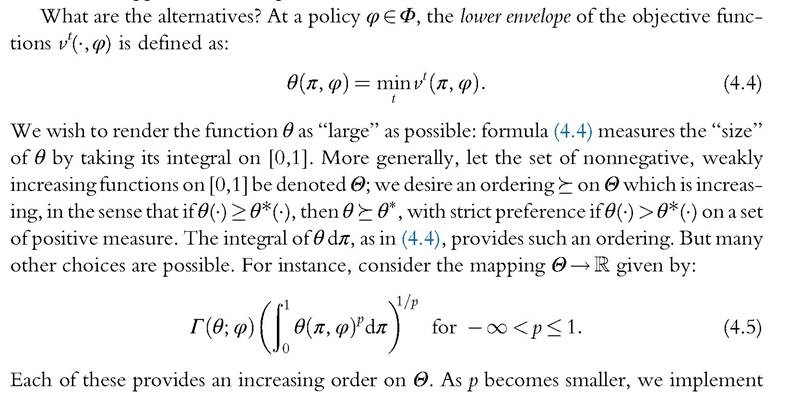
more aversion to inequalities that are due to effort. As p approaches negative infinity, the order becomes the maximin order, where no reward to effort is acceptable.
We do not have a clear view about what the proper rewards to effort consist in, and hence remain agnostic on the choice of ways to order the lower envelopes The problem of rewards to effort goes back to Aristotle, who advocated “proportionality,” a view that is incoherent, as it depends on the units in which effort and outcomes are measured. Because we possess no theory of the proper rewards to effort, this is an open aspect of the theory. We believe that considerations outside the realm of EOp must be brought to bear to decide upon how much inequality with respect to differential effort is allowable.
Our agnostic view concerning the degree of reward that effort deserves contrasts with that of Fleurbaey (2008), who advocates an axiom of “natural reward” to calibrate the rewards to effort, as will be discussed in Section 4.5.
We can provide somewhat stronger foundations for the view that an equal-opportunity ordering of policies must maximize some increasing preference order on Θ. The first step is to note the importance of the lower-envelope function θ: for the persons who are most unfairly treated at a given policy are those, at each effort level, who experience the lowest outcomes, across types. (Hence, they are the ones represented on the lower envelope.) This is because the EOp view says outcomes that are different, due to circumstances, for those who expend the same effort, are unfair. The second step is to state an axiom which encapsulates a requirement of an EOp ordering % of Θ, which is:
Axiom DOM

Part A of Axiom DOM states that if one policy is preferred to another, it must make some people who are among the most unfairly treated are better off than the other policy, and Part B has a similar justification. Thus, DOM is a special case of what is sometimes called the person-respecting principle (see Temkin, 1993): that one social alternative is better than another only if some people are better off in the first than in the second.
It is not hard to show that (see Roemer, 2012):
Proposition
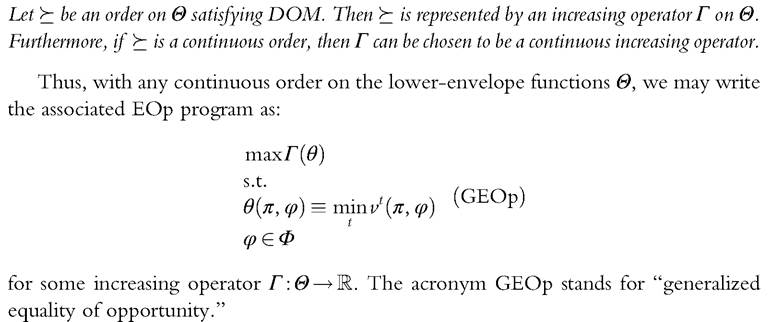
We reiterate the main point of this section. Because we possess no theory of what comprise the just rewards to effort, we should not be dogmatic on the exact way to order policies.
We have argued that an ordering of policies must come from an increasing order on the set of lower-envelope functions where the lower-envelope function induced by a policy φ is given by (4.5). This ambiguity in the theory results in program (GEOp), where the degree of freedom is the choice of the operator Γ. Considerations outside of the theory of equal opportunity might put constraints on the degree of overall inequality that is desirable or admissible in a society, and this can guide the choice of Γ.
 We have thus argued that the theory of equal opportunity is not intended as a complete theory of distributive justice, for two reasons. First, we have emphasized its pragmatic nature. We do not have a complete theory for what people are, indeed, responsible, and have advocated the present approach as one that should be viewed as providing policy recommendations for societies that are consonant with the society’s conception of responsibility. Thus, the choice of the set of types, and even of the policy space, will be dictated by social norms (we have illustrated the policy-space point with the health-expenditure example). Second, the theory does not include a view on what the proper rewards to effort consist in, and this is reflected in the openness inherent in program (GEOp).
Because we view the approach as most useful when the objective in question is something measurable like income, life expectancy, or wage-earning capacity, we shy away from taking an all-encompassing objective of “utility.” We view the usefulness of the approach as one for policy makers, in particular ministries, who are concerned with narrower objectives than overall utility: the health ministry has an objective of life expectancy or infant survival, the education ministry has an objective ofthe secondary-school graduation rate, the labor ministry is concerned with opportunities for the formation of wage-earning capacity, or for employment, and so on.
All these objectives are cardinally measurable, and it makes sense to use any of the operators defined in Equation (4.5) to generate an ordering on policies.Nevertheless, we wish to remark that it is possible to apply the theory where the objective is “utility,” if utility is cardinally measurable. (Actually, to use the operators in Equation (4.5) we require what is called cardinal measurability and ratio-scale comparability.) Because, when thinking about utility, we often conceive of effort as implying a disutility, we now show why this is not a problem for the application. Suppose utility functions over consumption and labor expended are given by u(x, L; w), where w 2 W is the individual’s wage rate. The distribution function of w in type t is given by Ft. Let us suppose we are considering the space of linear tax policies, where after-tax income is given by (1 — φ)wL + b, where b is a lump-sum demogrant and φ 2 [0,1] is the tax rate. (It is implicitly assumed, since wage rates are fixed, that production is constant-returns- to-scale.) Then, the utility-maximizing individual chooses his labor supply optimally, denoted by L(φ, w), and of course, budget-balance requires b = φ∫ wL(φ, w)dF(w), where F is the population distribution of w. Define wt(π) by Ft(wt(π)) = π. Then the outcome functions are just the indirect utility functions:

and we are ready to calculate the EOp policy. Here, “effort” is interpreted not as one’s labor supply, but rather as those actions the person took that gave rise to his wage-earning capacity. There are different distributions of wages in different types, reflecting the
differential circumstances that impinge upon wage-formation, but within each type, there is a variation of the wage due to autonomous factors that we view as effort and worthy of reward.
4.5.
More on the topic A MORE GENERAL APPROACH:
- Contents
- BACKGROUND AND DEFINITIONS
- FIVE COMPONENTS OF LEGAL COMPETENCIES
- Different types of tradable emission rights
- REVIEW OF FORENSIC ASSESSMENT INSTRUMENTS
- GREEN UNPLEASANT LAND
- REVENUE MODELS FOR CONVERGEDVIDEO SERVICES
- Agrawal M.. Textbook of Pediatrics. 3rd ed. — CBS Publishers,2025. — 973 p., 2025
- Data for Multidimensional Poverty Measurement
- Oman