A theoretical appraisal of EU integration
Institutional design has probably been the most important device for the EU member states to agree on common policies. The design, as a provider of appropriate incentives to the participating countries, can be presented in game-theoretic form as the achievement of the optimal common policy in coordination games among member states where a conflict of interest hinders the Pareto-optimal solution.
Many common policies have been transformed from prisoner’s dilemma (PD) games to coordination games of mutual advantage just because an institution made the cooperation strategy more profitable than the defection strategy. However, the widening number of both member states and common policies has intensified the integration process to the extent that the increasing complexity of the bargaining has made any agreement a difficult compromise in terms of the distribution of benefits and costs across member states. In general, institutions have been successful in achieving cooperative agreement on the proposed common policies when the member states were under a ‘veil of ignorance’ concerning the future division across the states of benefits and costs deriving from their implementation.An example of institution design is the regulation of competition in the manufacturing, public utilities and services markets. Competition policy has
played a relevant role in sustaining the implementation of the Single Market by a variety of community laws, deliberations and judgments regarding the monitoring and enforcement of rules not only for competitive market structures, but also for corporate governance, mergers and acquisitions. The problem is that public ownership in strategic sectors (energy, financial institutions and so on), oligopolistic market structures, and national regulations operating as non-tariff barriers are very common in the EU countries, but unevenly distributed across sectors and member states.
In game-theoretic terms, the desire to gain the highest free-riding pay-off - to get the best advantages of competitive European markets, while scarcely cooperating due to a slow domestic process of privatization and liberalization - has led many governments to a ruthless defence of their ‘national champions’. The EU institutions have been struggling in order to protect the integration process and avoid a situation whereby an efficient solution to the coordination game of constructing an environment of competitive markets could be jeopardized by the cooperationfailure pay-off matrix of the prisoner’s dilemma. The Commission has endeavoured to influence the privatization and liberalization processes inside the EU economies by endogenously influencing these processes through the provision of the necessary institutional infrastructure. The Commission’s strategy can be likened to fostering the pay-off structure of a ‘chicken game’ where the conflict of interests dominating the coordination nature of the players’ interaction is offset by the alteration of the PD game with a penalty greater than the pay-off of mutual defection. In Figure 16.1, for the sake of simplicity the pay-off matrix of the chicken game refers to two players only. We can think of the Commission as aiming at reducing the pay-off for defection from further liberalization. When the pay-off matrix of the EU competition game is modified from a PD to a chicken game, the possibility of mutual efforts is strengthened.Deliberations opposing state aid to strategic sectors, as well as pecuniary sanctions to punish monopolistic practices (collusion in price formation, mergers to control competition, low transparency and low compliance with regulations by companies operating in the service sector and so on) can be
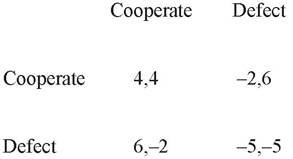
formally devised in terms of a penalty for being suckered (-2) greater than the pay-off associated with mutual defection (-5).
Since free-riding behaviour is discouraged, in contrast to the PD game, mutual defection ceases to be the rational strategy. However, the Commission’s efforts to enhance competition were undermined by the incentives to free-riding continuously created by the externalities across the various privatization and liberalization processes going on in the member states where a conflict of interest is aggravated by the variable degree of public ownership in the service sectors across the states. The generalization of an n-player chicken game, with the number of players who pre-commit to defection not exceeding the maximum number of individuals who may free ride on the cooperation of others without causing the non-provision of the public good (Taylor, 1987), may represent the formal explanation of the still lacking rationale for cooperative behaviour.Three further institutional designs - group asymmetry, procedural technologies regulating cooperative games with conflict of interest among member states and the commitment device of ‘tying-one’s-hands’ - can also help explain the EU integration process.
Group asymmetry
A first aspect of institutional design, which has been studied by both Olson (1965) and Keohane (1984), is group asymmetry as a facilitator of successful cooperation. Collective actions may be asymmetric in the sense that they may be laid out in a form that allows the common policy to deliver both public advantages for all countries and private advantages for single member states. An asymmetric strategic interaction was exploited by the countries launching a fixed but adjustable exchange rate system in Europe (the EMS) to put a stop to the accelerating inflation. The strategic interaction among the European countries - which consisted in the beggar-thy-neighbour situation of competitive devaluations and resulted in the PD suboptimal outcome of stagflation - was transformed in order to establish low inflation as a public good in Europe. Soon after its inception in 1979, the EMS cooperative agreement took the semblance of a hegemonic agreement, due to the asymmetric solution given to the n - 1 problem (since among n participants n - 1 bilateral parities are formed, just one central bank is left free to conduct its own monetary policy, while the monetary policy autonomy of the remaining n - 1 central banks is constrained by the commitment to defend the exchange rate).
An assurance game was set up in a leader-follower structure where a cooperation pledge from Germany - the leader country whose central bank was soon singled out as having the best performance in curbing inflation - created the positive net benefits from which the remaining countries, the followers, derived their incentives for participating in the collective action. During the EMS period, with tight bilateral bands, the Bundesbank virtually dictated themoney supply for the whole area, while the remaining central banks were compelled to peg their exchange rate to the German mark in order to take advantage of Germany’s reputation as the best performer for low inflation. This privileged position gave the German manufacturing sectors a private advantage to benefit from real depreciation vis-a-vis the remaining EMS countries.
Linkage across games
The EU institutions may also make recourse to an institutional design exploiting the interaction between games representing different areas in which cooperation could be pursued to advantage. A first case of linkage deals with the need by the largest member states to dodge the free-riding problem by organizing the implementation of common policies as a nested game with alternative asymmetric positive net benefits. The largest member states were able to overcome the conflict of interests by having one (or a subset) of them contributing or providing the most in a certain game, and another one (or a subset) doing so in another game. A condition for establishing the linkage between the two games is that the common policy proves to be mutually advantageous by the summation of the pay-off matrices. It can be shown that the case of connection between two games is linked to the kind of admitted institutional technology.
In Figure 16.2, the pay-off matrices of two games (I and II) are considered, with the pay-off values stemming from the status quo (SQ), enhanced cooperation (EC) by a subset of two out of three member states (A,B,C) and a common policy (CP).
The pay-off values of the game sum show that complete integration (that is, CP) - which compels member states to participate jointly in both policies - is inferior in terms of total welfare to enhanced cooperation. Therefore, the game sum shows that the outcome is different depending on whether or not enhanced cooperation is admitted as a possible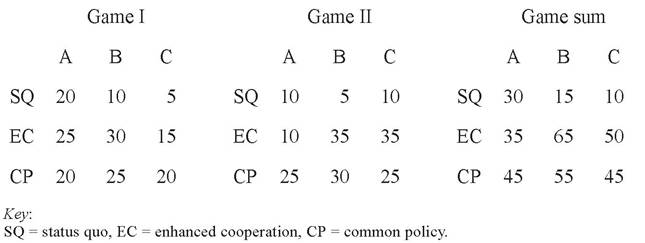
option. In the example, EC can be a superior alternative to CP in both games (that is, in the sum game). In fact, game I shows a possible enhanced cooperation between A and B, and game II shows a possible enhanced cooperation between B and C. In case of non-admission of enhanced cooperation, the maximizing option is definitely the common policy (the sum of the pay-off values for CP is higher than for SQ). However, CP no longer enjoys a preferential status vis-a-vis EC.
In fact, the Nice Treaty has amended the Amsterdam Treaty, whereby an enhanced cooperation could have been stopped by a veto from some other country. A subset of at least one-third of the total number of member countries can now submit a project to the Council which will be decided by qualified majority voting. The EU integration process might be weakened by this procedural change. It is easy to show that once enhanced cooperations are admitted, the CP outcome is undermined. In being compelled to enter the CP in both games, countries B and C lose with respect to entering an EC (in game I, between A and B; in game II between B and C). Even if negotiation costs were nil, the gain of 15 accruing to country A in passing from SQ to CP is insufficient to compensate the other two countries for renouncing EC. A fails to negotiate compliance with a CP because it is unable to cover the compensation of 10 due to B (5 in each game) plus 10 due to C in game II. Country B might then convince C to join in an EC in game II, so that A will have to renounce the CP and join B in an EC in game I.
This example demonstrates that the view according to which the EU integration process has gained flexibility, by the availability of the option by a subset of countries of autonomously choosing to start an EC, is flawed. As a matter of fact, the larger set of options magnifies the incentive to exert the threat of power and bargain on compensation.A commitment to ‘tie one’s hands’
This commitment consists in the exploitation by a country of the strategic interaction which can often be established between the outcome of a domestic game (the political elections in a society split between reformers and anti-reformers) and the EU game opposed by some member states (see Figure 16.3).
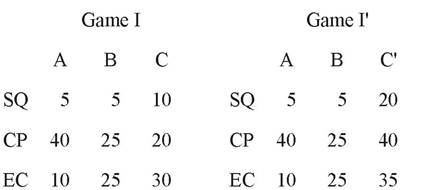
Assume that a common policy among three countries (A, B and C) is expected to enjoy substantial economies of scale only if game I is changed in game I'. In the initial situation of Game I an EC may be preferred by countries B and C, thus leaving country A in SQ. Suppose that country C - the only country in Game I of Figure 16.3 to show a lower pay-off for CP than for EC - could improve its pay-offs by getting rid of some inefficiency which negatively affects its capacity to exploit the economies of scale expected from a fully-fledged CP (for example, poor educational institutions
Key:
SQ = status quo, EC = enhanced cooperation, CP = common policy.
Figure 16.3 Games: tied hands matrices
hindering the level of human capital), as column C of game I' shows. The pay-off values of game I' indicate that A could gain its much higher CP payoff and C would prefer CP, to EC with B. Yet, some social groups in country C oppose the needed efficiency-enhancing reform (a structural change in education) because they would be negatively affected by the progressive taxation which is required to fund it. The institutional mechanism capable of rendering the common policy feasible is a change in the ‘contract’ between the agent (the coalition of parties in charge of the government in country C) and the principal (the constituency). Suppose that the coalition makes the political choice to take a bet in the polls by tying its hands by making the commitment to implement the reform despite the domestic distributive conflict. On the basis of the expectation of being able to convince the opposition voters of the long-term ‘mutual advantage’ of a higher social welfare, the coalition centres its electoral programme on the structural change in education as the first reform due to the ‘national interest’ to abide by an external constraint imposed by the supranational EU institutions and take advantage of the strengthening of the integration process.
Had the elections been won and the reform passed, the strategic interaction among the three countries would be modified. While B remains indifferent between CP and EC, the pay-off of both countries A and C is now higher in the case of a CP as C no longer prefers to set up an EC with B. The supranational solution of a CP is finally taken. Because B is aware that the institutional mechanism implemented in the domestic political arena of country C has changed the strategic environment, B is forced to enter the agreement for the CP in order to avoid the worst outcome (the SQ pay-off). However, in contrast to the example given, this top-down approach to the approval of common policies by the national constituencies may be undermined by asymmetric information. A government may have a vested interest in the proposed policy and public officials may be tempted to manipulate the voters’ opinion by distorting statistics and reports produced by governmental research agencies to their advantage.
Notes
1. The Constitution was approved by the European Council on 28 October, 2004 in Rome and at the time of going to press is being ratified by the national parliaments of the 25 member states.
2. The Treaty of Amsterdam included the Social Policy Agreement in Title XI of the TEC, despite the UK opting out of the 1989 Community Charter of the Fundamental Social Rights of Workers (the Social Charter). Its objectives cover employment promotion, proper social protection, dialogue between management and labour, the development of human resources, and combating exclusion (Article 136).
References
De Grauwe, P. (2003), Economics of Monetary Union, 5th edn, Oxford: Oxford University Press.
European Council (2000), Presidency Conclusions, Lisbon, 23-24 March.
Habermas, J. (2001), ‘Perche l'Europa ha bisogno di una Costituzione?' [‘Why Europe needs a constitution'], in G. Bonacchi (ed.), Una Costituzione senza Stato, New Left Review, 11 (Sept/Oct), p. 5-26.
Keohane, R. (1984), After Hegemony: Cooperation and Discord in the World Political Economy, Princeton, NJ: Princeton University Press.
Majone, G. (1996), Regulating Europe, London: Routledge.
Olson, M. (1965), The Logic of Collective Action, Cambridge, MA: Harvard University Press.
Scharpf, F.W. (1999), Governing Europe. Effective or Democratic?, Oxford: Oxford University Press.
Scharpf, F.W. (2002), ‘The European social model: coping with the challenges of diversity', Journal of Common Market Studies, 40: 645-70.
Scharpf, F.W. (2003), ‘Problem-solving effectiveness and democratic accountability in the EU', Max Planck Institute fur Gesellshaftsforschung Working Paper 03/1, February.
Taylor, M. (1987), The Possibility of Cooperation, Cambridge: Cambridge University Press.
Wallace, H. (1996), ‘The institutions of the EU: experience and experiments', in H.Wallace and W. Wallace (eds), Policy-Making in the European Union, Oxford: Oxford University Press, pp. 37-68.
17
More on the topic A theoretical appraisal of EU integration:
- BOTTOM-UP PRESSURES (ASCENDING PHASE)
- The revival of the discussion on constituent power (and some possible reasons for its previous abandonment)
- On History as Science and Science as History: In Search of a Methodology
- Performing case studies
- INDEX
- Introduction
- References
- References (incomplete)
- References
- The formal and the substantive: conflict and synthesis