On History as Science and Science as History: In Search of a Methodology
Writing the history of science a science is not an easy job. The Storia delle scienze opens with a long and deep methodological introduction by Agazzi meant to raise some of the many and very real problems involved in constructing a history of science:
• Discussion of the “criteria of demarcation” between science and the non-science.
• Analysis of the meaning of the term “science” and the difficulties of finding an agreed-upon meaning. (philosophia naturalis, episteme, techne, metaphysics...)
• Determining a list of disciplines called “scientific”, about which the history of science should be written.
• Analysis and choice of criteria for historical accuracy.
If these are problems every historian must confront, Agazzi points out two potential risks: reading the past in light of today’s scientific language and concepts, and not at all “historically”; or, worse, “evaluating” the past in the light of contemporary scientific ideas, reducing it to a “retrospective” of discovery and error that, again, in no way grasps its historical meaning.
If, in fact, a “result” or a “discovery” is thought of as a simple and pure component of ideal scientific knowledge, which is identified and collocated once and for all like a brick in a wall, it takes on an ahistorical coloring and its comprehension is reduced to that of its role within the logical-empirical context of science to which it belongs. Instead of a historical process, science would appear to undergo an “internal growth”, not dissimilar to that of a tree developing according to the preordained genetic plan of its seed. (Agazzi 1984, vol. I: 9).
Thus informed of the risks, we must not overlook the fact that our contemporary perspective on history could represent an opportunity. It is important to escape the false myth of a “complete historicization” with the pretense of understanding an era by rigorously using only what belonged to that era.
Rather, it is the presence of “supra-historical” elements that allow us to get close to the past. Agazzi asserts the importance of pinpointing elements of permanence of past science in present science, and cites Euclidean geometry as an example: when a “value of knowledge” (ibi: 10) persists, the history of science is not used as mere erudite cultural satisfaction.If it is difficult to do history as if it were a science, it is true that science is also history. The historical components present in a scientific theory must always be identified, isolated and then correlated within the theory itself. In this sense it is useful to evaluate these components in and of themselves, and not confuse the “value of knowledge” (or even the scientific tool) which makes the theory useful even today. Various examples could confirm Agazzi’s thesis. Let me cite only one: the early modern approach to astronomy, entirely astrometrical, was integrated into and then replaced by observational astronomy and astrophysics,[CL] which use today many more methods of analysis and instruments to observe and measure, beginning with electromagnetic telescopes and continuing straight up to the “neutrino telescope”. Nevertheless, astronomy and celestial mechanics, the oldest components of astronomy, are today a less central component of the science of the cosmos. And yet they are an important part. On December 19, 2013 the spacecraft Gaia went into orbit as part of the European Space Agency’s space astrometry mission.
Returning to our discourse, it would be incorrect to suggest that studying the astrometry of the Seventeenth Century helps us with that of today. Such a study has a historical value which may rather be of interest to the philosophy of science if it helps describe the scientific revolution in a new or unexpected way. This, however, does not imply a ban on using current knowledge to better understand the past. Proof is given by the widespread use of calculating programs to evaluate archaeoastronomical data (for example, to verify a past eclipse) or to validate the accounts of past astronomers in the history of experimental science (for example, confirmation of observational data gathered by astronomers like Galileo.)
If science today is interested in confronting theories (on a synchronic level), then the history of science is interested in the diachronic dimension of science in order to understand theories in various periods. Even if this proves difficult, if we want to develop a coherent and ordered discourse on the history of science we need to stress a few fundamentals of historical research:
• Evaluation of the cultural context (e.g.
instruments, cultural background, the role of science in society..• Functionality of a scientific theory in its historical context (such as the astrometrical techniques of our example);
• Supra-historical durability of data (e.g. trigonometrical calculations of the 1600s, still valid today, although in a different formalism);
• Study of the formation and conception of scientific objects over the course of history (e.g. the change in meaning of the word “planet”).
In light of these considerations, we can understand why Agazzi is against the partial and unilateral reduction of the history of science to an “internal” or “external history”. The historian’s job is to assemble these two instances completely and harmoniously. Depending on the particular and actual needs of his or her research, the historian will have to use elements of both approaches. In Agazzi’s work we can perceive a faint tendency to give more room to “external history”, but such a preference is quickly rectified in favor of an ordered and scientific consideration of historical research. When a historian has to narrate events connected through an interdisciplinary approach to construct a credible and intelligible version of them, his or her originality is inescapable. In such cases, the use of current scientific terminology is not excluded.
Let’s now attempt to summarize Agazzi’s suggestions by identifying two ways of writing the history of science: a historical history of science and an epistemological history of science.
1. The historical history of science would principally be the history of science written using the standard methods of historical research: attention to sources and documents, textual and contextual analysis, the appeal to philology, etc. We might call this the bottom-up approach, as it begins with historical data in order to reconstruct an adequate epistemological picture of events. This is in part the work done by the “new philosophy of science”. This level of analysis has inevitably influenced the philosophy of science in its epistemological origin.
2. In the history of science what matters more are the theoretical perspective and the conceptual keys orienting the historical reconstruction. This approach might be called top-down, as it looks at history from a theoretical point of view, which is initially independent from the historical data. For example, this happens when we evaluate past theories using present-day concepts: in the example of astrometry of the 1600s, we might speak of the underdetermination of competing astrometrical theories, although at the time no philosopher could have come up with the idea of ‘underdetermination’. In light of such an idea, however, many problematic relations among theories can be explained. This level of analysis implicates epistemological problems (as how we know the reality of which scientific theories speak) even before ontological ones (what reality is behind the theories).
These two ways can and must be methodologically integrated at various levels: given a specific scientific theory, we study its historical content, make an epistemological analysis and give an evaluation to summarize it. At each of these levels, the historical and epistemological sensibilities come into continuous contact with each other (Fig. 1).
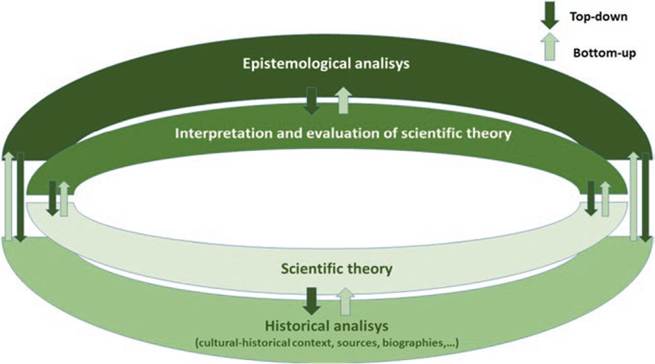
Fig. 1 Interaction between historical analysis and epistemology
3
More on the topic On History as Science and Science as History: In Search of a Methodology:
- On History as Science and Science as History: In Search of a Methodology
- Alai M., Buzzoni M., Tarozzi G. (eds.). Science Between Truth and Ethical Responsibility: Evandro Agazzi in the Contemporary Scientific and Philosophical Debate. Springer,2015. — 337 pp., 2015
- APPENDIX THE HUMAN SCIENCES
- William Stanley Jevons
- REFERENCES
- Carl Menger
- REFERENCES
- The Liability of Science to Ethical Appraisal
- Notes
- B Science and the Scientific Method