Trade unions, wages and collective bargaining
This chapter first identifies the main institutions involved in the process of collective bargaining in the UK. The structure and growth of trade unions are then traced, and the role of employers and government examined.
A simple ‘marginal productivity' model of wage determination is presented, before assessing the degree to which unions can use their ‘bargaining power' to modify the predictions of this model. Other factors affecting the wage bargain, such as comparability, work conditions, cost of living and productivity agreements, are considered. The role of government in setting a minimum wage is assessed, as are the impacts of the minimum wage. The chapter concludes by examining the impact of collective bargaining on pay differentials, restrictive practices and strike activity.Types of trade union
A trade union has been described as ‘a continuous association of wage-earners for the purpose of maintaining or improving the conditions of their working lives’ (Webb and Webb 1896, p. 1). Although useful, this definition does not reflect the whole range of trade union objectives. The Trades Union Congress (TUC) outlines 10 general objectives of unions, with improved wages and terms of employment at the top of the list. Other aims, such as ‘full employment’, ‘industrial democracy’ and a ‘voice in government’, are included, but the emphasis is on the unions’ ‘capacity to win higher wages through collective bargaining as one of their most effective methods of attracting membership’.1
Despite having some objectives in common there is still a considerable amount of diversity between unions in the UK (Table 14.1). Most unions are relatively small. In 2010 some 49% of unions had fewer than 1,000 members each, but together they accounted for only 0.3% of total union membership. There has been a progressive reduction in the number of unions, from the peak of 1,384 unions in 1920, to 179 in 2010.
The reduction has been particularly marked for small unions. The number of unions with fewer than 1,000 members has more than halved since 1979. In 2010 the 10 largest unions (Table 14.2) accounted for 77% of total membership. The trend towards fewer and larger unions, largely as a result of mergers, is well established, but the 179 British unions provide a contrast with the 17 industrial unions in the former West Germany.Four broad headings have been traditionally used to classify trades unions in the UK, namely craft, general, industrial and ‘white-collar’ unions.
Craft unions
These were the earliest type of union, and are mainly composed of workers regarded as ‘qualified’ in a particular craft. Most craft unions now include workers with the same skill across the industry or industries in which they are employed, such as the Associated Society of Locomotive Engineers and Firemen (ASLEF).
Table 14.1 Uni ons and union membership, 1979 and 2010.
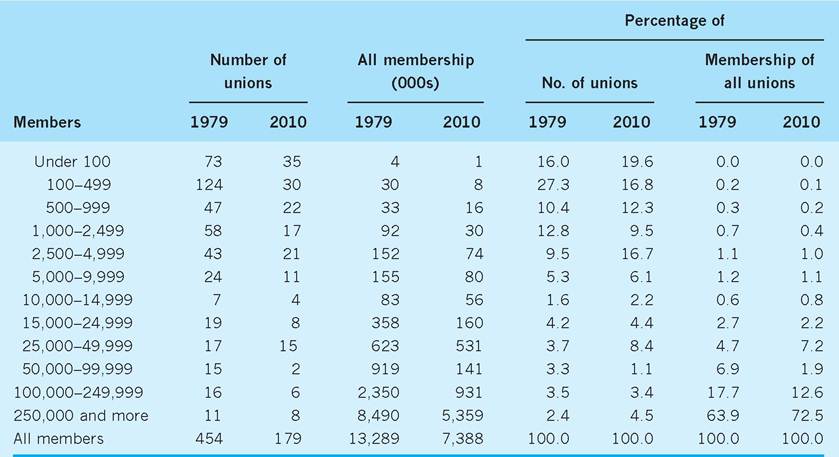
Source: Adapted from Certification Officer (2010) Annual Report of the Certification Officer, 2009/10 and previous Issues.
Table 14.2 The top 10 largest TUC unions, 2009/10
| Rank | Name | Membership |
| 1 | Unite the Union1 | 1,635,483 |
| 2 | UNISON: The Public Sector Union2 | 1,362,000 |
| 3 | bgcolor=white>GMB3601,131 | |
| 4 | Royal College of Nursing of the United Kingdom | 400,716 |
| 5 | Union of Shop Distributive and Allied Workers (USDAW) | 370,763 |
| 6 | National Union of Teachers (NUT) | 366,657 |
| 7 | National Association of Schoolmasters/Union of Women Teachers (NASUWT) | 322,142 |
| 8 | Public and Commercial Services Union (PCS)4 | 300,324 |
| 9 | Communication Workers Union (CWU)5 | 230,968 |
| 10 | Association of Teachers and Lecturers (ATL) | 206,993 |
1Unite was formed in 2007 as a result of the merger of the Transport and General Worker's Union (T&G) and Amicus (itself a merger of The Amalgamated Engineering and Electrical Union (AEEU), and the Manufacturing, Science and Finance Union (MFS)).
2UNISON was formed in 1993 and is composed of three public sector unions, NALGO, NUPE and COHSE.
3GMB is the formal designation of the Boilermaker and Allied Trades Union (composed of seven sections which cover both white and blue collar workers).
4PCS was formed in 1998 as the merger of the Civil and Public Service Association (CPSA) and the Public Services, Tax and Commerce Union (PTC).
5CWU was formed in 1955 as a result of a merger between the National Communications Union and the Union of Communication Workers.
Source: Adapted from Certification Officer (2010) Annual Report of the Certification Officer 2009-2010, p. 62.
General unions
These unions originated in the 1880s in the attempt to organize semi-skilled and unskilled workers not covered by the craft unions. General unions do not restrict their membership to workers with specific skills, nor to particular industries or occupations. Examples include Unite the Union with 1,635,483 members and GMB with 601,131 members.
The distinction between craft and general unions is not always clear. Over the last decade or so, this problem has been complicated by the growth of merger activity in the trade union movement. For example, in May 1992 the Amalgamated Engineering Union (AEU) merged with the Electrical, Electronic, Telecommunications and Plumbing Union (EETPU) to form the Amalgamated Engineering and Electrical Union (AEEU). The new union included occupations within the engineering and electrical sectors, which can be classified as ‘craft’ type occupations, as well as a variety of semi-skilled and unskilled machine operators who could legitimately be placed in the ‘general union’ category.
Industrial unions
These attempt to place under one union all the workers in an industry, whatever their status of occupation. The National Union of Mineworkers (NUM) comes closest to this in the UK, covering most of the occupations engaged in mining operations, though now very much reduced in size.
Other examples of industrial unions include the Iron and Steel Trades Confederation (ISTC) and the Communication Workers Union. Most industrial unions in the UK are ‘a matter of degree rather than kind’. In other words, they usually cover a large number of those engaged in the industry, but by no means all.‘White-collar’ unions
These restrict their membership to professional, administrative and clerical employees. ‘White-collar’ unions have expanded faster than any other type of union in the post-war period. Large numbers of professions are now organized as unions, such as the Royal College of Nursing of the UK (RCN) with 400,716 members and the National Union of Teachers (NUT) with 366,657 members.
As in the case of general and craft trade unions, the distinction between white-collar and manual unions is also becoming clouded by merger. This was exemplified in July 1993 by the formation of UNISON as a result of an amalgamation of the white-collar National and Local Government Officers’ Association (NALGO) with the two primarily manual workers’ unions, the National Union of Public Employees (NUPE) and the Confederation of Health Service Employees (COHSE). Similarly, in January 2002, the AEEU and the Manufacturing, Science and Finance union (MSF) merged to form Amicus which brought together skilled and semi-skilled workers in the electrical and engineering sectors with supervisory and managerial grades in the manufacturing, science and finance sectors. In fact, the overwhelming majority of unions now have features taken from more than one category of union, suggesting the need for new and alternative classifications. For example, some unions may now be more usefully classified as either ‘closed’ or ‘open’. They may be said to be ‘closed’, in that they restrict membership to a clearly definable trade or profession such as the British Airline Pilots’ Association (BALPA), or to a particular industry as with the NUM. In contrast, ‘open’ unions seek to recruit a diverse membership, such as the large general unions, thereby making them less susceptible to decline as particular industries ebb and flow.
It is difficult to provide an accurate pattern of trade union membership by industry, as over 4 million members belong to unions recruiting over several industries. The fact that the UK does not have just a few industrial unions as in West Germany, or enterprise unions as in Japan, poses problems not only for classification but also for collective bargaining. The ‘multi-union’ structure of the UK means that many unions are involved in negotiations at both plant and enterprise levels. This can cause problems for both management and unions. Management may experience difficulties in coordinating negotiations with several different unions, often in the same plant. Unions may have to compromise individual aims and policies when part of a ‘team’ negotiating with employers. Multiunion plants or enterprises may also lead to inter-union rivalry and conflict. For instance, the Rail and Maritime Transport union (RMT) and ASLEF compete for membership among London Underground employees. There is also rivalry among the teaching unions in both schools and university sectors for membership.
The Trades Union Congress
The TUC was founded in 1868 with the aim of improving the economic and social conditions of working people, and of promoting the interests of its affiliated organizations. In 2010 there were 58 affiliated trade unions representing 88% of trade unionists in the UK. The TUC is mainly concerned with general questions which affect trade unions both nationally and internationally, and has participated in discussions relating to the national economy through its membership of the National Economic Development Office (NEDO), although the government’s abolition of NEDO in 1992 removed a major residual channel of communication. The General Council of the TUC represents the organization in the period between one annual Congress and another and is responsible for putting Congress decisions into effect. The General Council has no authority to call strikes, or to stop strikes called by its members, but can offer advice on disputes.
Under Rule 11 the General Council can intervene in unofficial strikes and make recommendations to the unions and employers concerned.The TUC has also been successful through its Organising Academy in training union recruiters and improving the professionalism of unions’ recruitment strategies. Although the influence of the TUC on the UK government has waned considerably since the 1970s, it has an influence on European legislation as a member of the European Trade Union Confederation (ETUC). The ETUC represents the interests of some 60 million trade unionists in Europe, both within and outside the EU, and is one of the ‘social partners’ in the EU along with the employers’ organizations UNICE and CEEP (see below). The partners have negotiated ‘frameworks agreements’ that have been adopted as EU Directives and which are binding in UK law. These Directives are considered more fully in the section on the Social Chapter.
I Trade unions and change
Until 1980 the fall in employment, and therefore the number unionized, in the primary and secondary
Table 14.3 Trade union membership and density in the UK, 1979-2010 (000s and %).
Civilian Potential
employees trade union Trade union Density*
| Year | in employment | Unemployed | membership | membership | (%) |
| 1979 | 23,173 | 1,295 | 24,368 | 13,289 | 54.5 |
| 1981 | 21,892 | 2,520 | 24,412 | 12,106 | 49.6 |
| 1983 | 21,067 | 3,104 | 24,171 | 11,236 | 46.5 |
| 1985 | 21,423 | 3,271 | 24,694 | 10,821 | 43.8 |
| 1987 | 21,584 | 2,953 | 24,537 | 10,475 | 42.7 |
| 1989 | 23,661 | 1,799 | 25,460 | 10,238 | 40.2 |
| 1990 | 22,918 | 1,665 | 24,583 | 9,947 | 40.5 |
| 1992 | 23,198 | 2,779 | 25,977 | 9,048 | 34.8 |
| 1994 | 22,937 | 2,796 | 25,733 | 8,278 | 32.2 |
| 1996 | 23,624 | 2,388 | 26,012 | 7,935 | 30.5 |
| 1998 | 24,569 | 1,822 | 26,397 | 7,851 | 29.7 |
| 2001 | 24,161 | 1,431 | 25,592 | 7,779 | 30.4 |
| 2005 | 24,817 | 1,425 | 26,242 | 7,559 | 28.8 |
| 2010 | 24,943 | 2,450 | 27,393 | 7,388 | 27.0 |

industries was more than compensated for by the rise in employment, and so the number unionized, in the service industries. Since 1980 this trend has been broken (see Table 14.3) and with it the sustained growth in trade union membership over the postwar period. In fact, membership fell substantially by 44.4% between 1979 and 2010, with union density declining from a peak of 54.5% in 1979 to 27.0% in 2010. A breakdown of membership by sex reveals that of the 7.4 million or so union members in 2010, 50% were women, giving a density of 29.5% compared to a density of 25.2% for men.
Factors affecting union growth and decline
Explanations of the factors which affect union membership (and in particular the decline in the density figure since its peak in 1979) can be grouped under three broad headings.
Labour force composition
This set of explanations highlights the role of changes in the compositions of the workforce as a factor affecting the decline in union density, the argument being that the composition of employment has moved away from the industries, occupations and regions where union density was relatively high, and towards those industries, occupations and regions where union density tends to be relatively low.
For example, union membership differs by sector. In the private sector, the average union density is 15.1% whilst in the public sector it rises to an impressive 56.6%. As far as occupations are concerned, union density in the category designated ‘Professional occupations’ (which includes teachers, health workers, business and public service workers and those in science and technology) has an average union density of 47.5% whilst for ‘Sales and customer service’ occupations (such as those workers in the retail/ wholesale service sectors) union density drops to an average of only 12.3%. In terms of employment status (i.e. whether a person is full-time or part-time, self-employed or a trainee), the statistics show that union density is much higher for full-time workers (29.6%) than for part-time workers (21.6%) or for full-time self-employed (10%). It also seems that the size of workplace is an important factor. For example, the average union density in workplaces
employing 50 or more employees is 37.0%, while that for workplaces employing fewer than 50 employees is only 17.2%. Gender is also a factor, with union density higher for females (29.5) than for males (25.2) and increasing with age and length of service for both males and females. Finally, union density varies by country/region, being highest in Northern Ireland (39.9%), followed by Wales (35.4%), Scotland (31.8%) and England (26.1%). However, rates vary in the regions of England, from a high 35.7% in the North East to 21.9% in the South East. Given these figures, it is obvious that the recent changes in the structure of the working population (see Chapter 1, Table 1.4) have had an adverse effect on union density.
The privatization of much of the public sector, the loss of engineering and related jobs via deindustrialization, the sharp increase in the number of selfemployed and part-time workers, the growth in the number of small companies, and the growth of female participation in the labour force are just some of the changes which have tended to decrease union density.
Another key factor behind falling trade union membership is the widespread failure of unions to organize workers in businesses that were set up after 1980. The proportion of British establishments which recognize manual and non-manual trade unions for collective bargaining over pay and conditions is 30 percentage points lower in post-1980 establishments than in the rest of the business community (Machin 2000). Although the largest decreases in recognition occurred in private sector manufacturing companies, there were also sharp falls in private sector services companies. Such organizations were often faced with particularly severe competitive conditions during 1980-2000 which tended to restrict their capacity to sustain the potential ‘costs’ of union recognition (Brown et al. 2009). In fact, unions were recognized for collective bargaining in only a fifth of such ‘new’ enterprises. Another factor relating to the issue of collective bargaining has been the rise of the ‘free rider’. Generally speaking, in workplaces where unions have a collective agreement with management on pay and conditions, most of the employees tend to belong to unions. However, over the period 19992009, there has been an increasing number of employees in workplaces who do not belong to the union and so are seen by many as ‘free riding’ on the benefits fought for by the unions. This is particularly so in the private sector where 63% of private sector employees were union members in 1999 but only 57% by 2009. Interestingly, recent research tends to point to the fact that the fall in union density over the last decade is more likely to be due to a waning appetite for unionism among employees in general, rather than any changes in labour force composition indicated above (Bryson and Forth 2010). This suggestion is strengthened by the fact that the percentage of UK employees who have never belonged to a trade union rose from an average of 22% in 1985-86 to 51% by 2006-08 (Bryson and Forth 2010).
Macroeconomic factors
Macroeconomic factors such as economic growth and unemployment, as well as movements in prices and wages, also have an effect on union membership and density.
Unemployment has obviously had a significant negative impact on union growth. Historically the major upswings in trade union membership have occurred in periods when unemployment has been relatively low or falling - for instance, 1901-20 and 1934-47. A study by Bain and Elsheikh (1982) found that in 15 of the 19 industries studied during the inter-war and post-war years, slow growth of unionization was correlated with periods of high unemployment, and vice versa. The Bain-Elsheikh model suggests that relatively high unemployment will reduce union bargaining power, and therefore discourage union membership. This conclusion is also supported by a survey which investigated the effects of the 1990-93 recession on TU membership (Geroski et al. 1995). That recession was shown to cause a still more rapid decline in trade union membership than might otherwise have been predicted.
However, some have suggested that the threat of unemployment may even act as a stimulus to union growth. Hawkins (1981) sees this as one factor in raising union density amongst white-collar workers threatened by technological and organizational change during the 1970s. Technology is something of a two-edged sword for unions; on the one hand it may create unemployment, whilst on the other it often confers substantial industrial ‘muscle’ on the key workers operating the new computerbased systems.
Price and Bain (1976) suggest that the rate of change of prices and the rate of change of wages may also influence union growth. Rising prices have a ‘threat’ effect so that workers unionize to defend real wages, particularly in the early years of an inflationary period. Wage rises have a ‘credit’ effect for unions, in that they are attributed to their bargaining power, and this promotes membership. Bain and Elsheikh (1982) found that the real wage variable, in one form or another, had a significant and positive impact on union growth in 15 of the 19 industries they studied. Also the desire to protect established pay relativities may affect union growth. For example, in advanced stages of incomes policies, when pay differentials have been substantially eroded, there is evidence that union membership increases. The suggestion here is that a series of injustices leads workers to seek greater bargaining power by joining unions in the hope of restoring differentials.
The rapid decline of both union membership and density in the 1980s and early 1990s suggests that macroeconomic factors may have a negative influence on union growth. Some of the macroeconomic factors also appear to have different effects on union density than those shown by some of the earlier studies quoted above. For example, Carruth and Disney (1987) tried to capture the effects of the main macroeconomic factors on union density by separating out the changes in union membership into two components: a ‘trend’ component influenced by changes in total employment, and a ‘cycle’ component which varies with macroeconomic variables such as wages, prices and unemployment. They note that when unemployment and real wage growth are high relative to the trend, membership growth is depressed. The ‘threat’ and ‘credit effect’ noted in earlier studies seem to have become much less effective. Interestingly, a study of the 1988-90 period (Metcalf 1994) noticed that the reverse relationship did not seem to hold; i.e. falling unemployment and slower real wages did not seem to halt the fall in union density. This may suggest that union density may be experiencing a long-term, secular decline rather than being affected only by short-run cyclical changes in macroeconomic variables.
This conclusion is substantiated by more recent research by Blanchflower and Bryson who were unable to establish whether the diminution of union influence was a cyclical phenomenon (Blanchflower and Bryson 2010). This points to a change in union/ management attitudes over the last decade which is investigated in the next section.
Industrial relations environment
This set of reasons relates to the influence on union membership and density of such factors as government and employer policies, and the trade unions’ own responses to such policies.
Carruth and Disney (1987) found that, in a historical context, Conservative governments have tended to exercise a negative impact on membership rates. Freeman and Pelletier (1990) and Minford and Riley (1994) also accord a strong negative impact on membership rates of the post-1979 legislative programme of the UK Conservative governments. Although it is difficult to be precise, there is little doubt that the post-1979 legislative reforms significantly weakened the position of trade unions. To these legislative reforms should be added the effects of government supply-side policies, with their emphasis on privatization and cost savings. For example, the total number of public sector employees decreased from just over 7 million in 1979 to 5 million in 1995 - a fall of 29%. Central government employment fell by 29%, local government employment fell by 9% and employment in the public corporations fell by 21%, over the same period. Given that the density of unionization is higher in the public sector than in the private sector, it is hardly surprising that the Conservative governments’ economic policies have been directly associated with a decline in union density. In the 1990s membership may have stabilized temporarily in the first few years of the New Labour government after 1997, but then union density continued to decline as a result of a changing perception of unionism in the community coupled with a ‘waning of appetite’ for unions amongst employees - a factor returned to below.
Changes in the attitudes of employers have also affected union membership over the last 20 years. For example, the incidence of companies refusing to recognize unions has increased. ‘De-recognition’ refers to the complete withdrawal of a trade union’s rights to negotiate pay on behalf of its members, although they may be represented for consultation purposes or during grievance and disciplinary hearings. De-recognition was a feature of several heavily publicized disputes in the 1980s, notably News International’s de-recognition of the print unions, P&O’s of the seafarers’ union and the government’s decision that union membership was incompatible with nationalsecurity at GovernmentCommunications Headquarters (GCHQ). Although these were far from being typical instances, they did serve to indicate a change in management power and the declining attractiveness of union membership in such circumstances.
However, although de-recognition was a factor at work it should be noted that the key determinant was the inability of trade unions to gain recognition for collective bargaining in newly established workplaces, which might be due in part to the attitude of employers (Bryson and Forth 2010). The environment surrounding the workplace appears to have changed in recent years, with empirical evidence seeming to show that unionization has had a negative effect on workplace financial performance in the 1980s. However, any such negative or inverse relationship would appear to have weakened appreciably from 1990 onwards as a result of various factors, including a fall in union wage premium (which decreased labour costs), a decrease in demarcation disputes and other inflexible labour policies, and the emergence of a more positive attitude in the workplace about productivity enhancing practices (Wood and Bryson 2009). A final point to note is that the status of unions in society may have changed. For example, in the mid-1980s some 53% of people felt that unions had ‘too much power’ while only 10% said they had ‘too little power’, with 5% of the respondents ‘unsure’. By 2007 only some 13% of people felt that unions had ‘too much power’, with as many as 24% of people saying that unions had ‘too little power’ and a large 20% saying that they were ‘unsure’. This reversal in attitudes and the growth of the ‘unsure’ category tends to indicate a greater uncertainty about the function of unions in society (Bryson and Forth 2010).
I The employers
Employers’ associations
Many employers in the UK are members of employers’ associations which seek to regulate relations between employers and trade unions. These associations are usually organized on an industry basis rather than a product basis, as with the Engineering Employers’ Federation (EEF Ltd) with over 4,000 members in 2010. Their role includes negotiating with unions at industry level, the operation of procedures for the resolution of disputes, and the provision of advice to members on employment law, manpower planning and other personnel matters. In some industries there are local or regional employers’ associations, combined into national federations, as with the Building Employers’ Confederation. Altogether there are about 126 national employers’ associations which negotiate the national collective agreements for their industry with the trade unions concerned, and most of these belong to the Confederation of British Industry (CBI).
Membership of employers’ associations has tended to fall over the past 20 years as the trend towards company bargaining has gained ground. Large companies, such as the car manufacturers, BP, ICI and Shell, prefer to bargain on a company basis with unions rather than be part of a multi-employer bargaining team.
The Confederation of British Industry
This is the largest central employers’ organization in the UK, representing 80% of the top FTSE 100 companies and 50% of the top FTSE 350 companies. In 2010 the CBI represented 24,000 businesses employing around 33% of the UK private sector workforce across 32 industrial sectors. Policy is determined by a council of 330 members, and there are 230 permanent staff members, including representatives with the EU in Brussels. The CBI seeks to represent the broad interests of businessmen in discussions with the government, with national and international institutions, and with the public at large. It nominates the employers’ representatives for such bodies as the Advisory, Conciliation and Arbitration Service (ACAS). Like the TUC, the CBI is affiliated to a Europe-wide representative organization, BUSINESSEUROPE (the Confederation of European Businesses) which represents 40 central industry and employers’ federations across 34 countries in Europe. It also works in tandem with the European Centre of Enterprises with Public Participation (CEEP) that represents public sector employers.
Individual employers
Over the last 15 years the influence of management has increased as the pressures of unemployment and international competition shifted power away from unions and towards management. Recent management initiatives to increase employee flexibility, to improve quality, and to introduce more performance- related pay have begun to create a ‘cultural change’ within individual workplaces. One such change has been the issue of trade union recognition within the company.
The most difficult aspect of collective bargaining in the UK is the fact that workers of a given company often belong to different unions, i.e. multi-union companies. As a result, management often have to negotiate with each union separately. The changing competitive environment mentioned above has caused a shift in the locus of power away from employers’ association bargaining with unions and towards individual company bargaining. This shift in power has often resulted in company management attempting to limit bargaining rights to a single trade union within the workplace, i.e. ‘single unionism’. The advantage to management of such arrangements is that it simplifies the bargaining process and prevents conflict over demarcations between different skill groups represented by different trade unions within the same enterprise. Although only around 200 firms concluded single-union agreements prior to the advent of statutory recognition (e.g. BICC cables, Ikeda, Hoover and Bosch), the new procedure has substantially increased the number of such arrangements.
Another approach to collective bargaining has been the rise of ‘single-table bargaining’ which means that, unlike ‘single unionism’, more than one union is allowed to exist within the company but they have to bargain jointly as a single unit with management rather than separately. These arrangements are supported by the TUC and by individual unions as preferable to single-union deals. Examples are to be found in engineering, the privatized water companies and in car manufacturing, e.g. Rover. Both singleunion and single-table bargaining have tended to reflect a shift in power within the workplace, namely towards management and away from unions.
In addition to the issues of union representation, management have been involved in trying to increase employee flexibility by ‘multi-skilling’, i.e. by widening the skills of each worker (functional flexibility) and by varying the hours worked or employing more part-time or sub-contracted workers rather than fulltime workers (numerical flexibility). This trend has threatened union bargaining power, since part-time or sub-contracted workers have a lower union density, as noted earlier in this chapter. Multi-skilling also tends to restrict the ability of shop stewards to negotiate such subjects as staffing levels, job demarcations and the pace of work. Similarly the growth of performance- related pay (PRP), by linking reward to actual performance, may weaken the trade unions because part or all of the individual’s annual pay award is no longer subject to collective bargaining.
Finally, it is worth noting that the growth of quality consciousness in UK industry has enhanced the importance of teamwork. The introduction of such devices as quality circles, where groups of around 10 workers meet to discuss their work and suggest improvements, has increased employee involvement in the firm. The large-scale survey of workplace practices by the DTI in 1998 showed that many ‘new’ management practices had been introduced to create more employee commitment. Such practices included teamwork activity, team briefings and also performance appraisal meetings in which staff were invited to participate in setting targets and goals. The net effect of these increased attempts by management to involve employees has been to circumvent or marginalize unions while retaining union recognition, leaving the future of ‘collective’ (i.e. union) representation of the workforce rather unclear.
The emergence of ‘partnership agreements’ between management and trade unions in recent years suggests an attempt to prevent the marginalization of unions noted above. A formal partnership agreement between unions and management usually involves reciprocal agreements whereby employers receive union commitment to flexible work practices whilst union members receive greater work security and greater participation in the affairs of the company. Such partnerships have occurred in a variety of organizations such as Natwest Retail Banking and Tesco.
I The government
The government’s role in industrial relations is threefold: as an employer, as a legislator and as an economic and social policy-maker.
The government is a major direct employer of labour, with central government employing 2.6 million persons, or 4% of the workforce in 2010. It influences not only these pay settlements but also those of the local authorities and the remaining nationalized industries, in total an extra 6.1 million persons. The government can, through its position as a primary source of finance, and by using cash limits (see Chapter 18), affect wage bargaining and employment levels in the local authorities and the nationalized industries.
As a legislator, the post-1979 Conservative administration was particularly active, and made extensive use of the law in an effort to reduce what it perceived as excessive union bargaining power, resulting in high UK wage cost and low labour productivity. An examination of the major legal changes introduced since 1979, mainly in the 1980, 1982, 1988, 1989 and 1990 Employment Acts, and in the 1984 Trade Union Act, reveals important changes in the context of collective bargaining. The previous Conservative government consolidated its ‘step by step’ reforms with the passing of the Trade Union and Labour Relations (Consolidation) Act 1992 (TULR(C)A) as amended by the Trade Union Reform and Employment Rights Act 1993. The former Act was a measure designed to rationalize all previous relevant statutory provisions into a single act rather than to change the substance of the law. The latter Act aimed to modify some sections of the 1992 Act by enhancing the rights of individual employees and union members while also imposing certain regulations relating to industrial action. The 1997-2010 Labour government retained most of these legal reforms, and introduced important new statutes (e.g. setting a national minimum wage), as will be discussed later in this chapter.
The closed shop
This is a situation where employees obtain or retain a job only if they become a member of a specified trade union. Its advantages to unions and management are discussed below. This practice was progressively weakened by legislation in the 1980s and 1990s making unions liable to legal action from both employees and management if they tried to enforce the closed shop. The relevant legislation which deals with this aspect is contained in Part III of TULR(C)A. A sample study of 529 firms in the mid-1990s found that only 9% of firms still had formal closed-shop arrangements (Geroski et al. 1995). However, two important studies (Wright 1996; Addison and Siebert 1998) have shown that while formal union arrangements such as the closed shop may have collapsed among white-collar workers, manual workers and other groups have still retained informal methods of maintaining a closed shop, as in the case of closed-shop arrangements agreed between managers and labour.
Strikes and other industrial action
Since the end of the nineteenth century it has been impossible for a trade union to organize a strike without committing a tort, that is the civil wrong of interfering with the contract of employment between employer and employed. The committing of a tort enables the employer to obtain an injunction against, or claim damages from, the union. However, since 1906 Parliament has protected unions from this liability by providing them with immunity from civil action, and a major aim of the post-1979 legislation has been to narrow the scope of this immunity by rendering certain types of dispute ‘unlawful’.
Industrial action is unlawful when the union is no longer covered by immunity from civil actions brought by employers or other affected parties in the courts. If successful, the employer will obtain a court injunction prohibiting the dispute, and the union will face fines or the sequestration of its assets for failure to comply. An employer can also subsequently claim damages arising from losses sustained during the action.
An important provision in the 1982 Employment Act restricted ‘lawful trade disputes’ to those between workers and their own employer, making ‘political’ strikes and inter-union disputes unlawful (s. 219). Also rendered unlawful by the 1980 Employment Act was secondary action, i.e. action against an employer not party to a dispute (s. 224). Picketing is now almost wholly restricted in law to the union members’ ‘place of work’, often even excluding another plant of the same employer. Restrictions on illegal picketing are effected by making unions liable to pay damages in civil actions brought against them by employers. The 1984 Act also meant loss of legal immunity in certain circumstances. Official industrial action, i.e. that approved by the union leadership, must be sanctioned by a secret ballot of the membership. The ballot must be held no more than four weeks before the event, and a majority of union members must be in favour of the action. If the action takes place without majority consent, then the union loses any legal immunity for organizing industrial action that it may have enjoyed in the past. These provisions were strengthened by the 1988 Employment Act which gave the individual union member the right not to be called out on strike without a properly held secret ballot and, most controversially, in view of the stated opposition of both the CBI and the Chartered Institute of Personnel and Development, the right not to be disciplined by his or her union for refusing to strike or for crossing a picket line. The Act also established a Commissioner for the Rights of Trade Union Members to provide funds and advice to individuals wishing to take legal action to exercise these rights (s. 62). However, this office was abolished by the Employment Act of 1999, which also gave the Certification Officer the power to hear the complaints of trade union members against their unions.
The Employment Act 1999 also strengthened the rights of those employees engaged in ‘official’ industrial action, i.e. action which has been officially authorized by the unions involved. Previously employees could, in certain circumstances, deem to have been fairly dismissed for such union activity. However under the new Act the dismissal of such employees is deemed automatically unfair for the first eight weeks of the action, a period which may be extended if the employer fails to take ‘reasonable steps’ to resolve the dispute. Such changes followed the expressed desire of the Labour government to create a workplace environment of greater trust and co-operation.
The 1990 Employment Act took the control of union behaviour even further by requiring that the union leadership must take positive steps to repudiate ‘unofficial action’, i.e. actions undertaken by union members without union consent (that is of the executive committee or president or general secretary). For instance, the union must do its best to give written notice to all members participating in the action that it does not receive the union’s support. Failure by the union to take such steps could mean loss of immunity for the union, even though the action is unofficial. In addition, the Act allowed employers to dismiss unofficial strikers selectively at the place of work (e.g. the strike leaders) and deny those dismissed the right to claim unfair dismissal. Any industrial action because of such dismissal would now be deprived of immunity (s. 223).
The Trade Union Reform and Employment Rights Act 1993 passed two main provisions relating to the organization of industrial action. First, ballots held in support of action should be fully postal and subject to independent scrutiny, effectively restricting the initiation of action at ‘rank-and-file’ level. Second, unions are to be required to give seven days’ written notice before industrial action can be taken. This affords a longer waiting period to help settle any dispute. The unions argue, however, that it also gives employers rather longer to prepare for any dispute. The Act also provided government assistance for members of the public to seek damages from trade unions for the effects of unlawful industrial action, but this was abolished by the Employment Relations Act 1999 (ERA). ERA also amended the rules on ballots, enabling employers and trade unions to continue negotiations beyond the four-week deadline for the commencement of industrial action after the date of the ballot. In addition, ERA issued a code of practice on how ballots should be conducted that can be used by courts to determine breaches of the law. It also made it clear that an overtime ban constituted industrial action short of a strike, and not full strike action.
The Employment Relations Act 2004 simplified the law on industrial action ballots and also ballot notices and provided increased protection for employees against dismissal by employers when taking official and lawfully organized industrial action. For example, the Act extended the period in which an employee involved in an official strike could not be dismissed from eight to 12 weeks.
Legal regulation of wages and conditions of work
Many legal regulations which had originally been designed to place a ‘floor’ on both wages and conditions of work were dismantled after 1979 by successive Conservative governments in order to remove alleged disincentives to employment and to help increase labour flexibility. For example, the abolition of the Wages Councils in 1993 took away minimumwage guarantees for low-paid workers in the industries for which these Wages Councils existed. In addition, the UK also initially ‘opted out’ of the ‘Agreement on Social Policy’ contained in the Social Protocol of the Maastricht Treaty - commonly known as the Social Chapter. This absolved the UK government from the need to implement certain EU Directives regulating employer/employee relations, a policy reversed in 1997 by the incoming Labour government.
Although also committed to workforce flexibility, the Labour government reversed some of this earlier legislation. It established the Low Pay Commission to make recommendations for a National Minimum Wage (NMW), which is considered further below (p. 288). It also legislated against the blacklisting of union members and sought to improve the rights of workers on ‘zero hours’ contracts (i.e. where workers have no guaranteed paid hours). ERA 1999 also gave employees the statutory right to be represented in formal disciplinary and grievance proceedings, which unions have seen as a possible route to recognition and new members as it implies union access to previously nonunion workplaces (McKay 2001).
The Employment Act 2002 introduced further individual rights for employees, the most significant of which address certain ‘family-friendly’ practices to promote ‘work/life balance’. From April 2003, maternity leave was increased and working fathers were given the right to two weeks’ paternity leave. Employees are also able to request flexible working from their employers, such as job sharing, flexi-time, home-working and part-time work. Employers have the right to refuse such requests, but must explain their reasons for this to the employee in writing. ERA 2004 also changed the operation of some individual employment rights by improving the enforcement regime of the National Minimum Wage, and giving protection against unfair dismissal to employees with less than one year’s service who requested flexible working.
Trade union democracy
The Trade Union Act 1984 and Employment Act 1988 embodied a number of provisions for internal union democracy in addition to those pertaining to strike action. Members of the main executive committee of a trade union must have been elected in a secret ballot of the union’s members within the previous five years. The Employment Act of 1990 contained the right of members to a postal vote in elections for all members of union governing bodies and for key national leaders. In addition, the 1984 Act required trade unions with political funds to ballot their members at least every 10 years. Only if this is done, and majority assent for the fund achieved, can the union continue to spend money on ‘political’ matters, such as a campaign against new legislation or in support of a political party. To date, of all ballots which have been held on this matter, a substantial majority have been in favour of retaining the fund.
The Trade Union Reform and Employment Rights Act 1993 modified some sections of the TULR(C)A by taking the issue of democracy further. First, it strengthened the rights of individuals by giving them greater freedom to belong to the union of their choice. For example, an individual could belong to more than one union and unions could not dismiss a member for failing to support a strike. This had obvious implications for relationships between unions and their members. Second, it also gave trade union members the right not to have union subscriptions deducted from their pay except with their written consent. The latter ‘check off’ arrangements were seen as threatening union membership levels and were repealed in 1998 by the Labour government.
Statutory recognition of trade unions
An important legislative change relating to trade union recognition was introduced in June 2000 under Schedule 1 of the Employment Relations Act 1999, which amended the Trades Union and Labour Relations (Consolidation Act) 1992. This schedule covers workers in organizations with at least 21 employees where a trade union has made a request to be recognized as the representative of employees for bargaining purposes. If an employer rejects the request, the union can apply to the Central Arbitration Committee (CAC) which has to decide whether the union has the support of the majority of the workforce that comprises the proposed ‘bargaining unit’, i.e. the group of employees to be covered by collective bargaining. If 50% or more of the bargaining unit are members of the union applying for recognition, then the CAC may award automatic recognition. If this criterion is not met, then a ballot can be held. In this case recognition will depend on the union receiving a majority of the votes in a ballot and at least 40% of the workers entitled to vote having done so. The recognition agreement lasts for three years.
The impact of this legislation on union membership was considered earlier in the chapter, and its use has proved less problematic for trade unions than they envisaged, given the formidable qualifications for recognition that the procedure imposed. From June 2000 to the end of March 2002, 175 applications for recognition were received by the CAC, of which 86 were ultimately withdrawn, 12 were rejected by the CAC, 34 were pending and in 14 cases recognition was decided by the Committee without a ballot. Only 29 cases proceeded to a ballot and 20 of these led to union recognition. The relative success of the unions involved in the procedure reflects their avoidance of making applications where they were not very confident about membership levels and support for recognition in the bargaining unit.
Probably the most difficult part of the recognition procedure is the decision about the appropriateness of the bargaining unit, which must be ‘compatible with effective management’. Not only has this been a source of conflict between unions seeking recognition and management, but it can also cause friction between unions competing for membership. For example, the TGWU was recognized by Eurotunnel to represent its train drivers in the teeth of opposition by ASLEF, the train drivers’ union (Walsh 2000). Whilst the Labour government extended the rights of employees to collective representation, UK law places more restrictions on industrial action than anywhere else in the EU, and the Labour government remained committed to the outlawing of strikes called in sympathy with other unions, or union actions that can broadly be deemed as political.
In its legislative capacity, therefore, the government can alter the balance of power between employer and employee. However, it is difficult to assess how far any legislation can be effectively used by employers, as this depends upon a complex array of factors, such as management style, the firm’s size and position within both product and labour markets, the availability of alternative tactics and the anticipated repercussions of recourse to law on a firm’s industrial relations.
ERA 2004 made no substantive changes to the 1992 and 1999 Acts but did give trade unions earlier access to workers and stipulated a duty on parties to refrain from engaging in ‘unfair practices’, responding to the suggestion that, in the past, employers had engaged in unfair practices by trying to undermine trade union recognition. The Act did not, however, provide for union recognition rights in small firms, i.e. those employing fewer than 21 workers.
The European Union and UK industrial relations
The European Union is discussed more fully in Chapter 27, but the current proposals of the European Commission are of potentially great significance to the UK. The most important measures are contained in the European Social Charter and the accompanying ‘Action Programme’ for its implementation. The Charter contains provisions relating to both the individual and collective rights of workers, but it is important to recognize that it is a statement of principles or intent and that by itself it creates no legally enforceable rights. However, the Commission plans to give legal form to the Charter’s contents over the next few years, which at present enjoy majority support in the Council of Ministers.
Only a brief outline of the Charter can be given here, but measures pertaining to individual employee rights include greater freedom of movement within the Community, the right to training, protection regarding health and safety and against discrimination, provisions to safeguard the employment conditions of the young, disabled and elderly, and employees at large, and minimum rules on work duration, rest periods and holidays, shift work and systematic overtime. Broadly similar rights are to be extended to part-time, casual and temporary workers. The Charter excludes a commitment to minimum wage legislation. Measures relating to collective labour law are more limited, and the Charter does not propose any legally enforceable right to bargain for trade unions where this is not already part of a member state’s law. However, the Charter does include important prospective rights to information and consultation plus the ‘participation’ of employees before companies make decisions on redundancies and closures.
Implementing the Social Chapter
The Labour government’s reversal of the ‘opt-out’ from the Social Chapter led to the adoption of EU Directives which have had important implications for industrial relations. Under the Social Chapter, the European Commission must consult with the social partners (ETUC, UNICE and CEEP) about the content of its proposals, with much of the ensuing legislation arising out of ‘framework agreements’ negotiated at European level by the partners. Successful agreements which have been adopted by the Commission include the Parental Leave Directive (which gave parents the right to leave work after the birth or adoption of a child), the Part-time Workers’ Directive (which extended equal rights and prorata benefits to part-time staff) and the Fixed-Term Contracts Directive (which strengthened the rights of workers under such contracts, as well as discouraging their use). This last Directive is unique in that it is the first to be initiated by UNICE in the employment field (Gennard and Judge 2002). However, the Labour government restricted the impact of the part-time workers’ regulations by limiting the scope for comparison between such employees and full-time staff to those working under the same type of contract and at the same location (McKay 2001).
The Working Time Directive was implemented in the UK in 1998 and contained provisions for a legal right to four weeks’ paid holidays and an upper limit to the working week of 48 hours (averaged over 14 weeks), together with various other entitlements, such as the right to rest periods. The impact so far has been marginal, with the government allowing both individual and collective ‘opt-outs’ by employees from the legislation. British employee relations have also been affected by the European Works Council Directive of 1994 (extended to the UK in 1998). The European Works Council (EWC) is a term used for a pan-European forum of employee representatives set up for the purpose of information and consultation. Multinationals with at least 1,000 employees working in the EU and with at least 150 employees working in two or more of its member states are required to establish an EWC, which consists of managers and elected representatives from the workforce across its European operations. It must meet at least once a year to discuss the progress and prospects of the company, as well as any decisions likely to affect more than one EU member state, e.g. closures or mergers. The EWC Directive was revised by the Council and the European Parliament in May 2009. The changes contained in the new (‘Recast’) Directive were due to be transposed into national law by June 2011, and have important implications for all companies in terms of the scope of the legislation, both those with an existing European Works Council and those yet to set one up.
A significant new measure that extends the principle of consultation is the Information and Consultation Directive (2002), which was opposed by the Labour government. This gives employees in establishments with at least 50 employees rights to information and consultation on the performance of the business and on decisions relevant to employment, including substantial changes to work organization, particularly where jobs are threatened.
As a complement to EU statutes, the Human Rights Act 1998 (HRA) came into force in 2000, with important implications for British employee relations. For example, it includes the requirement that internal disciplinary procedures in the public sector organizations must conform to standards of proof and procedures expected of courts and tribunals. The HRA’s effects on the private sector are less clear, but employment practices are likely to be subjected to more rigorous examination under the Act which, like the EU Charter, also enshrines a right to freedom of association.
The structure of collective bargaining
Collective bargaining has been defined by Clegg (1978) as referring to ‘the whole range of dealings between employers and managers on the one hand, and trade unions, shop stewards and members on the other, over the making, interpretation and administration of employment rules’. These rules are both substantive, determining pay, hours, overtime, manning levels, holidays, etc., and procedural, governing the way in which substantive issues are settled. One of the most significant changes which has taken place in UK industrial relations over the last 30 years has been the decrease in the percentage of employees covered by collective bargaining agreements. For example, between 1984 and 2009, the percentage of total employees covered by collective bargaining arrangements fell from 71% to 32%. The effects of decreased union density, the legal changes introduced by government, the privatization movement, and the increased power of management all contributed towards this downward trend. Despite this radical change, collective bargaining between unions and employers is still of major importance in most of the UK’s key sectors, and occurs at a number of levels.
National or multi-employer bargaining
This level of negotiation predominates in the public sector in which centralized bargaining gives rise to relatively formal, fixed-term and comprehensive agreements, leaving little scope for localized or workplace bargaining. However, there is now a clear trend towards more decentralized bargaining in the public sector. The ‘local management of schools’ initiative, together with the creation of semi-autonomous NHS Trusts, necessarily imply further moves towards local bargaining. Moreover, both the privatized water companies and electricity generators have withdrawn from industry-level agreements, and decentralization is becoming the norm for the privatized elements of British Rail. Finally, the ‘contracting out’ to private tender of many services previously supplied by local authorities clearly reduces the coverage of national bargaining in this sector.
In the private sector national bargaining occurs on an industry level, between employers’ associations and trade unions, or federations of unions. This was once the main type of collective bargaining, but has declined in importance in many industries so that by the late 1990s it covered only about 15% of employees in the private sector (e.g. electrical contracting). In fact, industry-wide and multi-employer bargaining has already disappeared from a number of sectors, including the clearing banks, the cable industry, provincial newspapers and independent TV companies. Nevertheless, a potentially important development in multi-employer bargaining is the growth of ‘coordinated bargaining’ across Europe, defined as ‘an attempt to achieve the same or related outcomes in separate negotiations’ (Sisson and Marginson 2002). At EU-sector level, ETUC and its constituent industry federations, such as the European Metalworkers’ Federation, have initiated procedures to combat ‘social dumping’ by multinational companies (MNCs). In MNCs, many of which operate across Europe, there is pressure from top management to implement ‘best practice’ policies (such as team-working and annualized hours) across their European subsidiaries as, for example, in the case of General Motors. This type of coordinated bargaining is at an early stage but nevertheless could have an impact on UK industrial relations, although significant decentralization is likely to remain.
Single-employer bargaining
This occurs at two levels: (a) corporate, i.e. at the level of the company or whole organization; and (b) establishment, i.e. at the level of the workplace, such as the factory, plant or office.
The widespread practice of informal bargaining at workplaces in the 1960s, generally in the manufacturing sector, was criticized by the Donovan Commission in 1968. The Commission recommended that tacit, unwritten deals between local managers and shop stewards should be replaced by written formal agreements of specified duration and on clearly delineated issues. This encouraged the rise of corporate or company-level bargaining and the greater involvement of senior management.
However, this shift to company agreements, largely initiated by US-owned multinationals to exert greater control over collective bargaining, has not been universal. In fact, establishment- or plant-level bargaining remains important in many industries, such as clothing, and the footwear, brick and timber industries. More significantly, recent changes in managerial practice, which have devolved more responsibility to middle management for running individual establishments as separate budget or profit centres, have enhanced formal plant bargaining at the expense of company-wide negotiation. The growth of multiproduct or multi-divisional firms such as Unilever, Philips, Coates Viyella and Lucas, for example, is evidence of such trends towards division and establishment level bargaining. However, this development has been accompanied by a decline in the range of substantive issues which many managements are prepared to negotiate with unions. Moreover, and of perhaps greater future importance for workplace bargaining, there has been a marked increase in systems of individual assessment and reward, some linked to the profit performance of the company, which could further undermine collective representation. Studies have shown that 14% of non-managerial employees in the private sector have their pay negotiated at corporate level and 9% at workplace level. This compares with 16% and 35% respectively in the public sector (Cully et al. 1999). Bargaining has become more decentralized over time, moving from the multiemployer to the corporate level, and on the other hand from the corporate level to the establishment or plant level. The main reasons cited for the growth of establishment- or plant-level bargaining include better control of profitability levels by taking into consideration local labour market conditions and more ability to reward individual employees according to performance.
Advisory, Conciliation and Arbitration Service (ACAS)
ACAS was established as an independent statutory body on 1 January 1976 and is formally independent of direct ministerial intervention. The agency stemmed from the Department of Employment’s Conciliation and Arbitration Service which had often been criticized as not being independent since it was directly under the control of a government minister. Its role is to provide impartial information (advisory) and to help prevent or resolve problems between employers and their workforces (conciliation and arbitration). The service is controlled by a council consisting of 12 members, including an independent chairman and 11 other members with experience of industrial relations (e.g. trade unionists, academics and others), all of whom are appointed by the Secretary of State for Industry. For example, in 2009/10 it completed 849 in-depth advisory meetings, 765 conciliation events and arbitrated or mediated in 44 disputes. Conciliation is the process of bringing parties together in a dispute in order to move forward towards a settlement, whilst arbitration involves an independent arbitrator or board of arbitrators,2 who decide on the outcome of a dispute and whose decision may have legal force. Of the 44 arbitration cases dealt with by ACAS in 2009/10, ‘dismissal and discipline’ accounted for 55% of the cases and ‘pay and conditions of employment’ for 43% (ACAS 2010).
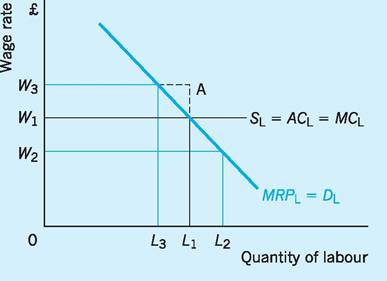
Fig. 14.1 Wage determination in a competitive market.
always be required if the revenue gained from selling the output produced by the last person, the marginal revenue product of labour (MRPl),3 is greater than the extra cost of employing that person, the marginal cost of labour (MCl). In a competitive labour market (see Fig. 14.1), the supply of labour (5l) to each firm would be perfectly elastic at the going wage rate (W1), so that the wage rate is itself the marginal cost of labour.4 The profit-maximizing firm would then hire people until MRPl equalled MCl, i.e. L1 persons in Fig. 14.1. If more than L1 persons were hired, then the extra revenue from their hire would fail to match the extra cost incurred.
Under these conditions the MRPl curve becomes the demand curve for labour (Dl), since at any given wage rate the profit-maximizing firm will employ labour until MRPl equals that wage rate. For example, if the wage rate falls to W2 in Fig. 14.1, then demand for labour rises to L2.
Wage determination and collective bargaining
The neo-classical view of wage determination is embodied in ‘marginal productivity’ theory. With many small buyers of labour (firms) and many small suppliers (i.e. non-unionized individuals), the wage rate would be determined by the intersection of demand and supply curves for labour.
The demand curve for any factor, including labour, is seen as being derived from the demand for the product or service it produces. Additional labour will
Wages and unions
If the labour force is now unionized, then the supply of labour to the firm (or industry) may be regulated. However, even though unions bring an element of monopoly into labour supply, theory suggests that they can influence only price or quantity, but not both. For example, in Fig. 14.1 the union may seek wage rate W3, but must accept in return lower employment at L3. Alternatively, unions may seek a level of employment L2, but must then accept a lower wage rate at W2. Except (see below) where unions are able to force employers off their demand curve for labour (MRPl), then unions can raise wages only at the ‘cost’ of reduced employment. However, a given rise in wages will reduce employment by less, under the following circumstances.
1 The less elastic is final demand for the product.
2 The less easy it is to substitute other factors for the workers in question.
3 The lower the proportion of labour costs to total costs of production.
All of these circumstances will make the demand curve for labour, MRPl, less elastic.
Unions and bargaining power
Unions may seek to force the employer off his demand curve for labour so that he makes less than maximum profits. It may then be possible for wages to rise from W1 to W3 with no loss of employment, i.e. at point A in Fig. 14.1. How effective unions will be in such strategies will depend upon the extent of their ‘bargaining power’.
Chamberlain defines union bargaining power as:

Although this ratio cannot be measured, as it relies on subjective assessments, it is a useful analytical tool. If unions are to exert effective influence on management the ratio must exceed unity. That is to say, it must be more costly for management to disagree (e.g. loss of profits, or market share as a result of strike action) than to agree (e.g. higher labour costs and manning levels). The higher the ratio, the more inclined management may then be to agree to the union’s terms.
The level of the wage demand will affect union bargaining power. The more modest the wage claim, the lower the management cost of agreement, and the higher Chamberlain’s ratio, i.e. the greater is union bargaining power. This will increase the prospects for securing higher wages with stable employment.
Union density will also affect bargaining power. The greater the proportion of the industry unionized, the less easy it will be to substitute non-union labour. The management costs of disagreeing to union terms will tend to be higher, so that the ratio, i.e. union bargaining power, rises. Equally, the higher is union density in the industry as a whole, the easier it is for any particular company to pass on higher wage demands as price increases to consumers without losing market share. This is because competing firms in the industry will also be facing similar wage-cost conditions. High union density therefore reduces the management costs of agreeing to union terms, and again raises the ratio, i.e. union bargaining power. High union density will therefore also increase the prospects for securing higher wages with stable employment.
Even macroeconomic factors can be brought into this analysis. The higher the level of real income in the economy, the higher will be demand for ‘normal’ goods. Management will then be able to pass on cost increases as higher prices with relatively less effect on demand. This will reduce management costs of agreeing to union terms, raise the ratio, and with it union bargaining power.
Another main factor which affects the bargaining power of trade unions is the degree of competition in the product market. For example, Gregg and Machin (1991) found that those unionized firms facing increased competition in the market for their product experienced slower wage growth than those unionized firms that did not. In other words, increasing competition in the product market tends to reduce the bargaining power of unions to raise wages. This seems to indicate that unions are becoming more aware of the potential ‘costs’ to them in terms of unemployment if they bargain for higher wages when their firm is experiencing intense competition.
However, one must recognize the existence of many other dimensions to union bargaining power, such as the degree of unanimity or conflict within unions over bargaining goals and methods. Unions will also vary in the militancy of their members and the bargaining abilities of their leaders. All this makes the assessment of bargaining power extremely difficult. It is also important to note that the ‘resource’ theory of the impact of trade unionism on the firm does not accept that the exercise of this power will necessarily raise production costs. Instead, the theory argues that unions can significantly increase productivity by providing an efficient means for the management and settlement of disputes. Thus, collective bargaining reduces the costs of individual expressions of grievances, which may raise the ‘quit’ rate of key employees and the incidence of absenteeism or poorquality work. Further, the ‘shock’ effect of unions’ negotiation of pay rises may force managements to increase efficiency in order to absorb higher costs.
Wages and employers’ associations
Wages are determined by a variety of factors, of which union bargaining power is but one, admittedly important, element.
Employers’ associations are themselves able to create an element of monopoly on the demand side of the labour market (i.e. ‘monopsony’). These associations bring together the employers of labour in order to exert greater influence in collective bargaining. Standard theory suggests that monopsony in the labour market will, by itself, reduce both wages and employment in the labour market.
In Fig. 14.2, under competitive labour market conditions the equilibrium would occur where the supply of labour (5l = ACl) equalled the demand for labour (MRPl), giving wage Wc and employment Lc. If monopsony occurs, so that employers bid the wage rate up against themselves, then it can be shown that the MCl curve will lie above the 5l = ACl curve. For example, if by hiring the fourth worker, the wage (= ACl) of all workers is bid up from £5 to £6, then the ACl for the fourth worker is £6 but the MCl for the fourth worker is higher at £9 (£24 - £15). The profit-maximizing employer will want to equate the extra revenue contributed by the last worker employed (MRPl) to the extra cost of employing the last worker (MCl). In Fig. 14.2 this occurs with L1 workers
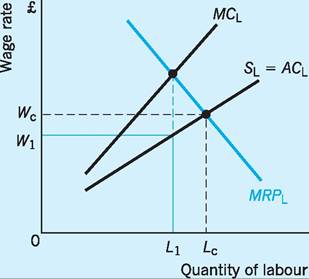
Fig. 14.2 Wage determination with monopsony in the labour market.
employed. Note, however, that the employer only has to offer a wage of W1 in order to get L1 workers to supply themselves to the labour market. The wage W1 is below the competitive wage Wc and the level of employment L1 is below the competitive level of employment Lc. This is the standard case against monopsony in a labour market, namely lower wages and lower employment as compared to a competitive labour market.
When monopoly on the demand side (employers’ associations) is combined with monopoly on the supply side (trade unions), the wage and employment outcome becomes indeterminate. This is often called ‘bilateral monopoly’.
The existence of employers’ associations will clearly affect the strength of union bargaining power. The greater the density of their coverage within an industry, the smaller might be the management costs of disagreement, e.g. in the case of a strike there is less likelihood of other domestic firms capturing their markets. By reducing the numerator of the ratio, union bargaining power is reduced.
Wages and government: the National Minimum Wage
The National Minimum Wage (NMW) covering minimum wages for employees over the age of 18 was introduced in April 1999, and in October 2004 the NMW was extended to cover 16- and 17-year-olds. Table 14.4 shows the increases in the rates of NMW for three categories of workers between April 1999 and October 2011. The NMW has been revised upwards at regular intervals during this period, with the adult rate increasing by 65% between 1999 and 2011, and the Youth Development Rate (18-21 years) increasing by 64% over the same period.
Figure 14.3 illustrates the problem of setting too high a minimum wage. If the NMW is set above the competitive wage (Wc) for any labour market, then there will be an excess supply of labour of L' - L*, with more people supplying themselves to work in this labour market than there are jobs available. In Fig. 14.3 the actual level of employment falls from Lc to L*.
However, there have been a number of studies suggesting that in the US, a higher minimum wage has actually increased wages and employment (Atkinson 1996). But it has been noted that many of
Table 14.4 National minimum wage rates per hour, April 1999 to September 2011.
| Aged 16-17 | Aged 18-21 | Aged 22 and over* | |
| April 1999 to May 2000 | - | £3.00 | £3.60 |
| June 2000 to September 2000 | - | £3.20 | £3.60 |
| October 2000 to September 2001 | - | bgcolor=white>£3.20£3.70 | |
| October 2001 to September 2002 | - | £3.50 | £4.10 |
| October 2002 to September 2003 | - | £3.60 | £4.20 |
| October 2003 to September 2004 | - | £3.80 | £4.50 |
| October 2004 to September 2005 | £3.00 | £4.10 | £4.85 |
| October 2005 to September 2006 | £3.00 | £4.20 | £5.05 |
| October 2006 to September 2007 | £3.30 | £4.45 | £5.35 |
| October 2007 to September 2008 | £3.40 | £4.60 | £5.52 |
| October 2008 to September 2009 | £3.53 | £4.77 | £5.73 |
| October 2009 to September 2010 | £3.57 | £4.83 | £5.80 |
| October 2010 to September 2011 | £3.64 | £4.92 | £5.93 |
Source: Low Pay Commission (2010a) Historical Rates.
*From Oct. 2010 this rate is applied to those aged 21+. Also from Oct 2010 an Apprentice Minimum Wage of £2.50 per hour is applied to apprentices under 19 years and those aged 19 and over in the first 12 months of their apprenticeship.
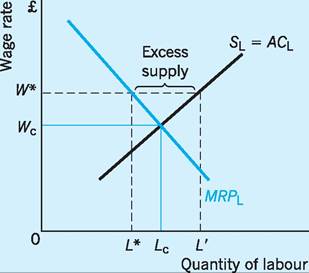
Fig. 14.3 Minimum wage (l√*) set above the competitive market wage (IVc).
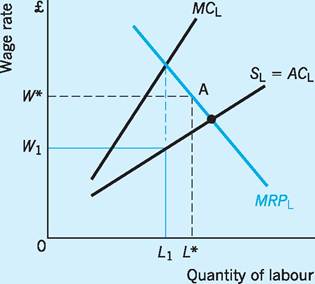
Fig. 14.4 Minimum wage (l√*) raising both wages and employment with monopsony in the labour market.
the US studies have involved labour markets (e.g. fast food) which are dominated by a few large employers of labour, i.e. monopsonistic labour markets.
In fact our earlier analysis of monopsony might have led us to expect this. For example, if in Fig. 14.4 the initial monopsony equilibrium was wage W1 and employment L1, then setting a minimum wage of W* would result in a rise in both wages (W1 to W*) and employment (L1 to L*). Since no labour is supplied below the minimum wage W* this is the effective labour supply curve at W* (W* = ACl = MCl). The profit-maximizing situation is at point A on the MRPl curve, where the marginal cost of hiring the last person (MCl) exactly equals the extra revenue resulting from employing that last person (MRPl). So imposing a minimum wage on a labour market that is already imperfect (here monopsony) can increase both wages and levels of employment.
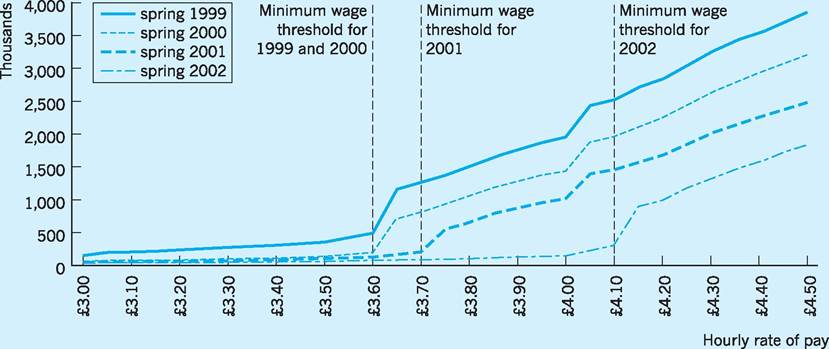
Fig. 14.5 Numbers of jobs paid below different hourly rates of pay for people aged 22 and over, UK, 1999-2002. Source: Heasman (2003).
The impact of the minimum wage legislation on low pay in the period following its introduction can be seen in Fig. 14.5 which gives the number of people aged 22 and over who were paid below a range of hourly wage rates. The figures are given in the form of four lines, each representing a different period in time and indicating the number of people earning below the specified hourly wage rate at the date shown. The NMW levels at the different dates are also provided.
First, it can be seen that there is a tendency for a significant increase in the number earning just above the minimum wage shortly after the introduction of the NMW, suggesting that employers are responsive to raising pay just above the minimum wage around the time the NMW was introduced or subsequently changed. Second, over the period 1999-2002, each successive time line is below the one representing the previous time period, indicating that a change in the NMW threshold has impacts that continue into future time periods, with progressively fewer people paid below that ‘new’ benchmark as time moves on. Overall it would seem that the numbers of jobs paying wage levels below the NMW threshold appear to be very responsive to the threshold changes but with something of a time lag (Heasman 2003).
Despite the decreases in numbers of workers earning low wage rates (as shown in Fig. 14.5 by the downward shift in the lines over time), there are still a significant number of low-paid workers in some sectors of economic activity. For example, the percentage of workers paid less than £5 per hour is higher in sectors such as Hotels and Restaurants (44% below £5 per hour), Wholesale, Retail and Motor trades (29%), Agriculture, Hunting and Fishing (22%) and the Community, Social and Personal sector (21%). Similarly, part-time jobs are about five times as likely to be low paid as full-time jobs, whilst women’s jobs are three times as likely to be low paid as men’s jobs (Heasman 2003).
The work of Heasman noted above has been developed further in research by Butcher (2005) and by the Low Pay Commission (2010b). The research work of the Commission can be seen in Fig. 14.6. This figure shows how the earnings at each of the percentiles of the earnings distribution have changed on average each year over four periods: 1992-97 (before the minimum wage was introduced), 19982004 (early years of the minimum wage upratings), 2004-08 (more recent periods of uprating) and 2008/09 (the latest figures for the decade).
During the period before the introduction of the minimum wage, i.e. 1992-97, the wages of the lowest paid increased by less than those of the median earners (i.e. those at the 50th percentile), while the wages of the top half of the earnings distribution increased by more than those of the median earners. However, following the introduction of the minimum wage
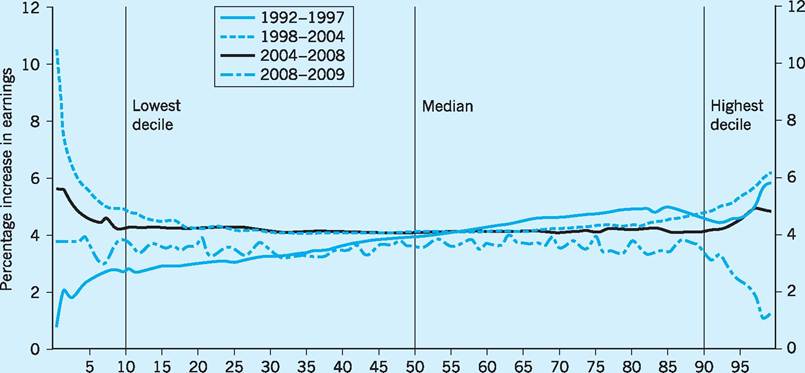
Percentile of the gross hourly earnings excluding overtime distribution (adults aged 22 and over)
Fig. 14.6 Annual increase in hourly earnings of employees aged 22 and over by percentile, UK, 1992-2009. Source: Low Pay Commission (2010b) Figure 2.15.
between 1998 and 2004, those at the bottom of the earnings distribution received higher pay rises than the median earners. Between 2004 and 2008, the bottom half of the earnings distribution still received pay rises above the median earners, though the differential narrowed. Finally, in 2008-09, the recession appears to have narrowed the differentials for the lower half of the distribution, so that earnings for this group increased at roughly the same rate as the median percentile, while the growth of the highest decile was below that of the median.
Much of the research on the effects of the NMW can be divided into four areas: first, to determine the effect of NMW on the wage growth of low-paid employees; second, to determine the number of workers who have been affected by the NMW: third, to determine the relationship between NMW and employment; and, finally, to clarify the relationship between NMW and the distribution of income.
In relation to the first area, Swaffield (2009) uses a technique which attempts to calculate what the real wage growth of low-paid employees would have been in the absence of the NMW or NMW uprating, and then to compare this with the actual real wage rate growth. She concluded that low-wage employees had experienced significantly higher pay increases since the introduction of the NMW than previously. She also found that the wage growth of the lower wage employees followed trends in the growth of NMW, i.e. the wage growth of this sector was larger than would have been expected when the NMW was higher than average earnings and smaller when the NMW was lower than average earnings. It appears that employers must have followed the trend of the NMW - being prepared to give higher wages when NMW growth rates were high, and giving lower wage rises when the NMW growth rates were low.
In relation to the second area, figures show that the NMW raised the pay of between 1.2 million and 1.3 million workers by around 15% (Dickens and Manning 2004) with more females being helped by the NMW (8.2% of all female workers) than males (3.2%) (Dickens and Draca 2004). Further, the minimum wage does not seem to have created ‘spillover’ effects, i.e. the NMW did not create a loss of jobs for other workers earning more than the NMW. Interestingly, research shows that firms tend to shift wages up for all workers when the NMW increased, so that both groups gained. In other words, firms seem to set their wage depending on the action of their competitors and also on market conditions. They often prefer to absorb the extra labour cost, rather than trying to secure maximum return per worker by squeezing wages (Lam et al. 2006).
As far as the relationship between the NMW and employment is concerned, no strong negative or positive effects of the NMW on employment have been found. Studies in this area have tended to compare job losses in the types of jobs or industries most affected by the minimum wage with those least affected by the minimum wage. However, there seems to be some evidence of employers cutting hours of work in response to the minimum wage (Stewart and Swaffield 2004). Other studies have focused on specific parts or sectors of the economy affected by low wages, such as the care homes sector - but even here only minor negative effects on jobs have been found (Arulampalam et al. 2004).
Finally, the question is often asked as to whether the minimum wage has reduced labour market inequality. Research in this area appears to show that while the minimum wage has helped those at the lower end of the earnings distribution (Butcher et al. 2009), other workers further up the earnings scale have also increased their earnings. It may be that the NMW helped to prevent wage inequality getting more unequal, rather than fundamentally changing the income distribution in favour of lower earners. It is worth remembering that the poorest households are not affected by the NMW, either because they are not in work or because they are pensioners (Machin 2003).
Wages and other factors
Wages can also be influenced by institutional practices which bear little relation to market conditions.
‘Spillover' and comparability
The ‘spillover’ hypothesis argues that wage settlements for one group of workers are transmitted (‘spill over’) to other groups through the principle of comparability, irrespective of product and labour market conditions. For example, the pay awards achieved by ‘wage leaders’ often give rise to a sequence of similar settlements in the same ‘wage round’ for other workers.
Non-pecuniary advantages or disadvantages
Not all jobs have the same conditions of work. Some are hazardous, dirty, boring, require the working of unsocial hours, or receive various perquisites (‘perks’).
These will inevitably form part of the collective bargain, and ultimately affect the wage outcome. In some circumstances wage demands may be modified as the union places greater emphasis on non-wage factors.
Cost of living
The cost of living is an important factor in determining the wage claim, and has even been a formal part of wage settlements. When inflation is accelerating, unions become still more preoccupied with securing cost-of-living increases. This can trigger a wage-price spiral when unions overestimate future rates of inflation.
Productivity agreements
Part of the wage bargain may include the abandonment of restrictive practices, and the raising of production in return for higher wages. During the 1960s a whole series of formalized productivity agreements were concluded. The first and most celebrated of these was negotiated between Esso and the unions at the oil refinery at Fawley. A whole range of restrictive practices, including demarcation rules, excessive overtime and time-wasting, were ‘bought out’ by management for higher wages.
I The effects of collective bargaining
The process of collective bargaining is vital in deciding both pay and conditions of service for millions of employees in the workplace. In 2009, some 32.5% of all UK employees were covered by such negotiations between employer and employee representatives. Collective bargaining covered only 17.6% of all private sector employees while it covered 67.4% of public sector employees. Although the coverage of collective bargaining is falling, the process itself is still seen by many analysts as having an effect on the UK labour market, despite the fact that the overall coverage is decreasing.
Pay differentials
A number of studies have suggested a significant pay differential between unionized and non-unionized workers. During the 1980s studies by economists such as Nickell and Andrews (1983) and Nickell (1989) placed this differential as high as 20% in favour of unionized workers, though studies in the 1990s by Metcalf (1994) suggested a lower figure of around 10%. Other research of Blanchflower (1996) also suggests a pay differential of around 10% between unionized and non-unionized workers. The evidence also suggests that such differentials have decreased over time and that they depend, in part, on the degree of union density across sectors; the greater the union density, the greater the pay differential (Addison and Siebert 1998).
However, the nature of the pay differential observed between union and non-union labour may be due to more than simply collective bargaining. First, union labour may be of higher quality than non-union labour, with some of the pay differential due to the higher marginal revenue product of union labour. Second, employers may raise the wages of non-union labour in an attempt to forestall unionization, thereby eroding the pay differential. Third, incomes policies imposed by governments may affect the union/non-union pay differential. Flat-rate norms which are often a part of incomes policy will compress the pay differential that union bargaining power might otherwise have secured.
In practice, the particular effect of trade unions on pay is very difficult to disentangle from those of other labour market conditions. It is interesting to note, however, that both union and non-union workers have on average been able to secure very large increases in real wages, even during periods of high unemployment. The latest research has shown that the differential (or premium) between union and non-unionized workers fell from 10% in the mid-1990s to around 8-9% between 1997 and 2002. Since that time, the differential has fallen significantly to 5.9% by 2009 (Bryson and Forth 2010). Interestingly, the wage differential (wage premium) noted previously seems to rise with recession and unemployment as unions may have been more successful than non-union workers in resisting downward pressures on wages during such periods (Bryson and Forth 2010). This may suggest a fall in the price elasticity of demand for labour as the capital/labour ratio has increased, thereby reducing labour costs as a proportion of total costs (see above), and may also indicate a low and negative unemployment elasticity of real wages.5 In fact, unemployed workers have perhaps ceased to exert a permanent influence on wage determination.
Restrictive practices and labour utilization
It has been suggested that the process of collective bargaining reinforces the unions’ perception that they have ‘property rights’. These rights may include a variety of established practices which have been used to protect jobs or earnings. These practices have important consequences for labour utilization and may form part of the collective bargain. They include the closed shop, minimum staffing levels, demarcation rules, seniority principles, strikes, etc. We briefly review a number of the most important ‘restrictive practices’.
The closed shop
Closed shops confer a number of advantages on trade unions. First, they permit monopoly control over labour supply. This increases the union’s ability to disrupt production through industrial action, and therefore raises its ‘bargaining power’. In terms of Chamberlain’s ratio (p. 287), it raises the ‘management cost of disagreeing’, and therefore union bargaining power. Second, closed shops prevent the ‘free rider’ problem, whereby non-union labour benefits from union bargaining power. Third, closed shops make it easier to enforce agreements reached between unions and management. Indeed, despite restricting the freedom of employers to choose whom they will employ, the closed shop has the benefit of bringing more order and certainty to industrial relations.
As we have seen, all forms of closed shops in the UK are strictly illegal under section 137(1)(a) of the Trade Union and Labour Relations (Consolidation) Act 1992 (c. 52), reflecting the government’s desire to reduce union bargaining power and to protect the right of an individual not to join a trade union. The incidence of closed shops has decreased rapidly since 1979 with contemporary estimates suggesting that only some 9% of firms continue to have some form of closed shop agreement with unions.
Established practices
In industries such as printing, the railways and car production, unions often have, by tradition, some control over staffing levels, job speeds, the introduction of new technologies and demarcation issues, in other words, which type or grade of workers should undertake particular types of work. As a result, management decisions over the allocation of labour within an enterprise are subject to union influence.
The seniority principle
This is the principle whereby union members with the longest service in a firm are the first to be promoted and the last to be made redundant. This principle may conflict with the firm’s desire to employ younger, more flexible and cheaper workers. However, companies may sometimes wish to retain senior workers, having already made a substantial investment in them through specific training. One survey using the British Household Panel Survey showed that for male employees, the seniority-earnings profile appeared to be steeper (i.e. more prominent) in the union sector, while occupation-specific expertise had a more significant effect on wages in the non-unionized sector (Zangelidis 2004).
These restrictive practices may enter into the collective bargain. Unions may seek to trade them for higher wages - as in the productivity agreements noted above. Through ‘buying out’ restrictive practices in this way, management seeks a more efficient utilization of labour, and thereby higher productivity.
The strike weapon
One of the most powerful ‘property rights’ perceived by the unions is their ability to affect the collective bargain by withdrawing their labour, i.e. going on strike. This is viewed by some as the ultimate form of restrictive practice. The use of the strike weapon by unions in the UK has been the subject of much research and debate.
Table 14.5 demonstrates that compared to its major economic competitors the UK was less strike- prone than the OECD and EU averages over the whole period shown. It is often in the context of strikes that governments and employers see union ‘property rights’ as detrimental to Britain’s economic performance, while the unions themselves perceive the withdrawal of labour as a response to the failure of management. In the UK disputes over pay are the most common cause of working days lost, accounting for 70% of the total in 2005-09, followed by staffing and redundancy issues (19%) and work allocation issues (10%), although attributing strikes to a single cause often masks the existence of other contributory factors. The threat of industrial action by a trade union may alone be sufficient to achieve its aims, but one must
Table 14.5 Strikes: international comparisons 1997-2006 (working days not worked per thousand employees).
| Country | 1997-2001 | 2002-2006 | 1997-2006 |
| Canada | 192 | 180 | 186 |
| Spain | 178 | 164 | 170 |
| Denmark | 292 | 38 | 164 |
| Italy | 62 | 111 | 88 |
| US | 54 | 15 | 34 |
| UK | 14 | 28 | 21 |
| France | 20 | 10 | 15 |
| Germany | 1 | 6 | 4 |
| Japan | 1 | 0 | 1 |
| EU 22 | 37 | 41 | 39 |
| OECD | 43 | 31 | 37 |
Source: Modified from Economic and Labour Market Review, International comparisons of labour disputes in 2006 (Hale 2008).
be careful not to overestimate its role or that of actual strike incidence in the process of bargaining. The CBI has reported that both are only rarely given as a reason for employers conceding wage increases.
Although the improvement in Britain’s strike record is clear and indisputable, there has been a dramatic rise in notified individual grievances. For example, the Advisory, Conciliation and Arbitration Service (ACAS) has reported a substantial rise in cases received for conciliation, i.e. prior to a hearing by an industrial tribunal. Perhaps the lack of actual strike activity may not be a good indicator of the actual stresses and strains experienced within the labour market!
Conclusion
We have seen that the trade unions play an important role in the wage-bargaining process, despite the recent decline in union density. The employers’ associations and the government are also important roleplayers in the process of collective bargaining. In recent years there has been a shift in the private sector from national or industry-wide bargaining to singleemployer and, increasingly, establishment bargaining of a largely ‘formal’ nature. Wage negotiation is, however, a complex procedure, and the outcome depends upon the relative ‘bargaining power’ of both management and unions. Wages are also affected by a variety of ‘non-market’ factors, such as comparability, work conditions, cost of living, and the ‘trading’ of restrictive practices. Government legislation in the form of the National Minimum Wage will also influence the wage outcome. Collective bargaining can have an important effect on pay differentials and may even help enshrine a variety of established (restrictive) practices which have been used to protect jobs or earnings. However, the use of the strike weapon appears to be limited to large plants in specific industrial sectors, though the fact that these are often the basic UK or export-orientated industries may still leave the UK at a disadvantage vis-a-vis her international competitors.
Key points
■ Most trade unions are relatively small; around 49% have fewer than 1,000 members. However, these unions have only 0.3% of total union membership. In fact, very large unions with over 250,000 members have around 73% of total union membership.
■ Trade unions in the UK can be one of four types: craft, general, industrial or white-collar. In Europe most unions are industrial.
■ There has been a sharp fall in union membership: in 1979, 54.5% of all employees were unionized, but by 2010 this figure had fallen to only 27.0%.
■ Unions can usually secure higher wages only at the ‘cost’ of less employment unless their bargaining power is strong. If this is the case, they may be able to force employers off their labour demand curves, securing higher wages with no loss of employment.
■ Chamberlain defined union ‘bargaining power’ as the ratio between the management costs of disagreeing and of agreeing to union terms. The larger the ratio, the greater the union bargaining power.
■ A given rise in wages will usually reduce employment by less: (a) the less elastic the demand for the final product, (b) the less easy it is to substitute labour by other factors of production, (c) the lower the proportion of labour costs in total production costs.
■ The government has legislated to reduce union power in various ways, e.g. removing the closed shop, imposing conditions on strikes and other union activities, deregulating the setting of wages and other working conditions, and promoting trade union democracy. It has also legislated to introduce a National Minimum Wage.
■ Other factors influencing the wage settlement include spillover and comparability, non-pecuniary advantages/disadvantages, the cost of living and any productivity agreements made between employers and employees.
■ Fewer strikes currently occur in the UK than is the average for the advanced industrialized countries; e.g. over the period 1997-2006, only around 21 working days were lost per 1,000 employees in the UK compared to 37 for all advanced industrialized countries.
Now try the self-check questions for this chapter on the Companion Website. You will also find useful links to relevant websites.
Notes
1 Trades Union Congress evidence to the Royal Commission on Trade Unions and Employers’ Associations (1968).
2 It may also refer to a Central Arbitration Committee. This is an independent national body which provides boards of arbitration for the settlement of trade disputes.
3 The marginal revenue product of labour (MRPl) equals the marginal physical product of labour (MPPl) times the price of output. Because of diminishing returns to labour, the MPPl curve will eventually begin to slope downwards. This is the part of the curve reflected in Fig. 14.1, since, if MPPl slopes downwards, so will MRPl.
4 In Fig. 14.1 we assume the firm to be small, so that changes in its demand for labour are insignificant relative to total demand for that type of labour. As a result it can purchase all the labour it requires at the going wage rate. For this firm, the supply curve of labour can be regarded as perfectly elastic at the market wage rate. Therefore wage rate = average cost of labour = marginal cost of labour.
5 Unemployment elasticity of real wages =
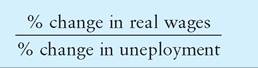
Oswald estimates a coefficient of about -0.10, i.e. ‘we can expect a doubling of unemployment to lower wages by (ceteris paribus) a little under 10%.’
References and further reading
ACAS (2010) Annual Report and Accounts 2009/10, London, Advisory Conciliation and Arbitration Service.
Addison, J. and Siebert, W. (1998) Union security in Britain, Journal of Labour Research, 19(3): 495-517.
Arulampalam, W., Booth, A. and Bryan, M. (2004) Training and the new minimum wage, Economic Journal, 114, Conference volume. Atkinson, B. (1996) National minimum wage, Developments in Economics, 13.
Bain, G. S. and Elsheikh, F. (1980) Unionization in Britain: an inter-establishment analysis based on survey data, British Journal of Industrial Relations, 18(2): 137-57.
Bain, G. S. and Elsheikh, F. (1982) Union growth and the business cycle: a disaggregated study, British Journal of Industrial Relations, 20(1): 34-43.
Blanchflower, D. (1996) The Role and Influence of Trade Unions Within the OECD, Discussion Paper No. 310, London, Centre for Economic Performance, LSE.
Blanchflower, D. G. and Bryson, A. (2008) Union Decline in Britain, IZA Discussion Paper No. 3436, April, Bonn, Institute for the Study of Labor.
Brown, W., Bryson, A., Forth, J. and Whitfield, K. (2009) The Evolution of the Modern Workplace, New York, Cambridge University Press.
Bryson, A. and Forth, J. (2010) Trade Union Membership and Influence 1999-2009, CEP Discussion Paper No. 1003, September, London, London School of Economics and Political Science.
Butcher, T. (2005) The hourly earnings distribution before and after the National Minimum Wage, Labour Market Trends, October, 427-35.
Butcher, T., Dickens, R. and Manning, A. (2009) The Impact of the National Minimum Wage on the Wage Distribution, Research Report for the Low Pay Commission, Low Pay Commission; University of Sussex; and London School of Economics.
Carruth, A. A. and Disney, R. (1987) Where have two million trade union members gone?, Economica, 55(217): 1-18.
Certification Officer (2010) Annual Report of the Certification Officer 2009/10, London.
Chamberlain, N. and Kuhn, J. (1965) Collective Bargaining (2nd edn), Maidenhead, McGraw Hill. Clegg, H. (1978) The System of Industrial Relations in Great Britain, Oxford, Blackwell.
Cully, M., Woodland, S., O’Reilly, A. and Dix, G. (1999) Britain at Work as Depicted by the 1998 Workplace Relations Survey, London, Routledge. Daniel, W. W. and Millward, N. (1983) Workplace Industrial Relations in Britain: The DE/PSI/ESRC Survey, London: Heinemann Education Books.
Dickens, R. and Draca, M. (2004) The Employment Effects of the October 2003 Increase in the National Minimum Wage, November, London, Low Pay Commission. Dickens, R. and Manning, A. (2004) Has the National Minimum Wage reduced UK wage inequality? Journal of the Royal Statistical Society, Series A (Part 4), 613-26.
Disney, R. (1994) The decline of unions in Britain, Economic Review, November, 12-15. Freeman, R. E. and Pelletier, J. (1990) The impact of British union legislation on trade union density, British Journal of Industrial Relations, September, 141-64.
Gennard, J. and Judge, G. (2002) Employee Relations (3rd edn), London, Chartered Institute of Personnel and Development.
Geroski, P., Gregg, P. and Desjonqueres, T. (1995) Did the retreat of UK trade unionism accelerate during the 1990-93 recession?, British Journal of Industrial Relations, 33(March): 35-54.
Gregg, P. and Machin, S. (1991) Changes in union status, increased competition and wage growth in the 1980s, British Journal of Industrial Relations, 29(4): 603-11.
Hale, D. (2008) International comparisons of labour disputes in 2006, Economic and Labour Market Review, 2(4): 32-39.
Hawkins, K. (1981) Trade Unions, London, Hutchinson.
Heasman, D. (2003) Patterns of low pay, Labour Market Trends, 111(4): 171-9.
Lam, K., Ormerod, C., Ritchie, F. and Vaze, P. (2006) Do company wage policies persist in the face of minimum wage? Labour Market Trends, March, 69-82.
Low Pay Commission (2010a) Historical Rates, London, The Stationery Office.
Low Pay Commission (2010b) National Minimum Wage: Low Pay Commission Report 2010, cm.7823, March, London, The Stationery Office.
Machin, S. (2000) Union decline in Britain, British Journal of Industrial Relations, 38(2): 631-45.
Machin, S. (2003) Wage inequality since 1975, in Dickens, R., Gregg, P. and Wadsworth, J. (eds), The Labour Market under New Labour: The State of Working Britain, Basingstoke, Palgrave Macmillan, 191-200.
McKay, S. (2001) Between flexibility and regulation: rights, equality and protection at work, British Journal of Industrial Relations, 39(2): 285-303.
Metcalf, D. (1994) Transformation of British industrial relations? Institutions, conduct and outcomes 1980-1990, in Barrell, R. (ed.) The UK Labour Market, Cambridge, Cambridge University Press.
Millward, N. and Stevens, M. (1987) British Workplace Industrial Relations, 1980-1984, The DE/ESRC/PSI/ACAS Survey, Aldershot, Gower.
Minford, P. and Riley, J. (1994) The UK labour market micro rigidities and macro obstructions, in Barrell, R. (ed.) The UK Labour Market, Cambridge, Cambridge University Press.
Nickell, S. and Andrews, M. (1983) Unions, real wages and employment in Britain, 1951-79, Oxford Economic Papers, 35: 183-206.
Nickell, S., Wadhwani, S. and Wall, M. (1989) Unions and Productivity Growth in Britain, 1974-86, CLE Discussion Paper No. 353, London, Centre for Labour Economics, LSE. ONS (2010) Labour Market Statistics, October, Office for National Statistics, London.
Price, R. and Bain, G. S. (1976) Union growth revisited, British Journal of Industrial Relations, 14(3): 339-55.
Price, R. and Bain, G. S. (1983) Union growth in Britain: retrospect and prospects, British Journal of Industrial Relations, 21(1): 46-68.
Sisson, K. and Marginson, P. (2002) Co-ordinating bargaining: a process for our times?, British Journal of Industrial Relations, 40(2): 197-220.
Smith, P. and Morton, G. (2001) New Labour’s reform of Britain’s employment law, British Journal of Industrial Relations, 39(1): 119-38. Stewart, M. and Swaffield, J. (2004) The Other Margin: Do Minimum Wages Cause Working Hours Adjustment for Low-wage Workers? London, Low Pay Commission.
Swaffield, J. (2009) Estimating the Impact of the 7th NMW uprating on the Wage Growth of Low Wage Workers in Britain, Research Report for the Low Pay Commission (University of York). Walsh, J. (2000) Eurotunnel single union battle provides an early test for CAC, People Management, 22 June.
Webb, S. and Webb, B. (1896) The History of Trade Unionism, Harlow, Longman.
Wedderburn, L. (1990) The Social Charter, European Company and Employment Rights, London, Institute of Employment Rights.
Wood, S. and Bryson, A. (2009) High involvement management, in Brown, W., Bryson, A., Forth, J. and Whitfield, K. (eds), The Evolution of the Modern Workplace, Cambridge, Cambridge University Press, 151-75.
Wright, M. (1996) The collapse of compulsory unionism? Collective organization in highly unionized British companies 1979-1991, British Journal of Industrial Relations, 34(December): 497-513.
Zangelidis, A. (2004) Seniority Profiles in Unionised Workplaces: Do Unions Still Have the Edge? Discussion Paper 2004-9, October, Centre for European Labour Market Research, Aberdeen, University of Aberdeen.