Creation and Origins
Creation stories abound in the myths of Native North America, and there is a remarkable variety in the types of creation narratives. Some myths focus on the creation of the earth and the origins of humans in general, and others simply account for the origins of one particular people.
Some myths tell of people coming to the surface of the earth from deep underground, and others tell of humans being fashioned from corn by creator gods.The Creators and Sacred Power
In Native myths, acts of creation are most often attributed to superhuman beings, often referred to simply as “creators.” Because of the vast differences between Native religions, it is difficult to make generalizations about Native conceptions of superhuman beings. Some Native religions, like those of the Great Plains tribes, hold a belief in a supreme being, sometimes known as the Great Spirit. Such religions, like that of the Lakota, may also teach that all elements of creation, both animate and inanimate, contain the spiritual essence of the Great Spirit. Sometimes the supreme being is thought to be somewhat removed from the day- to-day lives of human beings. Spirits or lesser deities, however, may be more active in everyday human affairs.
Many Native religions also share a belief in a supreme force or sacred power. This sacred power may be manifest in different ways. It may be inherent in parts of the natural world, or it may be an important quality of gods or other supernatural beings. The Navajo of the southwestern United States teach of a Holy Wind, which is a spiritual force that inhabits every element of creation. The Holy Wind enters living beings through their own breath and directs their actions and thoughts. In this way, the Holy Wind connects all living things.
The Aztecs of central Mexico recognized a sacred power that infused elements of everyday life and supernatural beings.
The Aztecs also recognized many different deities, who possessed different aspects of sacred power. Some deities were associated with the power of creation and fertility, and others with the sun. The god Quetzalcoatl, who is often depicted as a feathered serpent, was thought to possess the sacred power of creation. Many mythic narratives surround Quetzalcoatl. One myth teaches that he assisted with creation by providing food and nourishment for the Aztec people. As a result, he is regarded as an important culture hero in Mexico.1Human Origins and Human Ancestors
The creation narratives of indigenous North American religions differ significantly from each other in their accounts of the origin of humans. Some myths describe how humans were created, and others focus on how they came to live in a particular geographic locale. Despite such differences, Native myths often teach that human beings and human ancestors originated in the Americas. This belief contradicts anthropological theories that the Americas were settled by people from Asia tens of thousands of years ago.
The Mayan people of Mexico and Central America have complex creation narratives. Mayan cultural roots go back thousands of years. Although most myths of the Americas have been transmitted orally, the Maya have an ancient written language and texts that contain their mythic heritage. The Quiche Maya, one of several Mayan ethnic groups, are from the highlands of Guatemala. The Quiche creation epic, known as the Popol Vuh, contains stories about creation, the exploits of the gods, and the first humans. The written text of Popol Vuh in the Quiche language dates back several centuries.
The Popol Vuh contains a dramatic account of the creation of the first humans. The creator gods attempted to make humans several times but failed in their first three attempts. The first time, the gods succeeded in creating animals, but they could only squawk and chatter—they could not speak. This disappointed the gods, who wanted humans to be able to worship them with spoken language.
The second time, the creators made humans out of mud, but the clumsy figures just melted away. The third time, the gods fashioned wooden manikins. The manikins looked human and could talk, but they were cruel and heartless. The Popol Vuh tells that these manikins became the first monkeys. Finally, the creators mixed cornmeal with water to fashion human beings. This attempt was successful, and the humans could talk, think, and worship the gods.-Other Native myths do not describe the creation of humans but instead account for their emergence on the surface of the earth. The Zuni live in the southwestern United States. In Zuni mythology, a god called Awonawilona created the world from his own breath and body. At the time of creation, the ancestors of the Zuni lived underground in dark and unpleasant conditions. Eventually, two warrior gods were created. They led the ancestors out from under the earth to live on its surface in the sun. Zuni mythology teaches that the Zuni were the first people on the surface of the earth, but every few years the earth would open again and another people would emerge. The Zuni regard the other Southwest peoples who followed them, like the Navajo and the Hopi, as their younger siblings.3
Think about the nature of sacred narratives, or myths, in Native American and other religious traditions. Do myths play a similar or different role across religions? How so?
\___________________________________________________________________ J
Navajo creation myths similarly describe the ancestors of humans, sometimes known as Holy People, emerging from under the surface of the earth. The myths tell that ancestors of the Navajo lived a stressful and conflict-ridden life underground. This unpleasantness was due to the inherent chaos of their environment—there was neither order nor purpose to life under the earth, and people behaved badly toward one another. To escape the turmoil, the ancestors traveled through many subterranean worlds in search of one in which order would prevail.
They finally emerged on the surface of the earth. First Man and First Woman were born, and it was their responsibility to help create this world.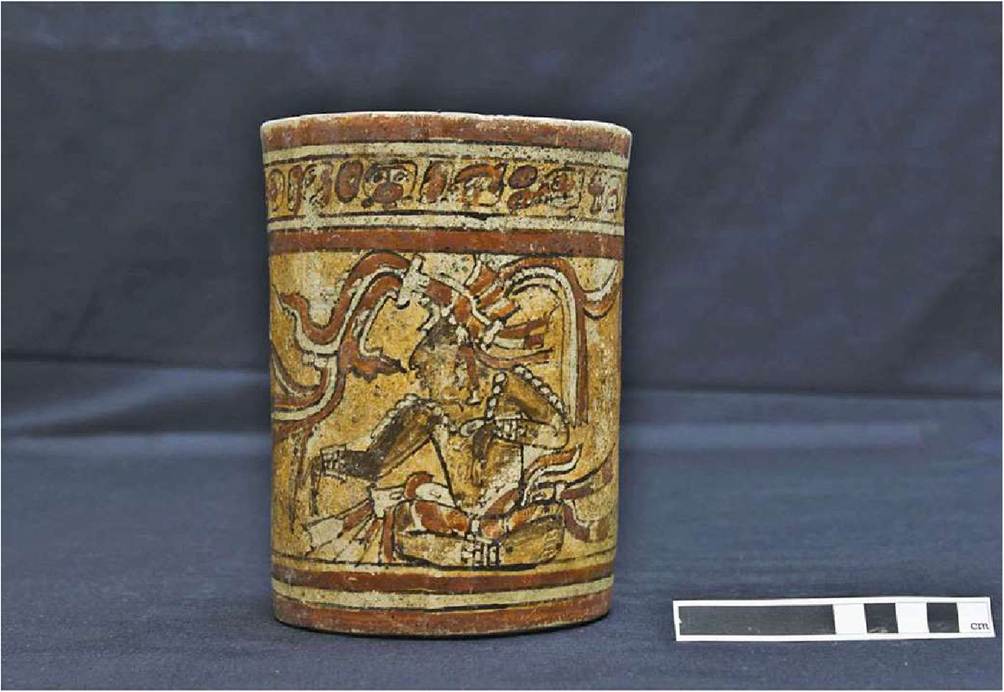
This seventh- or eighth-century vase from Guatemala depicts scenes from the Popol Vuh.
The ancestors prepared the world for humans through specific rituals using special objects. The rituals established order and served as the foundation for Navajo religious practice, even as practiced today. In one ritual, the ancestors created a painting on the ground, in which they depicted all that was going to exist in the world. Then, through prayer and song, the real world came to be from this wonderful painting. In stark contrast to the chaos underground, the world was perfectly balanced and ordered. Eventually, an important figure known as Changing Woman was born. She gave birth to heroic twins, who prepared the way for humanity by vanquishing monsters that roamed the earth. Then, Changing Woman created the first Navajo people from her own body.41
In some religions, ancestors are the spiritual representations of what humans can hope to become. The Pueblo peoples are cultures of the Four Comers region of the American Southwest that include the Hopi and the Zuni. Among the Pueblo peoples, ancestral spirits are known as kachinas. Kachinas, which may take the form of animals, plants, or humans, represent the spiritually perfect beings that humans become after they die. The Hopi believe that in this life, humans are spiritually imperfect. But in the afterlife, the Hopi leave their human nature behind and become unsullied spirits. Humanity’s spiritual imperfection is represented in public dances and ceremonies by clowns. This is because, in Hopi mythology, a clown led human beings as they emerged from the ground. In some of these ceremonies, masked dancers portraying the kachina spirits tell the clowns to mend their imperfect ways and strive to be better human beings. When the dancers don the masks, the kachina spirits inhabit and inspire them.5
More on the topic Creation and Origins:
- Creation Story in Bonda Religion
- Brodd Jeffrey, Little L., Nystrom B., Platzner R., Shek R., Stiles E.. Invitation to World Religions. 4th edition. — Oxford University Press,2022. — 1196 p., 2022
- Origins
- Ukraine or Little Russia?
- The origins and development of Zionism
- Social Origins of Aggressive Expansionism
- The “dramatic circumstances” and the origins of the U.S. constitutional order
- ORIGINS OF CONFLICT
- The origins of constitutional democracy
- The Pre-capitalist Origins of Ruskin’s Thought