Curses and Petitions for Justice from Megara, Knidos, and Corinth
Inscriptions on lead tablets are common artifacts from the Mediterranean world, and they date from the classical Greek period to the Christian era. These tablets range from simple requests to the gods to harm someone (e.g., “Maxima Pontia, for destruction,” Stroud 2013, nos.
130, 131) to more complex texts that call on multiple gods, use magical words (voces magicae), and include figures or drawings. Curse tablets often addressed issues in the agonistic social world of the ancient Mediterranean: love, athletic contests, and court cases were some of the most prevalent reasons that individuals wrote curse texts (Faraone 1991). Petitioners also invoked gods to right injustices, and the tablets that I analyze here are such “prayers for justice.”[132]Of the many curse tablets extant, I have selected these from Megara, Knidos, and Corinth because together they illuminate strategies for mysterious speech and writing, secret and public aspects of cursing, and blending multiple cultural traditions. The Megara tablet uses the language of ανάθεμα that occurs in 1 Corinthians, and it displays hybridity of “Hekatean” and “Hebraic” sources of authority, a cultural intersection similar to that at play in 1 Corinthians, in which Paul balances “Greek” and “Jewish” expectations of his messages (1 Cor 1:22— 24). The Corinth tablets locate magical language and practice in the city to which Paul writes and, with the Knidos tablets, provide additional examples of targets being “handed over” to become ανάθεμα.
A lead tablet from Megara, dated to the first or second century CE (fig. 1), includes the terms ανάθεμα, “something dedicated or cursed,” and αναθεματίζω, “to curse,” and invocations of “Hekatean” and “Hebrew” elements.[133] The lead tablet is inscribed on both sides and does not appear to have been rolled or pierced but may have been folded where a horizontal break occurs in the center.
The inscription begins with three lines of voces magicae, untranslatable words that have Greek elements.[134] An etched line extends horizontally across the top of the tablet and separates the voces magicae from the intelligible Greek part of the curse, which begins with the verb καταγράφομεν, “we inscribe” (l. 4). This verb is common in curse tablets and calls attention to the written nature of the object and the action of scratching the prayer onto the metal.[135] Purchase documentsSide A
ΖΩΑΦΕΡ τον θαλασσόσημον ΣΕΚΤΑ ΝΤΗΑΠΑΦΟΝΟΧΑΙ παιδικόν Πανα- [ίτι]ον έγναμμένον ΚΕΧΑΙΑΝΜ [... κα]ταγράφομεν τούς έκ ΕΞΑΙΟΝ..... ΕΙτους αυτά και άναθεματίζ- [ομ]εν αυτούς· Αλθαία Κόρη ορεο[β]- [αζ]άγρα'Εκάτη άκρουβόρη Σελή- [νη.]ΙΘΙΒΙ... ΜΗ· τούτους άναθεμα- [τί]ζομεν· σώμα, πνεύμα ψ[υ]χήν [δι]άνοιαν φρόνησιν αϊσθησιν ζοήν [καρδ]ίαν λόγοις Έκατικίοις όρκίσμ[α]- [σί] τε άβραικοΐς
...
σους Γη 'Εκάτη Τ...\ ους [κ]ελευόμενοι ύπό τών ιερών ονομ- [ά]των άβραικών τε όρκισμάτων· τρίχας κεφαλήν ένκέφαλον πρ[όσ]- [ω]πον άκοάς οφρ[ύς] μυκτήρας ΟΙ προν σιαγόνας οδόντα[ς] ψυχήν στοναχεΐν ύγεία[ν] τόν αίμα σάρκας κατακάει[ν] [στον]αχεΐ δ πάσχοι και Frag. 1 (lost)a
ΚΑΞΖΩ
b
- - -ME
- -ΤΟΝΟΠ
- - -Α
ZOAPHER TON THALLASSOSEMON SEK NTEAPAPHONQCHAi the beloved child Panaitios inscribed (here?) echaipen. We curse those epaipen. them and we anathematize them. Althaia, Kore, oreobazagra Hekate Moon who devours its tail. ithibi. we anathematize them—body, spirit, soul, mind, thought, feeling, life, heart—with Hekatean words and Hebrew oaths. Earth Hekate.
commanded by the holy names and oaths of the Hebrews—hair, head, brain, face, ears, eyebrows, nostrils... jaws, teeth. so that their soul may sigh, their health may. their blood (and) flesh may burn and (let) him/her sigh with what he/she suffers.
Side B
έπιορκίζω...
και τήν [τ]- ριώνυ[μο]ν σε[λήνην...] και α...ΣΑΙ νύκτιον μέσον δταν τόν π[... σ]- τρέφης και τά θειάων περιπ. ν ούρανοδρόμε καρτερόχ[ειρ] θεωρητέ κυανόπεπλε κα..
.ΟΠΕΤ... κατά γην και κατά [θά]- λα(σ)σαν ή είνο[δία?] ΕΝΩΝΠ άναθεματί- (ζ)ομεν τούτο[υς] τούς κατά Ι.
... του Α... ΚΗΚΟΥ... ΦΑΝΙ. [κα]- [τα]γρά[φο]μεν [είς] κολάσε[ις...] και [ποι]νήν και. ΜΕΤ.
ΕΣ
παρά. περι τών Π.
. ΕΧΑ
τό σώμα·
άνάθεμα.
I invoke... also Moon, the triple-named, who (circulates?) in the middle of the night whenever the. walk about, who courses the heavens with a strong hand, the visible one with the dark-blue mantle. on land and sea, Einodia (?)... we anathematize (?) them.
and enroll them for punishments, pain, and retribution.the body.
Anathema.
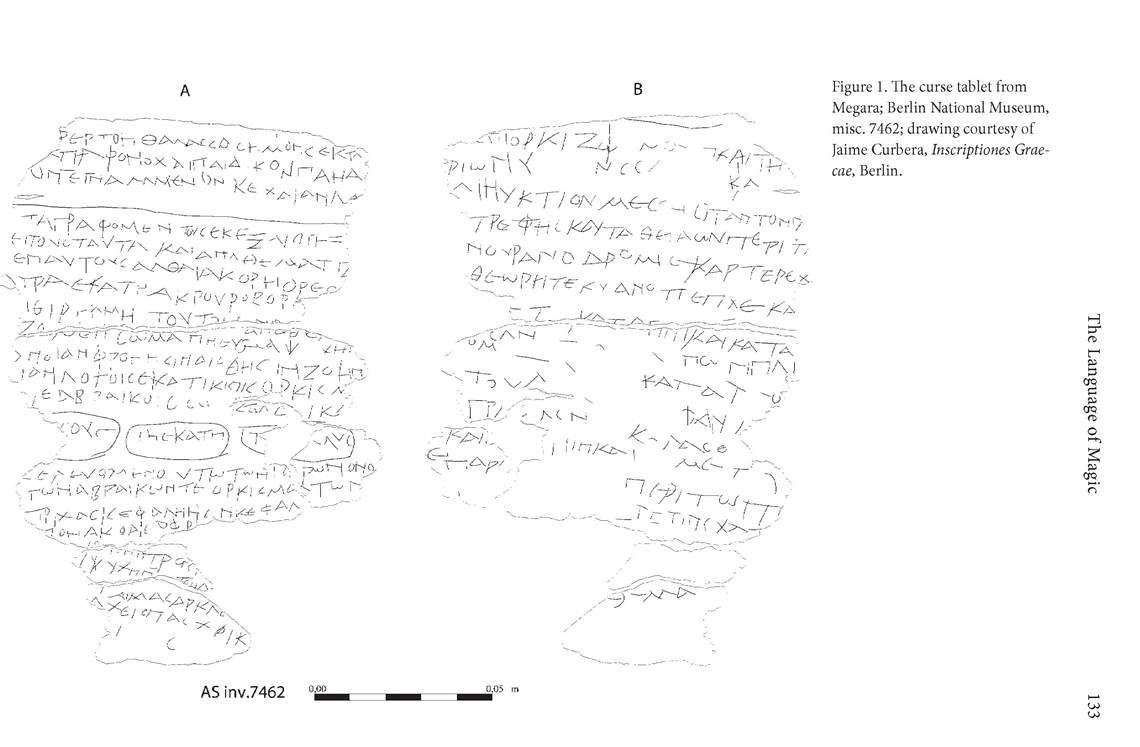
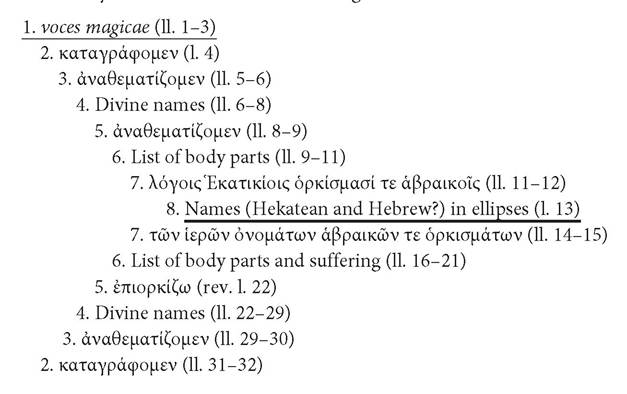
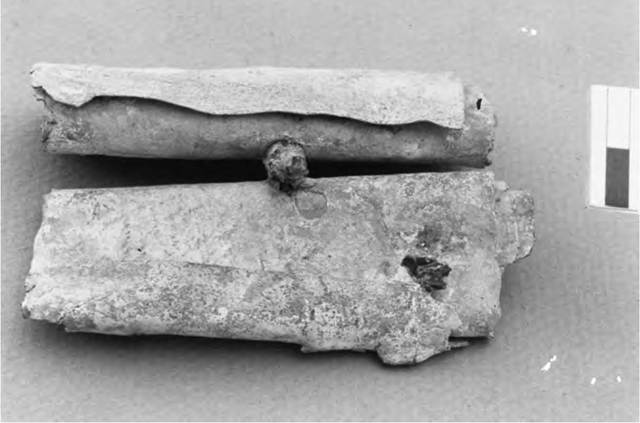
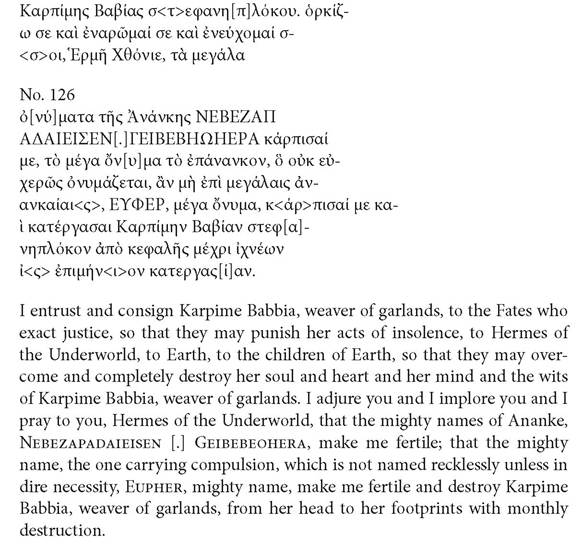
use this verb when one person has conveyed or transferred property or slaves by deed to a buyer (Plutarch, Vit. par. 2.482C; P.Oxy. 1703; 472.19; 306). A similar transaction takes place in this request; the petitioner is placing the victim into the hands of the gods s/he invokes, primarily Hekate. S/he does not state why s/ he does so. The second verb in the tablet is άναθεματίζομεν (l. 5), “we dedicate to evil or curse,” a verb used also in lines 8 and 29.[136] [137] At the end of the curse, the noun ΑΝΑΘΕΜΑ is set apart as if it were a title. The concept of άνάθεμα and dedicating a person to god is central to the logic of this tablet. After inscribing and cursing the targets, the petitioner addresses Hekate with Greek epithets and names in unknown or mysterious languages: Αλθαία Κόρη όρεο[βαζ]αγρα'Εκάτη άκρουροβόρη Σελή[νη].[138] [139] The petitioner repeats, “we anathematize them,” and adds a list of personal targets: “body, spirit, soul, mind, thought, feeling, life, heart.” Lists of body parts often occur in binding spells and proceed from head to toe. This list, however, is abstract and targets the “spiritual” rather than “physical” parts of the person. The άνάθεμα gains its power through λόγοις 'Εκατικίοις όρκίσμασί τε άβραικοΐς, “Hekatean words and Hebrew oaths” (ll. The reverse side begins with the verb έπιορκίζω, “I swear an oath,” or “I exorcise.” The verb connects this side of the tablet with the “oaths [όρκισμάτων] of the Hebrews” from the obverse. Roy Kotansky argues that concepts of demon possession and exorcism are characteristic of Semitic magic and foreign to classical Greek thought, which instead engaged in binding spells and called upon gods and demons from the underworld (Kotansky 1995, 246-65). In the Hellenistic and Roman periods, however, magical texts blend Greek binding spells with Semitic exorcisms and amuletic protection against indwelling demons. This tablet is an example of this blending (Kotansky 1995, 273-75). Rather than calling on lao, Adonai, or Michael—common names for Hebrew exorcistic purposes—this tablet substitutes Hekate and retains elements of traditional Greek defixiones—registering the target for punishments and listing targeted body parts. The curse finishes with additional epithets that implore Hekate as someone whose character and mythology makes her appropriate for cursing. She is “triple-named,” evoking the triple-headed image of Hekate, and she goes about in the middle of the night, which makes her ideal for nocturnal activities (ll. 22-24).[140] The text ends with additional uses of the verbs αναθεματίζω and καταγράφω (ll. 32-29), and finally the word ΑΝΑΘΕΜΑ set apart from the rest of the curse (Gager 184,1992 n. 22).[141] While ανάθεμα in typical Greek usage indicates an offering or dedication to a god, in Septuagint Greek it translates the Hebrew ?ΊΠ (herem) and signifies something set apart for destruction (Lev 27:28; Deut 7:26; 13:17; Josh 6:17-18; 7:11-13; Zech 14:11; Philo, Migr. 98; Her. 200). The reuse of these verbs highlights the symmetry of the curse: On the obverse, after voces magicae and a horizontal line, it begins with καταγράφομεν, followed by αναθεματίζομεν and a list of divine names. On the reverse is a list of divine names, followed by αναθεματίζομεν and καταγράφομεν. At the center of the structure are the names in ellipses, on either side of which are references to “Hebrew oaths.” Table 1. Symmetrical Structure of the Megara Tablet 1. ANEOEMA (l. 38) The language and graphic organization of the tablet highlight two characteristics of magic in the ancient Mediterranean world: obscurity and hybridity. Obscurity occurs in the opening voces magicae and in the named and unnamed gods. The petitioner signals that s/he knows how to address the gods—here, with Hebrew and Hekatean words. Hybridity occurs in the melding of multiple traditions. The petitioner seems familiar with Hekatean traditions, since s/he knows her epithets and images. The Hebrew elements likely surface in the framed names at the center of the tablet. In Greek and Latin literature, the Jews, especially Moses and Solomon, have a reputation for magic.[142] Magical papyri and tablets invoke the Jewish lao, Sabaoth, Adonai, and the archangels, alongside Greek and Egyptian names.[143] The Sepher ha-Razim, incantation bowls, and amulets demonstrate Jewish practices of harnessing divine powers from the Second Temple period to late antiquity, in Palestine and the diaspora (see Bohak 2011). In this text, the blending of “Hebrew” with “Hekatean” is not haphazard: The coexistence is formulaic and structured to achieve a wide-ranging call to powerful gods. The Megara tablet provides little information about its ritual setting because its find spot and context are unknown. By contrast, the curse tablets found in the Sanctuary of Demeter in Knidos, in Asia Minor, provide more information about their location and ritual. These tablets provide important parallels to those found in the Sanctuary of Demeter in Corinth, which I will discuss, and demonstrate the public nature of curse practices. Charles T. Newton found fourteen lead tablets dating to the first century BCE near statue bases in the temple (Newton 1863, 2:719-45. Nos. 81-95 [= DT 1-13]). These formulaic prayers for justice invoke Demeter as the primary agent of justice, as well as Kore, Pluto, and other “gods with Demeter.”[144] The prayers lack voces magicae and graphic and linguistic obscurity. They name the petitioners, who are in all cases women, but rarely name the target, either because he or she is unknown or because the target's recognition of his or her wrong and action to rectify it is critical for the ritual process. The targets have wronged the petitioners in some way; one target has accused the petitioner of poisoning or cursing her husband, and she wants to clear her name (Newton 1863, no. 85 [DT 4]). In another inscription, someone has taken clothing from the petitioner, and she wants him or her to return it to the sanctuary (Newton 1863, no. 82 [DT 2]). As in the Megara tablet, the petitioner transfers the target and case of injustice to the goddess. The Knidos tablets use the verbs άνιερόω and άνατίθημι, “make an offering” or “dedicate,” which emphasize the ritual act of dedication to the goddess. As in the Megara tablet, the targets are άνάθεμα, handed over to the goddess for judgment, and the curses ask that the goddess cause the target pain.[145] This affliction leads to a ritual in which the target goes to Demeter, the divine arbiter of justice, to confess. Many of the tablets include a clause that protects the petitioner in cases where she might encounter the target: “Let it be permissible for me to go to the same bath, under the same roof, or to the same table.”[146] This clause suggests that the target is unknown, the community is small, and she will encounter the cursed person. The divine power is a contagion; once someone has requested the goddess obtain justice and inflict harm, retributive power has been released and has the potential to affect those near the target. The ritual tablet, then, serves as a curse and an apotropaic device; it seeks justice and protects. The Knidos tablets were found folded, broken, and pierced with nails. Newton interpreted the holes in the top center of many of the tablets to indicate that they were displayed in the temple.[147] Most curse tablets, including prayers for justice, were found in graves or wells, hidden from view. The display of the Knidos tablets highlights the tension between secrecy and common knowledge in curse procedures. They ritualize public knowledge of acts that were normally secret—both the curse ritual and the wrongdoing that caused it. Through display of the tablets, women who petitioned Demeter simultaneously sent a message to the goddess and to the community, and this dual audience gave the ritual power. In Knidos, Demeter was a goddess suitable for petitions for justice. Also in Corinth, women from the first to fourth centuries CE inscribed tablets and deposited them in the Sanctuary of Demeter. Excavators found eighteen tablets, many of which were rolled up and pierced with nails. Ten of them were found near altar bases in a dining room from the Greek era of the Sanctuary, the only part of the abandoned lower terrace rebuilt by the Romans.[148] Other tablets were found in a nearby room on the lower terrace and on the upper terrace near the central and easternmost temples, thought to be dedicated to Kore and the Fates.[149] The earliest of the tablets dates to the mid-first century CE, about a quarter of a century prior to Roman rebuilding (Stroud 2013, nos. 130 and 131). Several tablets resemble prayers for justice, like those at Knidos. One appears to be a love spell and another a curse for a court case. Many of the tablets are fragmentary and difficult to decipher.[150] In addition to the ten tablets in the “Building of the Tablets,” excavators found used terracotta lamps and incense burners (θυμιατήριον). These objects, combined with the small space and lack of windows, suggest a dimly lit atmosphere in which only a few people could gather. Also in this room, excavators noted bits of lead from other disintegrated tablets (Stroud 2013, 147). These lead remnants and the possibility of other decomposed materials (wax, paper, etc.) often used in magical procedures demonstrate the significance of the lead tablets that are extant. The Sanctuary of Demeter saw a significant amount of ritual activity, possibly nocturnal, involving inscribed incantations. A rolled up tablet (no. 133) found near the south wall of the central temple on the upper terrace exhibits similarities with the petitions for justice at Knidos (Stroud 2013, 125-26; Corinth inv. MF-1973-38). The text of this tablet begins: Κυρία Δήμητρα δίκια. The term δίκαια may be either an epithet for the goddess, “Lady Demeter, the Just,” or a neuter plural connected to the request that follows the vocative naming of the goddess. Either way, Demeter is Figure 2. The double curse tablet no. 125/126 (Corinth inv. MF-1969-294 and MF-1969-295), as found; Source: Stroud 2013, 104; photo courtesy of American School of Classical Studies at Athens, Corinth Excavations. associated with obtaining justice.[151] This tablet is the only one recovered from the Sanctuary that calls on Demeter. Beyond the initial address, the text is cryptic. The second line may include the name Ανάγκη, “Necessity,” which occurs in other tablets from the Sanctuary (Stroud 2013, 127; see tablets 122, 125/126). The verb [άν]έθηκαν, “they dedicated,” occurs in line 5. We have seen the language of άνατίθημι in the Megara and Knidos tablets. The petitioner here has likewise dedicated a target to Demeter, or made him or her άνάθεμα. A better-preserved text is the double tablet, nos. 125/126 (fig. 2), against a woman named Karpime Babbia.[152] No. 125 παραθίτομα[ι] και καταθί[το]μα[ι] Καρπί- μην Βαβίαν στεφανηπλόκον Μοίραις Π- ραξιδίκαις δπως έγδεικ[ήσ]ωσι τας ΰβρ{ι}εις, Έρμη Χθονίω, Γη, Γης παισίν, [δ]πως κατεργά- σωναι και διεργάσωνται ψ[υ]χήν αυτής και καρδίαν και νοΰ αυτής [και] φρένες These two lead tablets were rolled up together and pierced with nails. This tablet shares with the Knidos tablets a desire for justice and displays another concern central to Demeter cults: female fertility. The petitioner “consigns and entrusts” (παραθίτομαι καί καταθίτομαι) a woman named Karpime Babbia to the “Fates who exact justice [Μοίραις Πραξιδίκαις].”[153] The unnamed female petitioner wants the Fates to expose Karpime Babbia's “acts of insolence” (τας ΰβριεις). The misspellings and letter transpositions in these lines may indicate that the author has limited literacy. She asks “Hermes of the Underworld, Ge, and the children of Ge,” to attend to the woman's destruction. As in the Megara tablet, the petitioner lists the parts of her target that she wants destroyed—“her soul and heart and her mind and wits.” The pathos of the situation emerges in the rhythmic and supplicatory language of the curse: “I adjure you and I implore you and I pray to you, Hermes of the Underworld.” She calls on the “great names” to make her fertile (κάρπισαί με): first, Ανάγκε, Necessity, who is often invoked in the magical papyri and who, according to Pausanias, had a sanctuary dedicated to her and Βία (“Force”) on the slope of Acrocorinth near the Sanctuary of Demeter (Descr. II.4).[154] Second, she invokes two voces magicae.[155] The petitioner repeats the call to “the mighty name, the one carrying compulsion, which is not named recklessly unless in dire necessity [avavKaic],” and asks a third time for fertility. Karpime Babbia’s injustice may relate to the petitioner’s lack of fertility. Perhaps she insulted the barren woman or flaunted her own ability to have children. The woman’s recourse is this tablet and ritual, especially asking the gods to give Karpime “monthly destruction.” The repeated requests for fertility, supplicatory language, and call to Necessity indicate a powerless position. The petition, accompanied by precise rituals and spoken words in a dark room, gives the woman power. Finally, one curse tablet from the first century CE in the Building of the Tablets is a love charm. The petitioner “binds” (Karabsopsuw) Secunda Postumia—“her mind, her wits, her hands, her sinews, her knees, her entire body” (Stroud 2013, 86-87, no. 118). On the reverse is an “intentional and puzzling palimpsest” in which a different hand wrote two texts: first, an unintelligible text, and then, another text inscribed in both horizontal and vertical lines on top of the first text (Stroud 2013, 91-92). The jumble of letters may include voces magicae or a message intended to be read in a different direction, or it could be completely unintelligible. Either way, the obscurity and mystery created by writing in layers is intentional and viewed by the author as communicating a message (or messages) to an otherworldly recipient. This limited selection of curse tablets shows their formulaic yet fluid nature. The metal and the act of targeting a person for judgment remains the same, but the ritual and language varies. The logic of magic requires petitioners to address the gods so that they will attend to their requests. Knowledge of foreign and unknown names and mysterious languages translates into power to achieve supernatural and social results. The value of foreign and mysterious knowledge leads to processes of blending traditions and languages—Greek, Hebrew, and Egyptian. What other people know about the ritual act, moreover, influences the perceived efficacy of the curse. The process at Knidos ritualizes public knowledge in order to accomplish justice. The palimpsest text from Corinth hides and reveals a divine message. Both the locutionary and inscribed parts of the ritual lead to communication with the god. The performative statements “I inscribe” or “I curse” or “I dedicate” happen in the moment of speaking and have permanent expression in writing. Students of 1 Corinthians may hear much that resonates in this discussion of the use of obscure language, esoteric and common knowledge, and speaking and writing in these tablets. The same issues arise in Paul's arguments about praying in tongues and prophesying. I will now turn to Paul and begin with his use of the term ανάθεμα.
More on the topic Curses and Petitions for Justice from Megara, Knidos, and Corinth:
- Chapter Twelve Eric Moore Channeling Identity: The Fountain of Glauke in Corinth and Jacob's Well in John 4
- Restorative Justice: social service, paradigm shift, or social justice movement?3
- Restorative justice in Islamic law: application in Malaysian legal history and the criminal justice system
- Justice, utility and the ‘Justice of Nature'
- Justice as Performance
- Justice and Iconography
- Restorative Justice
- Reflections on Justice as Fairness
- Understanding the Term “Environmental Justice”
- Transitional Justice
- Accepting That Justice is Fair
- Defining restorative justice