FRANCESCA ROCHBERG, UNIVERSITY OF CALIFORNIA, BERKELEY
From the features and marks on the sheep’s liver and other entrails to the characteristics of the human body and face to the behavior of animals and the appearances of stars and planets, the investigation of the meaning of ominous signs in ancient Mesopotamia took shape in serialized lists of omens arranged as correlations between the signs and what they signified.
An omen is a pair of interdependent elements, on the one hand a sign in the natural world or social environment, and on the other an event in social life. The connection between the two elements is expressed by means of a conditional statement “If P, then Q.” The signs collected in written lists of “If P, then Q” statements corresponded to visible, imaginable, or conceivable phenomena, but always grounded in consideration of or in relation to physical things. This paper is concerned with form and its effect as a systematizing device in omen texts. Form and system are two key aspects of what constitute the general principles of Mesopotamian omen divination as represented in omen text series (entitled Summa P “If P”). These principles give us not only insight into the internal consistency and coherence of the texts, but also the styles of reasoning employed. The practice of divination is a separate issue and is not addressed here except in a minor way.An omen statement, from a formal point of view, can be seen as a relationship between two propositions (P and Q) which function as premise and conclusion. Logically, the conclusion, or consequent, is inferable from the premise. In his study of theories of the sign in classical antiquity, G. Manetti drew the conclusion that,
from the point of view of a historical reconstruction of the discipline of semiotics, the most significant aspect of Mesopotamian divination is that it is centered precisely on a distinctive and individual notion of the sign, which is a scheme of inferential reasoning that allows particular conclusions to be drawn from particular facts (Manetti 1993: 1-2).
One of the most basic of inference schemes, or rules of inference, is modus ponens. It is defined by its form, thus: If P, then Q. P, therefore, Q. This inference scheme was first defined as such in Stoic philosophy in the context of the investigation of the logic of propositions and inference from signs (Rochberg 2009: 14-15, n. 5). All Babylonian omens qualify. Thus, “If Jupiter becomes steady in the morning: enemy kings will be reconciled” (Reiner and Pingree 2005: 40-41 line 1, without indicating breaks). Jupiter is steady in the morning. Therefore, enemy kings reconcile. The “If P, then Q” statements of the omen lists relate sign and signified in the manner of the antecedent and consequent of inferences of this form. A temporal or sequential relationship between the sign and the signified may be read into the grammar of the Akkadian “if... then,” or summa-clause, the antecedent expressed in the preterite, the consequent in the durative, though the temporal relation seems to be mitigated by the fact that the entire statement is hypothetical and can even contain an antecedent which cannot occur (is unobservable). The relation between P and Q remains, therefore, somewhat abstract from a temporal standpoint. Further consideration of the connections between P and Q (below) clarify this problem. Regardless of the temporal relation, antecedent and consequent in the omens maintain a certain logical relation, as any conditional statement does, and this logical relation will apply independently of phonetic, semantic, causal, or empirical connections between the statements P and Q (Rochberg 2009).
The question of what the conditional form might suggest about the meaning and purpose of omens has not been adequately addressed because of certain assumptions about the origins of omens in empirical connections enabling the prediction of Q on the basis of P and rationalizing future predictions of Q from P (Rochberg 2004: 268). A former consensus on this point no doubt underpins Manetti, who allows that the empirical connection constitutes one form of connective tissue between P and Q, or what he calls the “passage from protasis to apodosis” (Manetti 1993: 7).
He said, “the first type of passage is linked to what is known as divinatory empiricism: the protasis and the apodosis record events which really occurred in conjunction in the past” (1993: 7, emphasis in the original). He takes as evidence of this divinatory empiricism the Mari liver models, whose interpretation has been subject to some difference in interpretation (Rochberg 2004: 269). Apart from this evidence, however, Manetti recognized a tropic associative connection, usually based in analogies of various kinds, between protasis and apodosis as well as the schematic expansion of elements of the antecedents (which he calls “codes”) familiar from all omen series. The empirical, however, is viewed as original to the conception of the ominous sign and the other modes of relating P and Q are of secondary origin in a historical evolution of Mesopotamian divination (1993: 7).In basic agreement with Manetti concerning non-empirical modes of relating P and Q in omen statements, I differ with his historical conclusions about an original empiricism underpinning divination by signs. The construction of omens in which paranomastic relations between a word in the protasis and one in the apodosis, or where various analogies made between elements of the sign and its portent, or, indeed, where “impossible” phenomena which cannot have been observed at any time are presented in omen protases, all demonstrate omen divination’s independence from empiricism. Without any evidence in support of the actual observation of co-occurring phenomena the thesis of an original empirical relation remains purely conjectural. Though the non-empirical nature of the bulk of the cuneiform omens is clear, it is worth making explicit by a few examples. Let us again take the omen “If Jupiter becomes steady in the morning, enemy kings will be reconciled.” To accept the empirical association of P and Q is to presume that at some time in the past it was observed that following the steadiness of Jupiter in the morning, enemy kings were reconciled, and further, to justify on the basis of that empirical connection future predictions about enemy kings being reconciled whenever Jupiter is “steady.” But this omen is simply built upon an analogy drawn between the elements of the protasis, that is, Jupiter, Marduk’s star, connoting rulership, and its “steadiness” (expressed with the verb kanu) connoting rectitude and stability, and the elements of the apodosis, that is, peace between enemy kings.
The same is true for instances of paranomasia between words in the antecedent and consequent. For example, in the extispicy series (Clay 1923: no. 13:65): “If the coils of the intestine look like the face of Huwawa (written logographically dHUM.HUM): it is the omen of the usurper king (also written logo- graphically, IM.GI = Akkadian hamma’u) who ruled all the lands.”Here the antecedent is related to the consequent by a wordplay based on the homophonous echo of HUM.HUM in hamma’u, not by any empirical connection between intestines coiled that way and a usurpation. The homophony pertains between the logogram dHUM.HUM in the
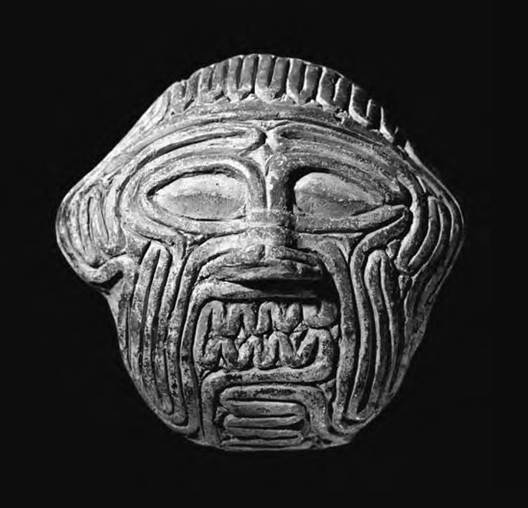
Figure 2.1. Clay mask of the demon Huwawa. Sippar, southern Iraq, ca.
1800-1600 B.C. 8.3 X 8.4 cm. ME 116624. Courtesy of the British Museum
protasis and the Akkadian reading of the logogram IM.GI in the apodosis. The antecedentconsequent connection, therefore, is based upon a homophonic play that requires and even presupposes a sensitivity to orthographic practice of the highly trained cuneiform scribe. Though the meaningful connection between antecedent (intestinal coils appearing as the face of Huwawa) and consequent (usurpation) is based on the phonetic play between words, the image (fig. 2.1) refers to the visual aspect of the imagery conjured by the protasis alone. Regarding the connection between protasis and apodosis, the omens illustrate scribal invention involving the sounds, meanings, writings, literary allusions (e.g., Clay 1923: no. 13:33, in which the coils looking like an eagle are read as “the omen of Etana,” who ascended to heaven on the back of an eagle), as well as visual analogies between elements, such as might be constructed between the appearance of a cuneiform sign and what it signifies: “If the coils of the intestine look like a PAP-sign: your capital will prosper over the enemy’s capital.” Here the PAP-sign, two crossed wedges, is visually iconic for the notion of conflict.
Or, coils that appear as a kubsu-cap (Clay 1923: no. 13:47), the headdress associated most particularly with royalty (or divinity), are read as significant for the “throne,” again by an iconic means of sign representation.To return to the question of the temporal relation of Q to P, then, if the omen consequent is meant to convey the meaning, or the reading (interpretation) of P, then we do not have a series of observation statements about what particular event in fact occurred following another particular event, but a series of hypothetical statements showing that P indicates Q. From such statements, however, one could come to expect Q in the event of P, and it is here that the potential for prediction is located.
The analogies drawn from sign to portent represent attention to particulars, but not necessarily to observable particulars, though visual analogies between elements of the protasis and apodosis are also attested. Associations of elements such as the sounds or meanings of words are not dependent upon empirical observation, yet, as the examples just mentioned illustrate, they construct meaningful and valid signification between antecedent and consequent that depend instead upon cultural or linguistic conventions. Analogic relationships construed between phenomena, especially analogies based on the sounds, spellings, or meanings of words for phenomena, are certainly subject to, but not wholly determined by sensory perception. Correspondingly, such relations are limited not by perception but by conception. As seen in some of the examples given, analogic connections made between particular elements of the protases and apodoses justify the inferential character of Babylonian omens. But the particularity of the analogous referents in the statements of protasis and apodosis (e.g., the homophonic relation between HUM.HUM and hamma’u) in no way compromises the general force of the omen. As T. Czezowski observed,
Mill claimed that reasoning by analogy — “from particulars to particulars,” as he put it — is the fundamental form of reasoning, while reasoning by induction is in a sense a synthesis obtained by embracing a number of analogical cases together.
To Mill a general statement is a conjunction of singular sentences which are subordinated to it. The train of reasoning is as follows: on the basis of a number of similar observations saying ‘a is b,' when there are no observations to the contrary ‘we feel warranted — as Mill says — in concluding, that what we found true in those instances hold in all similar ones, past, present, and future, however numerous they may be” (Czezowski 2000: 110, citing Mill 1886: 122).The omen constructed by means of an analogical connection is assumed to apply “whenever P,” and therefore has validity beyond any single occurrence.
The use of schematic relationships such as up-down, the four directions, the five colors, has been cited as a reason why ominous “phenomena” are not always observable in actuality. The celestial omens exhibit this characteristic. Phenomena such as the eclipse where the shadow moves in a direction opposite to that which occurs in reality, indeed, most of the extant Jupiter omens of Enuma Anu Enlil are “impossible.” These have the planet “entering,” “passing,” “coming close to,” or “being in the middle of” fixed stars whose latitudes with respect to Jupiter's path prevent this from ever occurring. In fact, as David Pingree pointed out (in Reiner and Pingree 2005: 28), “this choice of constellations far removed from the path of Jupiter seems to be deliberate,” because when the planet is north of the equator (between the spring and fall equinoxes) the constellations it is associated with in these omens are to the south and vice versa. This can be explained in terms of the value placed by the scribes on conception as well as perception, and the omen corpus forces us to try to understand just what the relation is between the conceivable and the possible in ancient Mesopotamian thought, and how these categories map onto physical actuality. The character of the omen lists, which is the result of its formal as well as schematic nature, shows the importance not only of a different kind of knowledge, but also a different way of categorizing the physical.
That the relationships between the empirical, the actual, and the possible should be constructed differently in the Babylonian conception almost goes without saying. In later antiquity, for example, one can refer again to the Stoics, whose views on the actual and the possible also map differently from ours. The Stoic definition of the possible is rooted in the investigation of propositions (possible vs. necessary) and therefore has to do with the nature of predicates and their relation to principal (as opposed to initiating) causes. That the Stoic definition of possibility took shape in the context of the logic of propositions and how truth functions with respect to past or future events was furthermore of importance to the analysis of oracles and omens (Reesor 1965: 293). As in the Stoic discourse, the significance of the possible in cuneiform divination applies as well to the connection between antecedent and consequent in the context of making statements concerning future events. In light of the evident interest in possibility represented by the omens resulting from schematization without regard for actuality, the empirical dimension of omens hardly applies at the level of the connection between P and Q, even when the phenomenon of the protasis is observable. But in addition to the schemata which expand the possibilities for constructing signs, the many analogies and wordplays that connect P to Q by virtue of cuneiform cultural conventions, some of the nature of wordplay only evident to scribes (or Assyriologists), are also evidence of the relative unimportance of the empirical on the level of the connections made between P and Q. That each omen forms a valid conditional, however, is of the essence.
The analysis of the conditional form of Babylonian omens shows that though the omen statements certainly posit relations between phenomena that do not depend upon the physical and causal connections we ourselves would make, the relation between protasis and apodosis is a logically valid one that furthermore can be classified with inferences expressed in the form of conditionals. Inferential reasoning, sometimes embedding analogic reasoning, thereby lies at the basis of the connections between the propositions of antecedent and consequent. The claim that divination proceeds by means of a rational and systematic method is nothing new but perhaps shows from yet another standpoint that the particular difference in assumptions about the phenomenal world that we find in cuneiform divination texts are unrelated to cognition, being a function rather of culture. Second, and more interesting I think, is that the logical and systematic features of ancient Mesopotamian divination appear to be direct consequences of the use of the conditional as its form and mode of expression. Of course it is above all the logical and systematic nature of omen divination that has justified its classification as an ancient science.
Given the previous observation that despite its logical and systematic nature Mesopotamian divination does not conform to (modern) scientific standards of causality or knowledge, we might question whether the term “science” is too loaded, or simply anachronistic and inapplicable to an investigation of the human (cognitive) interaction with physical phenomena in ancient Mesopotamia. The same question has been addressed with respect to pre-nineteenthcentury sciences in general (Cunningham 1988; Cunningham and Williams 1993; Cunningham and French 1996). But to limit the discussion of what the nature of ancient Babylonian divination is by erasing the term “science” from our discourse about it leads us back to the dichotomy of science and non-science, science and religion, or worse, science and superstition. If the term “science” is confined to the modern era, as Peter Dear has discussed in his critque of Cunningham’s thesis (2001), medieval and renaissance science, including natural philosophy and the physical and mathematical sciences also end up on one side of a great divide between science and non-science. Dear’s sensitive critique argues for further refinement of the categories science and natural philosophy and their relation to religion, and a finer-grained empirical as well as historicist treatment of sources in terms of which the sciences are defined.
Attempting such a finer-grained analysis of the sources for Babylonian divination as well as other ancient sciences (e.g., astronomy, magic, medicine) is a worthy goal. Focussing on formal considerations of the omen texts has uncovered the logical and systematic nature of these texts as a direct result of their conditional form. Their logical, systematic, and inferential character, I would argue, warrants classification with science. Other aspects of cuneiform divination, particularly those involving the practice (as opposed to the nature) of divination, indicate other possible classifications, for example, with magic or religion. The problem is that none of these categories are found in Akkadian terminology, though there are words for observe (nasaru) and predict (qabu), apotropaic ritual (namburbu), incantation (siptu), and gods (ilu).
The category “non-science,” on the other hand, does not seem to be useful as its purpose is to set what we now hold to be justified correct scientific knowledge apart from unjustified or wrong belief. This has the mouthfeel of morality rather than history. For analyzing cuneiform omen texts, dichotomous models only generate and then perpetuate un-nuanced ideas about what the nature of Mesopotamian divination was, reminiscent of early anthropological characterizations of other divination systems as pre- or non-logical (such as Spencer, Frazer, Tylor and, most famously, Levy-Bruhl) and therefore as invalid explanations of phenomena.
In light of the above analysis of the effect of the conditional on the logical structure of omens it would be difficult to sustain claims to pre-logical thinking, or the notion of a different rationality. It must be said that more recently it has been pointed out that Levy-Bruhl did not promote a racist agenda, as did some in the early twentieth century, and ultimately, under pressure from some of his critics, came to think that his two types of “mentalites” (the pre- logical and the rational) coexisted within all societies. The result of this wholesale revision was that magical thinking, which was not genetic, cognitive, or evolutionary, was not replaced by non-magical thinking through the inexorable progress of cognitive evolution. Anthropology rid modern cognitive historians of the idea that “primitives” had a tremendous oral memory but a limited power of abstract reasoning (van der Veer 2003: 183; cf. Peek 1991).
Correspondingly, the history of the use of the term “superstition” further demonstrates its inapplicability to Mesopotamia. The pejorative meaning of the Latin superstitio stems from the first-century B.C. Roman condemnation of divination not sanctioned by the State, later having the force of “unreasonable religious belief,” as opposed to religio, the reasonable, or proper, fear of the gods (Salzman 1987: 174 and nn. 10 and 14). Legislation in A.D. 297 against illicit divination and superstitio was an ideological and political tool, aimed against sorcerers and Manichaeans, not against the practice of divination in principle. Because of its origins, the use of the term “superstition” in historical analysis, unlike use of the term “science,” can only have an invidious effect, connoting wrong belief. Despite the diversity of the cuneiform divination corpora, there is no evidence of ideological conflict such as that between orthodox and unorthodox divination in the Roman principate. More importantly, no distinction was ever invoked in cuneiform texts between say, astronomy and astrology. This is clear in the late Uruk tablet which gives effective rules not only for predicting month lengths and lunar eclipses from empirical data available in the astronomical diaries, but also contains sections for use in predicting worldly events of a political nature, such as we have in omen apodoses, and concludes with the subscript BE-ma ES.BAR 3,20 ana IGI-ka sa dUDU.IDIM.MES ina lu-mas KIN.KIN-ma “In order for you to see a divine decision (purussu) about the king you seek (the positions) of the planets within the (zodiacal) constellations” (TU 11 rev. 37, Brack-Bernsen and Hunger 2002: 12). Whatever issues around which the terms “astronomy” and “astrology” later came to be distinguished, including implications about the nature of their knowledge, do not apply in cuneiform texts.
Furthermore, D. Martin has argued that the rejection of superstition was not “due to the rise of ‘rationalism’ or ‘empiricism’ in the ancient world” (2004: 230). He shows that the investigation of the natural causes of disease was due to a shift in belief about the nature of the gods, that they were incapable of perpetrating evil. Martin continues,
ancient intellectuals never demonstrated that the gods were good; they assumed it. They did not discover new “evidence” about the nature of the divine.... No, the rejection of divine and daimonic causation of disease did not come about simply because certain Greek men were suddenly “rational” thinkers whereas all their countrymen were “irrational,” nor because they suddenly became “empiricists” whereas their countrymen couldn't see nature in front of their faces. The modernist depiction of ancient “science” as caused by a development of “empiricism” or “rationality” is misleading and ultimately not supported by the evidence. Rather, we must look to ancient social and cultural sources for the invention of “superstition” (Martin 2004: 230).
Why this observation is relevant to the study of Mesopotamian divination is precisely that, even though our evidence does show an underlying rationality, its classification as “science” on that basis is only part of the story. We still need to look to the larger social and cultural context and put the rational dimension into a more complex whole of meanings, methods, and practices that constituted prognostication by means of ominous signs in ancient Mesopotamia.
The last generation of historians of science has rejected the science-superstition dichotomy and other such binaries as not terribly useful, especially when placed in an evolutionary scheme that has science's objective truths and transcendent achievements as triumphing over lower forms of thought. But science is no longer viewed as signaling a liberation from primitive or archaic thought. In fact, as Geoffrey Lloyd put it,
the ideas that rationality is distributed unevenly across peoples or populations, that some are better endowed in this respect than others, that there are groups that exhibit an inferior rationality or are otherwise deficient in this faculty, those ideas look like the very worst kind of cognitive imperialism (Lloyd 2007: 151).
We do not want to project the defining features of modern science back into antiquity where knowledge takes other forms, is based on other methods, and has other aims. Nevertheless, in full awareness of the anachronism, ancient divination, astrology, and magic are now readily classified as sciences on the grounds that some characteristics of science are considered to be continuous over the course of history, even while its content or aim is discontinuous.
The purpose of the foregoing discussion was primarily intended to establish a formal unity across omen text genres by the use of the conditional statement and the implementation of reasoning styles (by analogy, and by inference). Anchored by its tight logical structure, the lists of conditionals “If P, then Q” proved to be an effective instrument for making connections, and also served as a systematizing device. If these applications of the conditional warrant categorization as science, perhaps it is more useful for the history of science, as illustration of its diversity, than it is for an analysis of Mesopotamian culture. But as science (to paraphrase Quine and Ullian 1978: 3-4) reveals what for a particular community constitutes knowledge, skill in reasoning, and, in some relative way, truth — specifically, truth derived from such reasoning — the thousands of conditional statements compiled in omen series are of the essence for understanding how Babylonian and Assyrian scribes perceived and conceived the world in which they functioned, how they thought about what connected or related the propositions comprising conditionals, and, consequently, what for them constituted knowledge, skill in reasoning, and even truth.
BIBLIOGRAPHY
Brack-Bernsen, L., and H. Hunger
2002 “TU 11: A Collection of Rules for the Prediction of Lunar Phases and of Month
Lengths.” SCIAMVS 3: 3-90.
Clay, Albert T.
1923 Epics, Hymns, Omens and Other Texts. Babylonian Records in the Library of
J. Pierpont Morgan 4. New Haven: Yale University Press.
Czezowski, Tadeusz
2000Knowledge, Science, and Values: A Program for Scientific Philosophy. Edited by L. Gumanski. Poznan Studies in the Philosophy of the Sciences and the Humanities 68. Amsterdam and Atlanta: Rodopi.
Cunningham, Andrew
1988 “Getting the Game Right: Some Plain Words on the Identity and Invention of
Science,” Studies in History and Philosophy of Science 19: 365-89.
Cunningham, Andrew, and Roger K. French
1996 Before Science: The Invention of the Friars’ Natural Philosophy. Aldershot: Scolar
Press.
Cunningham, Andrew, and P. Williams
1993 “De-centring the ‘Big Picture': The Origins of Modern Science and the Modern
Origins of Science.” British Journal for the History of Science 26: 407-32.
Dear, Peter
2001“Religion, Science, and Natural Philosophy: Thoughts on Cunningham's Thesis.” Studies in History and Philosophy of Science 32: 377-86.
Levy-Bruhl, Lucien
1922 Les fonctions mentales dans les societes inferieures. 6th edition. Travaux de l'Annee
sociologique. Paris: Alcan. First published 1910 by Felix Alcan.
1976 La mentalite primitive. Les classiques des sciences humaines. Paris: Retz. First pub
lished 1922 by Felix Alcan.
Lloyd, Geoffrey E. R.
2007 Cognitive Variations: Reflections on the Unity and Diversity of the Human Mind.
Oxford: Clarendon Press.
Manetti, G.
1993 Theories of the Sign in Classical Antiquity. Translated by C. Richardson. Indianapolis:
Indiana University Press.
Martin, D.
2004 Inventing Superstition: From the Hippocratics to the Christians. Cambridge: Harvard
University Press.
Mill, J. S.
1886 A System of Logic, Ratiocinative and Inductive. London: Green.
Peek, Philip M., editor
1991 African Divination Systems: Ways of Knowing. Indianapolis: Indiana University
Press.
Quine, W. V., and J. S. Ullian
1978 The Web of Belief. New York: Random House.
Reesor, M. E.
1965 “Fate and Possibility in Early Stoic Philosophy.” Phoenix 19: 285-97.
Reiner, Erica, and David Pingree
2005 Babylonian Planetary Omens: Part Four. Cuneiform Monographs 30. Leiden: Brill;
Boston: Styx.
Rochberg, Francesca
2004 The Heavenly Writing: Divination, Horoscopy, and Astronomy in Mesopotamian
Culture. Cambridge: Cambridge University Press
2009 “Inference, Conditionals, and Possibility in Ancient Mesopotamian Science.” Science
in Context 22: 4-25.
Salzman, M. R.
1987 “‘Superstitio’ in the Codex Theodosianus and the Persecution of Pagans.” Vigilae
Christianae 41: 172-88.
van der Veer, R.
2003 “Primitive Mentality Reconsidered.” Culture and Psychology 9: 179-84.
oi.uchicago.edu
More on the topic FRANCESCA ROCHBERG, UNIVERSITY OF CALIFORNIA, BERKELEY:
- FRANCESCA ROCHBERG, UNIVERSITY OF CALIFORNIA, BERKELEY
- 12 ON SEEING AND BELIEVING: LIVER DIVINATION AND THE ERA OF WARRING STATES (II)*
- TABLE OF CONTENTS
- To the monastery at Canterbury and the universal church, Brother Roger de Berkeley[992] sends greetings.
- THE SEVEN PRIMORDIAL ELEMENTS
- WHY PROPHECY AND OMEN DIVINATION BELONG TO THE SAME SYMBOLIC UNIVERSE
- CONCLUSION