God as Trinity
Like Judaism, Christianity is a monotheistic religion. But Christianity differs from its parent religion in defining the one God in terms of three aspects of divinity. For Christians, there is a single divine nature that expresses itself eternally in the “persons” of Father, Son, and Holy Spirit.
The doctrine of the Trinity was not put into precise language until 381 at the Council of Constantinople, one of the meetings at which early Christian leaders assembled to establish doctrine. Building on the work of the Council of Nicea (325), the bishops at Constantinople produced the Nicene Creed, a statement of the doctrine that many Christians continue to recite in public worship:
We believe in one God, the Father, the Almighty, maker of heaven and earth, of all that is seen and unseen. We believe in one Lord, Jesus Christ, the only Son of God, eternally begotten of the Father,
God from God, Light from Light, true God from true God, begotten, not made, one in Being with the Father. Through him all things were made.
For us and for our salvation he came down from heaven:
by the power of the Holy Spirit
he was born of the Virgin Mary, and became man.
For our sake he was crucified under Pontius Pilate;
he suffered, died, and was buried.
On the third day he rose again in fulfillment of the scriptures;
he ascended into heaven and is seated at the right hand of the Father. He will come again in glory to judge the living and the dead, and his kingdom will have no end.
We believe in the Holy Spirit, the Lord, the giver of life, who proceeds from the Father [andfrom the Son]. He has spoken through the prophets.
We believe in one holy catholic [“universal”] and apostolic Church.
We acknowledge one baptism for the forgiveness of sins.
We look for the resurrection of the dead, and the life of the world to come. Amen.
As you can see, the Creed is divided into three parts corresponding to the three “persons” of the Trinity. It tells us about the relationships among the three persons as well as the functions of each.
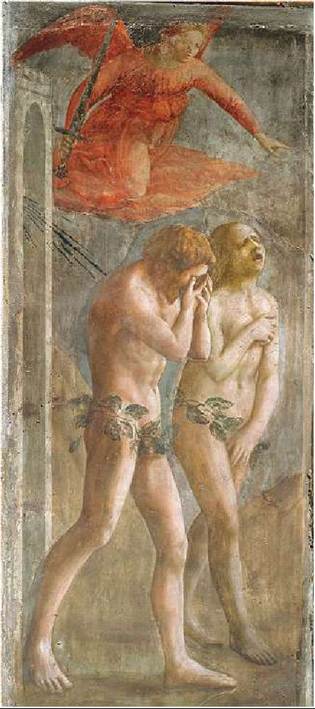
Adam and Eve Banished from Paradise. In this fresco, the Renaissance painter Tommaso Masaccio (1401-1428) captured both the shame of Adam and Eve and the fear they felt as they were expelled from the Garden of Eden and separated from God.
The opening statement is about God the Father, the omnipotent (“almighty”) Creator of all reality, spiritual as well as material, visible as well as invisible. There is one God, upon whom all things depend for their existence.
The second part of the Creed focuses on God the Son, who is “one in Being with the Father”— that is, of the same divine substance or essence as the Father. For the sake of humanity, the Son became fully human as well as fully divine. As a revelation of divinity on earth, the Son enabled those who recognized him as sudi to come to a greater understanding of God: “If you know me, you will know my Father also” (John 14:7). Beyond revealing the Father, the Son has three other roles. First, recalling the Gospel of John (1:3), the Creed states that “through him all things were made.” Second, the suffering and death of the Son have made salvation possible. Third, the Son, as the risen Christ, will one day return to judge the world.
The final part of the Creed affirms that the Holy Spirit “proceeds” from the Father, implying the Spirit’s sameness in substance or essence with the Father. The addition of the Latin filioque (“and from the Son”) by the Western church, never accepted in the East, underscores the sameness of all three persons of the Trinity. Just as the Father represents God’s power in the creation of the world, and just as the Son both reveals the Father and redeems a sinful humanity, the Holy Spirit represents God’s continuing presence in the world. Since the beginning, when God breathed the “breath of life” into Adam (Hebrew ruach means both “breath” and “spirit”), the Spirit has given life to all of creation. Christians believe that since the descent of the Holy Spirit at Pentecost, it has animated, empowered, and guided the Church. Finally, it is the Spirit within that helps believers as they reach out to God in prayer (Romans 8:26) and that nurtures virtues such as love, patience, kindness, gentleness, and selfcontrol (Galatians 5:22-23).
More on the topic God as Trinity:
- God as Trinity
- THE ANGELS OF GOD
- ADITYA, THE SUN GOD
- The Hindu Gods and God
- God, Creation, and Original Humanity
- ANICONISM
- Bonda’s Relationship with God and Supernatural
- God Speaks to Abraham
- The Family (Children of God)
- “when god himself came”