God, Creation, and Original Humanity
Christian thought about God, the world, and humanity begins with the first verse in the Bible: “In the beginning God created the heavens and the earth” (Genesis 1:1). Here, and in the story of creation that follows, the Bible makes a dear distinction between created things and their Creator.
God is transcendent, existing outside space, time, and the other limiting factors that give the world its order and finitude. And yet God is also immanent, or present in the world, sustaining and caring for all things with a loving benevolence that touches even the least of creatures.Much as a work of art tells us something about the artist, Christians believe that creation tells us something about God. Paul made this point in his letter to the Romans: “Ever since the creation of the world his eternal power and divine nature, invisible though they are, have been understood and seen through the things he has made” (Romans 1:20). For Christians, the goodness, beauty, power, and design evident in the world are all expressions of God’s nature. But it is God’s goodness, and the consequent goodness of the world itself, that are emphasized in the biblical story of the world’s beginnings. At the completion of each stage of creation, it says, “God saw that it was good” (Genesis 1:10,18,21,25) and, ultimately, that it was “very good” (Genesis 1:31). Finally, Christianity teaches that the entire order of existing things, and especially human beings, is the deliberate and purposeful expression of a divine love that a grateful creation should return to God in praise. “Let heaven and earth praise him, the seas and everything that moves in them” (Psalms 69:34).
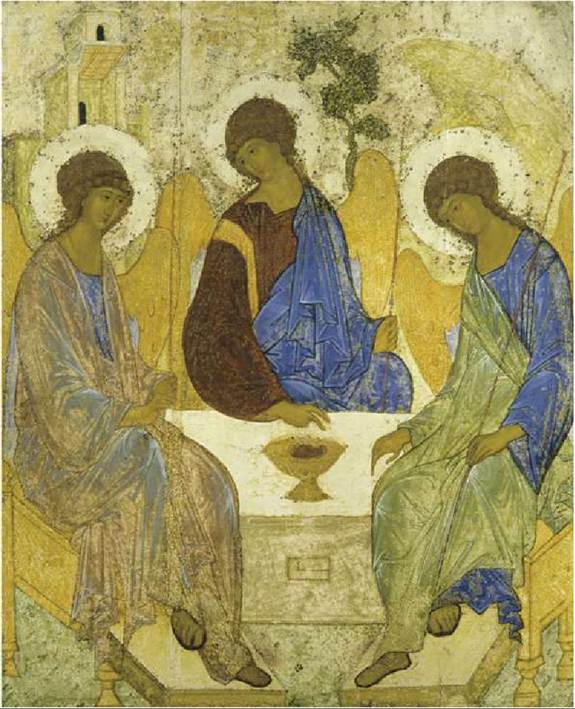
Andrei Rublev’s icon of the Holy Trinity (1411) is considered a masterpiece of Orthodox religious art. It depicts (from left to right) God the Father, God the Son, and God the Holy Spirit.
On one level, the three figures are the “angels” through whom God appeared to Abraham in the Old Testament. On a higher level, they represent the Trinity in a way that uses color, light, and imagery to give the viewer a glimpse into its unfathomable mystery.Christians believe that, despite its original perfection, the world as we know it today falls far short of God’s intentions, plagued as it is by suffering, injustice, and death. These evils cannot be attributed to God because they are completely opposed to God’s perfection. Instead, Christianity points to creation itself—and, more specifically, to humanity.
The story of creation relates that “God created humankind in his image” (Genesis 1:27). For centuries, Christian thinkers have sought to understand all that is entailed by this assertion. Some have found the image of God in the human capacity for rational thought. Others have said it can be seen in the “dominion” God gave to human beings over all the earth (Genesis 1:26), which resembles God’s rule over the entire universe. All Christian thought, however, acknowledges that human beings have a unique ability to love God, just as God loves them.
This idea is found in the biblical narrative that describes how God placed Adam and Eve, the first human beings, in a garden-like paradise called Eden. Whether we understand Adam and Eve as literal human beings or as symbols of original humanity—the Hebrew word adam means “humankind”—the point of the story remains the same. For as long as human beings related to God in loving obedience, they lived in joyous harmony with their Creator, but their eventual decision to disobey God brought an end to that harmony and, consequently, to the harmony of creation as a whole (Genesis 2:4-3:24). It was through sin that evil in all its forms became a reality in the world. Worst of all, sin separated humanity from God. In the Christian view, the salvation of creation from sin’s destructive effects begins with the salvation of human beings. It is only through salvation from sin that they are restored to that original relationship with God in which they find their true place, purpose, and fulfillment. In the words of Augustine, the great fifth-century saint, “You have made us for yourself, and our hearts are restless until they find rest in you.”1
How do Christian teachings about God compare with those of the related religions of Judaism and Islam and those of Hinduism and Buddhism?
More on the topic God, Creation, and Original Humanity:
- ADITYA, THE SUN GOD
- Supernatural Beings: Gods and Spirits
- Brodd Jeffrey, Little L., Nystrom B., Platzner R., Shek R., Stiles E.. Invitation to World Religions. 4th edition. — Oxford University Press,2022. — 1196 p., 2022
- The polity and humankind on the island
- A. Eve, Mary and the Church
- Is Chemical Research Ethically Neutral?
- The Zoroastrian Community: Social and Ethical Responsibilities
- Nineteenth-Century Japanese New Religions
- XAT 2011
- The core ambiguity of modern Islamic constitutionalism: the scope and authority of human-made legislation