Index
Animals
demons appear as 54, 81, 115, 217-219 in magic 51, 124, 142-144, 147, 159, 161-163, 263, 298-299, 301, 303, 309, 321, 332
Angels 62, 93, 113-114, 117, 131, 139-140, 146-147, 149, 171, 180-183, 192, 213, 225, 272, 294, 300, 328, 398, 402-403, 414
Astrology 56, 187-188, 196, 258-261, 283, 292-293, 297-302, 307, 314-321, 323-325, 327, 332-334, 379
Childbirth 74, 87-89, 104, 147, 403, 418
Children 49, 73, 84, 88-89, 93, 95-96, 163, 166, 221, 263, 267-269, 303, 344-345, 348, 351-352, 403
Common cold 66
Deafness 59
Demonology
Christian 176-179, 181-188, 201-202, 225, 304-305, 377, 383, 385, 389, 396-403, 408-411
Hellenistic 179-181, 304-308, 317-318, 321 Islamic 321-322, 327-328
Jewish 82-86, 112-114, 119, 126-128, 180 Demons
Appearance 55, 64, 71, 77-78, 92-93, 106-107, 115-116, 193, 205-206
Associated with particular places 28, 55, 67-71, 123-124, 306, 417
Definition and terminology 5, 24-29, 53-58, 63-64, 74-76, 82, 182, 412-414
Nature of 1-2, 19-20, 23, 64, 107, 113-114, 120-121, 225, 183, 368, 371, 416
Origins of 82-84, 128, 180-181, 202, 417 Position in Cosmos 1-2, 54-56, 181, 306-308, 327-328, 414
Dreams 135-136, 161-162, 164-173, 190, 212, 383
Earache 117
Epilepsy 44, 49, 52, 55-56, 256, 266-270, 303, 342, 348, 351, 353-354, 365, 415-416
Evil eye 117, 164, 335, 398, 403
Exorcism 20-23, 30, 55, 86-89, 98, 101-102, 125, 131, 220-221, 226, 242, 348, 350, 353, 360-362, 364, 372, 413
Fever 41-52, 87-89, 99, 274, 302, 311
Genizah 95, 113, 148-149, 162 Ghosts 33, 38, 54, 67, 93, 168, 244-245,
299-300, 305-306, 310, 414
Headache 52, 55-56, 99, 117, 327 House, protection from demons 66-71, 74, 103, 116, 124, 165-166, 298, 417
Hysteria 365
Illness
as divine punishment 55-58, 129, 220, 229, 240-241, 330, 346-347, 350, 353, 369-370
as test 2
Illusions, demonic 185-187, 206-208 244-247, 265, 268, 285-286, 344-345, 366, 371, 382-383
Incubus 246-248, 250 Infertility 85
Insomnia 140-143, 147-148, 158-159, 164,
170
Magic, as cause of illness 32, 52, 67, 118, 129-130, 135-174, 265, 294-295, 301-302, 319, 321, 327-329, 360
Mania 240, 274, 277, 365
Melancholy 243-244, 273-290, 319,
365-366, 373, 416
Mental illness 52, 76, 85, 87, 118, 126, 140, 147, 170, 190-191, 207-208, 210-212, 235-253, 283, 287-288, 294-295, 301-302, 311, 327, 339-354, 365-366, 372-374, 415-416; see also Mania, Melancholy, Possession.
Miracles 4, 236-237, 249-251, 253, 364, 372, 339-356, 364, 372, 399-402, 406-407, 410; see also Saints
Night 91-92, 106-107, 124-125, 165-167, 214,
265, 299-300, 306, 310
Pain 67, 118
Paralysis 49, 52, 73
Passover 93-95
Plague 58, 85, 90-91, 94, 169, 329-331
Possession 1, 7, 101-102, 106, 177, 184-185, 187,
190, 215-224, 238-242, 252, 268-269, 285-286, 310, 340-341, 343-354, 359-37, 376-377, 379, 413, 415
Pregnancy 98, 100-101, 104, 168
Saints 3, 217, 220-221, 226, 238-252, 339, 341-352
Scrofula 405-407
Skin Diseases 52, 56
Sleep 88, 99, 134-172, 300
Stroke 169
Suffocation 245-246
Sunstroke 91
Tooth pain 48-49, 88, 405
Tumours 303
Vertigo 67
Wasting illness 99
Witchcraft, early modern 7, 289, 360, 362,
364, 366, 376-393, 396, 414, 417
Wounds 58-59, 410
Cuneiform Sources
Akkadische und sumerische Keilschrifttexte
ASKT 11 VII 88-89
Assyrian and Babylonian Letters
| ABL 663 | 66 |
| Assyrian Medical Texts | |
| AMT 14 | 44nn19&25 |
| 19 | 51n61 |
| 20 | 45n31 |
| 23 | 44n19 |
| 44 | 44n19 |
| 45 | 44n19 |
| 48 | 44n19 |
| 55 | 46n35 |
| 63 | 51n61 |
| 78 | 44n19 |
| 80 | 45n28 |
| Atrahasis Epic | 74n41 |
| Babylonian Theodicy | 62n5 |
| British Museum | |
| bm 42272 | 49n52 |
| BM 42431 | 51n61 |
| bm 43196 | 51n61 |
| bm 92669 | 32 |
| bm 92670 | 32-33, 36-38 |
| K2581 | 47n44, 51n61 |
| Dialogue of Pessimism | 62n5 |
| Die babylonisch-assyrische Medizin in Texten | |
| und Untersuchungen | |
| BAM 3 | 43n13, 45nn26-27, 46nn33&36-38, 48, 50n60 |
| 7 | 48 |
| 52 | 44n19 |
| 66 | 44n19 |
| 88 | 44n19 |
| 108 | 45n28 |
| 111 | 43n18 |
| 120 | 45n30,48 |
| 143 | 43n13 |
| 145 | 46n40 |
| 146 | 46n40, 47n45, 48n48 |
| 147 | 51n61 |
| 148 | 51n61 |
| 159 | 43n18,46n34 |
| 168 | 45n28, 48 |
| 171 | 44n19 |
| 174 | 45n28 |
| 315 | 43n13, 51 |
| 393 | 44n19 |
| 480 | 43n13,45nn26-27,48, 50n60 |
| 494 | 48n48 |
| 503 | 46n32 |
| 510 | 48n48 |
| 575 | 45nn28-29 |
| 578 | 46n34 |
| 579 | 45nn28-29 |
| Dumuzi's Dream | 73 |
| Enuma Anu Enlil | 86n16 |
| Hymn to | |
| dLama-sa6-ga | 28 |
| Hymn to Ninegala | 32n30 |
| Hymn to Ninisina | 32n30 |
| Incantation against the Asakku | |
| demon | 63 |
| Incantation of the | |
| piglet | 76 |
| Iraq Museum | |
| im 132670 | 45n27 |
| IM 21180X | 30-31 |
| Lagash canal riddles | 27-28 |
| Lugalbanda I | 29 |
| Maqlu series 52n68, 171 | 6:79-86 | 93 |
| 6:185 | 66 | |
| Old Babylonian Incantation against Lamastu | 7:73-79 | 73 |
| bin 2, 72:6-9 66 | 7:98-100 | 68 |
| yos xi, 19:1-11 74 | 8:1-23 | 75 |
| 9:32 | 66 | |
| Poem of the Righteous | 9:91’-115’ | 68 |
| Sufferer 62 | 11: exc. 7 | 69-70 |
| 12:13-20 | 25n15 | |
| Prescriptions for Undoing Witchcraft | 13-15:149-151 | 73 |
| 3. C rev. 24-26 67 | 13-15:220-230 | 52n68 |
| 16:15-16 | 64 | |
| SAA X | 16:168-175 | 52n68 |
| 160 47n42 | ||
| 202 47n42 | Uruk Lament | 28 |
| 230 47n42 | ||
| 302 49 | ||
| 304 47n42 | Ancient Egyptian Sources | |
| 315 51n61 | ||
| Book of the Dead | 54n3 | |
| Spdtbabylonische Texte aus Uruk | 163 | 57 |
127 49n52
Book of the Gates 54ns
Steine als Schutz- und Heilmittel
| 67 | 50n60 | British Museum | |
| 109 | 44n21, 50n60 | BM EA 10059 | 56n8 |
| 116 | 44n24 | ||
| 130 | 50n60 | Coffin Texts | 57 |
| 130a | 50n60 | Edwin Smith Papyrus | 59 |
| Traite Akkadien de | 67 | ||
| Diagnostics et Pronostics Medicaux | Letters to the Dead | 54 | |
| Papyrus Ebers | 59 | ||
| Udug Hul | 25, 74, 82n3, 83n7, 86n16, 88, 92-93 | 854e | 59 |
| 1:35’ | 66 | Pyramid Texts | 57-58 |
| 2:62-71 | 52n68 | ||
| 3:73-76 | 69 | ||
| 3:138-144 | 52n68 | Hebrew Bible | |
| 3:159-162 | 69 | ||
| 4:158-169’ | 70 | Genesis | 100 |
| 4:176 | 66 | 1-11 | 83n8 |
| 4:179’-186’ | 70-71 | 2:21 | 146n33, 148 |
| 5:72 | 66 | 6:1-4 | 180 |
| 5:124-141 | 93 | 15:12 | 146n33 |
| 5:185-188 | 71 | 18-19 | 92n48 |
| 6:1-39 | 93 | 28:11 | 148 |
| 6:55-63 | 52n68 | 41:5 | 148 |
Exodus
7:14-10:29 96
12:1-14 93-94
12:14 94
12:21-23 93-94
12:23 93
12:42 92
15:26 117-118
23:21 115
34:7 87> 98
Leviticus
12:2-4 98
Numbers
6:23-27 85П15
14:18 98
22-24 402П16
Deuteronomy
2:24-25 211
28 86П15
Judges
9:23 82
1 Samuel
16:14 82,129
16:14-23 3,4П5
16:23 82
17:47 211
2 Samuel
24:10-17 91П40
1 Kmgs
5:13 105
Isaiah
50:11 116
Zechariah
3:2 95
Psalms
8:4 183П32
22:4 213
70:2 214
78:49 93
91 90-91,106
91:7 121H20
91:11 116
96:5 190n60
106:5 185
116:6 116
Proverbs
6:4 146n33
6:10 146n33
Job 62,386
1:6-12 94n57
1:12 129
2:6 129
6:4 91n39
33:15 146n33
Ecclesiastes
9:11 386
Daniel
2:29 167n83
4 110,239n17
4:2 167n83
4:25-34 353
7:7-8 106
Ezra 83n9
Nehemiah 83n9
Dead Sea Scrolls and Other Ancient Jewish Inscriptions
cd (Damascus 9, 89
Document)
16:3-4 94n55 (See also 4Q266
and 4Q272)
1QS (Community Rule) 109n38
1Q20 (1QapGen) 8-9, 83n9, 85, 100-101
4Q196-4Q199 81n1, 107
(4QToba-d ar)
| 4Q200 (4QTobe) | 81m, 107 | Jubilees | 81n1, 83n9, 85, 94 100, 180 |
| 4Q242 (4QPrNab ar) | 9, 86n16, 109 | 10:3-4 | 189n57 |
| 10:8 | 2 | ||
| 4Q260 (4QSf) | 103n22 | 10:10-14 | 188n51 |
| (See also 1QS) | 49:2-3 | 94 | |
| 49:15-16 | 95 | ||
| 4Q264 (4QSJ) | 103n22 | ||
| (See also 1QS) | Life of Adam and Eve | 181n21 | |
| 4Q266 (4QDa) | 98n5,104 | Testament of the Twelve Patriarchs | |
| (See also cd) | Reuben | 184, 189n56 | |
| 4Q272 (4QDg) | 98n5,104 | Tobit | 8-9, 81, 83n9, 85 |
| (See also CD) | 3^7 | 104 | |
| 5 | 92n48 | ||
| 4Q394-4Q399 | 6:17 | 104 | |
| (4QMMTa-f) | 94 | 8:4-8 | 104, 107 |
| 4Q510-4Q511 | Wisdom of Solomon | 181n21 | |
| (4QShira-b) | 9,107-109 | ||
| 4Q560 | New Testament | ||
| (4QExorcism ar) | 8-9, 85-89, 96, 98-105 | ||
| Matthew | |||
| 11Q5 (11QPsa) | 3, 90, 106 | 8:28-34 | 126, 239n17 |
| 9:32-33 | 1n2 | ||
| 11Q11 (11QapocrPs) | 8-9, 85, 90-92, 95-96, | 12:22 | 1n2 |
| 105-107 | 17:14-18 | 1n2 | |
| 26:17 | 95n58 | ||
| 11Q19 (11QT) | 94 | 27:24 | 201 |
| Ketef Hinnom | Mark | ||
| amulets | 82,85n15 | 1:26 | 353 |
| 1:32 | 353 | ||
| 5:1-20 | 1n2, 126, 239 | ||
| Apocrypha and Pseudepigrapha | 5:9 | 92n47 | |
| 5:9-13 | 2 | ||
| 1 Enoch | 81n1, 83-86, 94n55 | 9:16-29 | 268-269 |
| 1-36 | 84,180-181 | 9:29 | 359, 372 |
| 6-11 | 84,85n14 | 14:2 | 201 |
| 15 | 84 | 14:12 | 95n58 |
| 72-82 | 86n16 | ||
| Luke | |||
| 2 Enoch | 181n21 | 4:40-41 | 1n2 |
| 6:18-19 | 353-354 | ||
| Ben Sira | 8:26-39 | 126 | |
| (Ecclesiasticus) | 81n1 | 8:30 | 92n47 |
| 38 | 386 | 9:37-43 | 239n17 |
95,
| 10:18 | 181n22 | Galen | |
| 22:7-8 | 95n58 | On Affected Parts | 243, 275n6, 276n7, 277, 279, 284, 289n40 |
| Acts | |||
| 20:1 1 Corinthians | 201 | Hippocrates Aphorisms On Airs, Waters, | 276n7 |
| 7:20-24 | 386 | and Places | 314 |
| 12:9-11 | 401n10, 408 | On the Sacred Disease | 5 |
| Hebrews | |||
| 11:28 | 95 | Homer Iliad | 147n35 |
| Classical and Late Antique Greek and Latin Sources Apuleius | Iamblichus of Chalcis On the Pythagorean Way of Life Kyranides | 196 293, 295, 298, 305, 310-311 | |
| On Plato and his Doctrine | 179n15,187n48 | ||
| Aristotle | Philolaus of Croton | 196-197 | |
| Metaphysics | 196 | ||
| On the Heavens | 196 | Plato | |
| On the Soul | 197 | Epinomis | 179-180 |
| Politics | 199 | Pha edo | 197 |
| Republic | 197-199 | ||
| Artemidorus Daldianus | Tim aeus | 179, 198-199 | |
| The Interpretation | |||
| of Dreams | 136n7 | Plotinus | |
| Enn eads | 317 | ||
| Cicero | |||
| Tus culan | Plutarch | ||
| Disputations | 199-200 | Moralia | 203n65 |
| Corpus Hermeticum | 292-293, 311n57 | Proclus | |
| Pla tonic Theology | 306-307 | ||
| De XV stellis | 295-296,298-300, | ||
| 305, 310 | Pseudo-Apuleius | ||
| Herbarius | 269 | ||
| DefixTab 155 | 145-146, 149-151, 153, | ||
| 157-159, 173 | Rufus of Ephesus | ||
| On Melancholy | 275n6, 277n8, 279-282, | ||
| Dioscorides | 287n35 | ||
| On Medical | |||
| Material | 260n17 | Seneca | |
| Letters | 200 | ||
| Greek and Demotic | 55n7, 101-102, 143n26, | ||
| Magical Papyri | 144-145, 149, 158-159, | Stobaeus | |
| 162-163, 308-310 | On the Passions | 200 | |
Patristic and Early Christian Sources
Acts of John 178, 184, 191П61
Ascension of Isaiah 178, 184, 191П62
Athanasius of Alexandria
Against the
Heathen 10, 194, 201-206, 208
Letter to Marcellinus 10, 193, 209
Life of Antony 2, 10, 192-195, 201-202,
204-210, 213-214, 226, 230
On Luke 10:22 and
Matthew 11:27 203
On the Incarnation 202ПП60 & 62
Athenagoras of Athens
Embassy for the
Christians 175-176, 179-182,
185-187, 190-191
On the Resurrection
of the Body 175
Augustine of Hippo
Confessions 223n28
The City of God 239nn17-18,304n40,
305n44
The Happy Life 266n36
Basil of Caesarea Homily on the
First Psalm 4
Clement of Alexandria
Stromata 179П13,187П48
Epistle of Barnabas
Erma's Shepard
Eusebius of Caesarea
Ecclesiastical History
Preparationfor the Gospel
178
10, 178, 184, 189, 191
176П4
182П25
Evagrius of Pontus
Chapters on Prayer 212-213
| Praktikos | 211n112, 212 | ||
| Talking Back | 210-211 | ||
| To Eulogius Treatise on Various | 211-212 | ||
| Evil Thoughts | 175n3 | ||
| Gelasian Decree | 105 | ||
| Gregory of Tours | |||
| Miracles of | |||
| St Martin | 239n18 | ||
| History of the Monks | 228n53, 230 | ||
| Irenaeus | |||
| Aga inst Heresies Demonstration | 178n13, 189n53, 203n65 | ||
| of the Apostolic Preaching | 178n13, 180n20, 181n21 | ||
| Isidore of Seville | |||
| The Etymologies | 266,304П40 | ||
| Jerome | |||
| Letters | 223,230П60 | ||
| Life of Hilarion | 210П103 | ||
| John Cassian | |||
| Conferences | 214 | ||
| John Chrysostom | |||
| Letter to Stageirios | 415-416 | ||
| Julius Africanus | |||
| Kestoi | 159 | ||
| Justin Martyr | |||
| Apologies Dia logue with | 177-178, 185, 187n48 | ||
| Trypho | 177-178, 185, 187n48, 190n59, 191n62 | ||
| Life of Pachomius | 208 | ||
| Origin | |||
| Aga inst Celsus Homilies on | 180n19 | ||
| Numbers | 180n19 | ||
| Palladius of Galatia | bt Berakhot 6a | 121-122, 144n26 | |
| Lausiac History | 215,223-231 | bt Berakhot 10b | 105n27 |
| Letter to Lausus | 225 | bt Berakhot 55b | 126, 167n83, 168 |
| bt Berakhot 56a | 168 | ||
| Paulinus of Nola | bt Berakhot 57b | 135n5 | |
| Hym ns | 215-223,229-231 | bt Berakhot 60b | 146n33 |
| Letters | 223, 231 | bt Shabbath 67a | 123n23 |
| bt Shabbath 151b | 124 | ||
| Pseudo-Clementine | bt Eruvin 18b | 128 | |
| Homilies | 219 | bt Pesahim 56a | 105n27 |
| bt Pesahim 109b | 124, 127 | ||
| Sayings of the Desert | bt Pesahim 110a | 122 | |
| Fathers | 192 | bt Pesahim 111a | 123 |
| bt Pesahim 111b | 125, 130 | ||
| Shenoute | bt Yoma 77b | 120 | |
| Can ons | 208 | bt Rosh | |
| Hashanah 11b | 124, 127 | ||
| Sulpicius Severus | bt Hagigah 16a | 113 | |
| Life of St Martin | 210n103 | bt Gittin 68a-b | 123 |
| bt Sanhedrin 101a | 123 | ||
| Tatian the Syrian | bt Sanhedrin 109a | 128 | |
| Address to the | bt Shevuot15b | 106 | |
| Greeks | 176n7, 182-183, 187-191 | bt Hullin 105b | 123, 126 |
| bt Hullin 107b | 120 | ||
| Tertullian | |||
| On Women’s Dress | 180n20 | Bodleian Library |
Heb.
33.31 162-163Testament of Solomon 105
Cambridge University Library
| Theodoret of Cyrus | cul T-S K 1.28 | 148-149 | |
| Questions on the | cul T-S K 1.123 | 95-96 | |
| Book of Kings | 105 | ||
| Harba de-Moshe | 9, 135, 138, 139n15, | ||
| Victricius of Rouen | 160-163, 170-171, 174 | ||
| Praising the Saints | 220n20 | ||
| Josephus | |||
| An tiquities of the | |||
| Early, Late Antique and Medieval Jewish | Jews | 9, 101, 104, 182n25 | |
| Sources | Wars of the Jews | 104,128 | |
| Amulets and magic | Midrashim | 113 | |
| bowls | 87-88, 92, 95-96, | Genesis Rabbah | 123, 128 |
| 99n10, 102-103, 113-119, | Leviticus Rabbah | 122 | |
| 124-125, 127-132, 135, | Numbers Rabbah | 143n23 | |
| 138, 140n18, 150, | |||
| 152-157, 163-174 | Mishnah | 112 | |
| m Avot 5:6 | 128 | ||
| Babylonian Talmud | 114, 119 | ||
| bt Berakhot 3a-b | 123n23, 124 | Palestinian Talmud | 113 |
| bt Berakhot 5a | 125 | pt Berakhot 2.d | 125 |
PT Eruvin26.c 106
pt Pesahim 9:2 i05n26
Philo of Alexandria
On Punishments i83n34
On the Giants i8in23
Pirkei Avot i39ni3
Sefer Adam i39ni2, i4oni6
Sefer ha-Razim 9, I35, I38-I50, I58,
i6o-i6i, I63, i6yn83,
I70-I7I, I74
Sifre to Deuteronomy i25n27
Targum Pseudo
Jonathan I80
Tosefta ii3
Zohar ii9
Arabic Sources (including Medieval)
Abu Ma'shar
Kitab al-Madkhal
al-kabtr 3i4-3i7,332ni08
Abu Sa'id Ibn Bakhtishu'
Ris ala ft al-tibb 324
'All ibn Rabban al-Tabari
Firdaws al-hikmah 3I6-3I7,332,
337nni4i-i42
al-Buni
Lata'if al-isharat 327n84
al-Buni (pseudo)
Shams al-ma'arf al-kubra 326-327,336ni36
Shams al-ma'arf wa latajf al-'awarif 326-327, 333, 336
Tarttb al-da'wat 328-329,333-334
al-Razi
al-Kitab al-Hawt
ft tibb 276,28ini8
Ibn Hajar al-'Asqalani
Badhl al-ma'un ft fadl al-taUn 33I
Ibn 'Imran
Maqalaft al-malthuliya 276n7, 277, 279-283
Ibn al-Jazzar
Zad al-musafir 350
Ibn Qayyim al-Jawziyah
Miftah dar al-sa'ada 334-335
al-Tibb al-nabawt 330-331,335-336,
338ni44
Ibn Ridwan
Risalaft daf ' madarr al-abdan 330n95
Ibn Sina
Kitab al-Qanun
ft al-tibb 275n6, 276, 277n8, 324
Kitab al-Shifa‘ 325
Ibn Taymiyah
al-Quwa al-khafiyyah 334
al-Kindi
al-Ibana 'an sujud 3i8
al-Majusi
al-Kitab al-Malakt 3i6-3i7, 323, 34ini0
Qusta ibn Luqa
Kitab ft al-'amal bi-al-kura al-nujumiyya 26i
Maqalahft ishtirak al-tabai 267n40
Risalaft al-farq baina al-ruh wa al-nafs 322-323
| al-Ruhawi | Alfonsine Lapidary (Madrid | ||
| Adab al-tabib | 323,338ni43 | ms Escoriai, h.I.15 etc.) | 256-270 |
| al-Sakkaki | |||
| al-Kitab al-shamil | Alfonsine Tables | 258n6 | |
| wa al-bahr al-kamil | 327-328 | Alia Miracula Sancti | |
| Johannis | 245n44 | ||
| Thabit ibn Qurrah | |||
| Kitab al-dhakhira | Arnau de Vilanova | ||
| fi ilm al-tibb | 329 | Antidotum contra | |
| venenum | 288n37 | ||
| Yuhanna ibn al-Salt | De amore heroico | 272, 274, 277n9 | |
| Kunnash tibbi | De reprobacione | 13, 271-277, 283-284, | |
| nujuml | 316 | Eulogium de notitia | 287, 289-290 288n38 |
| Ghayat al-hakim | Pars operativa | 275-277,283-285 | |
| (Picatrix) | 13, 258n7, 297, 301-303, 308n5i, 310-311, | Arnold of Saxony | |
| 319-322, 329, 332-334 | Definibus rerum | ||
| naturalium | 267n39, 268 | ||
| Qur’an | 13, 331, 335-336, 338 | ||
| 17:82 | 329n91 | Ars Notoria | 293 |
| 37:i-3 | 327 | ||
| 72:3-6 | 333n119 | Bede | |
| 72:26-27 | 327n82 | Vita Sancti | |
| 74:30 | 328n89 | Cuthbertl | 210n103 |
| Rasail Ikhwan | Benedict of Peterborough | |
| al-Safa" | 318-319, 322, 332n112 | Miracula Sancti |
| Thomae 245-246, 247n54, | ||
| bl Delhi Arabic 1946 | 320 | 343-345, 347-352, 354 |
Bernard of Gordon
Lilium medicine 276n7,286-287
| Adam of Eynsham | Constantine the African | ||
| Magna Vita Sancti | De melancholia | 243n37, 276n7, | |
| Hugonis | 347 | 277-280, 282-287 | |
| De physicis ligaturis | 267n40 | ||
| Albertus Magnus | Liber pantegni | 278n11, 341, 343 | |
| De mineralibus | 267n39,268 | Viaticum | 278011,350 |
| Super Matthaeum | 285n30 | ||
| Corpus Glossary | |||
| Albertus Magnus (?) | (Corpus Christi | ||
| Speculum | College, ms 144) | 246n49 | |
| Astronomiae | 292-294, 296-297, 304 | ||
| See also Pseudo-Albertus Magnus. | De imaginibus | 296, 300-303, 307, 310 | |
| De imaginibus et horis | 297, 299, 310 | Guibert of Nogent De Pignoribus | |
| Sanctorum | 251n63 | ||
| planetarum | 297> 307 | ||
| Hildegard of Bingen | |||
| De imaginibus sive | Causae et curae | 243n36,285030 | |
| annulis septem | |||
| planetarum | 297, 300, 303-304, 310 | Historiae Coenobii | |
| Burgensis Scriptores | 343ni8 | ||
| De Miraculis Sancte | |||
| Marie de Rupe | Idea Salomonis | 300n29 | |
| Amatoris | 243n37 | ||
| John of Morigny | |||
| De viginti quattuor | Liber visionum | 293 | |
| horis | 297, 299-300, 310 | ||
| Liber de fantasmatibus | 273 | ||
| El Libro de la agafecha | 258n7 | ||
| Liber Eliensis | 242 | ||
| El Libro de las cruces | 258nn6-7 | ||
| Liber planetarum | 297, 303-304, 311 | ||
| El Libro de las | |||
| estrellasfjas | 258nn6-7 | Liber S. Gilberti | 242, 251 |
| El Libro de lasfazes | 259 | Libri centre et | |
| circumferencie | 273 | ||
| El Libro de las formas | |||
| y de las imdgenes | 258n7 | Marbod of Rennes | |
| Liber lapidum | 259n10, 267-268 | ||
| El Libro de los juicios | |||
| de las estrellas | 258n6 | Miracula S. Jacobi | |
| manu | 244 | ||
| El Libro delAlcora | 258nn6-7 | ||
| Miracula S. Swithuni | 241n25, 245n46, | ||
| ElLibro del quadrante | 258n7 | 246n48, 247-248 | |
Medieval Sources
Felix
Vita Sancti
Guthlaci
Auctore Felice 210ni03, 213ni22
Gregory the Great
Vita sancti
Benedicti 2ionio3
Goscelin of Saint-Bertin (Goscelin of
Canterbury)
Miracula S. Ivonis 24in25, 242, 244n40
Gratian
Decretum 353
Munich Manual of Demonic Magic (Bavarian State Library,
Munich, clm 849) 294-295
Peter of Spain
Thesaurus Pauperum 4T7
Philip, prior of St Frideswide's
Miracula S. Frideswidae 242,244n38
Picatrix - see Ghayat al-hakm
Pseudo-Albertus Magnus
Experimenta 293
Pseudo-Aristotle
Lapidarium Aristotelis 266-267
Pseudo-Aristotle
Secretum secretorum 283n2i, 293
Pseudo-Ptolemy
Opus imaginum 296,310-311
Pseudo-Thebit (Thabit ibn Qurrah)
De proprietatibus quarundam stellarum 296
Reginald of Durham
Life of St Godric 241-242,246n48
rGyudbzhi (Four Tantras) 412
Thomas Aquinas
Summa contra gentiles 289
Thomas of Monmouth
Miraculi Sancti
Willelmi Martyris Norwicensis/Vita et passio Willelmi
Norwicensis 238-241, 248, 347
William of Auvergne
De legibus 283n21
De universo 284n25,285
William of Canterbury
Miracula Sancti
Thomae 245-246, 248, 339
342n16, 345-351, 354-355
Vita Sancti Thomae 342012
Early Modern Sources
Anon.
A true and most
Dreadfull 37on35
Archivo Historico Nacional
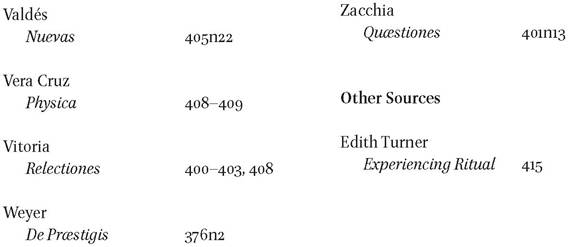
A.H.N. 89, exp. 15 403nni8-20, 404
A.H.N.
91, exp. 12 407n26, 408n29,4iinn38-4i
Adams
The blacke devil 374
Argentine
De praestigiis 377
Azpilcueta
Manual 408-409
Bee and Denison
The most wonderful 359n2
Benivieni
De abditis 384n38
Binsfeld
Tractatus 389n49
Bodin
Demonomanie 383n35
Boissard
Tractatus 3891150
Burton
The Anatomy 373-374,377n7
Cardano
De Subtilitate 378010
Castanega
Tratado 399,403
Cesalpino
Daemonum 376
Ciruelo
Reprobacion 399-400, 403, 408
Clowes
A Briefe 378
| Codronchi | Houllier | ||
| De Morbis | 377n6 | Singulares | 384n38 |
| Cotta | Jorden | ||
| A Short Discouerie | 14,378-382, 384-386, 388-389, | A b riefe discourse | 362 |
| 392 | Lemnius | ||
| Cotta contra | Occulta | 377n5 | |
| Antonium | 378, 386n41, 387-389, 391, | Lombard | |
| 392n61 | Sen tences | 387n44 | |
| The Triall of | |||
| Witchcraft | 14-15, 378, 381-391, | Man and Winnington | |
| 393n63 | Witches of Warboys | 381 | |
| Darrel | More | ||
| An apologie | 359n1,362n10 | A true discourse | 360n2 |
| 363n15 | |||
| A true narration | 367 | Nyndge | |
| The replie | 363n15 | A true andfearefull | 367n25,37on36 |
| Deacon and Walker | Pare | ||
| A Summarie | 363nn15-16 | Des monstres | 377n5 |
| Dialogicall Discourses | 14, 363-375 | Perkins | |
| Del Rio | Discourse | 390-391 | |
| Disquisitiones | 409-410 | Peucer | |
| Erastus | Commentarius | 377n5 | |
| Disputationis | 377n6 | Pomponazzi | |
| Ewich | De naturalium | 376n1 | |
| De sagarum | 376n3 | Potts | |
| Fisher | The Wonderfull | 381n22 | |
| The copy of a letter | 367n24, 369n34 | Scaliger | |
| Gregoire | Exotericarum | 378n10 | |
| Syntaxes | 387n44 | Scot | |
| Harsnett | The Discoverie | 368, 378n12, 391, | |
| A discouery | 361, 374n45 | 392n60 | |
| Henricus Institoris | Taylor | ||
| Ma lleus | laphets first publique | 374n46 | |
| Maleficarum | 383, 385 | Torquemada | |
| Holinshed | An tiguas | 405n22 | |
| Chronicles | 381 |
11 Where possible, both figures will be referred to primarily by their own native terminology, with a similar logic to the argument presented by Rangar Cline in his work on angels in
6 Robert D.
Biggs, “Medizin” in Reallexikon der Assyriologie und Vorderasiatischen Archäologie Bd. 7, ed. Dietz O. Edzard (Berlin—New York, 1987-1990), p. 624b; Hector Avalos, Illness and13 Stol has rightly observed that “medical texts never give ummu as a diagnosis because the word is too general”—see Stol, “Fevers”, p. 3. On the other hand, the medical rubrics use this term as an illness-name: summa amela ummu ibassu “If somebody has been seized
19 Prescriptions against ud.da tab = seta hamit “he is inflamed with heat-radiance” (bam 393 obv. 23-26 and rev. 22-25 etc.). Prescriptions against ud.da kur = seta kasid “he has been overcome by heat-radiance” (amt 14 7 // amt 44 6+amt 45 1 col. I 1-14 // bam 66 rev. 4-25’ etc.). Prescriptions against ud.da sa.sa = seta summur “struggling with heat radiance” (amt 45,6 + 23 5 + 48 1 + 48 3 + 78 3 i 1-33’ // amt 44 6+amt 45 1 ii 1-2 etc.). Prescriptions against tab ud.da = himit seti “burning of heat-radiance” (bam 171 rev. 19-21 etc.). Prescription against ud.da gig = seta maris “he is ill with heat-radiance” and ud.da diri = seta malt “he is full of heat-radiance” (bam 52 rev 12-22 // bam 88 rev. 1-9 etc.).
20 “Fire” is one of the personified or demonised diseases. It “descends from the sky” or “from the mountain” and “eats the flesh” and “consumes the bone” of the patient. See Nathan Wassermann, “Between Magic and Medicine—Apropos of an Old Babylonian Therapeutic Text against kurdrum disease,” in Disease in Babylonia, eds. Markham J. Geller and Irving L. Finkel (Leiden, 2007), pp. 40-53. Stol discusses isdtutu “fires” and ummu “heat”, used interchangeably in a group of Middle Babylonian letters from Nippur—Stol, “Fevers”, pp. 2-3. In some incantations from Egypt, the term “fire” was similarly used as metaphor for fever—seeJoris F. Borghouts, Ancient Egyptian Magical Texts (Leiden,
197* 1), p. 52.
21 Only in an amulet list—see Anais Schuster-Brandis, Steine als Schutz- und Heilmittel. Untersuchung zu ihrer Verwendung in der Beschworungskunst Mesopotamiens im 1. Jt. v. Chr. (Münster, 2008), p. 129 (no. 109).
22 Stol translates these two terms as “shivering fever” and “cold shiver”, which he interprets as the two forms of stadiumfrigoris preceding the stadium caloris—see Stol, “Fevers”, p. 19.
23 See Henry Stadhouders, “The Pharmacopoeial Handbook Sammu sikinsu—An Edition,” Le Journal des Medecines Cuneformes 18 (2011), pp. 1-55.
24 See Schuster-Brandis, Steine, pp. 131-132 (no. 116).
25 amt 14,7:7-8 etc.
42 Based on the translation of Kocher: “seine oberen Korperpartien kalt, die un[te]ren (jedoch bis in) seine Gebeine (hinein) glühend heiß sind)”—see Franz Kocher, “Ein Text medizinischen Inhalts aus dem neubabylonischen Grab,” in Uruk. Die Gräber, eds. Rainer
M. Boehmer, Friedhelm Pedde, and Beate Salje (Mainz, 1995), p. 213. According to the
52 Farber, “Lamastu”, pp. 139-142, with references to earlier literature. The close connection between ummu and the Lamastu demon occurs in a medical commentary from Hellenistic Uruk: ddim.me: um-mu [dumu.m]i d60 : me : um-mu “Lamastu is fever (and) daughter of Anu. me means fever” (SpTU I 27 obv. 25). Two prescriptions from bm 42272,
15 It is worth noting that some texts that were later canonised were used for apotropaic purposes even before the Exile, e.g. the Priestly blessing of Num 6:23-27 was used in the Ketef Hinnom silver amulets—general apotropaic texts without the mention of any special danger; see Gabriel Barkay et al., “The Amulets from Ketef Hinnom: A New Edition and Evaluation”, Bulletin of the American Schools of Oriental Research 334 (2004), pp. 41-71. The background for the use of amuletic texts is well illustrated by the list of blessings and
19 Philip Alexander thinks that 4Q560 has preserved the “remnants of a recipe book containing the texts of amulets, which a professional magician would have copied out and
23 See Joe Zias, “The Cemeteries of Qumran and Celibacy: Confusion Laid to Rest?” Dead Sea Discoveries 7 (2000), 220-253; Susan G. Sheridan et al., “Anthropological Analysis of the Humain Remains: The French Collection,” in Khirbet Qumran et ‘Ain Feshkha. Etudes d’anthropologie, de physique et de chimie, ii, ed. J.-B. Humbert and J. Gunneweg, Novum Testamentum et Orbis Antiquus. Series Archeologica 3 (Fribourg, 2003), pp. 129-169. Tomb A in cemetery North (today destroyed) and tomb 7 in the western part of an alignment of graves in the northern sector of the main cemetery may contain female skeletons. However, the woman of tomb 7 does not seem to have been buried according to usual practice. More recently excavated, the resting places of female bodies have been found in the eastern extremity of the central promontory. On two occasions it seems to have constituted a reburial (BE2a and BE2b). Despite the limited graves excavated (around 60 of 1200), it is possible that the Qumran cemeteries are exclusively composed of male graves. Tombs T7 and BE2a, BE2b—both reburials performed a short time after death— are located at the margins of the main cemetery. These tombs are contemporary with
4 Since the Hebrew Bible referred to dreams as divine messages, even the rabbis could not completely deny the authority of the oneiric experience as a medium between God and man, concluding that “dreams are one sixtieth of prophecy” (bBerakhot, 57b). On dreams in the Hebrew Bible, see Ruth Fidler, Dreams Speak Falsely?Dream Theophanies in the Bible: Their Place in Ancient Israelite Faith and Tradition (Jerusalem, 2005) [Heb.]; on dreams in the Babylonian Talmud, see Philip S. Alexander, “Bavli Berakhot 55a-57b: The Talmudic Dream
15 The count is according to Margalioth, SepherHa-Razim; if we count separately the different applications of certain recipes, in which some alterations are required, the total number of recipes is thirty-eight. The seventh firmament does not contain magical recipes.
25 The expression “1’D’D mN HNT N^W “which never saw light," might refer to either an embryo or a puppy born dead. The “embryo of a dog" is mentioned in pgm IV.2441-2621 (vv. 2578-79), an incantation also aimed at sending dreams and accomplishing dream revelations, and in pgm IV.2622-2707 (vv. 2645-46), a spell for “protection, attraction, sending dreams, causing sickness, producing dream visions and removing enemies,"—see Hans
28 For pgm vii.396-404 and pgm vii.429-58, see Karl Preisendanz et al., eds., Papyri Graecae Magicae, Die Griechischen Zauberpapyri (Leipzig, 1928-1931), vol. 2, respectively,
40 See Mastrocinque, “Le defixiones’,’ pp. 58-59. On circus magic, see Florent Heintz, “Circus Curses and their Archaeological Contexts,” Journal of Roman Archaeology 11 (1998),
69 For an introduction to the bib, see James A. Montgomery, Aramaic Incantation Texts from Nippur (Philadelphia, 1913), pp. 7-116; Cyrus H. Gordon, Adventures in the Nearest East (London 1957), pp. 160-174; Naveh and Shaked, Amulets and Magic Bowls, pp. 19-21; Shaul Shaked, “Magical Bowls and Incantation Texts: How to Get Rid of Demons and Pests” [Heb.], Qadmoniot 129 (2005), 2-13; Bohak, AncientJewish Magic, pp. 183-194. The
17 Athenagoras, Legatio, 23.4: Πρώτος Θαλής διαιρεί ώς οί τά εκείνου άκριβούντες μνημονεύοσιν εις θεόν εις δαίμονας εις ήροας. Αλλά θεόν μέν τόν νούν τού κόσμου άγει, δαίμονας δέ ούσίας νοεί ψυχικάς καί ήρωας τάς κεχωρισμένας ψυχάς τών άνθρώπων, άγαθούς μέν άγαθάς, κακούς
13 I will not, for instance, investigate Hippocratic medical theory in this paper, nor Judeo- Christian ideas about the healing qualities of music. For a good summary of the development of humoral theory, see Jacques Jouanna, “The Legacy of the Hippocratic Treatise The Nature of Man: the Theory of the Four Humours,” in Greek Medicine from Hippocrates to
117 Praktikos 55, 56 and 64. Joest, “Acedia and Apatheia ii,” p. 280, argues that anaSeta consists in “the harmonious cooperation of the parts of the soul, each of which is functioning according to its own nature”. This suggests that the Evagrian conception of apatheia was influenced by Platonic as well as Stoic philosophy (see above). Praktikos 89 specifies that the virtue that promotes harmony and concord between parts of the soul is justice.
37 Constantine’s De Melancholia may have been better known on the Continent: there is an example of a suicidal cleric suffering from a depressive form of melancholia in the twelfthcentury De Miraculis Sancte Marie de Rupe Amatoris, ed. Edmond Albe, Les Miracles de Notre-Dame de Rocamadour au xiie siecle (Toulouse, 1996), p. 202. For the transmission
1 The copy now in Madird, San Lorenzo de El Escorial, h.I.15, is a beautifully illuminated manuscript produced in the Castilian royal scriptorium in the 1270s. For the debate surrounding the date of production of this manuscript, see A.J. Cardenas-Rotunno, ‘El Lapidario Alfonsi: la fecha problematica del codice escurialiense h.I.15’, in Actas delxiii Congreso de la Asociacion International de Hispanistas (Madrid 6-11Julio 1998), ed. by F. Sevilla Arroyo and C. Alvar Ezquerra (Madrid, Castalia, 2000) I, pp. 81-87. The copies now in Madrid, San Lorenzo de El Escorial, &-II-16 and Madrid, Biblioteca Nacional, 1197 are reproductions in paper of the thirteenth-century Escorial ms h.I.15. While the Escorial ms &-II-16 has no use of decorations or rubrication, the manuscript in the Biblioteca Nacional de Espana, 1197, includes detailed copies of many of the miniatures and illustrations present in the Escorial ms h.I.15. Furthermore, it provides additional images by the sixteenth-century illustrator that complement some of the gaps left in the unfinished thirteenth-century copy of the Lapidario. For additional information on the transmission and illustration of this version of the Lapidario,
© KONINKLIJKE BRILL NV, LEIDEN, 2017 | DOI 10.1163/9789004338548_015
5 The text of this fourth lapidary is written in a different hand to the previous three; the decoration is also different. The treatise includes no miniatures or diagrams, and, even though space has been left for initials, these were never completed. The text is attributed in the manuscript to the Arab scholar Mahomat Aben Quich and the way in which the stones are presented here is significantly different to that of the first three lapidaries in the manuscript. The stones in this lapidary are organised in alphabetical order, even though the order of the letters does not follow the Latin, modern Arabic or Greek alphabets, although it may follow older forms of the Arabic alphabet—Diman and Winget, Lapidario, p. xxi. The description of the first stone, ‘anxoniz', is significantly larger than the rest, and the text also presents some
17 The lapidary texts assembled in the ms h.I.15 are unique in the way they associate material borrowed from Dioscorides’ De materia medica with astrological principles. Other lapidaries belonging to the Latin tradition do not openly associate the properties of the stones with the influence of celestial bodies. At most, they provide an indication of the appropriate astrological moment to harness the particular properties of any given stones—see N. Weill-Parot, Les ‘images astrologiques’ au Moyen Age et a la Renaissance:
31 Dela piedra que fuye del uino. Del ueyntiun grado del signo de tauro es la piedra que fuye del uino....Et a tal uertud que el que la trae consigo nol acaesce la ymagination aque
39 The texts that will be considered here include: the lapidary attributed to PseudoAristotle—V. Rose, ‘Aristoteles De lapidibus und Arnoldus Saxo’, eitschrift für deutsches
2 The first critical edition of this epistle is Epistola de reprobacione nigromantice ficcionis (De improbatione maleficiorum), ed. Sebastià Giralt, Arnaldi de Villanova Opera Medica Omnia (avomo), 7.1 (Barcelona 2005), whose text I am citing here by line (l.). On its
© KONINKLIJKE BRILL NV, LEIDEN, 2017 | DOI 10.1163/9789004338548_016
8 “Et signa eius principii sunt timor, dubitatio, cogitatio falsa in una re sola, et in omnibus aliis dispositionibus suis erit sanus. Et species opinionum eorum sunt infinite [...]. Et morantur cum his accidentibus per aliquod tempus, et postea fortificantur omnia accidentia melancolie”, Oeuvres de Rufus dEphese, eds. Charles Daremberg and Ch. Emile Ruelle (Paris, 1879),
10 The treatise by Ibn ‘Imran has been edited by Garbers including its Arabic text with a German translation and Constantine’s Latin version (cited above, in note 7). There is also
32 Cf. “Timor de re non timenda, cogitatio de re non cogitanda. [...]. Vident enim ante oculos formas terribiles et timorosas nigras et similia. [...] Videbat nigros homines”
42 On the relationship established between melancholy and witchcraft and the devil in Medieval and especially Early Modern Times, see Jole Agrimi—Chiara Crisciani, “Savoir medical et anthropologie religieuse. Les representations et les fonctions de la vetula (XIIIe-XIVe siecle)”, Annales. Economies, societes, civilisations 48/5 (1993), 1281-1308; DanielleJacquart, “De la science a la magie: le cas d’Antonio Guainerio, medecin italien du XVе siecle”, Litterature, medecine et societe, 9 (1988), 137-156; Roger Bartra, Cultura y melancolia. Las enfermedades del alma en la Espana del siglo de oro (Barcelona, 2001), pp. 49-63; Christopher Baxter, “Jean Bodin’s De la demonomanie des sorciers: the Logic of Persecution”, in The Damned Art. Essays in the Literature of Witchcraft, ed. Sidney Anglo (London—Boston, 1977), pp. 76-105; Stuart Clark, Thinking with Demons. The Idea of Witchcraft in Early Modern Europe (Oxford, 1997), pp. 179-213; H. C. Erik Midelfort, “Sin, Melancholy, Obsession: Insanity and Culture in Sixteenth-century Germany”, in Understanding Popular Culture. Europefom the Middle Ages to the Nineteenth Century, ed. S. L. Kaplan (Berlin, 1984), pp. 113-145;Jack L. Evans, “Witchcraft, Demonology and Renaissance Psichiatry”, Medical Journal of Australia 53/23 (1966); Oskar Diethelm, “The Medical Teaching of Demonology in the 17th and 18th Centuries”, Journal of the History of the Behavioral Sciences 6/1 (1970), 3-15; Thomas J. Schoeneman, “The Role of mental Illness in the European Witch Hunts of the Sixteenth and Seventeenth Centuries: an Assesment”,
38 According to Lucentini and Perrone Compagni (I testi e i codici, pp. 59-61), both fol. 26r (and the first part of fol. 26v, as one may assume) and fols. 42V-43V in bncf ii.iii.214 belong to De imaginibus sive annulis septem planetarum. There is, however, a possibility
107 Emilie Savage-Smith, “Introduction,” in Magic and Divination in Early Islam, pp. xix-xx; Pormann and Savage-Smith, Medieval Islamic Medicine, p. 145; Judith Wilcox and John M.
14 There is a difficulty in identifying the immediate context of the witch trials alluded to in A Discovery. One passage especially seems to refer to the recent Northampton trial at the end of chap. 8: “It is lastly obiected, that certaine witches lately dyingfor sorcerie, haue confessed themselues to haue bewitched this gentlewoman.” (p. 69, my italics). It is further confirmed in the opening of chap. 9: “The mention of witchcraft doth now occasion the remembrance in the next place of a sort of practitioners...” (p. 71). Yet the Stationers’ Register dates the book to 23 June 1612, that is a month before the Northampton trial took place, while no other witches had been hanged since 1606. One possible conclusion is that William Jones had indeed entered a copy of the treatise on the 23rd of June which was then revised before being printed later in the year. Another witchcraft pamphlet of 1613 presents the same incongruity between the Stationers’ Register date and that of the
38 The Triall, chap. ii, p. 17. Antonio Benivieni (1443-1502), was a Florentine physician, author of De abditis nonnullis ae mirandis morborum (1507); Jacques Houllier (1498-1562), in Latin Jacobus Stempanus Hollerius, was a French physician born in Etampes, and Cotta quotes from his Singulares aliquot authors obseruationes, chap. xxi, in De morbis internis
48 Stuart Clark showed that there was no such thing as a demonologist, neither as an academic position, nor as a recognized status (Thinking with Demons, Oxford, 1997). Yet even
More on the topic Index:
- Index
- INDEX
- ACKNOWLEDGEMENTS
- SOURCES FOR SLAVIC RELIGION
- Alpers Edward A.. The Indian Ocean in World History. Oxford University Press,2014. — 182 p., 2014
- Agrawal M.. Textbook of Pediatrics. 3rd ed. — CBS Publishers,2025. — 973 p., 2025
- Adhikari S.. Diagnosketch: A Visual Guide to Medical Diagnosis for the Non-Medical Audience Oxford: Oxford University Press,2022. — 665 p., 2022
- Bell Michael. City of the Good: Nature, Religion, and the Ancient Search for What is Right. Princeton University Press,2018. — 360 p., 2018
- Somalia
- AAP. Guidelines for Air and Ground Transport of Neonatal and Pediatric Patients. 4th edition. — American Academy of Pediatrics,2015. — 488 p., 2015