Islam and Nationalism
In the twentieth century, the nation-state came to dominate the political organization of the world. Muslim leaders took different positions on the ideal relationship between religion and the nation-state.
In many places, religion has served as a means to unify people across ethnic, class, and social boundaries. Some Muslim nationalists and political leaders envisioned a close link between their ideals of new states and Islam. Their vision involved a state government based on the principles of Islam and Islamic law as the basis for the legal system. Other leaders sought to distance nationalist policy from Islam and favored European secular states as political models.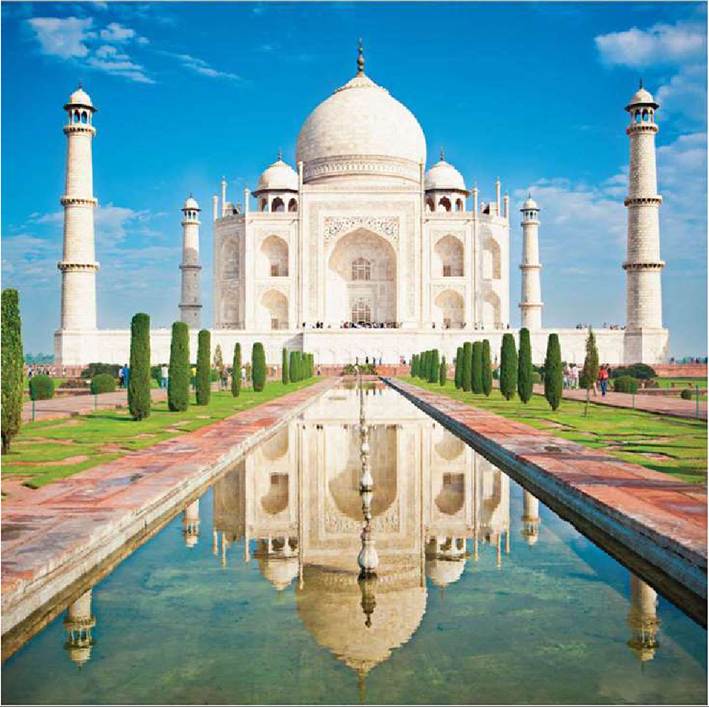
The Taj Mahal, in Agra, India, was built in the 1600s by the Mughal emperor Shah Jahan as a memorial and mausoleum for his beloved wife, Mumtaz Mahal.
When the Ottoman Empire collapsed at the end of World War I, Turkey moved toward embracing European ideals of secular nationalism. A man called Mustafa Kemal, better known as Ataturk, the founder of modern Turkey, embraced this ideal. He argued that Turkey should follow the path of the western European nations and separate religion from politics. Ataturk disbanded the powerful religious brotherhoods, which had been very important in Turkey, and embraced a secular legal system that did not incorporate Islamic law at any level. He also required Turkish people to dress in a European style, which meant that women had to abandon headscarves and men had to stop wearing the traditional hat called a fez.
Although these policies were far reaching, they did not eradicate Islam from public life in Turkey. For example, although Sufi religious brotherhoods had been made illegal, many Turkish people still followed the mystical path known as Sufism, which we discuss later in this chapter.
Although Islamic courts were no longer a part of the official legal system, Muslims still took disputes to Islamic legal authorities, particularly in rural areas. During the late twentieth and early twenty-first centuries, many Turks reembraced their Islamic heritage. The Justice and Development Party, which has been supportive of reintroducing Islam into public life, has been the majority party in the governing coalition since the early 2000s.Other Muslim countries followed a veiy different path than Turkey. For example, in the Indian subcontinent, which was colonized by Great Britain, discussions of independence and nationalism early in the twentieth century focused a great deal on religious divisions in the region. With India’s independence from Great Britain in 1947, two countries were formed: India and Pakistan. Pakistan was created as a Muslim homeland for the millions of Muslims who lived in South Asia. An important thinker behind the creation of Pakistan, Muhammad Iqbal, argued that Muslims needed a separate country to protect them from the majority Hindus in India. An organization called the Muslim League was instrumental in the early twentieth century in launching the idea of a separate state for the Muslim people of India. That ideal became a reality with independence. At first, Pakistan was divided into East and West Pakistan. In the 1970s, East Pakistan became the country that is now known as Bangladesh. Today, Pakistan and Bangladesh are among the largest Muslim-majority countries in the world. India’s Muslim population today is even larger than in Pakistan and Bangladesh, yet they are in the minority.
Iran is an important case study of Islam and nationalism in the twentieth century. Throughout much of the century, the shah (or king) of Iran was Reza Pahlavi. The shah embraced the ideals of the Western world and looked to Europe and the United States as models for development. However, Iran’s Shi‘i religious scholars were critical of the monarchy for marginalizing religious learning and religious authority in Iran.
Iranian liberals and Marxists also criticized the shah as a corrupt leader who was entranced with the Western world and closely tied to Western governments, particularly the United States. In 1978, a coalition of clerics, intellectuals, and women’s groups formed with the goal of removing the shah and his family from power. The revolution they staged in 1979 deposed the shah and ushered in the leadership of Islamic clerics. Not surprisingly, after the revolution, many of those people who had supported the overthrow of the shah felt neglected when the religious clerics took charge and formed an Islamic Republic.A religious scholar known as Ayatollah Khomeini (1902-1989) headed the new government. In Shi‘ism, the term ayatollah, which means “sign of God,” refers to religious scholars who have achieved a very high level of religious learning and scholarship. Khomeini had been one of the most outspoken critics of the shah among the religious scholars, and he argued that it was the duty of the religious scholars to build an Islamic state in Iran. This is precisely what happened in the aftermath of the revolution. The new government instituted strict reforms, which they argued reflected Islamic rules of behavior. Women were required to dress in a full- length black garment known as the chador. Many Iranians, among them intellectuals and professionals, left the country and made their homes abroad in places such as the United States and Canada.
Today, people in Iran are divided as to how much authority religious scholars should have in the government. The supreme leader of Iran remains an ayatollah; the current supreme leader, Ayatollah Ali Khamenei, succeeded Khomeini in 1989. Iran also has a president. In 2009, huge numbers of Iranians took to the streets to protest the disputed reelection of President Mahmoud Ahmedinejad, and many have interpreted the protests as criticism of the Islamic Republic. The protest has been called the Green Movement, or Green Revolution, after the color adopted by the opposition presidential candidate, Mir-Hossein Mousavi. In 2011, Mousavi openly supported the pro-democracy Arab Spring movements in other Middle Eastern countries and called for more protests. He was then placed under house arrest for the next several years, and he remains detained at the time of writing. The current president of Iran is the moderate Hassan Rouhani, who was reelected in 2017.
More on the topic Islam and Nationalism:
- Founding Values and the Development of the Idea of Unamendable Provisions
- Unity in Diversity
- Fundamentalist Islam: Afghanistan and the Taliban
- Conclusions
- Chapter 20 Communism and Nationalism
- Urban African-American Religions
- ISLAM
- Conclusion
- Islam and the Colonial Encounter in Africa
- Brodd Jeffrey, Little L., Nystrom B., Platzner R., Shek R., Stiles E.. Invitation to World Religions. 4th edition. — Oxford University Press,2022. — 1196 p., 2022