Later Islamic Empires: The Ottomans, the Mughals, and the Safavids
After the fall of the Abbasids, several powerful Islamic empires arose in the next few centuries. These were the Ottoman Empire in the Mediterranean region, the Safavids in Iran, and the Mughal Dynasty in India.
The Ottoman Empire spanned over 600 years, from the fourteenth to the twentieth centuries. The early empire was marked by rapid expansion, and at the height of its power, the Ottomans controlled much of the Middle East and Mediterranean, reaching into southeastern Europe and Africa. The empire reached its height during the fifteenth and sixteenth centuries, and in 1453 the Turks took the city of Constantinople, the former capital of the Byzantine Empire. The city, now called Istanbul, became the Ottoman capital and an important seat of Islamic learning and Islamic power. The Ottoman Empire did not come to an end until after World War I.
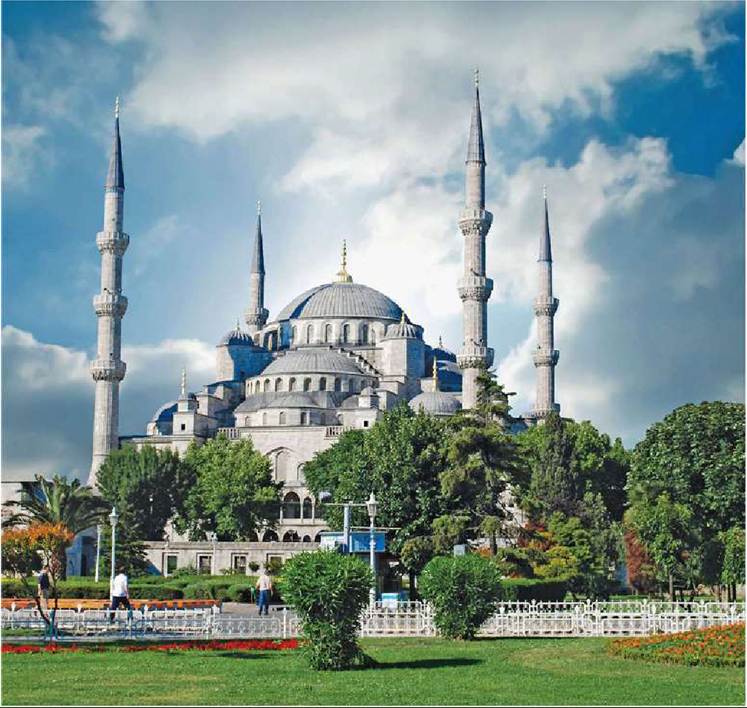
The Sultan Ahmed Mosque in Istanbul, Turkey, was built in the 1600s and is a fine example of Ottoman architecture. It is also known as the Blue Mosque because of the blue tiling inside.
At the same time that the Ottoman Empire reached its height, another Muslim empire arose thousands of miles away in South Asia. This dynasty, known as the Mughals, ruled much of India from the early sixteenth to the eighteenth centuries, even though the Muslim population was in the minority. The Mughal Dynasty, though not as long-lived as the Ottomans, saw a growth of literary and artistic development in South Asia. Mughal architecture is considered to have created some of the world’s most impressive buildings such as the Taj Mahal in Agra, India. The stunningly beautiful Taj Mahal was built in the 1600s by the Mughal emperor Shah Jahan as a memorial and mausoleum for his beloved wife, Mumtaz Mahal. The Mughal Empire reached its peak in the eighteenth century, and although there was a Mughal ruler until 1857 in India, Mughal power and territory saw a decline with the advent of British occupation of South Asia.
To the west of the Mughals during the same period, the Safavid Empire flourished in Iran. Perhaps the most notable aspect of the Safavid rule was the establishment of Shiism as the religion of Iran; to the present day, the vast majority of Iran’s Muslims are Shi'a. The Safavid period saw significant developments in Shfism, particularly in religious and philosophical thought. As with the Mughals, the period saw the development of great works of art and architecture.