Jacob's Well (John 4:4-42)
Visited by Christian pilgrims at least since the mid-fourth century CE, the water source known as Jacob's Well is located in a ravine between Mount Ebal and Gerizim, on the outskirts of modern-day Nablus—only a short distance from Tel Balata, the probable site of ancient Shechem.[314] According to biblical tradition Jacob, after parting ways with his brother, Esau, came to Shechem and bought the land around his camp, consecrating it to his god (Gen 33:18-20).
The patriarch's name would have had a legitimizing effect for those living in the surrounding environs, an effect which is transferred to the well in John 4. The shaft identified today as Jacob's Well measures just over two meters wide and reaches a depth ofFigure 3. Jacob's Well; image from www.BibleLandPictures.com / Alamy Stock Photo
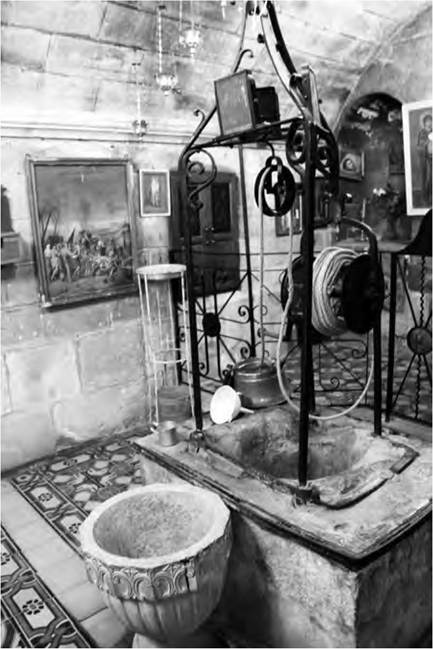
around thirty meters, the upper portion being lined with masonry and the lower cut into rock (see fig. 3). A puteal protects the mouth of the well, where it resides within a partially restored church on grounds owned by the Greek Orthodox Church (Stefanovic 1992; cf. Bull 1975). The well’s water, accumulating from rain and underground sources, would have been visible testimony to God’s favor, which John 4 exploits to good effect.[315]
Jesus’s interaction with the Samaritan woman transpires relatively early in his ministry, when he stops for a respite at Jacob’s Well in Samaria, en route from Judea to Galilee (4:3). This stopover sets the stage for the ensuing dialogue, during which Jesus describes his gift of life to the woman and identifies himself as messiah (4:7-26), disclosures he characterizes separately to his disciples as belonging to the work for which his father commissioned him (4:34-38). Jesus’s identity then becomes known to the villagers of nearby Sychar, first through the Samaritan woman's testimony and then their own subsequent exposure to Jesus (4:27-30; 39-42). Throughout the account the well remains a critical reference point, beginning with the comparison between its water (4:10) and the superior “living water” offered by Jesus (4:10).[316] The question is what message does it convey to John's community?