LUPERCALIA
One of the many other ancient festivals of Rome was the Lupercalia, celebrated on 15 February. The ritual content of this festival is fairly clear, but when it comes to the significance of the rituals the picture is more uncertain, since the sources offer different interpretations.
It is comforting to note, however, that not only modern scholarship, but also the ancient writers themselves seem puzzled concerning the various explanations of this festival.The ceremony started at the so-called Lupercal that was the cave where Romulus and Remus were found (see below). It is not known for certain what the word Lupercal means, but in antiquity it was assumed to be related to the word lupus, meaning wolf. In front of the cave some goats and a dog were sacrificed by the priests who were young men termed luperci. According to Plutarch’s description of the festival (Romulus [Life of Romulus] 21.3-8), two of these young men were touched on their foreheads with a bloody knife; the blood was immediately wiped off again by wool soaked in milk; the boys then burst into ritual laughter; and then they cut the goat skins into strips and raced around the Palatine hill, naked but for a belt around their waist, striking anyone in their path with the thongs. In connection with the ritual striking, women of childbearing age did not try to escape the blows, believing that they would assist fertility and easy childbirth.
Plutarch offers two different explanations for the festival: that it is a ceremony of purification, or that it is a commemoration of the myth of Romulus and Remus. According to the myth related by Livy (1.4-8), the twins Romulus and Remus were exposed in the Tiber and drift ed ashore near the Palatine hill. A she- wolf heard the babies crying and suckled the twins. A shepherd found the boys and raised them, and as young men they decided to found a city at the spot where they had grown up.
During a quarrel between the two over Remus’s alleged infringement of the ritual limits of the city, Remus was killed by Romulus or his supporters, and Romulus became the first king of the new city of Rome, named after him.In this mythical perspective, the two luperci in Plutarch’s description of the festival represent the twins. The bloody knife that is applied to their foreheads illustrates the twins’ dangerous situation in the past, and the cleansing with milk is a ritual reminder of how the boys were nourished and saved. In short, the Lupercalia was a celebration of the foundation of Rome. Other interpretations of the Lupercalia emphasize the fertility aspect of the festival as the most important: the group of naked youths running round the city, striking young women with a goat thong, bringing fertility and thus securing the future of Roman society.
Regardless of which interpretation one might prefer, the festival seems to have established an important ritual relationship between the past, the present and the future of Rome. Following this line of thought, the festival’s making of a collective Roman demographic and topographical identity could very well be the reason why the Lupercalia festival was celebrated for more than a thousand years of Roman history. A letter from the Roman bishop Gelasius testifies to the fact that the Lupercalia continued to be performed into the late fifth century CE (Gelasius Letter against the Lupercalia ch. 16; cf. Beard et al. 1998: II. 123-4). It appears that the bishop had to prohibit Christians from taking part in the festival, and that some of the Christians opposed the bishop’s ban, claiming that the traditional ritual of Lupercalia had to be performed in order to secure the continuity and welfare of the city. So, even though Christianity at that time was the official religion of the Roman Empire, some Christians still regarded the old pagan Lupercalia as an inseparable part of Roman culture.
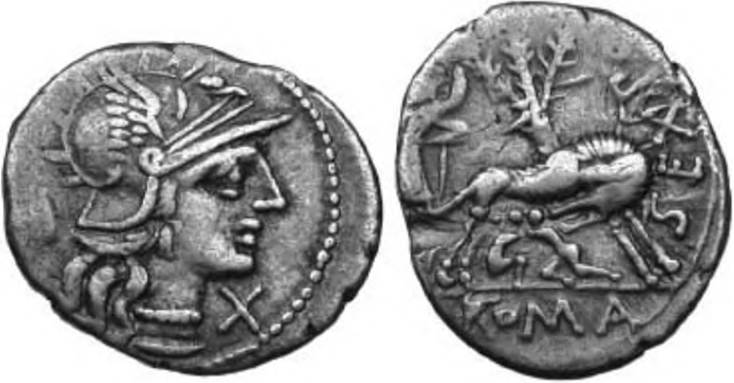
Figure 16.4 Roman Republican coin (ca.
137 BCE). Obverse: Head of the goddess Roma. Reverse: The she-wolf with the suckling twins Romulus and Remus. © Freeman & Sear, reproduced with permission.THE CULT OF CYBELE
During the long history of ancient Roman religion a number of foreign cults were incorporated into the official religion as a consequence of public prodigies and the subsequent instructions taken from the Sibylline Books. One prominent example is the cult of the fertility goddess Cybele from Asia Minor. The goddess was called Magna Mater (the Great Mother) by the Romans and the cult was incorporated into Roman religion in 204 BCE during the Second Punic War (Livy 29.10.4-11.8; cf. Beard et al. 1998: II. 209-11; Rasmussen 2003: 71, 246-9). A black cone-shaped cultic stone identified with Cybele/Magna Mater was shipped over from Pergamum to Rome and brought up to the temple of Victory on the Palatine hill. Later the Senate decided that she should have her own temple, also on the Palatine, and the annual Megalesia festival was instituted in her honour. It is worthy of note, however, that the Senate from the outset placed restrictions on Romans wishing to participate in the cult. The goddess had been accompanied to Rome by her own eunuch priests, but according to Dionysius of Halicarnassus (Roman Antiquities 2.19.3-5), Roman citizens were forbidden to take oaths as priests and priestesses of the goddess and were barred from taking part in the cult’s peculiar rituals. Sources (e.g. Juvenal Satires 6.511-21) likewise reveal a Roman aversion to the self-castrated priests with their strange, outlandish garb and their oriental, ecstatic dancing and wild music with noisy drums, pipes and cymbals. In other words, this foreign cult was incorporated in a very Romanized version, regulating Roman citizens’ participating in the cultic activities. The annual Roman celebration of Magna Mater did not copy the original content of the cult of Cybele, but featured a lectisternium, a sacred banquet given to statues of the gods, and ludi, games, which were days of processions, entertainments and competitions held in honour of particular gods or goddesses.
One might of course wonder why the Senate decided to import this very foreign and peculiar cult of Cybele in the first place. Nevertheless, according to the Sibylline Books it was the proper expiation of certain prodigies in a period of serious war-crisis. In addition, the historical circumstances seem to involve foreign policy issues, as the cult was borrowed from King Attalos of Pergamum in Asia Minor, Rome’s ally during the war against Philip of Macedonia. Finally, from a mythical perspective, the traditional “home” of Cybele, Mount Ida near Troy, was also assumed to be the birthplace of the Roman ancestor Aeneas. A consolidation of such a mythical and cultic relationship might have been considered beneficial to Rome’s relations with Attalos and his kingdom.
More on the topic LUPERCALIA:
- LUPERCALIA
- B. Bread as an Element of Sacrifices
- Romulus and Remus
- The Last Stalinist Festival
- Bredholt Christensen Lisbeth, Hammer Olav, Warburton David. The Handbook of Religions in Ancient Europe. Acumen,2013. — 456 p., 2013