Performance Traditions
There is a multitude of performance traditions in Hinduism, many of which cross over into the realm of ritual. Even the act of publicly reciting the Ramayana is believed to transform the performance site into sacred space.
Hindu sacred performance traditions include many different genres: theater, puppetry, dance, music, storytelling, processions, and street festivals.Ram Lila
The Ram Lila (“The Play of Rama”) is one of Hinduism’s most popular performance traditions. During the month of September, northern Indian villages and cities host Ram Lila festivals to coincide with the festival of Dussehra. These festivals, lasting anywhere from ten days to a month, are costume dramas based on the Ramayana. The most famous and elaborate Ram Lila is sponsored by the Maharaja (the hereditary ruler) of Ramnagar, a city located across the Ganges from Varanasi. The Ramnagar Ram Lila attracts pilgrims from all over northern India who come not only to participate in this annual festival but also to have darshan of Rama. The roles of Rama, Lakshmana, and Sita (the three principal characters of the Ramayana) are played by young upper-caste boys. For the duration of the Ram Lila, these boys are worshiped as the embodiments of divinity. Every evening, a priest waves a lamp, illuminating the principal characters who give darshan to the assembled pilgrims and devotees. Just as in a temple, where God is actively present in the icon, here, too, the very act of performing the Ramayana enables the young boys to embody divinity.
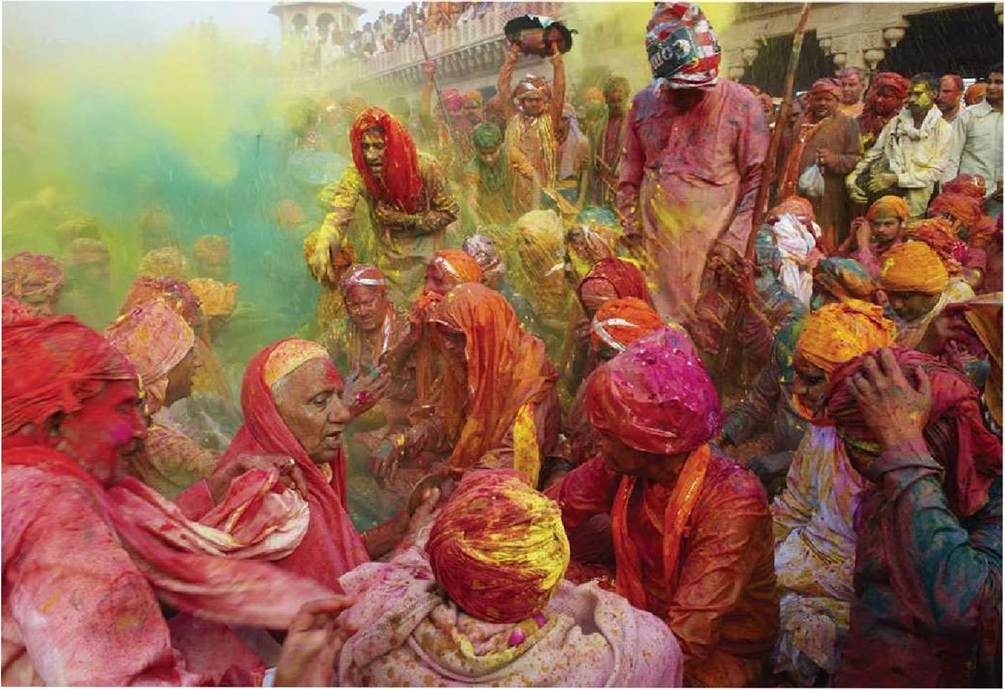
Fun and frolic characterize the spring festival of Holi, as participants mischievously smear colored powders or spray colored water on each other.
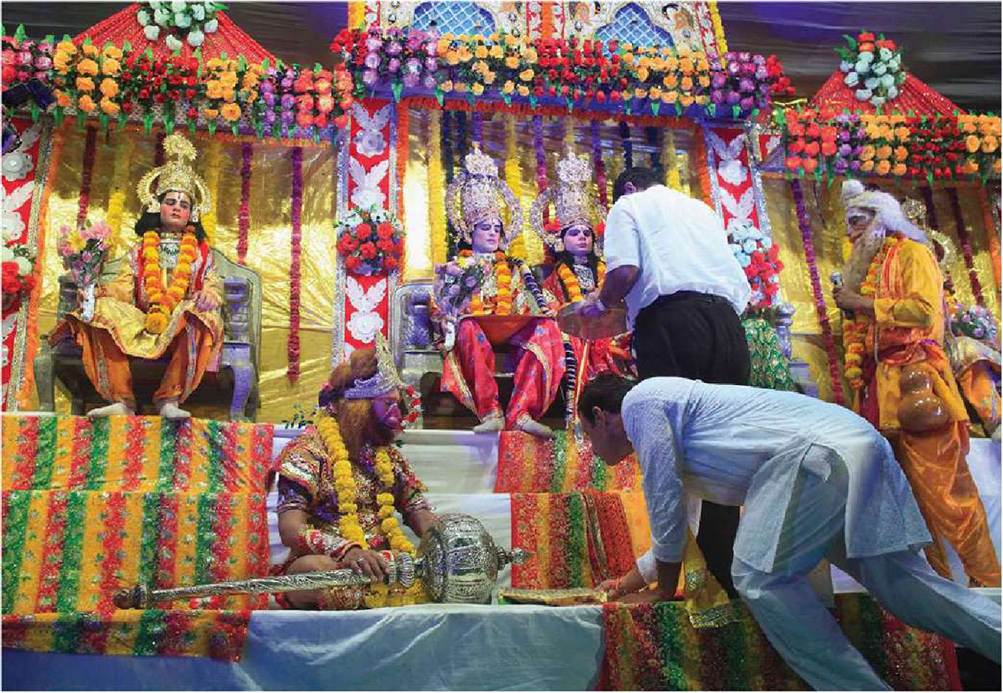
A performance in Mumbai, India, of Ram Lila, the very popular enactment of the Ra may ana.
Sacred Songs: Bhajan and Kirtan
The term bhajan refers specifically to devotional songs in Hinduism and Sikhism.
The bhajan helps the gathered community to contemplate the divine. This is usually achieved through repetition of key phrases and lines and also through a call-and-response format of singing. Often, profound mystical concepts are presented in simple language that everyone may understand.Bhajan may be contrasted with kirtan, which is not formal in either form or structure, nor is it constrained by setting. Kirtan may be performed in lively sing-along processionals that roam the streets. Instruments are not necessary for kirtan performance, although they are often used. There are two different types of kirtan performances: in one type, the kirtan leader and the chorus alternate singing the divine name; and in the other, a hymn is communally recited. Kirtan continues to be popular today, especially for the Vaishnava sect. As explained in Chapter 7. kirtan is also a vital component of Sikh worship.
Storytelling An important way in which Hindus learn about the content of their religion is through stoiytelling. Even today, as in centuries past, professional storytellers continue to travel particular routes throughout India to visit local festivals, where they sing the epics and other myths in all-night performances.
Modem Hindus enjoy sacred narratives through new and equally vibrant media, such as movies, television, and even comic books. Throughout the history of Hinduism, there have been numerous versions of sacred narratives, the Ramayana being perhaps the most obvious example. In recent decades, sacred narratives have been invigorated through print, radio, and television, as well as the Internet, with ever-new and imaginative retellings of these ancient stories.
More on the topic Performance Traditions:
- With the project in Zimbabwe in tatters, my colleagues and I began scouting for other places where introducing Saving for Change would make sense. Several countries in West Africa met our criteria:
- Cicero on Gyges’ ring and how Plutarch deals with the Puzzles
- FIVE COMPONENTS OF LEGAL COMPETENCIES