A Recipe for Sending Dreams in Harba de-Moshe [HdM Recipe N° 70]
Harba de-Moshe (HdM), The Sword of Moses, is a late antique Jewish magical treatise. It underwent several stages of redaction and exists in at least three different versions, all of which are preserved in relatively late manuscripts.56 In its longest version, HdM includes a literary-theoretical introduction, a long list of magical names, which represents the sword itself, and a collection of about one hundred and forty recipes for various purposes, all based on the recitation of a particular section of nomina barbara from the sword.57 In its extant forms, HdM is a late antique Babylonian composition, although it might
58 Bohak, AncientJewish Magic, pp.
178-179.59 The transcription and English translation are according to, respectively, Harari, Harba de-Moshe, p. 42 and Id., The Sword of Moses, p. 89.
60 For an introduction on nightmares according to contemporary medicine, see James F. Pagel, “Nightmares and Disorders of Dreaming,” American Family Physician 61(7) (2000), 2037-2042.
61 The percentage of recipes requiring a silver lamella is quite low in HdM—see Bohak, Ancient Jewish Magic, p. 177. Like dogs, roosters were commonly employed in ancient magic.
62 The string of magical names from the Sword reads “OUnniO '0 ONbllN ’Ol-OU '0 O1O10N ONTO '0 ”nuoin,”—see Harari, Harba de-Moshe, p. 33.
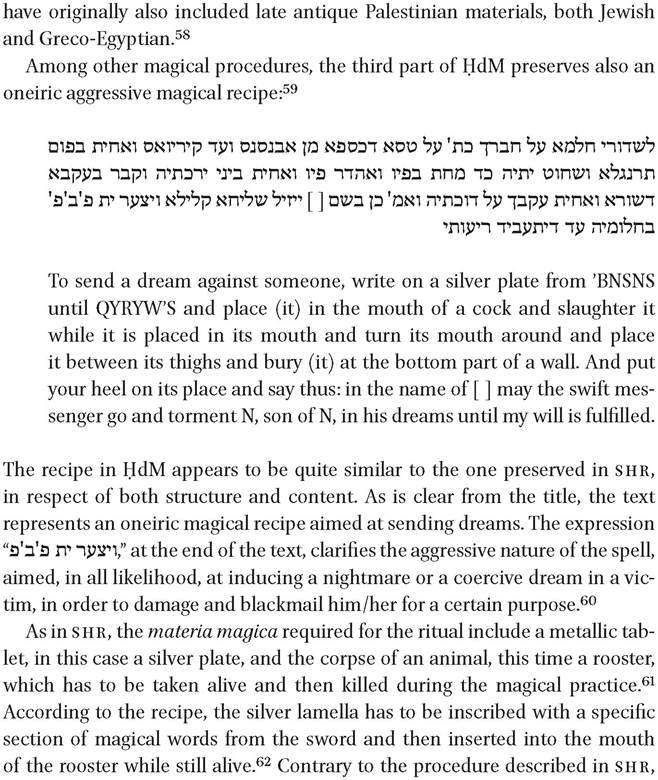
there is no need to seal the mouth of the animal with wax and a signet ring. Once the silver tablet is inserted in its mouth, the rooster is slaughtered and its body is twisted so that its beak is between its thighs. Finally, it is buried at the base of a wall. Besides functioning as a sacrifice to the non-human entities involved in the ritual, the body of the animal clearly symbolizes the victim. The magical knot created using the body of the rooster might indicate the subversion of the victim's physical and mental faculties as a result of the sleep disorder.
A recipe for erotic purposes, preserved on a magical rotulus from the Cairo Genizah that dates to the early tenth century, describes almost the same ritual dynamics: the placement of an inscribed lamella inside the body of a white rooster; the slaughter of the animal; the twisting of its body; and its burial.[365] Both texts present a strong aggressive component: the recipe in HdM being aimed at coercing the victim to have a certain dream and the Genizah recipe being intended to coercively induce a man and a woman to make peace[366] [367] The analogies with the erotic incantation in the Genizah rotulus might suggest an erotic character also for the recipe preserved in HdM, whose purpose may have thus been sending a spell of attraction to the victim through a dream. Spells of this kind are well attested also in pgm and pdm under the title “6v£iponogn6^.”65 Among them, an incantation in pgm XII.107-121 prescribes a strip of papyrus, written with myrrh, placed in the mouth of a black cat that died a violent death, thus coinciding with the magical procedure described in HdM and in the Genizah recipe.[368] The recipe in HdM lacks instructions for releasing the victim and the typical concluding formulae. It ends with an invocation to the “swift messenger” (Nb’bp Nn’bw), a supernatural entity who is also mentioned, at the beginning of the book, as being sent down to earth by God to search for a righteous person to whom he can deliver the mysteries. A similar epithet, “the swift prince,” also occurs in a historiola in the Babylonian incantation bowls, where the supernatural entity is described as helping a woman against demonic attacks against her children[369] The brief recipe for sending a dream in HdM is much less sophisticated than the spell in shr and contains no Graecisms[370] Nevertheless, it exhibits all the main features typical of oneiric aggressive magic and shows several analogies with other ancient Jewish magical texts, both Babylonian and Palestinian, as well as with magical textual corpora outside the Jewish tradition.