Religion as a Subject of Academic Inquiry
The academic study of religion, commonly known as “religious studies” (or sometimes as “comparative religion” or “history of religions”) is a relatively recent development. Prior to the European Enlightenment of the eighteenth century, it rarely occurred to anyone to think of a religion as an entity that could be separated from other aspects of culture, and therefore as something that could be defined as a distinct category and studied as such.
Enlightenment thinkers, most influentially the German philosopher Immanuel Kant (1724-1804), conceived of religion as something separate from the various phenomena the human mind is capable of perceiving.- This impulse toward categorically separating religion, coupled with European exploration of distant lands and their unfamiliar “religions,” launched efforts to understand religion that have continued to the present day. This shift means that we modern observers need to be cautious when appraising the religious aspects of other cultures, lest we make the error of assuming that all peoples have recognized religion as a distinctive category. Most cultures throughout history have had neither the conceptual category nor a term meaning “religion.”
William James defined religion as “the feelings, acts and experiences of individual men in their solitude.” This Orthodox Christian priest sits alone in the Amhara region of northwestern Ethiopia.
The academic study of religion is generally distinct from theology, the field of inquiry that focuses on considering the nature of the divine. Unlike religious studies, theology is an important example of doing and being religious, which naturally invites consideration of the supernatural and of the “truth” of religious claims. Religious studies, like most other academic pursuits, is to a large extent based on an approach to knowledge that depends on analysis of empirical data.
The discourse and actions of human beings can be observed and studied through normal means of academic inquiry; empirical evidence can be gathered, and through rational argumentation hypotheses can be formulated and supported. Supernatural beings and events normally are held to be beyond the reach of academic inquiry. The academic study of religion, as understood by the authors of this book, is therefore not theology, however much we might admire theologians and enjoy studying their work, which is itself an important human enterprise and a major component of religion.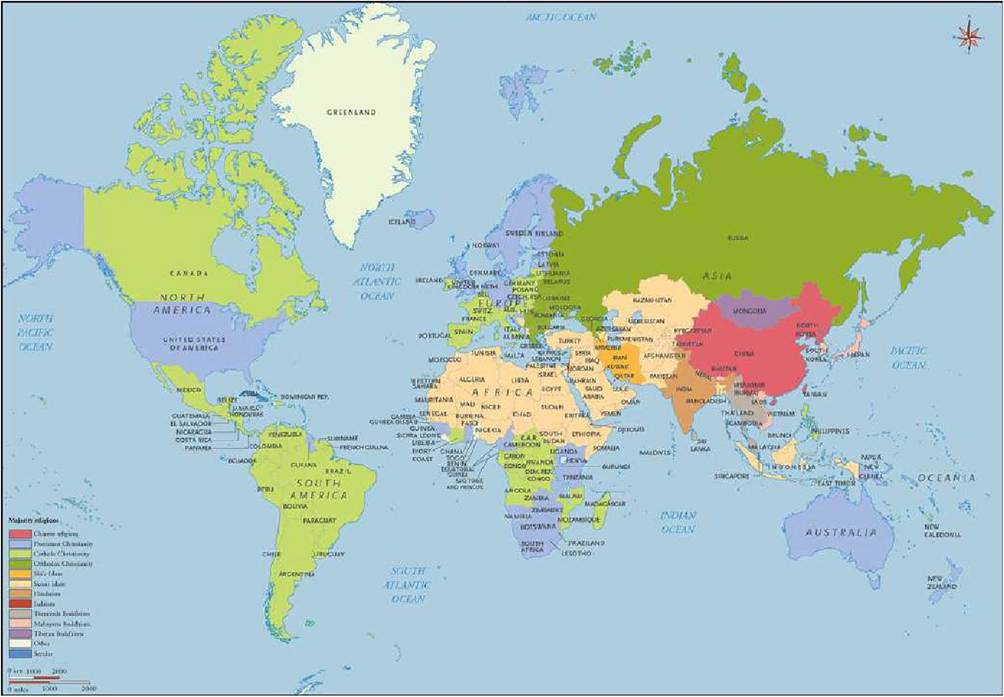
Religious affiliations of majority populations in the world today. Some countries have large populations of minority affiliations. In Germany, for example, there are nearly as many Catholics as Protestants.
Click here to learn more in an interactive map.
The Definitional Challenge
A natural outcome of the Enlightenment impulse toward categorically separating religion from other aspects of culture has been the attempt to produce a universal definition of the term. Scholars from various academic disciplines have struggled with this challenge without having produced a single definition that pleases everyone. Many theorists today dismiss the challenge as futile, and some even go so far as to argue that use of the term religion in academic study should be abandoned altogether because of its ambiguity and misleading inferences. Most scholars involved in religious studies, however, agree that they are studying basically the same subject, and for lack of a better term most are content with calling it “religion.”
The relevance of defining “religion” can be understood through an analogy that compares religions to houses. Embarking on a study of religions without concern over what, exactly, we are studying would be akin to setting off for foreign places to explore the nature of houses without first agreeing on what counts as a house.
Would we include apartments? Vacation cabins? Palaces? Defining terms helps us draw clear boundaries around the subject of study. Another challenge involves our preconceived notions of things. We might assume that everyone shares a common idea of a typical “house” (like the kind we learned to draw in grade school), but such an assumption is mainly the result of preconceptions based on our own culture’s norms. People from other cultures might dwell in structures that have little in common with our standard notion of a house.Let’s consider some notable attempts to conceptualize “religion” while keeping in mind our “house” analogy. When exploring the more specific category “world religion,” it will be useful to think of a similarly more specific categoiy of house: a mansion, and more specifically, an old mansion that has undergone a long process of refurbishing. Although certainly considered a type of house, a mansion has many rooms that serve a wide variety of functions and styles. Imagine an old mansion that has kept the same foundation and basic structure over the years, but to which various inhabitants have made changes that have enabled the structure to survive into modem times. Our study of the world’s religions is an invitation to explore several extraordinary “old mansions.” Our tools of study—beginning with considerations of definition —are designed to help us make the most of our explorations, to take in fully the teachings, the histories, and the practices of the world’s religions.
More on the topic Religion as a Subject of Academic Inquiry:
- Religion as a Subject of Academic Inquiry
- An Academic Approach to the Study of Religions
- The Sharia Inquiry Findings: Brief Overview
- Brodd Jeffrey, Little L., Nystrom B., Platzner R., Shek R., Stiles E.. Invitation to World Religions. 4th edition. — Oxford University Press,2022. — 1196 p., 2022
- Religion
- VOTIVE RELIGION
- What is Religion?
- Subject Index
- Religion
- Foucault: The Construction of the Subject