Sikhism as a Way of Life
One aspect of Guru Nanak’s teachings was the rejection of the outward forms of religion that he found troubling in the Islam and Hinduism of his day. Focused as he was on seeking the indwelling God through meditation on the divine Name, Guru Nanak regarded the external forms of religion as useless.
Guru Nanak’s rejection of outward forms of religion, however, has not led the Sikhs to avoid religious observances altogether. For one thing, Sikhs through the centuries have continued to celebrate annual festivals that are generally features of northern Indian culture. We noted previously that Guru Gobind Singh founded the Khalsa on the day of an important annual festival, Baisakhi Day, which is the first day of the Indian year (according to the Western calendar, this day occurs in March or April). For Sikhs, Baisakhi Day has the special significance of commemorating the founding of the Khalsa. Another important festival celebrated by Sikhs, as well as by Hindus and Jains, is Divali, the Festival of Lights (which takes place in October or early November). Other religious observations were instituted by the Sikh Gurus, most notably by Guru Gobind Singh, and are unique to Sikhism.
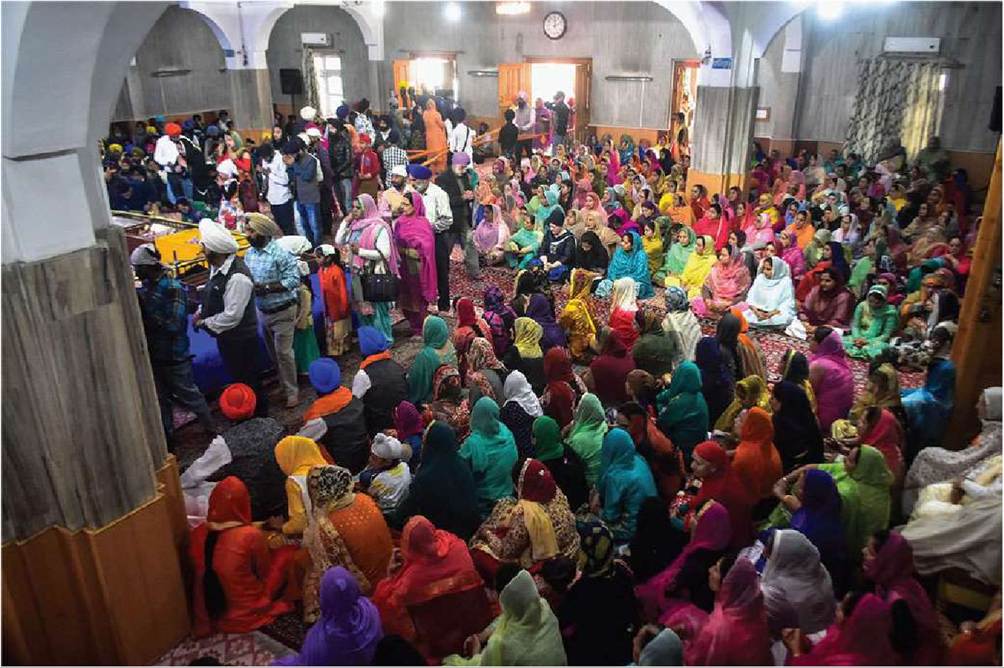
Sikhs celebrate Baisakhi Day on April 14, 2018, in Srinagar, India
VOICES:
An Interview with Onkar Singh
Onkar Singh is a Sikh who was born and raised in the Punjab, earned a PhD (Entomology) from the University of California, Berkeley, and served in India, Nigeria, Sudan, Liberia, and Indonesia before immigrating to the United States and becoming a US citizen. He has devoted his retirement years to educating his fellow citizens about Sikhism.
What is the significance of the Name of God, and does the fact that your name, “Onkar,” is one of the Sikh names of God have special significance?
God’s name is used to remember him, to meditate on him, to pray to him, and to seek his blessings.
People are named after different names of God (Bhagwan, Govind, Hari, Indra, Kartar, Eshwar, Ram, etc.) or gods and prophets (Krishan, Shiva, Jesus, Moses, Mohamed, etc.). I was named Onkar, after the most common name of God in the Sikh Holy Scriptures, following the tradition of choosing a name starting with the first letter of the hymn when Sri Guru Granth Sahib is opened at random.
Onkar Singh.
What is the primary purpose of prayer?
The primary purpose of Sikh prayer is to thank God (Vahiguru) for all his blessings thus far and to seek his blessings for the success of the task about to be started. Sikhs also ask for his continued blessings so that they submit to his will and continue to remember him at all times. The prayer ends with a request for their optimism and for the welfare and prosperity of the entire humanity.
How does wearing the turban relate to your religious beliefs?
In South Asia and Southwest Asia, the turban is a symbol of dignity, honor, respect, and responsibility. Guru Hargobind, the sixth Sikh Guru, asked his followers to wear turbans, carry arms, and ride horses, in opposition to a ban imposed on non-Muslims by the rulers. Further, in 1699, Guru Gobind Singh, the tenth Sikh Guru, prescribed the five articles of faith, including uncut hair (and the turban) mandatory for the Khalsa. I wear a turban as per the dictates and practice of my Sikh faith.
To what extent are the Golden Temple and the Sikh homeland of Punjab in general of special meaning for you, living in the United States?
The Golden Temple, Amritsar, is the most visited Sikh shrine. More people, of different faiths, castes, and so on, visit the Golden Temple than the Taj Mahal. Guru Arjan Dev, the fifth Sikh Guru, built this temple. He invited a famous Sufi saint, Mian Mir, to lay its foundation stone. Further, he compiled, edited, and installed the first edition of the Sikh Holy Book in this temple in 1604.
The Golden Temple Complex houses the SGPC (Shromani Gurdwara Parbandhak Committee) and includes the Akai Takht and some historic gurdwaras. Besides the Golden Temple, the Sikh homeland of Punjab has three Takhats and numerous historic gurdwaras. Sikh Americans, irrespective of the country of their birth, look upon Punjab as the Land of their Gurus, who preached Unity of God, practiced equality of humanity, and worked lovingly to unite the populace.What is the most important thing that non-Sikhs in the United States need to understand about your religion?
Non-Sikhs in the United States should understand that almost all who wear turbans in America are followers of Sikhism, which is not a branch of another religion (e.g., Hinduism or Islam) and has its own founder (Guru Nanak) and Holy Book (Sri Guru Granth Sahib) and worship places (gurdwaras), where all are welcome.
In this section, we focus on the ideals of the religious life, paying attention to the actual degree of participation among Sikhs today.