Sikhs inthe Diaspora
Sikhism clearly has become a global religion. For most Sikhs, traditional aspects of the religion as it has been practiced for centuries in its homeland, especially as defined by the Khalsa, tend to endure.
At the beginning of this chapter, we noted that there are approximately 25 million Sikhs in the world,15 of which approximately 70 percent follow at least the basic requirement of the Khalsa and do not cut their hair. Only about 15 percent of Sikhs have undergone the traditional ceremony of initiation into the Khalsa.With nearly 2 million Sikhs now living in the diaspora— (that is, outside of the Punjab and of India), the issues of these Sikhs have gained prominence. Many of the traditional practices taken for granted in the Punjab simply are not feasible—or, in some cases, even legal—in other lands. Consider, for example, Sikh funeral rituals. According to the Rahit, and in keeping with long-standing tradition, the body of the deceased is to be borne to the pyre on a bier, not in a coffin, and the fire is to be lit by a close relative or friend. In countries such as the United States, such a practice is not permitted; as a result, adjustments are made. The ceremonial departure for the cremation site is replaced by placing the coffin into a hearse, which then proceeds to a crematorium. (Or the ceremony is held at a funeral home that is equipped with a crematorium.) The lighting of the pyre is replaced by the chosen person pushing the button that conveys the coffin into the cremation furnace.
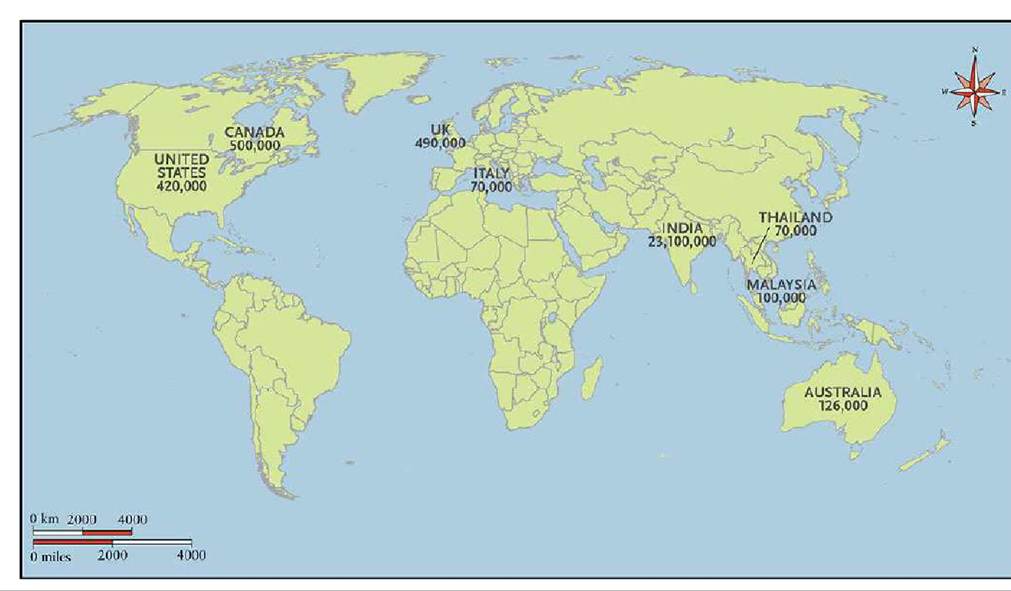
Countries with significant Sikh populations (all figures are approximate, as estimates vary widely).
Other challenging situations for Sikhs in the diaspora involve the Five Ks. Wearing the turban, for example, which is based on the requirement of uncut hair and is almost universal among male Sikhs in their traditional homeland, is an important symbol of Sikh identity.
But in many places in the diaspora, wearing a turban is not so easily done. In the United States, for example, there are laws requiring that helmets be worn when driving a motorcycle. A Khalsa Sikh who wishes to don the kirpan (the sword or knife, one of the Five Ks) when traveling by plane must be prepared for varying rules governing security practices at airport screenings.In some cases, governments have attempted to accommodate Sikhs. In the United Kingdom, for example, motorcycle helmet laws have been modified. But in many situations, such traditional practices as wearing the turban have led at least to inconvenience and sometimes even to tragedy. In the aftermath of the attacks on the World Trade Center and the Pentagon of September 11, 2001, Sikhs have been mistaken (presumably because of the wearing of the turban) for Muslims and have become targets of hate crimes, including murder.
For Sikhs living in the diaspora, this issue of identity needs to be weighed against practical concerns, sometimes even involving one’s safety. Whereas most Sikhs in the Punjab continue to follow the injunction not to cut their hair, most living in Western countries do not. The Panth, as a global religious community, must contend with this complex mix of issues and concerns.
GLOBAL SNAPSHOT
A Century of Sikhs in America
Of the nearly 2 million Sikhs who live outside of the Punjab, over half live in North America and the United Kingdom. About 500,000 Sikhs live in Canada, and about 420,000 live in the United States, although some estimates are significantly lower. Sikhs began to immigrate to North America in 1903, first to British Columbia and soon thereafter to other destinations. In 1912, the first gurdwara in the United States was established in Stockton, California. Over the course of the next three decades, the number of Sikhs immigrating to North America increased only gradually because of controls put in place by both the United States and Canada.
After World War II, when these controls were relaxed, both countries saw an increase in Sikh immigrants. In Canada, by the mid-1980s, about 30 percent of all South Asian immigrants were Sikh.-As this chapter explains, Sikhs living in the diaspora face special challenges in various ways, including their ability to observe the Five Ks—for example, when required by law to wear a helmet when driving a motorcycle, while also being true to kes, not cutting one’s hair. An innovative adaption relating to kes is the use of the patka, a smaller version of the turban that is often worn by Sikh boys and young men in North America. One Sikh website offers patkas for sale in four different sizes, ranging from eighteen inches square to twenty-seven inches square—still much smaller than the traditional turban, which is many feet long.
Sikh communities across North America tend to emphasize the importance of the gurdwara as a social as well as a religious gathering place, with the langar and its weekly meals being especially important. A publication on the 100-year history of Sikhism in California’s Central Valley credits the langar as having been “one of the primary reasons for the founding of Gurdwara Sahib Stockton.’’- In an article appearing in the New York Times at the time of the centennial celebration of the gurdwara, Bhira Backhaus, a Sikh native of Stockton and author of the novel Under the Lemon Trees, reminisces about attending the langar as a child.-
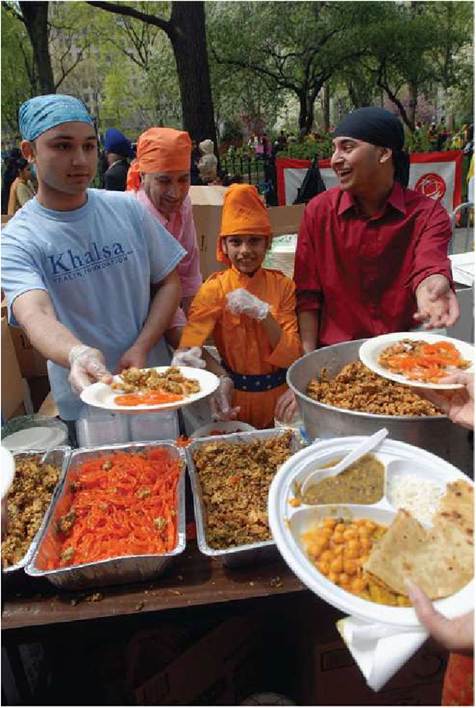
The langar meal is shared at the conclusion of the twenty-first annual Sikh Day Parade in New York City.
Self-Assessment 7.2
[Please note: You must be using an online, browser-based eReader in order to view this content.]
1 Hew McLeod, Sikhism (London: Penguin, 1997), 261.
-100 Years in the USA: Sikh-American Establishments & Their Journey, 1912-2012 (Stockton, CA: Pacific Coast Khalsa Diwan Society, 2012), 99.
http://www.nvtimes.com/2o12/o8/o8/opinion/a-sikh-temples-proud-historv.html
More on the topic Sikhs inthe Diaspora:
- Sikhs in Conflict and in Search of Nationhood
- Violence inthe Rise to Power
- The Ukrainian Diaspora
- 23 Zaporozhia and Southern Ukrainian Lands inthe Eighteenth Century
- The Ukrainian Diaspora: The Example of the Famine-Genocide
- Diaspora Judaism Reinvents Itself
- 28 The Ukrainian Diaspora
- The Ukrainian Diaspora
- How large is the Ukrainian diaspora, and what role does it play in North American politics?
- African Ritual Violence: Close Combat in Western Africa and the Diaspora
- This chapter will explore ritual violence in the form of close combat in precolonial western Africa (and the African diaspora) during the period of European contact from the mid fifteenth century until the late nineteenth century, a period which saw an end to the slave trade and the start of European colonisation.
- Sikhism is the most recent in origin of the recognised Indian religions.
- The History of Sikhism