Standardized and Alternative Demons
The sources discussed above reflect several different demonological views from a range of different traditions. The quotation from Speculum astronomiae as well as some of the examples presented here imply that medieval writers confronted a small-scale crisis whenever they encountered the anomalistic demonological views in new translations.
Thirteenth-century angst can be traced back to late antiquity, when Neoplatonically-orientated Hellenistic polytheism and demonology still formed an essential part of theological thinking. Some Christians adopted this tolerant view, but the most outstanding authors, such as Saint Augustine and Isidore of Seville, condemned non-Christian spiritual beings as demons or bad angels that were unambiguously evil, the causes of illnesses and calamities, and deceivers of mankind. Polytheistic pagan religions were lumped together with magical practices and other non-Christian rituals as works of demons and enemies of the true religion.[837]Augustine and Isidore's opinion became prevalent, and when Christianity spread to northern Europe, the endemic gods and spirits were usually labelled demonsjust as the Olympian gods had been before them. This demonizing interpretation of non-Christian spiritual entities dominated medieval and modern attitudes, and still exerted an influence on academic research in the first half of the twentieth century, when magic was regarded as the corrupted opposite of science and religion.41 For example, Aby Warburg, one of the pioneers in occult studies, regarded astrology as a dangerous enemy and a star-worshipper as a despicable creature, and systematically labelled decan divinities of old Egypto-Hellenistic astrology demons. As late as 1972, his follower Ernst Gombrich classified the personifications of planetary deities described by Renaissance theorist Marsilio Ficino as ‘demonic beings' with an intentionally negative connotation42
We have already seen that this prevalent attitude was not the only one that resonated in medieval Europe.
In his Forbidden Rites, Richard Kieckhefer refers to Richard Greenfield, who classified the demons of Byzantine practice into one of two main lines. The ‘standard tradition' followed the orthodox Christian view of demons as fallen angels and essentially evil followers of the Devil. The ‘alternative traditions' recognized several divergent leaders and hierarchies of demons, who were independent agents with virtues of their own. Kieckhefer goes on to suggest that the same distinction prevailed in the later medieval West as well, or at least one can discern the tension between orthodox Christian views and the Graeco-Roman conception of Socratic daimones.43Magister Speculi's anxiety possibly illustrates many aspects of this spiritual clash in medieval Europe. Fundamentally, the Christian orthodoxy controlled by the ecclesiastical elite responded negatively to the demonological views of magical disciplines. Nevertheless, the new astro-magical sources, which streamed into Europe in scientific guise during the twelfth and thirteenth centuries, challenged Christian views with regard to the nature of the spiritual world. The heritage behind this ‘alternative tradition' is manifold. The treatises close to natural magic (Kyranides, De XVstellis), for example, share many features with the folklore, mythology and medicine of ancient Mediterranean cultures. Firstly, demons (or spirits) often appear along with spirits of the dead or are assimilated with them. This was the most common belief, while philosophers and Church fathers confirmed that souls of the dead might become demons.44 The spirits of the dead were also summoned and placated with
41 See, e.g., Michael D. Bailey, “The Meanings of Magic,” Magic, Ritual and Witchcraft 1 (Summer 2006): 1-5, 9; and Hans Dieter Betz, “Magic and Mystery in the Greek Magical Papyri,” in Magika hiera, pp. 244-259.
42 Aby Warburg, Heidnische-Antike Weissagung in Wort und Bild zu Luthers Zeiten (1920). Gesammelte Schriften (Lichtenstein, 1969), pp.
491, 497. Ernst Gombrich, Symbolic Images: Studies in the Art of the Renaissance (Oxford, 1972), p. 173.43 Kieckhefer, Forbidden Rites. 154-155, 167, notes 1 and 2. Richard Greenfield, Traditions of Belief in Late Byzantine Demonology (Amsterdam: Adolf M. Hakkert, 1988).
44 E.g. St. Augustine, De civitate Dei, IX.11. Augustine is relying on Plotinus. sacrifices and other ritual practices. Secondly, the shadows and zoomorphic demons roaming at night can easily be connected with the larvae, lemures and manes of Roman mythology and with Graeco-Roman genii in different places, varying from the hearth to trees, mountains and rivers.[838]
Thirdly, although academic physicians processed the theories of humoral pathology, many diseases were commonly believed to be caused by spiritual beings. This is true especially in the case of mental disorders, which were generally connected to the spirit world. Fourthly, probably the habit of burying magical items underground or submersing them in water is also a continuation of the Graeco-Roman habit (defixio tradition) of hiding the tablets of curses dedicated to subterranean gods in graves, wells and springs[839]
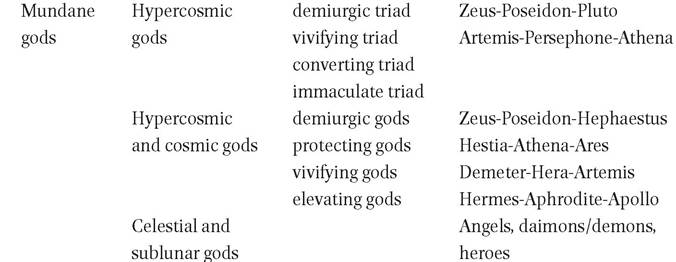
At the same time, the medieval manuals contain signs of organized structures of demons that bear allusions to late antique systems of philosophy and theology. Kieckhefer traces this tradition, which contains various ranks of (quasi-)independent demons, back to Late Hellenistic Neoplatonism, particularly in lamblichus and Proclus[840] Proclus (fl. fifth century ce) has provided us with a complex and meticulous hierarchy of gods and spiritual beings. Following Plato and views of oriental dualism, he divided the universe into the transcendental world inhabited by hierarchies of intelligible gods and in the material world inhabited by mundane gods. These lower divinities are categorized as hypercosmic, cosmic and sublunar gods, which together form several triads of divinities.
Besides the gods, the material world (that is, the celestial spheres and terrestrial level) is filled with hierarchies of angels, daimons and heroes[841]table 16.1 Categories of mundane gods according to Proclus. The table is originally reconstructed by H. D. Sajfrey andL. G. Westerink
One can easily make the assumption that the spirits capering through the magic manuals are descendants of this complicated Proclean system. This is not to say, of course, that the compilers of magical formulas were experts in metaphysics and theology, but rather that they were conscious of the basic functions of different spiritual beings in the Proclean system and shared basic assumptions with the Neoplatonic worldview in general.
Still, one possible connection to ancient theology lies in polytheism and astrolatry. Some magical treatises—especially those of Hermetic image magic and the anonymous De imaginibus contain traces of the adoration of planets, planetary spirits and Olympian deities associated with the planets. In the De imaginibus, the formulas are connected to one or two planets and carved with the names of the angels or spirits associated with those planets. Each sign of the Zodiac and each planet possesses four to eight spirits, the names of which are listed at the end of the manual (fol. 8r-v). De imaginibus septem planetarum, in turn, instructs the reader to fabricate a talisman that should resemble both Jupiter and the magician himself; the sigil of Jupiter should be carved on the figure’s head, the name of the magician on its forehead and the name of the planet on its chest. Finally, after suffumigations, the following words must be intoned: ‘Oh spirit of Jupiter, spirit of love and affection, make me lovable, cordial and placid.’[842]
The origin of the texts is uncertain, but the widespread use of planetary talismans and intermediary spirits indicates a magical tradition that many authors, such as David Pingree, have ascribed to the Sabaeans of Harran, a pagan community devoted to astrolatry and active between the eighth and eleventh centuries.[843] The Harranian origin was later seriously questioned,[844] [845] [846] [847] but regardless of the geographical birthplace, one can identify a tradition of image magic that concentrates on planetary talismans and whose theoretical framework is connected to Neoplatonic notions of spiritual hierarchies and celestial spirits. Nonetheless, although some affinities between ancient Neoplatonism and medieval magic in the Latin West can be recognized, the connection remains loose. The spirits apparent in the medieval treatises are seldom completely defined, nor are they distinctively connected with any specific system or organization. As a matter of fact, antiquity has left behind other textual testimonies that offer more direct examples of medieval magical practices. Papyri Graecae Magicae [pgm], ‘The Greek magical papyri,' is a body of papyri from Graeco-Roman Egypt deriving mainly from the second century bce to the fifth century CE. The collection contains magical spells and formulas, hymns and rituals that are mostly based on old Egyptian tradition, occasionally combined with the Hellenic traditions of Olympian gods.52 Many of the formulas are involved in one way or another with summoning the gods, angels (mostly Hellenistic and Egyptian, but also Judaeo-Christian entities), daimons, spirits and shadows (all of these terms are employed). The Papyri usually consider spiritual beings as friendly or neutral assistants that can be persuaded or compelled to answer questions or offer help in different situations53 (the only formula for expelling daimons appears to be Judaeo-Christian’’4). One formula, for example, requires summoning a divinity called Apollo in order consult him. The conjurer is instructed to write seven magical characters on a sprig of laurel, dress himself in a prophetic garment, burn certain exotic offerings, write sacred names on a linen cloth and finally call Apollo, beginning with the lines, ‘O lord Apollo, come with Paian. / Give answer to my question, lord’.[848] [849] In another experiment, a sacrifice of a cat and invocations of several spirits, angels, and heavenly and chthonic gods are used to summon daimons: I conjure you, the daimon that has been aroused in this place, and you, the daimon of the cat that has been endowed with spirit; come to me on this very day and from this very moment, and perform for me the nn deed.56 In general, a great number of formulas for medieval magic—both for ritual, natural and image magic—have obvious parallels in these Egyptian experiments. We have discussed traditions—Neoplatonic theology, polytheistic astro- latry and Egyptian folklore—that are characteristically syncretistic traditions of the Eastern Mediterranean in Late Antiquity and the Early Byzantine era. These traditions treat spiritual beings either neutrally or positively, and the relationship with demons, spirits and polytheistic divinities is often appreciated or at least is collaborative. The same features can be found in certain sectors of medieval magic, for example, in the Hermetic image magic and in other treatises of image magic. One must, however, point out that neither the Neoplatonic tradition nor the Papyri connect demons to illness except sporadically. This is partly due to the minuscule role that infirmities and healing play in the great cavalcade of charms that the Papyri offer, but also is partly due to the optimistic demonological view that the Papyri highlight. The origins of the negative accounts of spirits are found elsewhere—for example, in the mythologies and folklore of earlier Graeco-Roman antiquity and, of course, from the Judaeo-Christian doctrines.
More on the topic Standardized and Alternative Demons:
- Standardized and Alternative Demons
- WHO ARE THE ALTERNATIVE BORROWERS?
- Alternative Christianities and their Offshoots
- Is There an Alternative?
- CASE 137: Alternative Remedies
- Bhayro Siam, Rider Catherine (eds.). Demons and Illness from Antiquity to the Early-Modern Period. Leiden, Boston: Brill,2017. — xiv, 434 p., 2017
- Forces that have biased research on competition
- PauI R. Magocsi’s Work: Some Critical Comments
- Manus and marriage43
- The Validation of Signs