Statues of the King
The majority, if not all, of the images of kings in private tombs in Thebes in the Ramesside Period were, in fact, depictions of statues of the king. This can be seen in the similarities between images of statues of the king in festivals
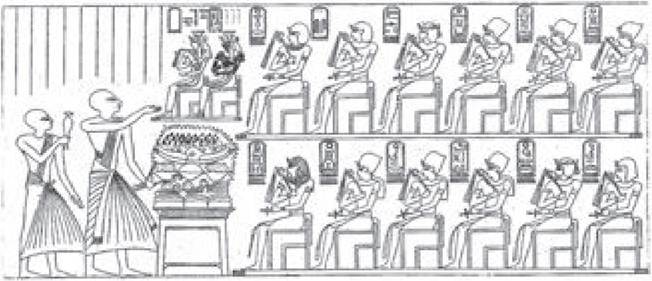
Fig.
3. TT19: Deceased and priests before two rows of seated kings and queens (Foucart 1935: pl. xii).and images of kings in other contexts within tomb depictions. If one looks at the depiction of the oracle of Amenhotep I from TT2 (Fig. 1) and compares it with the image of Amenhotep I from the king list in TT1937 (Fig. 3), one can see that Amenhotep I is wearing the same wig with band, while all but one of the other kings are wearing different headdresses - perhaps the use of this headdress for Amenhotep can be linked to a commonly seen statue of him, as depicted in TT2 (Fig. 1). Here one can see that it was through these statues, which played an active part in the lives of the communities, that the people felt a connection with pharaoh rather than through the person of the king himself. It appears that these images replaced the actual person of the king in the minds of the people, so that when they came to depict pharaoh in their tombs they were unable to produce an accurate likeness of the king, but could, instead, replicate his statue. It is possible that depictions of kings in tombs were less depictions of specific individuals than representations of the idea of the king as the head of the state. It has been suggested that the use of the same dress for certain groups of kings in tomb depictions is evidence that they were seen not as individuals but as a part of an ideological group (Redford 1986: 54). For example, in the scene in TT19 (Fig. 3), the Thutmoside kings all wear the khepresh,38 which identifies them as part of a genealogical grouping rather than as individuals (of course, the fact that Horemheb and Amenhotep III are also depicted wearing the khepresh in this scene may negate this theory).
Redford (1986: 53) agrees that the use of certain headdresses shows an attempt to copy specific cult statues - he uses the example of a depiction of the deceased adoring two rows of royal figures in TT284 and suggests that the crowns worn in this scene were used to display the ‘plurality of crowns a cult image might wear' (Redford 1986: 54).Perhaps a distinction should be drawn between the king as an individual person, and the king as the representative of the state. While the individual king is born, ages and dies, the king as the representative of the state and, indeed, of the gods, is an immortal concept. Images of royal figures in private tombs may be seen as showing the king as the representative of the state, an unchanging and eternal being, rather than focusing on the individual characteristics of each individual king, although this contradicts to some degree the suggestion that images in tombs represented specific cultic statues. This idea is discussed with relation to medieval kingship by Kantorowicz (1997: 364-72), and implies that the various crowns worn, for example, in the image in TT284, may be representing the different faculties of ‘kingship’ as an institution rather than crowns worn by specific kings or statues. There is some evidence of possible visits by the king to localities, but they are not common. Ostracon Cairo 25560, with which this contribution was begun, mentions a possible visit by Seti II to the West Bank at Thebes, but such visits are not commonly recorded, leaving one to suppose that they were rare. It is likely that the majority of state visits to villages were carried out by representatives of the king rather than by the king himself. This meant that many people had no access to the king as a person, and may, in fact, never have set eyes on him at all. Gasnier (2006: 277) stresses that state visits to the localities are a key factor in the forming of cultural memory and state legitimization as they help to ‘affirm the strength of the government and glorify pride in the locality’. But in the absence of such visits, perhaps this void was filled by appearances of statues of the king, which became an unchanging part of the tradition of the people. While he was alive, the king was visible to the people mainly through statues and monuments, a fact that did not change after his death, so it is not surprising that, in many ways, royal involvement in local life continued after the death of the pharaoh in much the same way as it had done during his life. The Ramesside emphasis on royal genealogy, especially within festivals, further encouraged a knowledge of royal ancestors which was then translated into private tombs. Images of deceased kings in private tombs at Thebes do not differ from those of the living king, suggesting little acknowledgement by the artists of the difference. One must ask whether pharaoh that was never truly ‘alive’ for the people could ever truly be ‘dead’.
More on the topic Statues of the King:
- The King Is Dead
- B. Mary as Earth-Goddess
- CHAPTER FOUR Town and Country Urban devotions and rural rituals
- The Scythians
- The Middle World
- The Validation of Signs
- Isis in the Greco-Roman World: Cultural Memory and Imagination
- CHAPTER ONE The New Jerusalem: Kiev