The context
The rise in the significance of the city was generally associated with the rise of the Mauryan empire in the late fourth century bce. The famed Greek emperor Alexander the Great had come to the banks of the Indus in 326 bce preparing his troops for entry into Northwest India.
Because of Alexander’s death, the invasion never occurred; yet among those princes preparing to battle Alexander was one Candragupta Maurya. Candragupta before long had amassed the largest army on the subcontinent with hundreds of elephants and tens of thousands of infantrymen. By either conquering or making alliances with the princes of other city-states, he established an empire that stretched across much of North India. Candragupta’s grandson, Asoka, enlarged the area of Mauryan hegemony, until after a particularly brutal battle with the Kalingas on the east coast he was moved to convert to Buddhism, or, at least, to selectively appropriate the teachings of his Buddhist mentors. Under Asoka’s selective application of Buddhist dhamma, the rudiments of a compassionate judicial system were implemented, non-violence and vegetarianism were encouraged and various religious sects were honored, though monasteries were patronized and Buddhist principles favored. Asoka came to be known by later Buddhist kings as the model Buddhist king - he was both bodhisattva and cakravartin (literally, “turner of the wheel” - the Buddhist term for the emperor who maintained stability in the state and presided over dhamma). Asoka sent emissaries into Persia, Afghanistan, and Sri Lanka. In fact, the emperor Tissa in Sri Lanka was converted to Buddhism by a relative of Asoka’s, and Sri Lanka eventually became a center of Theravada Buddhist culture.With the decline of the Mauryas in 181 bce the sense of nationhood dissipated and the subcontinent reverted to city-states and regional satrapies
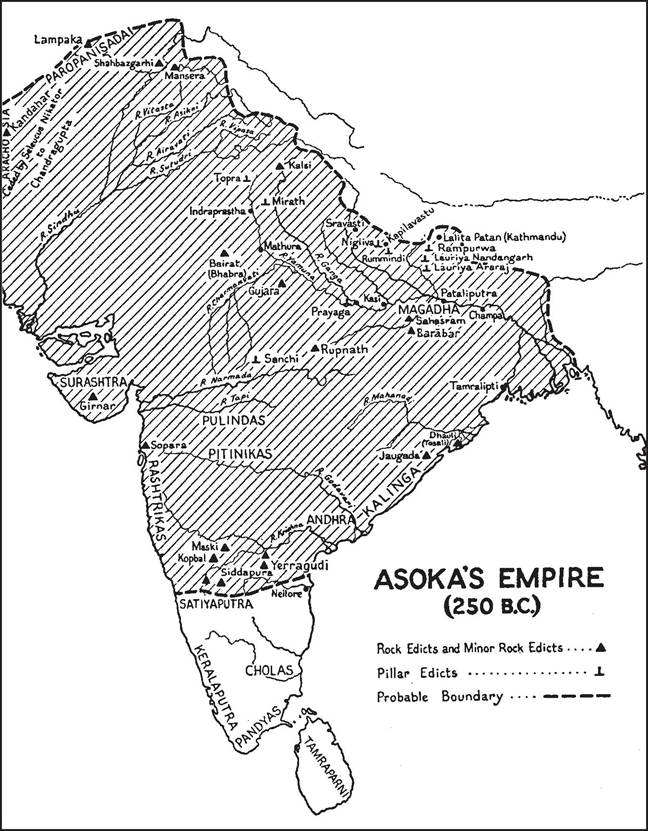
Map 1 Asoka's Empire
Reprinted from A Cultural History of India, ed.
by A. L. Basham (Clarendon Press, 1975), p. 587, by permission of Oxford University Press.for several centuries. The immediate successor to the Mauryas in the Gangetic basin was a brahman clan known as the Sungas. Its founder Pusyamitra sought to repress Buddhism and restore brahmanism in his realm. He is known to have performed at least two horse sacrifices (asvamedha).1 Upon Pusyamitra’s death, Smiga hegemony weakened and several foreign dynasties entered the scene. Among these foreign dynasties was one known as the Bactrian Greeks, who governed in the northwest and who mediated Indian and Greek culture. The Pahlavas (of Persian ancestry) began to govern in the northwest toward the end of the first century bce and were responsible for the infiltration of certain Zoroastrian and Persian motifs into the subcontinent.2 These included the Persian term for king, tratara (he who presides over all kings), which informed Indian notions of kingship; and the imagery of light/sun (from the Zoroastrian high god Ahura Mazda) which influenced Buddhist perceptions of Buddha in Northern India. One of these kings, Gondophernes, according to certain Greek texts, hosted the apostle Thomas.3
Another dynasty known as the Yueh-chis or Kusanas established hegemony in parts of Northern India from the first into the third century ce. It was during this period that commerce with china increased; the migration of Mahayana Buddhist monks to Central Asia and by the Silk Route into China increased; and certain Chinese influences filtered into India - these may have included the use of paper and the Chinese notion of the emperor as the son of heaven.
The Kusanas played a major role in the early centuries ce with their patronage of eclectic forms of religion and art. Under them we find the earliest forms of the Buddha figure expressed anthropomorphically and intimations of a Buddhist pantheon. Further to the south, the Sakas had gained hegemony and became patrons of vaidika art forms and mythologies of a newly emergent brahmanized pantheon.
This urban period came to a climax when Chandra Gupta I founded the Gupta dynasty in the Gangetic basin, in the area known as Magadha. Under the two centuries of the Guptas, Sanskritic literature and the arts flourished, temples were built, science was encouraged, and popular devotionalism mushroomed.These dynasties in the north were quite eclectic and cosmopolitan. Even by Asoka’s time Magadha included influences from Persia and the Middle East. The cities included peoples who had come in from rural areas, who spoke various dialects (known as Prakrits) and brought their deities and religious practices with them. The task of incorporating these various strands under the hegemony of the court became the responsibility of brahmans who now were serving as court rhetoricians, advisers to the kings, and public relations agents to the people. This combination of factors - the increased political power of kings; the rhetorical power of brahmans, and the pluralism of urban settings - had several consequences. The city was perceived not only as stable, but also as the appropriate center and venue for living out one’s obligations. Kings were to govern, not head for the forests. Indeed, there emerged a form of religion and lifestyle that could perhaps be termed “urban.” We sketch in some of those developments.
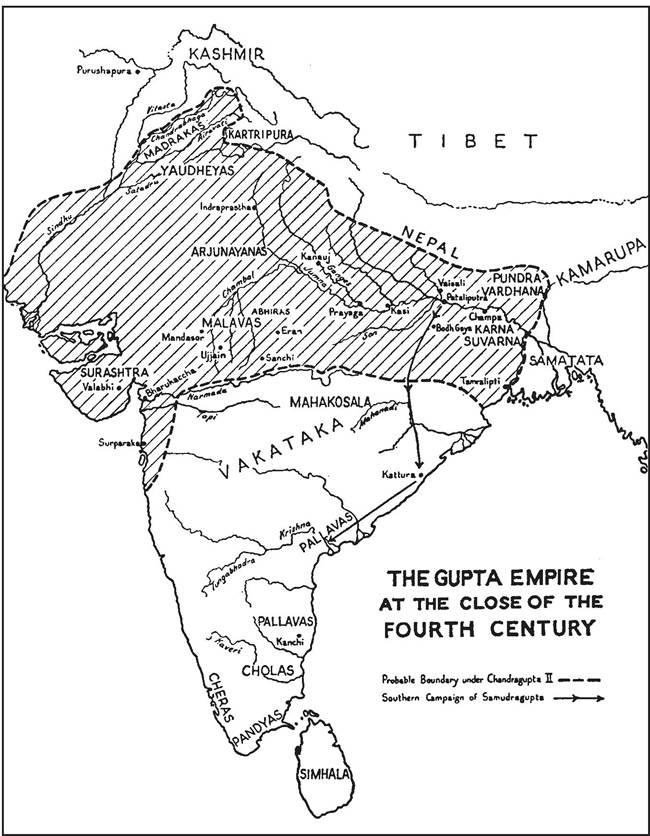
Map 2 The Gupta Empire
Reprinted from A Cultural History of India, ed. by A. L. Basham (Clarendon Press, 1975), p. 588, by permission of Oxford University Press.
Kingship and artha
One major development of this period was the sacralization of kingship and the legitimation of statecraft (artha). Perhaps as early as Candragupta Maurya’s time there appeared a text known as the Arthdsdstra, which articulates principles by which the king was to govern. Kautilya, traditionally thought to be a brahman minister in Candragupta’s court, is said to be author of this treatise, but in fact, the text is no doubt a compilation occurring over several centuries.
The text included the doctrine of matsya nyaya (literally, “the law of the fishes”). The idea presented here was that bigger fish eat smaller fish - that is, that as city-states were threatened, a king was forced to have strategies that would preserve the stability of his own domain. These strategies could include danda (“club”) - the Indian equivalent of just war; force could be used when necessary, though, presumably, as a last resort. Short of force, one could use saman - “conciliation” or “appeasement”; ddna - “gift” or the fine art of bribing or rewarding a neighboring king with booty; and bheda (“divide”) - the art of becoming an ally with your enemy’s enemy. Of course, one cannot assume that these strategies were followed by all kings.In addition to the strategies of statecraft articulated in such texts, kings throughout this period became increasingly extolled and sacralized, thanks in part to the vocabulary provided from Iran and China and the rhetorical role of their brahman ministers; the king became known as maharaja (great king); rajaraja (king of kings); and not least important, devaputra (son of the gods). The effect of this rhetorical support was to make the king (at least in vaidika settings) the preserver of dharma, he who preserved order and rendered the city-state the very microcosm of the universe itself. The king’s palace was similarly a microcosm. He was perceived as the personification of wisdom, the epitome of culture, and patron of the arts. Despite this rhetorical enhancement of the role of the king, his power could nonetheless be restrained by brahmans and other ministers in his court and even by pressure of the populace.4
More on the topic The context:
- FIVE COMPONENTS OF LEGAL COMPETENCIES
- Conclusion
- Background Context
- Conclusion
- Carving a Livelihood in Post-conflict Sierra Leone: The Benefits of Bike Riding
- Kuwait
- Conclusion
- Semantic of Empirical Theories via (SDTE) and Scientific Realism
- Oetzel John, Ting-Toomey Stella. The SAGE Handbook of Conflict Communication: Integrating Theory, Research and Practice. SAGE Publications,2013. — 912 p., 2013
- Political Context