The Importance of Balance: Humanity and the Natural World
Many indigenous North American religions emphasize the interrelationship of all things. As we saw earlier, the elements of creation, humans included, are often thought to share a common spiritual energy or sacred power.
This may be understood as a life force or as the presence of the supreme being. This idea is beautifully captured by the words of Black Elk (1863-1950), a famous Lakota religious leader. In a book titled Black Elk Speaks (1972), he tells of his life and of a great vision. He opens by saying: “It is the story of all life that is holy and is good to tell, and of us two-leggeds sharing in it with the four-leggeds and the wings of the air and all green things; for these are the children of one mother and their father is one spirit.”—This interconnectedness often extends to humanity’s relationship with animals. In some teachings, humanity is created as the companion of other creatures—not as their master. In other traditions, humans are thought to be descended from animal or animal-like ancestors. A myth of the Modoc of Northern California tells of the special relationship between humans and grizzly bears. The Sky God created all creatures and also created Mount Shasta, a 14,000- foot volcanic peak, which served as the home for the Sky God’s family. One day, his daughter fell to earth from the top of the mountain. She was adopted and raised by a family of grizzly bears, who could talk and walk on two feet. Eventually, she married one of the bears, and from this union were born the first people. When the Sky God eventually found his daughter, he was angry that a new race was born that he had not created. He then cursed the grizzly bears to forever go about on all fours.—
As a result of this interconnectedness, many Native religions emphasize the importance of maintaining balance among all things. Often, this is viewed as the primary responsibility of humanity.
A critical part of religious practice is therefore focused on developing and preserving harmonious relationships between humans and other elements of the world. As we have learned, Navajo myths tell that the ancestors learned to maintain this balance as an example to later generations. The myths of the Yurok of Northern California similarly describe a time when the Immortals inhabited the earth. The Immortals knew how to maintain balance, but humans did not. Thus, the Immortals taught the Yurok people ceremonies that they could use to restore the balance of the earth.—Sacred Places and Spaces
The focus on balance extends to the physical landscape. In many Native spiritual traditions, humanity is often thought to live in a reciprocal relationship with the land: each relies on and must care for the other, and all are part of a sacred whole. Certain geographical features, like rivers, mountains, and rocks, may be permeated with sacred power. Such places often feature prominently in mythology and are infused with power because of what happened there in the mythic past. One such place is Mount Shasta in northern California. Many tribes of the region regard the mountain as sacred because of its importance in mythology. Myths tell that the creator made the mountain so that he could reach the earth from the heavens. (As we saw in the Modoc myth, the creator resided in the mountain with his family.) Because of its sacred history, areas of Mount Shasta are powerful places where Native religious experts can make contact with the spirit world. To this day, leaders from several tribes use the area for religious ceremonies.
Among the White Mountain Apache of Arizona, the significance of certain places comes alive in the stories people tell about them. Tales about the local landscape are an important part of Apache cultural and religious knowledge, and they convey important moral teachings. The landscape is thus imbued with life lessons. An Apache woman named Annie Peaches told the anthropologist Keith Basso (1940-2013) about a place called “Big Cottonwood Trees Stand Here and There.” In the tale, the Apaches and the neighboring Pima were fighting near the big cottonwood trees.
The fighting awakened a sleeping old woman, but she thought the noise was simply her son-in-law cursing her daughter. She yelled at him and told him to stop picking on the young woman. The Pima heard her, rushed in, and killed her. The tale illustrates the danger of disregarding appropriate behavior: in Apache culture, a woman should not criticize her son-in-law unless her daughter asks her to intervene. The old woman suffered dire consequences from interfering; when Apache people pass the place known as Big Cottonwood Trees Stand Here and There, they are reminded of this social rule.13Myths that cast the land in a sacred light may also teach people how to build their communities. Thus, even architecture has a sacred dimension. Among the Navajo, the guidelines for building the sacred dwelling known as a hogan are found in myth. The Holy People taught that a hogan should be built as a representation of Navajo lands and the cosmos. Four posts, which represent four sacred mountains that surround the Navajo homeland, support the hogan. The roof represents Father Sky, and the floor is Mother Earth. The tipi, a typical structure of the tribes of the Great Plains, has a similar sacred blueprint. Each tipi is an image of the universe. The perimeter of the tipi is the edge of the universe, and the lit fire in the center represents the center of all existence. Joseph Epes Brown, a scholar of Native religions, writes that the smoke from the fire, which escapes the tipi through a hole in the ceiling, can carry messages to the spirit world.-4 The tipi is thus another axis mundi, connecting different planes of existence.
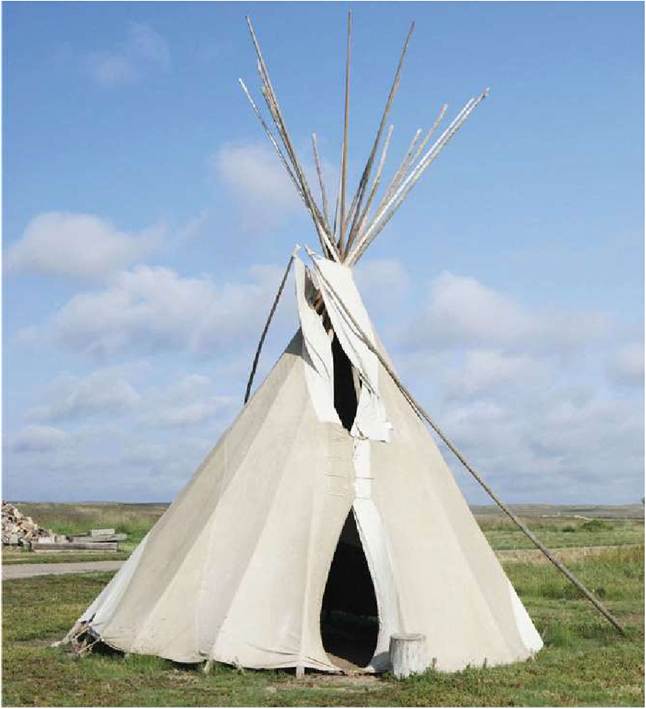
The tipi, a typical structure of the peoples of the Great Plains, has a sacred blueprint. Each tipi can be understood as an image of the universe.
Environmental Stewardship
Native communities in North America have historically utilized very sophisticated and complex practices to preserve and maintain the environment.
In recent years, the western United States has suffered from increasingly devastating wildfires. This is in large part due to climate change, as temperatures rise and droughts become more common. An additional factor, however, is that over the past century, the United States adopted a policy of suppression—most forest fires were extinguished rather than letting forests bum through a cycle of rejuvenation. Historically, many Native communities have practiced prescribed “cultural burns” to foster this cycle. In California, for example, the Karuk people regarded the land and fire as sacred, and engaged in such burns. However, in the nineteenth century, the state legislature criminalized these cultural bums. Today many Native communities are fighting to preserve sacred lands and forests using indigenous methods. Bill Tripp, a Karuk member, wrote in response to the 2020 fires in California:Our land was taken from us long ago and our Indigenous stewardship responsibility was taken from us too. The land is still sacred and it will forever be part of us. We hold the knowledge of fire, forests, water, plants and animals that is needed to revitalize our human connection and responsibility to this land. If enabled, we can overcome our current situation and teach others how to get it done across the western United States. The Karuk Tribe and Western Klamath Restoration Partnership is proposing fire solutions that focus on indigenous methods and leadership.15